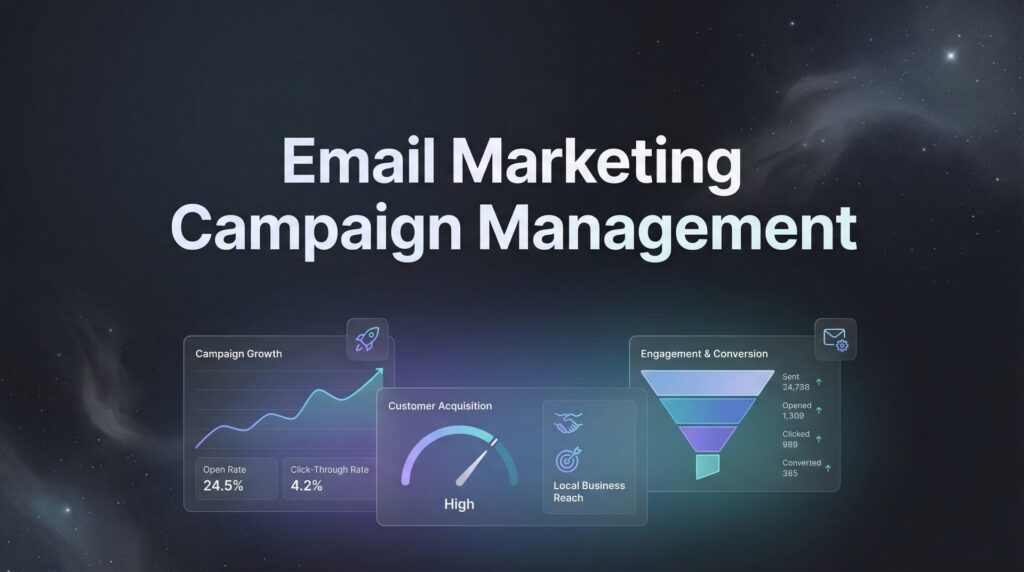
Your email list is a goldmine sitting in your CRM—but only if you know how to work it. Most local business owners blast out the occasional newsletter, cross their fingers, and wonder why their open rates hover around 12%. Here’s the truth: effective email marketing campaign management isn’t about sending more emails. It’s about sending the right emails to the right people at the right time with the right message.
When you nail this, email becomes your highest-ROI marketing channel—period.
This guide walks you through the exact six-step process we use to help local businesses transform their email marketing from an afterthought into a customer acquisition machine. You’ll learn how to set up campaigns that actually convert, segment your audience for maximum relevance, and track the metrics that matter for your bottom line. No fluff, no theory—just actionable steps you can implement this week.
Step 1: Define Your Campaign Goals and Success Metrics
Before you write a single word of email copy, you need to know exactly what you’re trying to accomplish. “Stay in touch with customers” isn’t a goal—it’s a wish. Real goals drive specific actions and can be measured in dollars and conversions.
Start by identifying your campaign objectives. Are you nurturing cold leads until they’re ready to buy? Re-engaging customers who haven’t purchased in six months? Promoting a seasonal service? Onboarding new customers to increase lifetime value? Each objective requires a different approach, different messaging, and different success metrics.
Here’s where most businesses go wrong: they track vanity metrics that make them feel good but don’t move the needle. A 35% open rate means nothing if nobody clicks through. A 15% click rate means nothing if nobody converts. You need to connect your email campaigns directly to revenue.
Set these measurable KPIs for every campaign: Open rates tell you if your subject lines work. Click-through rates reveal whether your content and calls-to-action resonate. Conversion rates show if people actually take the action you want. Revenue per email is the ultimate metric—it tells you exactly how much money each campaign generates.
But here’s the thing: these numbers mean nothing without context. Pull your current email performance data right now. What’s your average open rate? Click rate? How many sales can you attribute to email in the last 90 days? These baseline metrics become your benchmark for improvement.
The final piece: align your email goals with broader business objectives. If your priority is customer acquisition, your email strategy should focus on converting leads in your database. If you’re trying to increase repeat purchases, build post-purchase sequences that bring customers back. If you’re launching a new service, create awareness campaigns that educate your list about the offering.
Think of it like this: every email you send should either make you money now or set up a sale for later. If an email doesn’t do one of those two things, don’t send it.
Step 2: Build and Segment Your Email List Strategically
Your email list quality matters infinitely more than its size. A thousand engaged subscribers will generate more revenue than ten thousand people who ignore your emails. That’s why list hygiene and strategic segmentation are the foundation of effective email marketing campaign management.
Start with a brutal list cleaning session. Export your entire email list and identify contacts who haven’t opened an email in the last six months. Remove hard bounces immediately—these damage your sender reputation. Purge unsubscribes and spam complaints. Yes, your list will shrink. That’s the point. You want people who actually want to hear from you.
Now comes the game-changer: behavioral segmentation. This is where email marketing transforms from spray-and-pray to precision targeting. Create segments based on purchase history. Someone who bought from you three times in the last year should receive different emails than someone who bought once two years ago. They have different relationships with your business.
Segment by engagement level too. Highly engaged subscribers (opens and clicks regularly) can handle more frequent emails and direct promotional content. Low-engagement contacts need re-engagement campaigns or value-driven content to rebuild the relationship. Trying to sell to someone who barely remembers signing up is a waste of everyone’s time.
Lead source segmentation reveals where people came from and what they’re interested in. Someone who downloaded your “Home Renovation Cost Guide” has different needs than someone who signed up for “Quick Kitchen Updates.” Segment them accordingly and send relevant content that matches their original interest. Understanding how to use email marketing for lead generation starts with knowing exactly who you’re talking to.
For local businesses, geographic segmentation works incredibly well: If you serve multiple locations or service areas, segment by geography. Someone in the north part of your city might care about different seasonal services than someone in the south. Location-based promotions feel more relevant and personal.
Service interest segmentation helps you target the right offerings to the right people. If you’re a contractor who does both residential and commercial work, these are fundamentally different audiences. Segment them. If you offer multiple services, track which services each contact has shown interest in and segment accordingly.
Set up automated tagging systems so your list stays organized as it grows. When someone clicks a link about a specific service, tag them. When they make a purchase, tag them with the product category. When they haven’t engaged in 60 days, tag them for re-engagement. This ongoing hygiene prevents your list from becoming a messy, unsegmented blob.
The result? Every email you send reaches people who actually care about that specific message. Your open rates climb. Your click rates improve. Your unsubscribe rates drop. And most importantly, your revenue per email skyrockets because you’re no longer wasting messages on the wrong people.
Step 3: Map Your Email Sequences and Content Calendar
Random, sporadic emails kill your results. Consistency and strategic planning build revenue. This step is where you design the automated sequences and promotional campaigns that run your email marketing on autopilot while you focus on running your business.
Start with your automated sequences—these are the workhorses of email marketing campaign management. Your welcome series is the most critical sequence you’ll build. Someone just joined your list. They’re paying attention right now. This is your moment to make a strong first impression, deliver the value you promised, and guide them toward becoming a customer.
A solid welcome series includes three to five emails over 7-10 days. Email one delivers whatever you promised (discount, guide, resource). Email two shares your story and builds trust. Email three provides value (tips, insights, case examples). Email four introduces your core offer. Email five creates urgency or provides a special new-subscriber incentive.
Post-purchase sequences turn one-time buyers into repeat customers. After someone makes a purchase, send a thank-you email immediately. Follow up three days later asking how the product/service is working. A week later, request a review. Two weeks later, suggest complementary products or services. This sequence builds loyalty and drives repeat revenue.
Re-engagement campaigns rescue dying relationships before they’re gone forever. When someone hasn’t opened your emails in 60-90 days, trigger a re-engagement sequence. Start with “We miss you” messaging. Offer value to win them back. Give them control over email frequency. If they still don’t engage after three attempts, remove them from your active list.
Your promotional campaigns need strategic planning too: Build a content calendar around your business peaks and valleys. If you’re a landscaper, plan spring preparation emails for February, summer maintenance campaigns for June, and fall cleanup promotions for September. If you run a retail business, map campaigns to holidays, seasonal events, and inventory cycles.
The 80/20 content mix keeps your list engaged without burning them out. Eighty percent of your emails should provide genuine value: tips, insights, industry news, helpful resources, educational content. Twenty percent can be directly promotional: sales, special offers, new product launches. This ratio keeps people opening your emails because they know you’re not always selling.
Build email templates that match your brand and work flawlessly on mobile devices. Most people read emails on their phones now. If your email looks broken on mobile, it’s getting deleted. Create templates with clear hierarchy, readable fonts, and prominent calls-to-action that work on small screens.
Map everything on a calendar. When does each automated sequence trigger? When do promotional campaigns launch? What’s the cadence for your regular newsletter? Having this mapped out prevents overlapping campaigns, maintains consistent communication, and ensures you’re never scrambling to figure out what to send next.
Step 4: Craft High-Converting Email Copy and Subject Lines
Your email could have the perfect offer, flawless timing, and laser-targeted segmentation. But if your subject line doesn’t get opened and your copy doesn’t drive action, it’s all worthless. This is where the rubber meets the road in email marketing campaign management.
Subject lines are your first and often only chance to capture attention. The best subject lines create curiosity without being misleading, generate urgency without sounding desperate, and promise value without overpromising. Avoid spam triggers like “FREE!!!” or “ACT NOW!!!” These scream desperation and tank deliverability.
Test different approaches: Question-based subject lines (“Is your HVAC system ready for summer?”) work well for service businesses. Benefit-driven lines (“Save 3 hours every week with this simple change”) appeal to practical buyers. Curiosity gaps (“The one thing we never tell new customers…”) drive opens through intrigue. Personalization (“Sarah, your quote is ready”) increases relevance.
Inside the email, structure matters as much as words. People scan emails—they don’t read them word-for-word. Use clear hierarchy with a compelling opening line, short paragraphs (2-3 sentences maximum), and a single, crystal-clear call-to-action. If readers have to work to figure out what you want them to do, they won’t do it.
Personalization goes way beyond inserting a first name: Use behavioral triggers in your copy. “Since you downloaded our kitchen remodeling guide…” acknowledges their specific interest. Reference purchase history: “Last time you bought X, customers also loved Y.” Location-based personalization works great for local businesses: “Special offer for our downtown clients.”
Your call-to-action needs to be impossible to miss and easy to act on. Use buttons, not text links. Make them big enough to tap on mobile. Use action-oriented language: “Get Your Free Quote” beats “Click Here.” Create urgency when appropriate: “Book by Friday” or “Only 3 spots left.”
A/B testing reveals what actually works with your specific audience. Start by testing subject lines—this has the biggest immediate impact on performance. Send version A to half your list, version B to the other half. The winner becomes your control. Next, test your call-to-action: button color, copy, placement. Then test email length, content structure, and personalization elements.
Keep your copy conversational and benefit-focused. Write like you’re explaining something to a friend, not delivering a corporate memo. Focus on what the reader gets, not what you’re selling. “You’ll save $200 on cooling costs” beats “Our HVAC tune-up service costs $99.” The benefit is what matters.
Step 5: Set Up Automation and Trigger-Based Campaigns
Manual email marketing doesn’t scale. You can’t personally monitor every customer action and send perfectly timed follow-ups. That’s where automation transforms email marketing from a time-consuming task into a revenue-generating system that runs while you sleep.
Behavioral triggers are the secret weapon of effective email marketing campaign management. These campaigns fire automatically when someone takes a specific action, delivering the right message at exactly the right moment. The timing and relevance make them incredibly effective.
Abandoned cart campaigns are the obvious starting point for e-commerce businesses, but local service businesses can use browse abandonment too. When someone views your service page or starts a quote request but doesn’t complete it, trigger a follow-up email. “We noticed you were looking at our deck refinishing service—questions we can answer?” This simple automation recovers revenue that would otherwise disappear.
Milestone emails celebrate customer anniversaries and achievements. One year since their first purchase? Send a thank-you email with a loyalty discount. Customer’s business anniversary? Acknowledge it. These automated touchpoints strengthen relationships without requiring you to remember dates or manually send emails.
Drip sequences nurture leads through your sales funnel systematically: Someone downloads a lead magnet but isn’t ready to buy yet. No problem. Drop them into a nurture sequence that educates them over weeks or months. Each email provides value while subtly moving them closer to a purchase decision. The sequence runs automatically—you set it once and it works forever. Choosing the right marketing automation tools makes building these sequences dramatically easier.
Re-engagement campaigns save relationships before they die. When someone hits 60 days without opening an email, trigger a re-engagement sequence. “We haven’t heard from you in a while—still interested in [topic]?” Offer a compelling reason to re-engage. Give them options to update preferences or reduce email frequency. If they still don’t respond after three attempts, remove them from your active list to protect your sender reputation.
Post-purchase sequences drive reviews and repeat business on autopilot. Customer completes a purchase? Trigger a five-email sequence: immediate thank-you, usage tips three days later, review request after a week, complementary product suggestions at two weeks, and a loyalty offer at 30 days. This sequence increases customer lifetime value without any manual work.
The beauty of automation is consistency. Every customer gets the same high-quality experience regardless of how busy you are. No one falls through the cracks. No follow-ups get forgotten. The system handles it all while you focus on delivering great service. If you’re new to this approach, our guide on marketing automation for small business walks through the complete implementation process.
Step 6: Analyze Performance and Optimize Continuously
Data without action is just noise. This final step separates businesses that dabble in email marketing from those who use it as a primary revenue driver. You need to review performance religiously, identify what’s working, and ruthlessly optimize based on results.
Set a weekly review ritual. Every Monday morning (or whatever day works for your schedule), pull your email metrics from the previous week. Which campaigns performed best? Which subject lines got the highest open rates? Which calls-to-action drove the most clicks? Which emails generated actual revenue?
Track these metrics for every campaign: open rate (industry average is 15-25% for most local businesses), click-through rate (2-5% is typical), conversion rate (varies by offer but track it), unsubscribe rate (anything above 0.5% per campaign is a red flag), and most importantly, revenue attribution.
Revenue attribution connects your email efforts to actual sales: Use tracking links and campaign tags so you know exactly which emails drove which purchases. Your email platform should integrate with your CRM or sales system. When someone clicks an email link and buys, that sale gets attributed to that specific campaign. This tells you which emails make money and which ones waste time. If you’re struggling with attribution, learning to fix your marketing conversion tracking should be your first priority.
Implement learnings immediately. If Tuesday morning emails consistently outperform Friday afternoon sends, shift your schedule. If question-based subject lines beat benefit-driven ones for your audience, use more questions. If short emails (under 200 words) convert better than long ones, cut the fluff. Let data drive decisions, not assumptions.
Scale what works, kill what doesn’t. When you identify a winning campaign or sequence, double down. Send it to more segments. Increase frequency if performance stays strong. Create variations on the same theme. Conversely, if a campaign consistently underperforms, stop sending it. Don’t waste list goodwill on emails that don’t work. This optimization mindset is central to marketing campaign optimization across all channels.
Conduct quarterly list audits and strategy reviews. Every three months, step back and look at the big picture. How has your list grown? What’s your overall engagement trend? Which segments are most profitable? What new segments should you create? Are your automated sequences still relevant or do they need refreshing?
Test systematically, not randomly. Pick one variable to test at a time. Run the test until you have statistically significant results. Document what you learned. Then test the next variable. This disciplined approach builds knowledge about what works for your specific audience rather than just creating noise.
Your Email Marketing System Starts Now
Email marketing campaign management isn’t a set-it-and-forget-it task—it’s an ongoing process of testing, learning, and optimizing. Start by defining clear goals, segment your list so every message feels relevant, and let automation handle the heavy lifting. Then track your results religiously and double down on what drives revenue.
Quick implementation checklist: Define 2-3 specific campaign goals with measurable KPIs. Clean your list and create at least 3 behavioral segments. Map out your first automated sequence (start with welcome emails). Write and A/B test your first campaign. Review results after 2 weeks and optimize.
The local businesses that win with email are the ones that treat it like a system, not a sporadic activity. They understand that every email either builds the relationship or makes the sale. They know their numbers. They test constantly. They let data guide decisions instead of guessing.
Your email list represents people who raised their hands and asked to hear from you. That’s valuable. Don’t waste it with generic batch-and-blast campaigns. Give them relevant, timely messages that solve their problems and meet their needs. When you do this consistently, email becomes your most profitable marketing channel. The right email marketing software makes executing this strategy significantly easier.
Ready to turn your email list into your most profitable marketing channel? Start with Step 1 today. Define your goals, set your metrics, and commit to the process. The revenue is sitting there in your database—you just need the right system to unlock it.
Tired of spending money on marketing that doesn’t produce real revenue? We build lead systems that turn traffic into qualified leads and measurable sales growth. If you want to see what this would look like for your business, we’ll walk you through how it works and break down what’s realistic in your market.