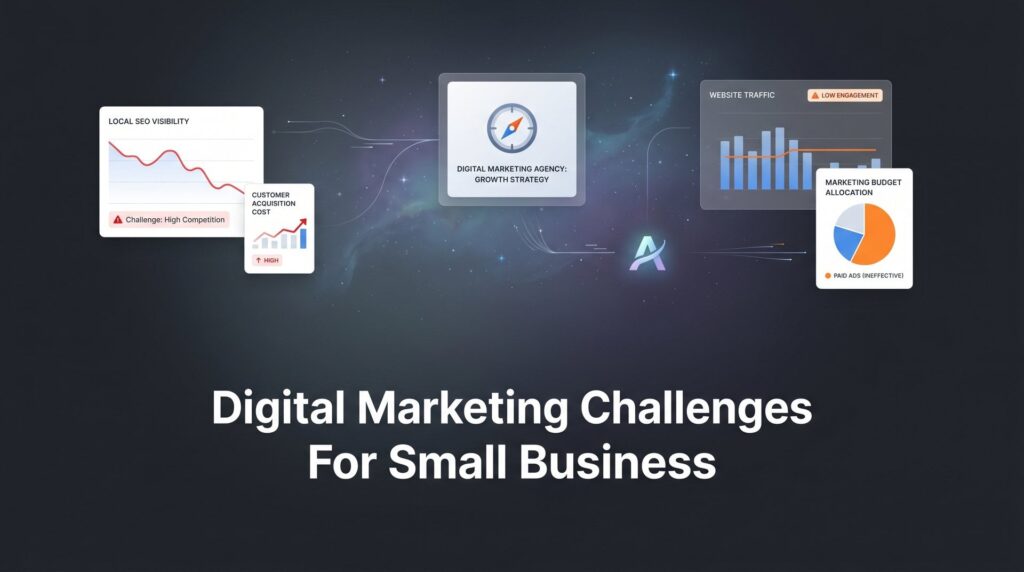
Small business owners wear dozens of hats, and digital marketing often ends up being the most frustrating one. Between algorithm changes, rising ad costs, and an overwhelming number of platforms to manage, it’s no wonder so many local business owners feel stuck spinning their wheels.
Here’s what most people don’t tell you: the digital marketing challenges for small business that you’re facing aren’t unique to you. They’re predictable, recurring problems with proven solutions. The difference between businesses that grow consistently and businesses that plateau usually isn’t budget. It’s strategy.
Whether you’re a plumber trying to fill your schedule, a pest control company fighting for local visibility, or any service business trying to turn clicks into actual customers, the same core problems keep showing up. And they’re all fixable.
This guide breaks down the seven most common digital marketing challenges small businesses face right now, along with a concrete game plan for overcoming each one. No vague advice. No fluff. Just the actionable fixes that actually move the needle on leads and revenue.
1. Stop Bleeding Money on Ads That Don’t Convert
The Challenge It Solves
Running ads without a conversion-focused system is like pouring water into a bucket full of holes. Many small businesses launch Google or Facebook campaigns, watch the budget disappear, and wonder why the phone isn’t ringing. The problem usually isn’t the platform. It’s the architecture of the campaign itself.
The Strategy Explained
Profitable ad campaigns aren’t built on good creative alone. They require tight targeting, proper conversion tracking, and dedicated landing pages that match the intent of each ad. When someone clicks an ad for “emergency plumber near me,” they should land on a page specifically designed to convert that search intent into a booked call, not your generic homepage.
Campaign architecture matters too. Grouping ads by service type, location, and audience intent allows you to control spend at a granular level, cut what’s losing money, and scale what’s working. Without this structure, you’re essentially guessing. Learning how to build profitable marketing campaigns from the ground up can help you avoid these costly mistakes.
Implementation Steps
1. Install conversion tracking before you spend another dollar. Whether it’s Google Tag Manager or a direct integration, you need to know which clicks become calls, form fills, and booked appointments.
2. Build dedicated landing pages for each core service and campaign. Match the headline on the page to the ad copy so visitors immediately know they’re in the right place.
3. Audit your current targeting settings. Negative keyword lists, geographic radius, and audience exclusions are often the fastest way to stop wasting budget on clicks that will never convert.
4. Set a clear cost-per-lead benchmark for each service. If you don’t know what a lead is worth, you can’t make intelligent decisions about where to cut and where to scale.
Pro Tips
Start with your highest-margin service, not your most popular one. Winning on profitability first gives you the budget to expand. Also, check your ad schedule. Many local businesses waste significant spend on overnight hours when no one answers the phone. Turn off ads when your team can’t follow up.
2. Fix Your Lead Quality Before You Chase More Volume
The Challenge It Solves
Getting more leads sounds like the obvious solution to slow growth, but if those leads are price-shoppers, no-shows, or people completely outside your service area, more volume just means more wasted time. Lead quality is often the silent killer of small business marketing ROI, and it’s a problem that starts long before someone picks up the phone.
The Strategy Explained
Pre-qualification happens at every stage of the funnel, starting with your ad copy. When your ads clearly communicate who you serve, what it costs (even a range), and what to expect from the process, you naturally filter out people who aren’t a fit before they click. This might feel counterintuitive because it reduces raw click volume, but it dramatically improves the quality of the leads that do come through.
Your landing page and intake form are the next filters. Asking the right questions upfront, such as service type, location, timeline, and budget range, helps your team prioritize and qualify before investing time in a follow-up call. Understanding why your digital marketing isn’t driving sales often starts with diagnosing this exact lead quality issue.
Implementation Steps
1. Review your ad copy for vague language. Replace generic phrases like “quality service” with specific qualifiers like service area, minimum job size, or what makes your business different from the cheapest option in town.
2. Add a qualifying question or two to your contact form. Keep it short, but ask something that helps you identify serious buyers versus casual browsers.
3. Create a simple lead scoring system, even a basic one. Flag leads by urgency, service type, and job size so your team knows who to call first.
4. Track your close rate by lead source. If leads from one channel close at a much lower rate, the problem is likely lead quality, not your sales process.
Pro Tips
Speed-to-lead matters enormously in local services. Responding to an inquiry within the first few minutes significantly increases the likelihood of converting that lead into a customer. Set up text or email notifications so your team can respond fast, even when they’re in the field.
3. Winning the Local Map Pack
The Challenge It Solves
For most local service businesses, the three Google Business Profile listings that appear above organic search results, known as the Map Pack, drive more calls than almost any other channel. If you’re not in those top three spots, you’re invisible to a massive portion of your local market. Many small businesses have never touched their Google Business Profile beyond the initial setup.
The Strategy Explained
Google’s own documentation states that businesses with complete, accurate profiles are more likely to be considered reputable and attract more customer interactions. This means every section of your profile matters: business category, service areas, hours, photos, services listed, and especially your reviews.
Local SEO signals that influence Map Pack rankings include the consistency of your business name, address, and phone number across the web (called NAP consistency), the volume and recency of your Google reviews, and the relevance of your profile to the specific searches you want to rank for. Investing in local business digital marketing services can accelerate your progress on all of these fronts.
Implementation Steps
1. Audit your Google Business Profile completely. Make sure every field is filled in, your primary category is precise, and your service areas accurately reflect where you work.
2. Build a review generation system. Ask every satisfied customer for a Google review, ideally within 24 hours of completing the job. A consistent flow of recent reviews is one of the strongest local ranking signals.
3. Post updates to your Google Business Profile regularly. Google rewards active profiles. Weekly posts about services, promotions, or completed projects signal that your business is active and engaged.
4. Check your NAP consistency across directories like Yelp, Angi, and local chamber listings. Inconsistencies confuse Google and can suppress your local rankings.
Pro Tips
Respond to every review, positive and negative. Your responses are public and signal to both Google and potential customers that you’re an engaged, professional business. A thoughtful response to a negative review often does more for your reputation than ten five-star reviews left unanswered.
4. Build a Website That Sells
The Challenge It Solves
Most small business websites function as digital brochures: they describe what the business does, show a few photos, and list a phone number. That’s not enough. If your website isn’t actively converting visitors into leads, every dollar you spend driving traffic to it is partially wasted. Conversion rate optimization (CRO) is the discipline that fixes this, and it’s often the highest-ROI improvement a local business can make.
The Strategy Explained
A website that sells is built around one primary goal: getting the visitor to take an action, whether that’s calling, filling out a form, or booking an appointment. Every design decision, from the placement of your phone number to the length of your forms, should serve that goal.
Page speed is foundational. Google has published research showing that as load time increases, the probability of a visitor bouncing increases significantly. On mobile devices, which account for a large portion of local search traffic, a slow site is a lead-killing problem. Beyond speed, trust signals like reviews, certifications, photos of your team, and clear service guarantees reduce hesitation and increase conversions. If your marketing is not driving sales, a poorly converting website is often the culprit.
Implementation Steps
1. Run your website through Google PageSpeed Insights and address the top issues flagged. Pay special attention to mobile performance.
2. Make your phone number click-to-call and visible at the top of every page without scrolling. Don’t make visitors hunt for it.
3. Add social proof above the fold. A review count, a recognizable badge, or a short testimonial near the top of your homepage immediately builds credibility.
4. Simplify your forms. Every additional field you require reduces the number of people who complete it. Ask for only what you genuinely need to make first contact.
Pro Tips
Heat mapping tools can show you exactly where visitors click, scroll, and drop off on your pages. Even a few days of data can reveal surprising friction points you’d never notice by just looking at the design. Fix the biggest drop-off points first before investing more in traffic.
5. Crack the Attribution Code
The Challenge It Solves
When you can’t tell which marketing channels are producing real customers, you’re making budget decisions based on gut feel. That’s expensive. Many small businesses know they’re getting some leads, but they can’t tell whether those leads came from Google Ads, organic search, their Facebook page, or the yard sign they put up last spring. Without attribution, you can’t optimize.
The Strategy Explained
End-to-end attribution means tracking the customer journey from the first click all the way through to a booked job or closed sale. For local businesses, this typically involves a combination of call tracking for ad campaigns, form submission tracking, and CRM tagging so that every lead has a source attached to it.
The goal isn’t perfect data, because perfect attribution doesn’t exist. The goal is directionally accurate data that helps you make smarter decisions about where to invest your marketing budget and where to cut.
Implementation Steps
1. Set up call tracking with a tool like CallRail or a similar platform. Assign unique phone numbers to different channels so you know whether a call came from Google Ads, your website, or a directory listing.
2. Configure Google Analytics 4 and connect it to your Google Ads account. Set up conversion events for form submissions, phone clicks, and appointment bookings.
3. Ask every new customer how they found you and record the answer in your CRM or even a simple spreadsheet. Self-reported attribution is imperfect but adds a valuable layer of qualitative data.
4. Review your attribution data monthly, not just when something feels wrong. Look for patterns in which channels produce leads that actually convert into paying customers, not just raw lead volume. Our guide on how to track marketing ROI effectively walks through this process in detail.
Pro Tips
Don’t just track lead volume by channel. Track lead quality. A channel that produces fewer leads but closes at a higher rate and generates larger jobs is more valuable than one that floods your inbox with tire-kickers. Revenue per lead is the metric that actually matters.
6. Stay Visible During Slow Seasons
The Challenge It Solves
Seasonal demand swings are a reality for most local service businesses. HVAC companies slow down in spring. Landscapers go quiet in winter. The instinct is to cut marketing spend when revenue dips, but that’s often the exact wrong move. Going dark during slow seasons means you lose momentum, fall in rankings, and start the next busy season from a weaker position.
The Strategy Explained
The solution isn’t to spend the same during slow seasons as you do during peak demand. It’s to invest strategically in channels that build long-term visibility and keep your brand in front of past customers and warm prospects.
Evergreen content, meaning blog posts, service pages, and FAQ content that answers questions your customers are searching year-round, continues to drive organic traffic long after it’s published. Google Ads remarketing services keep your business visible to people who have already visited your website, often at a much lower cost per impression than cold prospecting campaigns. And slow seasons are the ideal time to invest in local SEO improvements that take time to compound.
Implementation Steps
1. Identify your two or three slowest months based on last year’s revenue data. Plan your content and SEO investment calendar around those periods so you’re building during the dip, not reacting to it.
2. Set up a retargeting campaign on Google or Meta targeting past website visitors. Keep your brand visible to warm audiences even when you reduce prospecting spend.
3. Build an email list of past customers and send a reactivation campaign during slow months. Existing customers who had a good experience are often your easiest source of new revenue.
4. Use slow periods to audit and improve your website, update your Google Business Profile, and publish content targeting searches relevant to your upcoming busy season.
Pro Tips
Slow seasons are also the best time to ask for reviews, refresh your portfolio photos, and update your service pages. These improvements compound over time and mean you enter your next peak season with stronger local SEO signals and a more conversion-optimized website than your competitors who went quiet.
7. Stop Trying to Do Everything Yourself
The Challenge It Solves
The promise of digital marketing is that you can be everywhere at once: Google Ads, Facebook, Instagram, TikTok, email, SEO, YouTube, and more. For a small business owner with limited time and budget, trying to execute on all of it simultaneously is a recipe for doing everything poorly. Spreading thin across every platform is one of the most common and costly digital marketing mistakes small businesses make. Understanding why it’s difficult to scale marketing efforts can help you avoid this trap.
The Strategy Explained
The businesses that grow fastest are usually the ones that dominate one or two channels before expanding to others. The key is identifying which channel has the highest ROI for your specific business and market, then going deep on that channel before adding complexity.
For most local service businesses, that means mastering Google Ads and local SEO before touching social media advertising. For others, it might mean building a referral system before investing in any paid traffic. The point is to be strategic about sequencing, not reactive about channel selection.
Partnering with specialists for channels outside your core focus is often more efficient than trying to build internal expertise in everything. A digital marketing agency that specializes in local business growth can often produce better results on a specific channel than a generalist who’s managing ten things at once.
Implementation Steps
1. Audit your current marketing activities and calculate a rough ROI for each channel. Which one is producing the most revenue per dollar spent? That’s your primary channel to double down on.
2. Pause or reduce investment in channels where you can’t measure results or where results are clearly weak. Reallocation beats addition when budget is limited.
3. Identify which marketing functions genuinely require your expertise as the business owner and which ones can be delegated or outsourced. Your time has a cost, and spending hours on tasks a specialist could handle better is a hidden budget leak.
4. If you’re considering a marketing partner, look for specialists in your channel of focus rather than generalists. An agency with deep expertise in PPC management for local businesses will typically outperform a general marketing firm doing a little of everything.
Pro Tips
Before hiring any marketing partner, get clear on what success looks like in measurable terms. Define what a good cost per lead looks like for your business, what your target close rate is, and what revenue growth you’re trying to achieve in the next 12 months. Partners who can’t engage with those specifics are the wrong partners.
Putting It All Together
Overcoming the digital marketing challenges for small business isn’t about doing more. It’s about doing the right things in the right order.
Start by plugging your biggest revenue leaks. Fix your conversion tracking so you actually know what’s working. Tighten your ad targeting so you stop paying for clicks that will never convert. Make sure your website is built to turn visitors into leads, not just impress them. These foundational fixes often produce the most immediate impact.
From there, build upward. Invest in local SEO and your Google Business Profile to win the Map Pack searches that drive calls. Improve lead quality so your team spends time on buyers, not browsers. Build a plan for slow seasons so you don’t lose momentum when demand dips. And stop spreading thin across every platform when one or two channels, done well, will outperform all of them combined.
The businesses that win aren’t the ones with the biggest budgets. They’re the ones that treat marketing as a measurable investment, not a guessing game. Every dollar should have a job, and you should be able to trace it back to real revenue.
As a Google Premier Partner agency, Clicks Geek specializes in turning ad spend into profitable, measurable growth for local businesses. We’ve helped businesses across dozens of industries solve exactly the challenges outlined in this guide, from broken tracking and wasted ad spend to local SEO and conversion rate optimization.
If you want to see what this would look like for your business, we’ll walk you through how it works and break down what’s realistic in your market. No pressure, no generic pitch. Just a straight conversation about what’s actually possible.