You’re running ads. You’re posting on social media. Maybe you’ve even dabbled in SEO or hired someone to “handle the website.” But the phone still isn’t ringing the way it should, and every month feels like a grind to find the next customer.
Sound familiar? You’re not alone, and more importantly, you’re not doing it wrong because you’re lazy or uninformed. Customer acquisition is genuinely one of the hardest things a small business owner faces, and the landscape has gotten more complicated, more expensive, and more competitive in recent years. The frustration you feel isn’t a sign that marketing doesn’t work. It’s a sign that something specific in your approach needs to be diagnosed and fixed.
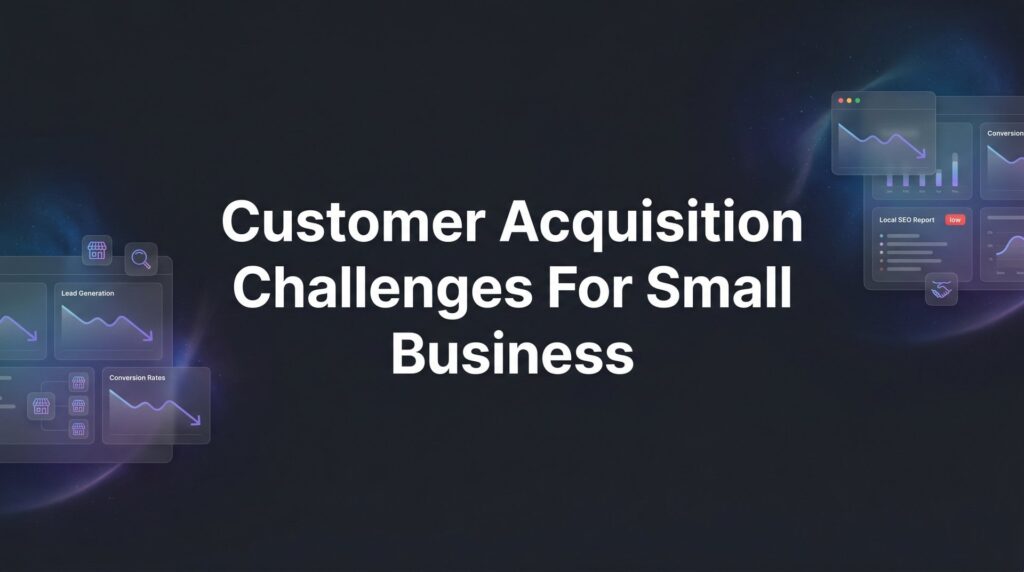
This article is a no-fluff breakdown of the real customer acquisition challenges for small business owners, the kind that actually keep you from growing. We’re talking about the budget traps, the visibility gaps, the lead quality problems, and the conversion issues that quietly drain your marketing dollars without producing results. More importantly, we’ll show you exactly what to do about each one.
Why Getting New Customers Feels Harder Than Ever
If you’ve been running ads for a few years and noticed that the same budget seems to buy fewer leads than it used to, you’re not imagining it. Advertising costs across Google and Meta platforms have climbed steadily, driven by more businesses competing for the same eyeballs. The economics of paid traffic have shifted, and small businesses with fixed budgets often feel that squeeze the most.
Local competition has intensified too. A few years ago, being the only plumber or carpet cleaner in your area with an active Google Ads campaign gave you a real edge. Now, more local service businesses are investing in digital marketing, which means the auction is more crowded, cost-per-click is higher, and simply showing up isn’t enough anymore. You need to show up better.
Consumer behavior has also changed in ways that raise the bar for every business trying to earn a new customer. Before someone picks up the phone today, they’ve often already read your reviews, checked your website, compared you to two or three competitors, and formed a strong opinion. The research phase happens entirely without you. If your online presence doesn’t hold up under that scrutiny, you lose the job before you ever get the call.
This shift means that customer acquisition is no longer just about reaching people. It’s about reaching the right people, making a strong first impression across multiple touchpoints, and earning enough trust that they choose you over everyone else they found in the same search. That’s a higher bar than most small business marketing strategies are currently built to clear.
The businesses that are winning right now aren’t necessarily spending more. They’re spending smarter, showing up consistently, and treating every piece of their digital presence as part of a connected system. The ones overcoming local business growth challenges are doing the opposite of guessing: they’re building integrated strategies that compound over time.
Understanding this context matters because it reframes the problem. The challenge isn’t that marketing doesn’t work for small businesses. The challenge is that the bar has risen and most small business marketing strategies haven’t risen with it. That’s fixable. Let’s start with the most common place money gets wasted.
The Budget Trap: Spending Without Knowing What Works
Here’s a scenario that plays out constantly with local service businesses. An owner spends a few hundred or a few thousand dollars a month on Google Ads or Facebook campaigns. Leads come in sporadically. Some jobs get booked. But when you ask them which specific campaigns are producing which customers, and what their actual cost per booked job is, they can’t tell you. The money is going out, some revenue is coming in, and nobody knows what’s actually connected to what.
This is one of the most common and costly customer acquisition challenges for small businesses. Running paid campaigns without proper tracking and attribution is essentially flying blind. You might be getting great results from one campaign and terrible results from another, but if you’re not measuring it, you’ll keep funding both equally and wonder why the overall return feels mediocre.
High cost per lead is another symptom of this problem, and it rarely comes down to budget size alone. More often, it comes from structural issues in the campaign itself: targeting that’s too broad, ad copy that attracts the wrong audience, or landing pages that aren’t built to convert. If you’ve ever wondered whether Google Ads is too expensive for small business, the answer usually lies in these structural gaps rather than the platform itself.
The fix starts with measurement, and it needs to come before anything else. You need to know where every lead comes from, what it cost to generate, and whether it turned into a paying customer. Implementing proper tracking for marketing results with call tracking, form tracking, and conversion setup isn’t optional. It’s the foundation of any campaign that’s going to improve over time.
Once you have real data, the picture usually becomes clear quickly. You’ll find campaigns or keywords that are generating leads at a reasonable cost and others that are burning budget with nothing to show for it. Cutting the waste and doubling down on what’s working is often more impactful than increasing total spend.
The broader mindset shift here is treating your marketing budget like a business investment, not a cost center. Every dollar should have an expected return, and if it doesn’t, you need to know why. That level of accountability is what separates businesses that grow their customer base predictably from those that feel like they’re always gambling on marketing.
Visibility Problems: If They Can’t Find You, They Can’t Hire You
Think about how your ideal customer finds a service business today. They open Google, type something like “plumber near me” or “pest control [city name],” and they hire someone from the first page of results, often from the map pack at the top. If your business isn’t showing up in that moment, you don’t exist to that customer. They’re not going to dig through page two or ask around. They’re going to call whoever is in front of them.
Many small businesses struggle with the fundamentals that drive local visibility. Inconsistent business listings across directories, a Google Business Profile that’s incomplete or unoptimized, thin website content that doesn’t signal relevance for your core services, and a lack of reviews all contribute to poor local search performance. A comprehensive local business online marketing guide can help you address these foundational issues systematically.
The review gap is particularly damaging. Customers routinely use review count and rating as a proxy for trustworthiness. A competitor with 150 Google reviews and a 4.8 rating will win the click over your business with 12 reviews almost every time, even if your actual work is better. Building a consistent review acquisition process isn’t just good for reputation. It directly affects your local search ranking and your conversion rate.
Paid search adds another layer. Competitors who run Google Ads alongside strong organic and local SEO create a visibility advantage that’s hard to overcome. Understanding the tradeoffs between local SEO vs paid ads for customer acquisition helps you build a strategy that captures demand at every stage rather than relying on just one channel.
The visibility gap widens over time. Every month a competitor invests in SEO and reviews while you don’t is a month they’re pulling further ahead. Catching up becomes progressively more expensive and time-consuming. The businesses that act early and build consistent visibility have a structural advantage that’s difficult to replicate quickly.
Lead Quality vs. Lead Quantity: The Hidden Acquisition Killer
Here’s a frustration that doesn’t get talked about enough: getting leads but not getting customers. The phone rings, but it’s someone fishing for the lowest price in town. You send a quote and never hear back. You spend an hour on a consultation and the prospect ghosts you. This is a lead quality problem, and for many service businesses, it’s more damaging than not having enough leads at all.
Poor lead quality drains time, morale, and money. Every low-intent inquiry you chase is time you’re not spending on real customers or on improving your business. It also skews your perception of what’s working. If your campaigns are generating 50 leads a month but only 5 turn into jobs, you might assume your closing rate is the problem when the real issue is that 45 of those leads were never going to buy from you at your price point.
The root cause usually traces back to targeting. Broad keyword targeting in Google Ads, for example, can pull in people who are searching for general information rather than ready-to-hire prospects. Running ads to a generic geographic area without filtering for the right service types or customer intent produces volume but not quality. If you’re struggling with this, learning how to get more qualified leads starts with tightening your targeting and pre-qualifying prospects before they ever reach your inbox.
Messaging plays a role too. If your ads and landing pages don’t clearly communicate who you serve, what you charge in the ballpark of, and what makes you different, you’ll attract everyone, including the people who will waste your time. Adding qualifying language, whether it’s a service area, a minimum job size, or a clear positioning statement, naturally filters out low-fit prospects before they ever submit a form.
Your follow-up system also matters. A fast, professional response to a new inquiry signals that you’re a serious business. Many service businesses lose good leads simply because they’re slow to respond or inconsistent in their follow-up. A lead that doesn’t hear back within the first hour or two has usually already called your competitor. Building a simple but consistent follow-up process, even just a quick call or text within minutes of a form submission, dramatically improves conversion on the leads that were actually qualified.
The goal isn’t to generate the most leads. The goal is to generate the right leads and convert them efficiently. That distinction is where a lot of marketing budgets either pay off or get wasted.
The Conversion Gap: When Traffic Doesn’t Turn Into Revenue
You can do everything right on the traffic side and still lose customers before they ever contact you. This is the conversion gap, and it’s one of the most underappreciated customer acquisition challenges for small businesses. Getting someone to your website or landing page is only half the battle. What happens when they get there determines whether that click turns into a call or a bounce.
Common conversion killers are often hiding in plain sight. A website that loads slowly on mobile will lose a significant portion of visitors before they even see your content. A homepage that doesn’t immediately communicate what you do, where you serve, and why someone should choose you gives visitors no reason to stay. A contact form buried three pages deep or a phone number that’s hard to find creates unnecessary friction. Missing trust signals like reviews, credentials, photos of real work, and professional design all raise doubt in the visitor’s mind.
Calls-to-action matter more than most business owners realize. “Contact Us” is not a compelling CTA. “Get a Free Quote Today” or “Call Now for Same-Day Service” tells the visitor exactly what to do and what they’ll get. Small changes in language, placement, and design can meaningfully shift how many visitors take action. Businesses that invest in profitable marketing strategies understand that optimizing what you already have often delivers better returns than spending more on traffic.
Here’s why this matters so much to your acquisition economics: doubling your conversion rate effectively cuts your cost per lead in half. If you’re currently converting two out of every 100 visitors into leads and you improve that to four out of 100, you’ve just made your entire ad budget twice as efficient without spending an extra dollar. Conversion rate optimization isn’t a nice-to-have. For businesses with limited budgets, it’s often the highest-leverage investment available.
The practical takeaway is to look at your website and landing pages through the eyes of someone who’s never heard of your business. Does it load fast on a phone? Is it immediately clear what you do? Is there a compelling reason to call right now? If you can’t confidently answer yes to all three, you have a conversion problem that’s quietly costing you customers every day.
Seasonal Slumps and the Feast-or-Famine Cycle
Many service-based small businesses know this pattern well: the busy season hits and you’re turning away work, then the slow season arrives and you’re scrambling to fill the calendar. The feast-or-famine cycle feels like a natural feature of certain industries, but in most cases, it’s actually a symptom of reactive marketing.
Reactive marketing means you only invest in customer acquisition when things slow down. You pause the ads when you’re busy because you don’t need more work, then restart them when the pipeline dries up. The problem is that marketing takes time to build momentum. By the time your campaigns are back up and running and starting to produce, you’ve already lost weeks of potential revenue to the slow period. Mastering seasonal business customer acquisition requires a fundamentally different approach to how you plan and budget throughout the year.
Competitors who maintain consistent campaigns year-round have a structural advantage. Their Google Ads account accumulates performance data that improves targeting over time. Their local SEO builds authority month over month. Their retargeting campaigns keep them in front of people who visited their site weeks ago and are now ready to buy. None of this is available to businesses that turn their marketing on and off based on how busy they currently are.
Building a more predictable customer pipeline requires treating acquisition as a year-round system rather than an emergency lever. That means maintaining paid search campaigns consistently, even at reduced budgets during peak season, so the data and momentum don’t reset. It means investing in local SEO and content that generates organic traffic regardless of what your ad budget is doing. Learning how to build a consistent customer flow means using retargeting to stay visible to warm prospects over time and keeping your pipeline full regardless of season.
The businesses that break the feast-or-famine cycle aren’t necessarily spending more overall. They’re distributing their investment more consistently and strategically, which smooths out demand and makes revenue more predictable. That predictability is what allows you to hire, plan, and grow with confidence rather than just reacting to whatever the market sends your way.
Turning These Challenges Into Your Competitive Advantage
Here’s the thing about every challenge we’ve covered: your competitors face all of them too. Most local service businesses are dealing with the same budget confusion, the same visibility gaps, the same lead quality frustrations. The difference between the businesses that grow and the ones that stay stuck is whether they diagnose these problems and actually fix them, or just keep doing what they’ve always done and hoping for a different result.
Every challenge listed above is also an opportunity. If most businesses in your market aren’t tracking their campaigns properly, getting your attribution right puts you ahead immediately. If your competitors have weak conversion rates on their landing pages, improving yours captures more revenue from the same traffic. Building a complete lead generation system for your local business that addresses each of these gaps creates compounding returns that are hard for competitors to match.
The businesses that win at customer acquisition treat it as a system, not a collection of disconnected tactics. Consistent visibility through both paid and organic channels. Smart spend with real tracking and attribution. High-converting landing pages and follow-up processes. Rigorous measurement that tells you what’s working and what to cut. These pieces work together and reinforce each other over time, creating a compounding advantage that’s hard for competitors to replicate quickly.
The honest question at some point becomes: do you have the time, expertise, and bandwidth to build and manage this system yourself? For many small business owners, the answer is no, not because they’re not capable, but because running a business already demands everything they have. Trying to also become an expert in Google Ads, local SEO, conversion rate optimization, and campaign analytics is a recipe for mediocre results across the board.
This is where partnering with a specialized agency that understands small business acquisition becomes a practical decision rather than just a convenience. The right agency doesn’t just run ads. They build the full system: the targeting, the landing pages, the tracking, the optimization, and the reporting that tells you exactly what your marketing investment is producing. The key is finding a partner that’s accountable to real results, not just activity metrics and monthly reports full of impressions and clicks that don’t translate to revenue.
The Bottom Line on Growing Your Customer Base
Customer acquisition challenges for small businesses are real, and they’re not going away. The market is more competitive, advertising costs are higher, and customers are more discerning than ever. But none of these challenges are unsolvable. They’re diagnosable, and once you know what’s actually causing the problem, fixing it becomes a matter of execution rather than guesswork.
Control your spend by measuring everything. Fix your visibility through consistent local SEO and paid search. Improve lead quality through tighter targeting and better qualifying mechanisms. Optimize your conversion rate so traffic actually turns into revenue. Build consistency into your marketing so you’re not at the mercy of seasonal swings.
These aren’t abstract concepts. They’re specific, actionable levers that move the needle on customer acquisition when you pull them correctly and consistently. The businesses that treat marketing as a system and invest in it with discipline are the ones that grow predictably. The ones that treat it as an afterthought or a last resort are the ones that stay stuck in the same cycles year after year.
Tired of spending money on marketing that doesn’t produce real revenue? At Clicks Geek, we build lead systems that turn traffic into qualified leads and measurable sales growth. We’re a Google Premier Partner agency that works specifically with local service businesses, and we know exactly what it takes to make acquisition economics work in your market. If you want to see what this would look like for your business, we’ll walk you through how it works and break down what’s realistic in your specific market. No fluff, no promises we can’t back up. Just a clear picture of what’s possible and what it takes to get there.