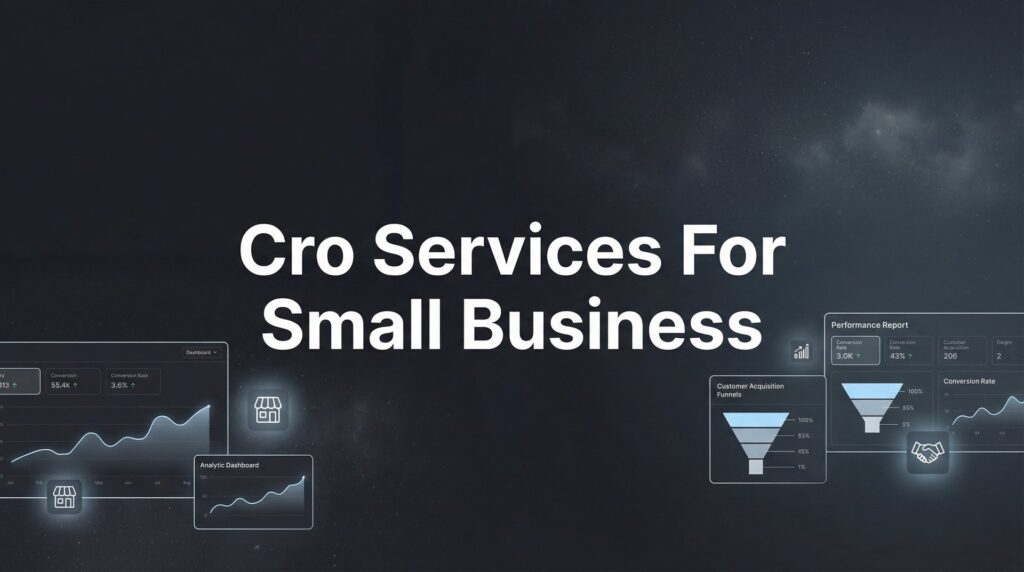
You’re paying for ads. You’ve invested in SEO. The traffic is coming in—maybe even better than you expected. But when you look at your actual sales numbers or lead forms, something doesn’t add up. All those visitors are browsing, clicking around, and then… disappearing. You’re left wondering where the disconnect is between the traffic reports that look promising and the bank account that tells a different story.
This is the conversion gap, and it’s costing small businesses thousands of dollars every month. The problem isn’t that you need more traffic—it’s that you’re not converting the traffic you already have. That’s where conversion rate optimization (CRO) services come in.
CRO isn’t about flashy redesigns or trendy website features. It’s about systematically identifying what’s preventing visitors from becoming customers and fixing those friction points. For small businesses operating on tight marketing budgets, improving conversion rates often delivers far better ROI than simply buying more ads. When you optimize what you already have, every marketing dollar works harder.
The Real Reason Your Website Traffic Isn’t Paying Off
Here’s a sobering reality: the average small business website converts somewhere between 1% and 3% of its visitors. That means for every 100 people who land on your site, 97 to 99 of them leave without taking any action. They don’t fill out your contact form, they don’t call, they don’t make a purchase—they just vanish.
Let’s look at the math. Say you’re spending $2,000 per month on Google Ads and driving 500 visitors to your website. At a 2% conversion rate, you’re getting 10 leads or sales. But if you could improve that conversion rate to just 4%—still modest by industry standards—you’d double your results to 20 leads without spending another dollar on advertising. Same traffic, same ad spend, twice the outcome.
This is why chasing more traffic without fixing conversion issues is like pouring water into a leaky bucket. You can keep adding more water, but you’re never going to fill it up until you patch the holes. If your marketing isn’t converting for your small business, the solution often lies in optimization rather than more spend.
So what creates those holes? For small business websites, several conversion killers show up repeatedly. Slow page load times top the list—when visitors wait more than three seconds for your page to load, many of them bounce before they even see your offer. Confusing navigation comes next. If people can’t quickly figure out where to go or what to do on your site, they’ll leave rather than struggle through it.
Weak calls-to-action are another major culprit. Generic buttons that say “Submit” or “Learn More” don’t give visitors a compelling reason to click. And then there’s the trust problem. Small business websites often lack the credibility signals that make visitors feel confident enough to hand over their contact information or credit card details. No customer testimonials, no security badges, no clear information about who you are—these missing elements quietly kill conversions every day.
The good news? Every one of these problems has a solution. That’s exactly what CRO services address.
What CRO Services Actually Include (And What to Expect)
When you work with a professional CRO provider, you’re not just getting someone to make your website “look better.” You’re getting a systematic approach to understanding why visitors aren’t converting and testing solutions to fix it.
A comprehensive CRO engagement typically starts with a website audit. This isn’t a superficial review—it’s a deep dive into your analytics data, user behavior patterns, and technical performance. The audit identifies specific pages where visitors drop off, forms where people abandon halfway through, and elements that might be creating friction in your conversion funnel. A thorough marketing audit for small business often reveals surprising opportunities for improvement.
User behavior analysis comes next. This involves tools like heatmaps that show where people click and how far they scroll, session recordings that let you watch actual visitor interactions, and funnel analysis that reveals exactly where the conversion process breaks down. This data tells you what’s actually happening on your site, not what you think is happening.
Then comes A/B testing—the backbone of effective CRO. This means creating variations of key pages or elements and splitting your traffic between them to see which version converts better. You might test different headline copy, button colors, form lengths, or page layouts. The key is changing one variable at a time so you know exactly what’s driving the improvement.
Landing page optimization focuses specifically on the pages where you’re sending paid traffic or where visitors enter your site. These pages need to be laser-focused on a single conversion goal, with every element supporting that objective. Form optimization tackles the lead capture process—reducing unnecessary fields, improving the flow, and making it as frictionless as possible to submit information.
Mobile experience improvements are critical because a significant portion of your traffic likely comes from smartphones. If your site isn’t optimized for mobile users, you’re losing conversions before the battle even begins.
Now, you might be wondering: can’t I just do this myself? The honest answer is—sometimes. If you have the time to learn the tools, analyze the data, and run systematic tests, you can make meaningful improvements on your own. Many small business owners start with DIY optimization and see real results.
Professional CRO services make sense when you need expertise you don’t have in-house, when your time is better spent running your business, or when you’ve hit a plateau with your own efforts. The right CRO partner brings experience from working with dozens or hundreds of websites, knows which tests to prioritize, and can implement changes faster than you could figure out on your own.
Set realistic expectations here: CRO isn’t a magic switch you flip once and forget about. It’s an iterative process. You’ll see some quick wins early on, but sustainable improvement comes from ongoing testing and refinement. Think of it as a continuous optimization cycle rather than a one-time project.
Why Small Businesses Have Unique CRO Advantages
Here’s something that might surprise you: small businesses often have significant advantages over enterprise companies when it comes to conversion optimization. The corporate giants have bigger budgets, sure, but they also have bureaucracy, approval chains, and technical constraints that slow everything down.
As a small business, you can implement changes fast. When you discover that a different headline converts 40% better, you can update it today—not six months from now after it’s been through three committees and a compliance review. This agility means you can test more variations, learn faster, and compound your improvements more quickly.
You also have direct access to your customers. Want to know why people aren’t filling out your contact form? Pick up the phone and ask them. Enterprise companies have to go through formal user research processes that take weeks or months. You can have a conversation this afternoon and implement changes based on that feedback tomorrow. Understanding how to get more customers for your small business often starts with these direct conversations.
The revenue impact of conversion improvements hits differently at smaller scales, too. When an enterprise company improves conversion rates by 1%, that might represent thousands of additional transactions—but it’s a rounding error in their overall business. For a small business, a 1% improvement might mean the difference between struggling and thriving. Even modest gains create meaningful financial impact.
Budget concerns are real for small businesses, and that’s actually where CRO shines. You don’t need to implement everything at once. A good CRO strategy identifies the highest-impact opportunities and tackles those first. Maybe your biggest leak is a confusing checkout process that causes cart abandonment. Fix that one thing before you worry about optimizing your blog layout. Focused, prioritized optimization fits small business budgets better than trying to do everything simultaneously.
This focused approach also means you can start seeing ROI quickly. When you’re not spreading your budget across dozens of initiatives, you can put meaningful resources into the tests that matter most and see results within weeks rather than months.
Inside the CRO Process: From Analysis to Results
Understanding how a typical CRO engagement unfolds helps you know what to expect and how to prepare. The process follows a logical sequence, though it’s rarely perfectly linear—you’ll often loop back to earlier stages as you learn more.
Discovery kicks things off. This is where your CRO partner learns about your business, your customers, your goals, and your current challenges. They’ll want access to your analytics, information about your marketing campaigns, and details about what you’ve already tried. The more context they have, the better they can tailor their approach to your specific situation.
Data analysis comes next. This is where the real detective work happens. Your CRO team will dig into your website analytics to identify patterns—which pages have high bounce rates, where users drop out of your conversion funnel, which traffic sources convert best and worst. They’ll set up heatmaps and session recordings to see how real visitors interact with your site. They might send surveys to recent visitors or customers asking about their experience.
This research phase reveals the problems you need to solve. Maybe your product pages load slowly on mobile devices. Maybe your contact form asks for too much information. Maybe your value proposition isn’t clear enough in the first three seconds someone lands on your homepage. Each insight becomes a potential opportunity for improvement.
Hypothesis development translates those insights into testable predictions. Instead of making random changes and hoping they work, you’re creating specific hypotheses: “If we reduce the contact form from 8 fields to 4 fields, we’ll increase form submissions by at least 20% because visitors will perceive it as less effort.” This approach ensures you’re testing with purpose and can measure whether your assumptions were correct.
Testing implementation is where hypotheses become experiments. Using platforms like Google Optimize, Optimizely, or VWO, your CRO team creates variations of your pages and splits traffic between them. Version A might be your current page, while Version B tests your hypothesis. The platform tracks conversions for each version and determines which one performs better with statistical significance.
Here’s something important: good testing requires patience. You need enough traffic and conversions to reach statistical significance—otherwise, you’re making decisions based on random noise rather than real patterns. For small business websites with modest traffic, this might mean running tests for several weeks rather than a few days.
Iteration and scaling come after you’ve identified winning variations. When a test shows clear improvement, you implement the winner permanently and move on to the next hypothesis. The process repeats continuously, with each round of testing building on what you learned previously. This compounding effect is where the real magic happens—each small improvement stacks on top of the last.
Integration with your existing marketing amplifies everything. When you improve your landing page conversion rate, your PPC management services suddenly become more profitable because each click costs the same but converts more often. Your SEO efforts pay bigger dividends because the organic traffic you’re earning converts at higher rates. CRO makes all your other marketing investments work harder.
Finding the Right CRO Partner for Your Business
Not all CRO services are created equal, and choosing the wrong partner can waste time and money while delivering minimal results. Knowing what to look for—and what to avoid—makes all the difference.
Start by asking potential CRO providers about their experience with businesses like yours. Have they worked with companies in your industry? Do they understand the specific challenges of your market? A CRO agency that’s only worked with e-commerce sites might struggle to optimize a local service business website, and vice versa. Relevant experience matters because they’ll recognize patterns and opportunities faster.
Ask about their testing methodology. How do they decide what to test? How do they ensure tests reach statistical significance? How do they prioritize which optimizations to tackle first? You want a partner who follows a systematic, data-driven approach rather than just making changes based on gut feelings or design trends.
Reporting transparency is crucial. You should understand exactly what’s being tested, why it’s being tested, what the results show, and what actions are being taken based on those results. If a CRO provider can’t clearly explain their process and results in terms you understand, that’s a red flag. You’re the client—you deserve to know what you’re paying for and whether it’s working.
Watch out for specific warning signs. Any CRO provider who guarantees specific conversion rate increases before they’ve even analyzed your site is either lying or incompetent. Conversion optimization involves too many variables to make guarantees. The honest answer is: “We’ll systematically test improvements and implement what works, but exact results depend on your traffic, your offer, and what we discover.”
Be wary of agencies that don’t emphasize data and testing. If they’re proposing changes based solely on “best practices” or what’s worked for other clients, they’re not doing real CRO—they’re just implementing someone else’s playbook without validating it for your specific situation. Every website is different, and what works for one business might fail for another. A skilled digital marketing consultant for small business will always customize their approach based on your data.
One-size-fits-all approaches are another red flag. If a CRO provider offers a standard package without first understanding your business, your customers, and your current performance, they’re not actually optimizing—they’re just selling a productized service. Real CRO requires customization based on your unique situation.
What does a good CRO partnership look like? It’s collaborative. Your CRO partner should treat you as part of the team, seeking your input on customer behavior, business priorities, and practical constraints. They should be transparent about what’s working and what isn’t. And they should focus relentlessly on your specific business goals—whether that’s more leads, more sales, higher average order values, or better qualified prospects.
The best CRO relationships are built on trust, communication, and shared commitment to continuous improvement. You should feel like you’re working together toward common objectives, not like you’re being sold a service you don’t fully understand.
Quick Wins You Can Test Right Now
While professional CRO services deliver the most comprehensive and sustainable results, you don’t have to wait to start improving your conversion rates. Several high-impact tactics can be implemented quickly and tested with minimal technical expertise.
Simplify your forms: Look at any lead capture or contact forms on your site. How many fields are you asking people to fill out? Each additional field creates friction and reduces completion rates. Try cutting your form down to the absolute essentials—usually just name, email, and phone number. You can always gather additional information later in your sales process. Test a shorter form against your current version and measure the difference in completion rates.
Improve your page speed: Slow-loading pages kill conversions before visitors even see your content. Use Google’s PageSpeed Insights tool to analyze your site and identify specific speed issues. Common quick fixes include compressing images, enabling browser caching, and minimizing unnecessary scripts. Even shaving two seconds off your load time can produce measurable conversion improvements.
Strengthen your calls-to-action: Replace generic CTAs like “Submit” or “Click Here” with specific, benefit-focused alternatives. Instead of “Learn More,” try “Get Your Free Quote” or “Schedule Your Consultation.” Make your CTA buttons stand out visually—they should be the most obvious clickable element on the page. Test different button colors, sizes, and copy to see what resonates with your audience.
Add trust signals: If your site lacks credibility indicators, you’re creating unnecessary doubt in visitors’ minds. Add customer testimonials with real names and photos. Display any industry certifications, awards, or recognitions you’ve earned. Include security badges near forms or checkout processes. Show your physical address and phone number prominently. These elements reduce perceived risk and make people more comfortable converting.
Before you implement any of these changes, establish your baseline. Log into your analytics and record your current conversion rates for key pages and actions. This gives you a comparison point to measure whether your optimizations actually work. Too many businesses make changes without tracking the impact, so they never know if they’re improving or just changing things randomly. If you’re struggling with lead generation, these quick wins can provide immediate relief while you develop a longer-term strategy.
Track your results for at least two to four weeks after implementing changes. This gives you enough data to see meaningful patterns while accounting for normal weekly fluctuations in traffic and conversions.
These quick wins can produce noticeable improvements, but they’re just the beginning. When you’ve implemented the obvious optimizations and you’re ready to dig deeper—when you want sophisticated testing, advanced analytics, and strategic guidance—that’s when professional CRO services deliver their greatest value. The DIY approach gets you started; expert services take you to the next level.
Making CRO Work for Your Business
Conversion rate optimization represents one of the smartest investments a small business can make in its marketing. While ads and SEO bring visitors to your door, CRO is what invites them in and turns them into customers. The compound effect of even modest conversion improvements transforms your entire marketing operation—every campaign becomes more profitable, every dollar spent works harder, and your growth accelerates without proportionally increasing your budget.
The businesses that win in competitive markets aren’t always the ones with the biggest advertising budgets. They’re the ones that convert their traffic most efficiently. They understand that optimization is an ongoing process, not a destination. They test, learn, refine, and repeat—continuously improving the experience they offer visitors and the results they generate for their business.
Whether you start with quick DIY improvements or partner with CRO experts from the beginning, the important thing is to start. Every day you operate with suboptimal conversion rates is a day you’re leaving money on the table. Your competitors are optimizing. Your industry is evolving. The question isn’t whether you should invest in conversion optimization—it’s how quickly you can begin capturing the revenue you’re currently missing.
Tired of spending money on marketing that doesn’t produce real revenue? We build lead systems that turn traffic into qualified leads and measurable sales growth. If you want to see what this would look like for your business, we’ll walk you through how it works and break down what’s realistic in your market.
Want More Leads for Your Business?
Most agencies chase clicks, impressions, and “traffic.” Clicks Geek builds lead systems. We uncover where prospects are dropping off, where your budget is being wasted, and which channels will actually produce ROI for your business, then we build and manage the strategy for you.