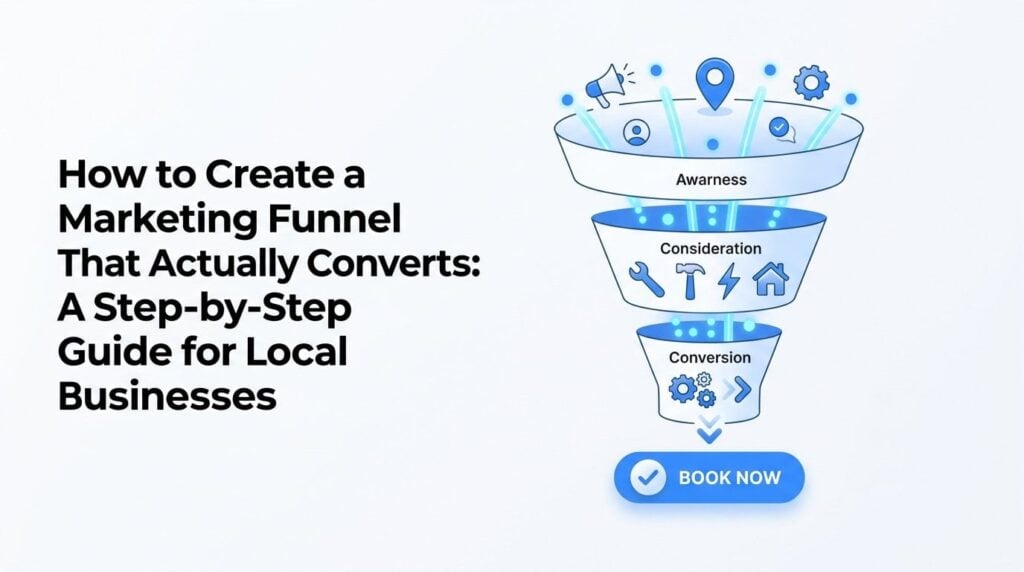
You’ve probably heard the word “funnel” more times than you can count. A marketing consultant drops it in a pitch. A Facebook ad promises to teach you the “seven-figure funnel.” Your nephew who took a digital marketing course sends you a diagram with six boxes and arrows.
None of that tells you what you actually need to know: how does a stranger in your service area go from having a problem to calling your number and booking a job?
That’s the only funnel that matters for a plumber, electrician, HVAC contractor, or any other local service business. It’s not a software stack. It’s not an automation sequence with seventeen steps. It’s the path a person takes from “I have a problem” to “I’m scheduling with these guys,” and your job is to make that path as clear and frictionless as possible.
The frustrating reality is that most service businesses already have pieces of a funnel. They’re running Google Ads. They have a website. They’ve got some reviews on Google. But the pieces aren’t connected with any intention, so they leak. Traffic arrives at a homepage that doesn’t convert. Calls come in but don’t get answered fast enough. Leads sit in a form submission inbox until the customer has already hired someone else.
This guide walks you through building a funnel that actually moves people to a booked job. Six steps, no marketing theory, no enterprise software required. By the end, you’ll have a clear picture of where your funnel is broken and what to fix first.
Step 1: Map the Decision Path Your Customer Actually Takes
Before you build anything, you need to understand how your specific customers make decisions. Not customers in general. Your customers, in your vertical, in your market.
The single most important variable in local service marketing is the emergency versus planned-work split. A burst pipe at 11pm and a kitchen remodel are both plumbing jobs, but the customer’s decision path looks nothing alike.
Emergency searches (burst pipe, AC down in August, no hot water) are short, high-urgency, and happen on a phone. The customer types something into Google, looks at the top three results, checks a star rating, and calls. The whole process takes under five minutes. Your funnel for this customer needs to be fast, visible, and frictionless. There’s almost no “consideration” phase.
Planned-work searches (seasonal HVAC tune-up, bathroom remodel, new landscaping) play out over days or weeks. The customer researches, compares, asks neighbors, reads reviews, maybe visits your website twice before calling. Your funnel for this customer needs to show up early, build trust over time, and give them a reason to choose you before they’re ready to commit.
Plumbing and electrical skew heavily emergency. HVAC maintenance and remodeling skew planned. Most businesses have a mix, but one type usually dominates, and that should drive your channel decisions in Step 3.
Now map the specific touchpoints in your market. A customer might find you through a Google search result, the Map Pack, a review site like Yelp or Angi, a neighbor’s referral, a Facebook post, or a direct mail piece. Walk through each one and answer honestly: do you currently show up there? Do you show up well?
The most common mistake at this stage is assuming every customer is in emergency mode. Owners build a paid ad campaign, get some calls, and think the funnel is done. Meanwhile, the planned-work customers who would have been their most profitable jobs never found them at all.
Success indicator: You can sketch a simple diagram showing how a customer moves from problem awareness to booked job, with a named channel at each stage. If you can’t draw it, you don’t know your funnel yet.
Step 2: Build the Foundation Before You Spend on Traffic
This is where most businesses get the order wrong. They start buying traffic before the infrastructure exists to convert it. That’s the equivalent of running ads for a restaurant where the kitchen isn’t open yet.
Three things need to be in place before a single dollar goes to ads or SEO.
Your Google Business Profile. The Map Pack captures roughly 42% of local clicks. That’s not a rounding error. Nearly half of everyone who searches for your service in your area is clicking on those three map results, not the organic listings, not the ads. An incomplete or unoptimized GBP profile means you’re invisible to almost half your potential customers before they even see your website. Fill out every field: services, service area, hours, photos, and at least one recent post. This is the highest-leverage free asset in local service marketing.
Your landing page. Your website’s job is one thing: convert a visitor into a phone call or form submission. It is not a brochure. It is not a portfolio. Every element should serve that single conversion goal. Your headline needs to name what you do and where you do it. Your service area needs to be explicit. Your trust signals need to be visible above the fold: license number, years in business, review count with star rating. One dominant call to action, preferably a tap-to-call button on mobile, needs to be the most obvious thing on the page.
Call tracking. You cannot improve a funnel you cannot measure. A call tracking number (services like CallRail or similar tools handle this) tells you which channel produced each call. Without it, you’re spending money and guessing which channel is working. This is not optional if you’re serious about improving your results.
Reviews deserve a separate mention because they function as funnel infrastructure, not just reputation management. Between 40 and 70 percent of local service leads convert by phone, and the first thing most callers do before dialing is check your reviews. A profile with fewer than 20 recent reviews will lose calls to a competitor with 80, even if your actual work is better. Getting reviews from every completed job is a systematic process, not something you hope happens organically.
If you want to understand how conversion problems on your page translate into wasted ad spend, the dynamics are spelled out in detail at clicksgeek.com/low-conversion-rate-hvac/, which covers HVAC but the principles apply across verticals.
Success indicator: Your GBP is fully filled out with services, photos, and a recent post. Your landing page has a click-to-call button visible without scrolling on mobile. You have call tracking active on at least one channel.
Step 3: Drive Awareness With Channels Matched to Your Urgency Split
Now you can spend on traffic. But which channel you start with should follow directly from the emergency versus planned-work split you mapped in Step 1.
Emergency-dominant verticals (plumbing, electrical, locksmith) should prioritize Google Ads and Local Services Ads first. Someone whose pipe just burst is not browsing Facebook. They’re searching on Google right now, and they’re calling whoever shows up at the top. Google Ads CPL for home services typically runs $18-35, and for high-ticket emergency jobs, that cost is easy to justify. LSA operates separately from standard Google Ads and shows up even above the traditional paid results, with a “Google Guaranteed” badge that carries real weight with callers. If you’re in an emergency-dominant vertical and you’re not running LSA, that’s the first thing to fix.
Planned-work verticals (HVAC maintenance, remodeling, landscaping) have more runway to build. Local SEO makes sense here because your customers are researching before they’re ready to call, and organic visibility compounds over time. Local SEO CPL can reach $7-15 at the 12-month mark, which is the most cost-efficient lead source available, but only if you have the patience for the ramp. You won’t see full efficiency for 6-12 months, so don’t start SEO the week before your slow season and expect it to save you.
Facebook and social ads, with a CPL range of $10-25, work best for planned services where you can put your name in front of homeowners before they’re actively searching. You’re planting awareness that pays off later when the need arises. For emergency work, it’s a poor fit because intent isn’t there at the moment of need.
For a direct comparison of how paid channels stack up against lead services in HVAC specifically, clicksgeek.com/google-ads-vs-lead-services-for-hvac/ breaks down the tradeoffs. And if you’re seeing leads come in but they’re the wrong type of jobs, clicksgeek.com/bad-leads-for-hvac/ covers why that happens and how to correct it at the channel level.
One firm rule: don’t try to run all three channels at once if you’re starting out. Pick the channel that matches your primary job type and your current budget. Get it profitable first. Then add a second channel. Spreading thin across three channels simultaneously usually means none of them get enough budget or attention to work properly.
Success indicator: You have one primary traffic channel live, with conversion tracking showing cost per lead. You know what you’re paying per call from that channel.
Step 4: Convert Visitors Into Calls and Form Submissions
The middle of the funnel is where most service businesses quietly hemorrhage money. Traffic arrives, looks around for a few seconds, and leaves. The ad spend was real. The result was nothing.
Speed and specificity are the two variables that determine whether someone calls or bounces. Your headline should name the service and the city. “Plumber in Lancaster, PA” outperforms “Welcome to Our Website” every time, not because it’s clever, but because it immediately tells the visitor they’re in the right place. The first five seconds on your page either confirm that or send them back to Google.
Trust signals matter differently for local customers than they do for e-commerce. Verified Google reviews with a visible star count, photos of named technicians, a service area map, and a license or certification badge all reduce the hesitation that kills conversions. These aren’t decorative. They’re answering the questions running through the visitor’s head: Are these people real? Do they work in my area? Can I trust them in my home?
For planned-work customers who aren’t ready to call right now, you need a low-friction alternative to the phone call. A free estimate offer, a seasonal inspection checklist, or a simple callback form gives them a way to engage without committing to a conversation they’re not ready for. Capturing that contact before they leave is the difference between a one-time visitor and a lead you can follow up with.
Mobile behavior deserves its own sentence. The majority of local service searches happen on phones. Your call button needs to be tap-to-call, not a number someone has to copy and manually dial. That friction costs you calls. Put the phone number in the hero section, in the middle of the page, and at the bottom. Burying it in the header alone is one of the most common and most fixable conversion problems we see.
Success indicator: Your conversion rate on your primary landing page is measurable in GA4. You know your current baseline rate and can track whether changes improve it.
Step 5: Handle the Lead Before It Goes Cold
You’ve paid for the traffic. The page did its job. Someone called or filled out a form. This is where a surprising number of businesses lose the job anyway.
Speed to response is the biggest single conversion variable in local service. A lead that doesn’t get a callback within a few minutes often calls the next result on Google before you’ve had a chance to pick up. This isn’t an exaggeration; it’s the behavior pattern that shows up consistently across home service verticals. The person with the problem wants it solved. They’re not loyal to you yet.
A missed-call text-back is one of the highest-ROI things you can set up in an afternoon. When someone calls and doesn’t reach you, they get an automatic text within seconds acknowledging the call and asking when is a good time to connect. It keeps you in the running instead of losing the lead to silence. Most CRM tools and phone systems support this, and it doesn’t require anything complicated.
The same urgency applies to form submissions. An automated email or text within five minutes of a form fill keeps you competitive. Waiting until the next business day is not a real option in most service verticals. The lead is already cold by then.
CSR scripting is the part of this step that owners most often overlook. The person answering your phone is the last stage of your funnel. All the ad spend, the SEO work, the optimized landing page, it all comes down to that conversation. A CSR who can’t give a ballpark range, explain your process clearly, or handle “how much does it cost?” will lose booked jobs that your marketing paid to deliver. Documenting a basic call script and training to it is not a big project, but it has an outsized impact on close rate.
For a deeper look at why lead quality problems often trace back to the response and qualification process rather than the channel, clicksgeek.com/how-to-improve-lead-quality-plumbing/ walks through this in the plumbing context. And if you want to understand the full booked-job conversion chain, clicksgeek.com/how-to-increase-booked-jobs-plumbing/ is worth reading alongside this step.
Success indicator: You have a documented response protocol. A missed-call text-back is active. You know your current close rate on inbound leads.
Step 6: Measure What Matters and Cut What Doesn’t
Most business owners who feel like their marketing isn’t working are actually flying blind. They know they’re spending money. They’re not sure what it’s producing. That gap is the problem, and fixing it doesn’t require a data analyst.
The only metrics that matter for a local service funnel are cost per lead, cost per booked job, and revenue per channel. Traffic numbers, impressions, and click-through rates are inputs. They tell you something is happening upstream, but they don’t tell you whether the marketing is profitable. If you can’t answer what a booked job cost you from each channel last month, you can’t make good decisions about where to spend next month.
Set up a simple tracking sheet. Channel, spend this month, calls generated, jobs booked, revenue from those jobs. Review it monthly. That’s it. You don’t need a dashboard with forty widgets.
The spend benchmark worth keeping in mind: most profitable service businesses spend 8-12% of revenue on marketing. If you’re spending more than that and not seeing proportional job volume, the funnel has a leak somewhere. The tracking sheet helps you find it.
Here’s how to read the leaks. High clicks but low calls means the landing page is failing. High calls but low bookings means the CSR or response process is failing. High bookings but poor margin means you’re attracting the wrong job types, which is a targeting and messaging problem, not a volume problem. Each symptom points to a different fix.
Ramp expectations matter here too. Google Ads can show directional results in 30-90 days. Local SEO typically takes 6-12 months to reach full CPL efficiency. Don’t shut down a channel before it’s had its full ramp period. The most common mistake is pulling the plug on SEO at month three because it hasn’t produced the same volume as ads, without accounting for the fact that SEO wasn’t supposed to be at full speed yet.
For a detailed breakdown of what high cost per lead actually signals and where to look for the fix, clicksgeek.com/high-cost-per-lead-hvac/ covers this specifically for HVAC, but the diagnostic framework applies broadly.
Success indicator: You can answer, within 10 minutes, what your cost per booked job was last month from each active channel.
Your Funnel Is a System, Not a Series of Separate Projects
Here’s the mindset shift that makes everything else click. Each of the six steps above is only useful in connection with the others. Google Ads without a converting landing page is a donation. A great landing page with no traffic does nothing. Reviews and a strong GBP without a fast response system loses leads at the last step, after you’ve done everything else right.
The most common failure pattern isn’t that any single piece is terrible. It’s that the pieces aren’t connected. Traffic arrives at a page that wasn’t built to convert it. Calls come in but don’t get answered quickly enough. Leads get captured but no one follows up. Each gap is fixable, but you have to look at the system as a whole to find them.
On timeline: a basic funnel with one traffic channel, a solid GBP, and a converting landing page can be operational in 30-60 days. Getting it to peak efficiency takes longer, but you’ll see directional results fast if the foundation is right. Don’t expect month one to look like month six.
Clicks Geek has been building lead generation systems for local service businesses since 2015. We’re a Google Premier Partner with playbooks across 298 industries and over $100 million in managed ad spend. We know what works in home services because we’ve run it across thousands of campaigns in verticals from plumbing to HVAC to electrical to landscaping.
If you want a second set of eyes on your current funnel or want to talk through which channel makes sense for your market, if you want to see what this would look like for your specific business, we’ll walk you through it and tell you honestly what’s realistic in your area. No pitch deck, no pressure.