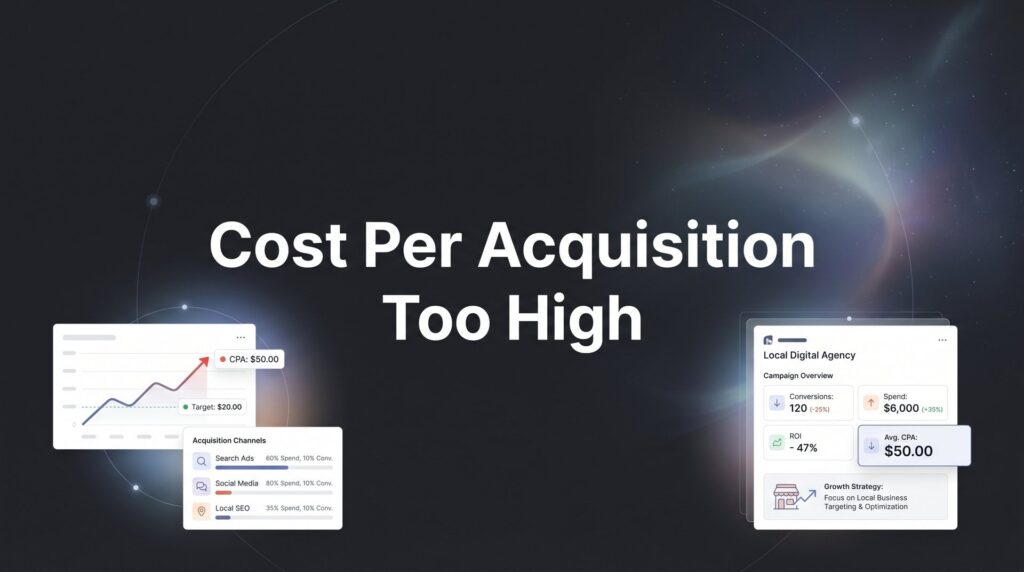
You check your ad account dashboard and feel your stomach drop. Another $3,000 spent this month, and you’ve landed exactly twelve customers. That’s $250 per acquisition. Your profit margin per customer? Maybe $180 on a good day. The math doesn’t work, and you know it.
This is the reality for countless local business owners right now. Your ads are running, clicks are coming in, but the cost to actually acquire a paying customer keeps climbing higher. It’s not just frustrating—it’s unsustainable. When your cost per acquisition is too high, you’re essentially paying for the privilege of losing money on every new customer.
Here’s the thing: a high CPA isn’t random bad luck. It’s a symptom of specific, fixable problems in your advertising system. Maybe you’re targeting the wrong people. Maybe your landing page is sending qualified visitors running. Maybe your conversion tracking is broken and you’re making decisions based on incomplete data. The good news? Once you diagnose the actual problem, you can fix it.
This guide will walk you through exactly how to identify what’s driving your acquisition costs through the roof and give you concrete strategies to bring them back under control. We’ve helped hundreds of local businesses turn unprofitable ad campaigns into reliable customer acquisition systems, and the fixes are often simpler than you’d expect.
What’s Actually Driving Your CPA Through the Roof
Let’s start with the basics. Your cost per acquisition is calculated by taking your total ad spend and dividing it by the number of conversions you generated. Spend $5,000 and get 20 customers? Your CPA is $250. Simple math, but it reveals something crucial: you can lower your CPA in two ways—reduce how much you’re spending, or increase how many conversions you’re getting.
Most business owners fixate on the spend side. They see the number going up and immediately think “I need to cut my budget.” But that’s often the wrong move. If you’re getting conversions, slashing your budget just means fewer customers. The real opportunity lies in identifying where you’re hemorrhaging money without results. Understanding what customer acquisition cost actually means is the first step toward controlling it.
The most common CPA killers are surprisingly predictable. Poor targeting means you’re paying to reach people who will never buy from you—like advertising plumbing services to apartment renters who don’t control their own maintenance. Weak landing pages convert visitors at dismal rates, so even qualified traffic bounces without taking action. Low-intent keywords bring in browsers instead of buyers. And conversion tracking gaps mean you’re flying blind, unable to see which campaigns actually work.
Here’s how to audit your current situation. Pull up your campaign data for the last 30 days. Look at your conversion rate first—if it’s below 2% for search campaigns or below 1% for display, you’ve got a conversion problem, not just a spend problem. Check your search terms report to see what queries are actually triggering your ads. You’ll often find expensive, irrelevant clicks hiding in there.
Next, examine your cost-per-click across campaigns. If certain campaigns have CPCs significantly higher than others without proportionally better conversion rates, you’ve found a leak. Look at your Quality Scores in Google Ads—scores below 5 mean you’re paying a premium for poor ad relevance, and that directly inflates your CPA.
Finally, verify your conversion tracking is actually working. Run a test conversion yourself. Fill out your own contact form or make a phone call from an ad. Does it show up in your reporting? Many businesses discover they’ve been missing 30-40% of their actual conversions because phone calls weren’t tracked or form submissions weren’t properly tagged.
This diagnostic process takes maybe an hour, but it will tell you exactly where to focus your optimization efforts. You’re not looking for perfection—you’re looking for the biggest leaks to plug first.
The Targeting Trap: When You’re Paying to Reach the Wrong People
Picture this: You’re a high-end kitchen remodeling company spending $200 per click to reach people searching for “kitchen ideas” and “DIY kitchen updates.” You’re getting clicks, sure. But these people aren’t ready to spend $40,000 on a renovation—they’re browsing Pinterest and looking for weekend projects.
Targeting too broadly is one of the fastest ways to destroy your CPA. Every click from someone who was never going to buy costs you money and drags down your conversion rate. The solution isn’t complicated, but it requires discipline: get ruthlessly specific about who you’re trying to reach.
Start with geographic targeting. If you’re a local business serving a 20-mile radius, why are you showing ads to people 50 miles away? Tighten your radius. Better yet, exclude specific ZIP codes where you know customers don’t convert well—maybe they’re too far for service calls, or the demographics don’t match your ideal customer profile.
Demographic targeting matters more than most businesses realize. If your average customer is a homeowner aged 35-65 with household income above $75,000, configure your campaigns to focus on that profile. Yes, you’ll reach fewer people. That’s the point. You want fewer, better-qualified prospects.
Behavioral and interest targeting can help, but be careful. Platforms like Facebook and Google offer endless targeting options based on user behavior and interests. The trap is selecting too many interests, thinking more options equals more customers. Instead, focus on high-intent behaviors—people who recently searched for your services, visited competitor websites, or engaged with content related to purchasing decisions in your category. A solid customer acquisition system for local businesses starts with precise targeting.
Now here’s the move that most advertisers skip: negative keywords and audience exclusions. These are your filters for keeping non-buyers out. If you sell premium products, add “cheap,” “free,” “DIY,” and “how to” as negative keywords. If you’re B2B, exclude students and job seekers. Every irrelevant click you prevent is money saved and CPA reduced.
Review your search terms report weekly and add negative keywords aggressively. You’ll be shocked how much budget gets wasted on search queries that sound relevant but attract the wrong audience. One of our clients reduced their CPA by 35% simply by adding 200 negative keywords over two months—no other changes needed.
Landing Pages That Convert vs. Landing Pages That Burn Cash
You’re paying $8 per click. A visitor lands on your homepage, sees your generic welcome message, gets confused about what to do next, and leaves within six seconds. You just burned $8 for nothing. Multiply that by a few hundred clicks per month and you’ve found your CPA problem.
Sending paid traffic to your homepage is one of the most expensive mistakes in digital advertising. Your homepage tries to serve everyone—existing customers, job seekers, random browsers, potential clients. It’s not built to convert someone who just clicked an ad about a specific service.
Dedicated landing pages work because they maintain message match. If your ad promises “Free Roof Inspection for Storm Damage,” your landing page should immediately reinforce that exact offer with a prominent headline, not bury it three paragraphs down beneath your company history. Learning how to create high converting landing pages is essential for reducing your CPA.
The essential elements aren’t complicated. You need a clear, benefit-focused headline that matches your ad. You need a single, obvious call-to-action—one form, one phone number, one next step. Giving people multiple options sounds helpful but actually kills conversions. Decision paralysis is real.
Trust signals matter enormously. Include customer testimonials, recognizable logos of clients you’ve served, industry certifications, and your Google reviews rating. People need reassurance that you’re legitimate before they’ll hand over their contact information or credit card.
Mobile optimization isn’t optional anymore. More than half your traffic probably comes from mobile devices. If your landing page takes seven seconds to load or requires zooming to read text, you’re losing conversions by the dozen. Test your page on an actual phone. If the form is hard to fill out or the phone number isn’t click-to-call, fix it immediately.
Quick wins you can implement this week: Remove navigation menus from your landing pages so visitors can’t wander off. Cut your form fields down to the absolute minimum—name, email, phone number, and maybe one qualifier question. Anything beyond that and completion rates plummet. Add a clear value proposition above the fold explaining exactly what happens after they convert. Replace stock photos with real images of your team, your work, or your location.
One of our clients was spending $12,000 monthly with a 1.2% conversion rate on their homepage. We built a dedicated landing page for their main service, kept everything else identical in the campaigns, and their conversion rate jumped to 4.1% within two weeks. Same traffic, same budget, but their CPA dropped from $340 to $98. The landing page took four hours to build.
Bidding Strategies and Budget Allocation That Actually Work
Automated bidding sounds like a dream. Let Google’s algorithm optimize your bids based on conversion likelihood, and watch your CPA magically decrease. Except when it doesn’t work, it can destroy your budget faster than almost anything else.
Here’s the reality: automated bidding strategies like Target CPA or Maximize Conversions need data to function. Specifically, they need at least 30 conversions in the past 30 days to make informed decisions. If you’re running a campaign that gets 8 conversions per month, automated bidding is essentially guessing. You’re better off with manual bidding or Enhanced CPC where you maintain more control.
When automated bidding does work—typically for campaigns with consistent conversion volume—it can legitimately improve your CPA by finding optimization opportunities you’d miss manually. But you need to set it up correctly. If you set a Target CPA of $100 but your historical CPA is $250, the algorithm won’t magically find cheaper conversions. It will just stop spending your budget because it can’t hit your target.
Budget allocation is where most businesses leave serious money on the table. You’re splitting your budget evenly across five campaigns, but three of them have CPAs twice as high as the other two. Why are you still funding the losers? Reallocate budget from underperforming campaigns to your proven winners. This sounds obvious, but inertia keeps businesses pouring money into campaigns that stopped working months ago. Following a proven customer acquisition cost reduction strategy can help you make smarter allocation decisions.
Review your campaign performance weekly and shift budget toward what’s converting. If your search campaign delivers a $120 CPA and your display campaign is at $380, move budget from display to search until you max out search volume. Then—and only then—consider whether display is worth optimizing or should be paused entirely.
Ad scheduling can significantly impact your CPA. Pull a day-of-week and hour-of-day report from your campaigns. You’ll often discover that conversions happen primarily during business hours Tuesday through Thursday, but your ads run 24/7. Why pay for clicks at 2 AM Sunday when nobody converts then? Adjust your ad schedule to focus budget on high-conversion time windows.
Device targeting works similarly. If your mobile conversion rate is 0.8% but desktop is 3.2%, you can either reduce mobile bids by 60-70% or pause mobile traffic entirely depending on volume. Some businesses need mobile presence for brand awareness, but if you’re purely focused on CPA, send budget where conversions actually happen.
Tracking Gaps: The Hidden Reason Your CPA Looks Worse Than It Is
Imagine you’re actually acquiring customers for $150 each, but your reporting says $280. You make decisions based on that inflated number—cutting budgets, pausing campaigns, shifting strategy—all because you can’t see half your conversions. This happens more often than you’d think.
Conversion tracking breaks in predictable ways. Form submissions work fine, but phone calls from your ads go untracked. Someone clicks your ad, calls your business, becomes a customer, and your reporting shows zero conversions from that campaign. Your actual CPA is reasonable, but the data says it’s terrible.
Phone call tracking is essential for any business where customers prefer calling over filling out forms. Implement call tracking numbers that dynamically insert when someone clicks from an ad. This allows you to attribute phone conversions back to specific campaigns, keywords, and ads. Without this, you’re missing a huge piece of your conversion picture. The best conversion rate optimization tools include robust tracking capabilities that capture every conversion type.
Offline conversions create similar blind spots. Someone clicks your ad, visits your store three days later, and makes a purchase. Your online tracking sees a click with no conversion. But a conversion absolutely happened—you just can’t see it in your dashboard. If you have a CRM or point-of-sale system, explore offline conversion imports that let you upload customer data back to your ad platforms.
Form fills seem straightforward, but they break too. Your conversion tracking fires when someone lands on a thank-you page, but your form redirects to the homepage instead. Or your tracking code is on the wrong page. Or it’s blocked by privacy settings or ad blockers. Test every conversion action monthly to verify it’s still firing correctly.
Attribution settings matter enormously. Last-click attribution gives all credit to the final touchpoint before conversion, but many customers interact with your ads multiple times before converting. If you’re only crediting the last click, you’re undervaluing your awareness and consideration campaigns. Experiment with data-driven attribution or position-based models to get a more complete picture.
One of our clients was convinced their Google Ads campaigns were failing with a reported CPA of $420. We implemented call tracking and discovered that 60% of their conversions came through phone calls that weren’t being tracked. Their actual CPA was $168—still room for improvement, but suddenly their campaigns were profitable instead of disastrous. They’d been one week away from shutting everything down based on incomplete data.
When to Optimize vs. When to Overhaul Your Entire Approach
You’ve been tweaking your campaigns for three months. You’ve adjusted bids, refined targeting, updated ad copy, and improved your landing page. Your CPA has dropped from $310 to $285. Progress, technically. But you need it under $150 to be profitable, and incremental improvements aren’t getting you there fast enough.
This is the moment to acknowledge that optimization has limits. Sometimes the problem isn’t execution—it’s strategy. You’re trying to optimize your way out of a fundamentally flawed approach, and no amount of tweaking will fix it.
Benchmark your CPA against both industry standards and your own unit economics. CPA varies wildly by industry. Legal services might see CPAs of $500-$1,000 because customer lifetime value is high. E-commerce might target $30-$50. What matters is whether your CPA allows for profitable growth at your price point and margin structure. Understanding how to scale customer acquisition profitably requires knowing your numbers inside and out.
If your product sells for $200 with a $80 profit margin, and your CPA is $150, the math doesn’t work. You can optimize until you’re blue in the face, but you need to either increase your prices, reduce your CPA by 50%, or find a different customer acquisition channel entirely.
Signs that incremental tweaks won’t save you: Your conversion rate is below 1% despite landing page improvements. Your average order value is too low to support paid acquisition. You’re in a hyper-competitive market where CPCs have doubled in the past year. Your product requires extensive education before purchase, making direct-response advertising ineffective. You’re targeting too small an audience to scale profitably.
When you hit these walls, you need strategic overhaul. That might mean shifting from Google Ads to Facebook where your audience is more accessible. It might mean changing your offer from “buy now” to “free consultation” to move prospects into a nurture sequence. It might mean targeting different customer segments entirely or repositioning your service at a premium price point that supports higher acquisition costs. A performance based marketing agency can help you identify which strategic shifts will have the biggest impact.
Professional PPC management accelerates this process because experienced agencies have seen your situation dozens of times before. They know which optimization levers actually move the needle and which are distractions. They can identify strategic problems faster because they’re not emotionally attached to your current approach. And they have the technical expertise to implement complex tracking, bidding, and targeting configurations that most business owners don’t have time to master.
The question isn’t whether you can eventually figure it out yourself—you probably can. The question is whether the time and money you’ll spend learning through trial and error costs more than just hiring someone who already knows the path.
Putting It All Together
A high cost per acquisition isn’t a death sentence. It’s a diagnostic signal telling you that something in your customer acquisition system needs attention. Maybe you’re targeting the wrong audience and paying for clicks that will never convert. Maybe your landing page is sending qualified visitors away. Maybe your bidding strategy is overpaying for results you could get cheaper. Maybe your tracking is broken and your CPA isn’t actually as bad as it looks.
The businesses that fix their CPA problems follow a systematic approach. They audit their current campaigns to identify the specific leaks. They tighten their targeting to stop wasting money on non-buyers. They build landing pages that actually convert traffic instead of burning it. They allocate budget based on performance data, not hope. They verify their tracking is capturing all conversions, not just the easy ones.
Most importantly, they recognize when optimization has reached its limits and strategic changes are needed. Tweaking bids and testing ad copy has value, but it won’t fix a fundamentally broken approach. Sometimes you need to step back and rebuild the system from scratch.
The difference between a profitable customer acquisition system and an expensive hobby often comes down to expertise and execution. You can spend months learning through expensive trial and error, or you can work with people who’ve already solved these exact problems hundreds of times.
Tired of spending money on marketing that doesn’t produce real revenue? We build lead systems that turn traffic into qualified leads and measurable sales growth. If you want to see what this would look like for your business, we’ll walk you through how it works and break down what’s realistic in your market.