You’re running ads. You’ve invested in SEO. Traffic is coming in, and the numbers look decent in Google Analytics. But the phone isn’t ringing the way it should, the contact form submissions are trickling in at a disappointing rate, and you’re left wondering where all those visitors are going.
Sound familiar? This is one of the most common frustrations we hear from local business owners, and the culprit is almost never the traffic itself. The problem is what happens after people land on your site. That’s where conversion rate optimization comes in.
Conversion rate optimization, or CRO, is the discipline of turning the traffic you already have into paying customers. Instead of spending more on ads to drive more visitors, you focus on making your existing visitors more likely to call, fill out a form, or book an appointment. It’s the missing multiplier in most local marketing strategies, and when done right, it changes the economics of your entire business.
At Clicks Geek, a Google Premier Partner agency specializing in CRO and lead generation, we see these techniques transform client results regularly. This article breaks down the practical, proven conversion rate optimization techniques that local businesses can implement to get more leads and sales from the traffic they’re already paying for.
Why Most Traffic Leaks Money
Let’s start with a clear definition. Conversion rate optimization is the systematic process of increasing the percentage of website visitors who take a desired action. That action could be a phone call, a form submission, a booked appointment, or a purchase. Your conversion rate is simply the percentage of visitors who complete that action divided by your total visitors.
If 1,000 people visit your plumbing company‘s website this month and 20 of them fill out a contact form, your conversion rate is 2%. CRO is the work you do to push that number higher, whether to 3%, 4%, or beyond.
Here’s why this matters so much. Running paid ads or investing in SEO without optimizing for conversions is like filling a leaky bucket. You’re spending money to bring people to your site, but a broken experience, unclear messaging, or missing trust signals sends them right back out the door. Understanding the tradeoffs between conversion rate optimization vs SEO helps you allocate your efforts where they’ll have the greatest impact.
It’s also worth distinguishing between two types of conversions. Macro conversions are your primary goals: a booked job, a signed contract, a completed purchase. Micro conversions are the smaller steps that signal engagement and intent: clicking a phone number, watching a video, downloading a guide, or visiting your pricing page. For local businesses, tracking both matters. Micro conversions tell you where people are in their decision-making process and where your funnel might be breaking down before they ever reach the macro conversion.
The compounding effect here is significant. A modest improvement in your conversion rate doesn’t just bring in a few extra leads. It changes your cost per acquisition from every ad campaign you run. Better conversion rates mean you get more customers from the same ad spend, which means your Google Ads campaigns become more profitable without changing your budget. That’s the real power of treating CRO as a core business discipline rather than a one-time website tweak.
Diagnosing Your Conversion Killers: Where to Start
Before you start optimizing anything, you need to understand where your funnel is breaking down. Guessing is expensive. Data-driven diagnosis is how you prioritize the changes that will actually move the needle.
Start with Google Analytics 4. Set up proper conversion events for every action that matters: form submissions, phone number clicks, direction requests, and any other goal relevant to your business. Our guide on Google Analytics setup for conversion tracking walks you through this process step by step. Without this foundation, you’re flying blind.
Once your tracking is in place, look at your funnel reports. Where are people entering your site? Which pages do they visit before leaving? What’s your bounce rate on key landing pages? GA4’s path exploration reports can show you the actual routes visitors take through your site, and where they drop off. A thorough conversion path analysis can reveal exactly where prospects are abandoning your funnel. Pay close attention to high-traffic pages with low conversion rates. Those are your biggest opportunities.
Next, layer in behavioral analytics tools. Hotjar and Microsoft Clarity are both excellent options, and Clarity is free. These tools give you heatmaps that show where people click and scroll, and session recordings that let you watch real visitors navigate your site. You’ll often spot conversion killers immediately: a CTA button that nobody scrolls to, a form that people start and abandon, or a confusing navigation that pulls people away from your offer.
Call tracking is another non-negotiable for local service businesses. Tools like CallRail let you assign unique phone numbers to different traffic sources and campaigns, so you know exactly which ads, pages, and keywords are generating phone calls. Without this, you’re likely underreporting your actual conversion numbers and misallocating your marketing budget.
On the question of benchmarks: conversion rates vary significantly by industry, page type, and traffic source. Paid traffic typically converts differently than organic traffic. A landing page built for a single offer will outperform a general homepage. Rather than chasing an industry average, focus on your own baseline and work to beat it consistently. The goal is continuous improvement against your own numbers, not hitting some external target that may not reflect your specific market or offer.
High-Impact CRO Techniques for Landing Pages and Forms
Your landing page has about three to five seconds to convince a visitor they’re in the right place. If your headline doesn’t immediately communicate what you offer, who it’s for, and why you’re the right choice, most people will leave before they ever read another word.
Headline and value proposition clarity is the single highest-leverage element on any landing page. Your headline should answer the visitor’s first question: “What’s in it for me?” Avoid clever wordplay that sacrifices clarity. “Trusted Plumbers in Phoenix, Available 24/7” beats “Your Plumbing Solution” every time for a local service business. Be specific about what you do, where you do it, and what makes you worth calling. Choosing the right landing page builder for conversions can make implementing these best practices significantly easier.
Form optimization is where many local businesses leave significant revenue on the table. The principles here are straightforward:
Reduce fields to essentials: Every additional field you add to a form reduces the likelihood that someone completes it. Ask only for what you genuinely need to follow up: name, phone number, and perhaps a brief description of the service needed. You can gather more information during the actual call or appointment.
Use multi-step forms: Breaking a form into two or three steps lowers the perceived effort for the visitor. The first step might just ask for a name and zip code. Once someone has started, they’re more likely to complete the process. This technique consistently improves form completion rates for service businesses.
Place forms above the fold: Don’t make visitors scroll to find your contact form. On a landing page, your form should be visible without scrolling, especially on desktop. On mobile, a prominent click-to-call button should be immediately visible.
Add trust signals near the CTA: A small row of Google review stars, a “Licensed and Insured” badge, or a “100+ 5-Star Reviews” statement placed directly beside or below your form can meaningfully reduce anxiety at the moment of decision.
CTA button optimization is another area with significant leverage. “Submit” is one of the weakest CTA phrases you can use. It tells the visitor nothing about what they’re getting. Replace generic labels with action-oriented, benefit-focused language: “Get My Free Quote,” “Schedule My Inspection,” or “Claim Your Free Estimate.” If your form abandonment rate is too high, weak CTA copy is often a contributing factor. The more specific and benefit-forward your CTA, the more it reinforces the value of clicking.
Button placement matters too. Your primary CTA should appear multiple times on a longer page: above the fold, after your key benefits section, and near any testimonials or trust elements. On mobile, ensure your CTA buttons are large enough to tap comfortably with a thumb, and that click-to-call links are active and properly formatted.
Building Trust That Converts: Social Proof and Credibility Signals
For local service businesses, trust is the conversion. When someone is considering hiring a plumber, HVAC technician, or home remodeler, they’re not just making a purchasing decision. They’re deciding whether to let a stranger into their home. The businesses that win online are the ones that make this decision feel safe.
Customer reviews and testimonials are your most powerful conversion tool, and their placement matters as much as their existence. Don’t bury your reviews on a dedicated testimonials page that most visitors never find. Place star ratings and review snippets directly on your landing pages, especially near your CTAs and pricing information. This is the moment of highest decision-making friction, and social proof is what pushes people across the line.
Google reviews are particularly valuable for local businesses because they carry implicit trust from a platform people already use. Displaying your aggregate rating and review count prominently, whether through a widget or a static callout, signals that real customers have vetted your business and found it trustworthy. This is one reason why working with a Google Premier Partner agency can be valuable—they understand how to leverage these trust signals effectively across your campaigns.
Trust badges and certifications serve a similar function. If you’re a Google Partner agency, display that badge. If you’re BBB accredited, show it. If your technicians are licensed and certified by industry associations, make that visible. These signals reduce what marketers call “buyer anxiety,” the hesitation that comes from uncertainty about whether a business is legitimate and competent.
One of the most underused conversion techniques for local businesses is authentic photography. Generic stock images of smiling people in hard hats or staged home interiors don’t build trust. Real photos of your team, your actual work, and your real customers do. Before-and-after photos of completed jobs, images of your branded vehicles, or candid shots of your crew at work communicate authenticity in a way that polished stock imagery simply cannot.
Case study snippets, even brief ones, can also be powerful. You don’t need a full written case study. A short callout that reads “Helped a family in Scottsdale save $800 on emergency pipe repair” is specific, relatable, and credible in a way that generic claims about “quality service” are not.
Speed, Mobile, and UX: The Technical Side of Conversions
You can have perfect messaging, compelling social proof, and a beautifully designed form, and still lose conversions to technical problems that have nothing to do with your copy or design. Page speed and mobile experience are conversion factors that many local businesses overlook entirely.
Page speed matters because attention is finite. Visitors who encounter a slow-loading page will leave before they ever see your offer. Google’s own research and Core Web Vitals documentation consistently supports the connection between page load time and user experience degradation. On mobile devices, where the majority of local searches now happen, slow pages are especially damaging because mobile connections can be less reliable than desktop broadband. Our guide on mobile ad optimization dives deeper into how to stop losing leads on small screens.
Run your key landing pages through Google’s PageSpeed Insights tool. Pay attention to your Core Web Vitals scores, particularly Largest Contentful Paint (how quickly your main content loads) and Cumulative Layout Shift (how stable your page is as it loads). These aren’t just SEO metrics. They directly affect whether visitors stay and convert.
Mobile-first design is non-negotiable for local service businesses. Consider how your site actually functions on a phone: Is your phone number a clickable link that opens the dialer? Are your CTA buttons large enough to tap without zooming? Does your navigation make it easy to find what someone needs quickly, or does it require digging through multiple menus? Is your form easy to complete on a small screen with a mobile keyboard?
Beyond speed and mobile, look at your overall user experience through the lens of friction reduction. On a dedicated landing page, your navigation menu can actually hurt conversions by giving visitors too many ways to leave before converting. Many high-performing landing pages remove the standard site navigation entirely, keeping the visitor focused on a single action. A well-structured sales funnel optimization approach ensures every element guides visitors toward your conversion goal. Eliminate anything that competes with that goal: sidebar links, pop-ups that interrupt the experience, or cluttered pages that make it hard to find the CTA.
The principle is simple: every element on your page should either support the conversion or get out of the way.
A/B Testing: How to Validate What Actually Works
Here’s where many businesses make a critical mistake. They implement CRO changes based on best practices and assume the work is done. But best practices are starting points, not guarantees. What works for one business, audience, or market doesn’t always work for another. A/B testing is how you find out what actually works for your specific situation.
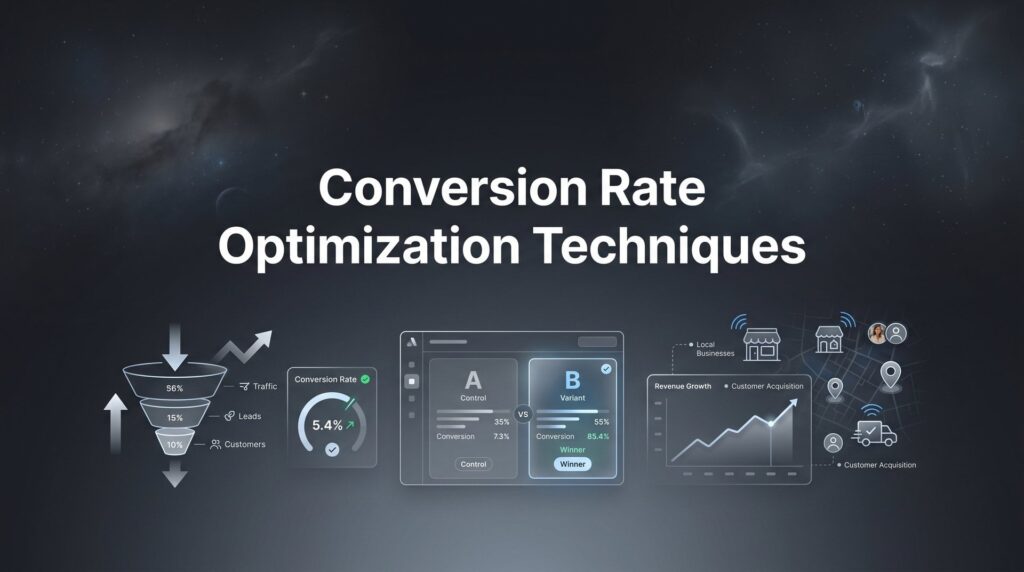
A/B testing, at its core, is straightforward. You create two versions of a page or element: the original (the control) and a variation with one specific change. You split your traffic between the two versions and measure which one produces more conversions. The version that wins becomes your new baseline, and the process repeats. Understanding the differences between conversion optimization software vs agency approaches can help you decide whether to manage testing in-house or bring in expert support.
The most important rule in A/B testing is to change one variable at a time. If you simultaneously change your headline, button color, and form layout, you won’t know which change drove the result. Isolate each variable so your data is clean and actionable.
Where should you start? Prioritize tests with the highest potential impact relative to the effort required. The best places to begin for most local service businesses are:
1. Headlines: Your headline has the most influence on whether visitors stay or leave. Test different value propositions, levels of specificity, and emotional angles.
2. CTA copy and placement: Test specific action-oriented language against your current button text. Test button placement above versus below your key benefits.
3. Form length: Test a shorter form against your current version. Fewer fields almost always improves completion rates, but you need to verify the tradeoff in lead quality for your specific business.
4. Hero images: Test authentic team photos against stock imagery, or before-and-after project photos against your current hero image.
5. Page layout: Test a simplified landing page with navigation removed against your current full-site layout.
One critical point about testing: run your tests until they reach statistical significance. Ending a test early because one variation looks like it’s winning is a common mistake that leads to false conclusions. Tools like VWO, Optimizely, and Google’s free offerings in this space will calculate significance for you, but as a general rule, you need sufficient traffic and conversions before drawing conclusions. For lower-traffic sites, this means patience.
CRO is not a one-time project. It’s an ongoing cycle: form a hypothesis, run a test, analyze the results, implement the winner, and start again. The businesses that treat this as a continuous discipline rather than a quarterly initiative are the ones that compound their conversion improvements over time.
Putting It All Together: Your Next Move
Conversion rate optimization techniques aren’t reserved for large enterprises with dedicated development teams and six-figure testing budgets. They’re especially powerful for local businesses, where every lead has real dollar value and the difference between a 2% and a 4% conversion rate can represent a significant change in monthly revenue.
The core insight to take away is this: optimizing what you already have is often more profitable than buying more traffic. If your current marketing is generating visitors who aren’t converting, the answer isn’t always to spend more on ads. Sometimes the highest-ROI move is fixing the experience those visitors encounter when they arrive.
Start with your tracking foundation. Then diagnose where your funnel is leaking. Focus your early optimization efforts on your highest-traffic landing pages, your forms, and your CTAs. Build trust through authentic social proof and credibility signals. Ensure your technical experience is fast and mobile-friendly. Then test, learn, and iterate.
Each improvement compounds. A faster page, a clearer headline, and a shorter form working together can produce results that far exceed what any single change would achieve alone.
Tired of spending money on marketing that doesn’t produce real revenue? Clicks Geek builds lead systems that turn traffic into qualified leads and measurable sales growth. If you want to see what this would look like for your business, we’ll walk you through how it works and break down what’s realistic in your market. As a Google Premier Partner agency specializing in CRO and lead generation, we can identify exactly where your conversions are being lost and put a plan in place to fix them.