You’re paying for clicks. You’re investing in SEO. Maybe you’re running Google Ads, Facebook campaigns, or both. Traffic is coming in, and yet your phone isn’t ringing the way it should. Your form submissions are trickling in instead of flowing. Your cost per lead keeps climbing, and you’re not sure why.
Sound familiar? The problem usually isn’t the traffic. It’s what happens after the click.
Conversion optimization testing is the systematic process of running controlled experiments on your website to increase the percentage of visitors who take a desired action, whether that’s filling out a contact form, calling your business, booking an appointment, or making a purchase. It’s not guesswork. It’s not redesigning your website on a hunch. It’s a disciplined, data-driven methodology that tells you exactly what’s working, what isn’t, and why.
Here’s why this matters more than almost anything else in your marketing budget: conversion optimization testing multiplies the value of every dollar you’re already spending on traffic. If you’re paying to bring 1,000 people to your landing page each month and 2% of them convert, that’s 20 leads. Improve that rate to 4%, and you’ve doubled your leads without spending a single extra dollar on ads. That’s not a marginal gain. That’s a business transformation.
This article breaks down exactly what conversion optimization testing is, the core methodologies you need to understand, how to build a testing framework that produces real results, which elements to test first, the mistakes that derail most testing programs, and how to decide when to bring in professional help. Let’s get into it.
Why Your Traffic Means Nothing Without a Testing Strategy
Most businesses treat their website like a brochure: build it, launch it, and hope it converts. But hope isn’t a strategy, and a static website is leaving money on the table every single day.
Conversion optimization testing is the disciplined practice of forming hypotheses about user behavior, running controlled experiments on specific website elements, and using data to determine which variations drive more of the actions you care about. The keyword here is “disciplined.” This isn’t about randomly changing your button color because you read a blog post. It’s about observing how real visitors interact with your site, developing an educated hypothesis about why they’re not converting, and testing that hypothesis in a structured way.
It helps to understand the relationship between conversion rate optimization vs A/B testing as concepts: CRO is the overall strategy for improving your website’s ability to turn visitors into customers, while testing is the specific methodology within it. Without testing, CRO is just opinion. With testing, it becomes science.
The compounding math behind conversion improvements is what makes this so powerful. Think about what happens when you improve your conversion rate, even modestly, across a business that’s already investing in paid traffic.
Lower cost per acquisition means your ad budget stretches further. More leads from the same traffic means your revenue grows without increasing spend. And as you scale your ad budget, every improvement you’ve locked in through testing scales with it. A higher-converting landing page at $2,000 per month in ad spend becomes dramatically more valuable at $10,000 per month. The gains compound.
For local businesses especially, this is critical. You’re often competing against larger companies with bigger budgets. You can’t always out-spend the competition. But you can out-convert them. A local plumber, dentist, or law firm with a systematically optimized website can generate more leads per dollar spent than a national competitor running generic campaigns to generic pages. The data around conversion optimization vs more traffic consistently shows that improving what you have outperforms simply buying more clicks.
The businesses that grow profitably aren’t always the ones spending the most on traffic. They’re the ones that have figured out how to make their traffic work harder. That’s exactly what conversion optimization testing is designed to do.
The Core Testing Methods Every Business Owner Should Know
Not all testing approaches are created equal. The right method depends on your traffic volume, what you’re trying to learn, and how quickly you need answers. Here are the three primary methodologies you’ll encounter.
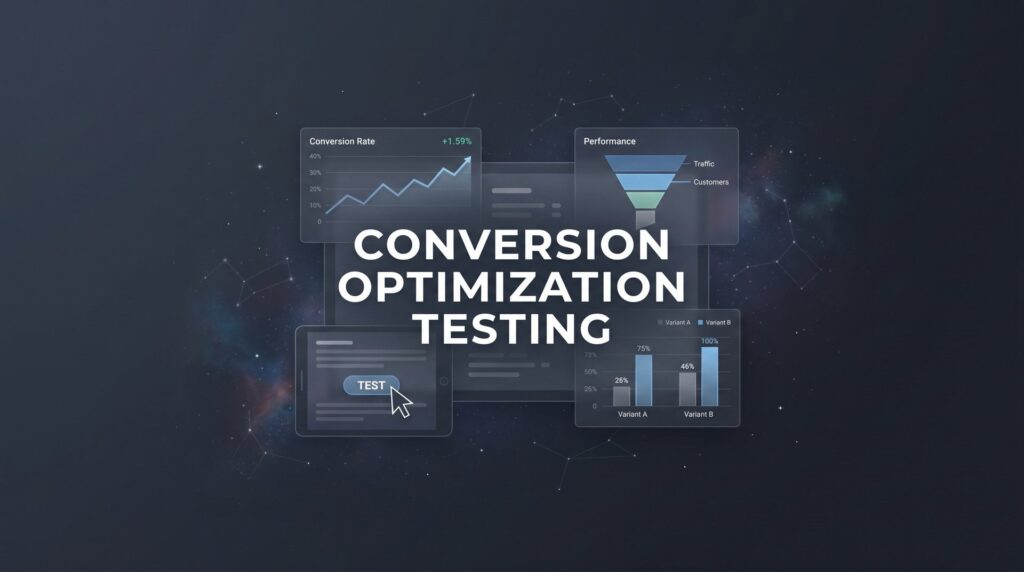
A/B Testing (Split Testing): This is the most widely used and most straightforward approach. You create two versions of a single element on a page: Version A (the original) and Version B (the variation). Your website traffic is split evenly between the two versions, and you measure which one produces more conversions over a defined period. For a deeper dive into this methodology, our guide on A/B testing for conversion optimization covers the fundamentals in detail.
The critical principle in A/B testing is that you change only one element at a time. If you change the headline on Version B and it outperforms Version A, you know the headline was responsible. If you had also changed the button color and the hero image, you’d have no idea which change drove the improvement. A/B testing works because of its simplicity and clarity.
Statistical significance is the standard that determines whether your results are real or just noise. The industry standard is a 95% confidence level, meaning you can be 95% confident that the difference in performance between your two versions isn’t due to random chance. Declaring a winner before reaching this threshold is one of the most common and costly mistakes in testing, and we’ll come back to that.
Multivariate Testing: Where A/B testing isolates a single variable, multivariate testing examines multiple variables simultaneously to understand how different combinations of changes interact with each other. You might test three different headlines combined with two different hero images, creating six total combinations to evaluate.
The advantage is efficiency: you can learn how elements interact rather than testing them sequentially. The significant downside is that multivariate testing requires substantially more traffic to reach statistical significance across all those combinations. This method is best suited for high-traffic pages where you can accumulate enough data quickly. For most local businesses, A/B testing is the more practical starting point.
Sequential Testing and Before/After Analysis: This is the simplest approach and the most accessible for lower-traffic websites. You implement a change, then compare performance metrics from a defined period after the change to a comparable period before it. Did form submissions increase after you rewrote the headline? Did phone calls go up after you added a trust badge above the fold?
The limitation here is obvious: you can’t control for external variables. Seasonality, changes in ad spend, news events, and dozens of other factors can influence conversion rates between periods, making it difficult to attribute changes definitively to what you tested. Sequential testing is less statistically rigorous, but it’s better than not testing at all, particularly for businesses that don’t yet have the traffic volume to support proper A/B experiments.
Understanding which method fits your situation is the foundation of an effective testing program. Start with what you can actually execute well, then graduate to more sophisticated approaches as your traffic and experience grow.
Building a Conversion Testing Framework That Actually Works
A testing program without a framework is just a series of random experiments. You might get lucky occasionally, but you won’t build the systematic improvement that compounds over time. Here’s how to build a framework that produces consistent, meaningful results.
Step 1: Audit and Prioritize Your Opportunities
Before you test anything, you need to know where to focus. Not all pages are created equal. Your highest-traffic, lowest-converting pages represent the greatest opportunity because improvements there will have the most significant revenue impact.
Pull up your analytics and look for pages where a large volume of visitors are arriving but few are converting. Look at your paid landing pages first: these are pages you’re actively paying to drive traffic to, so improving their conversion rate optimization for landing pages has an immediate and measurable financial return. Also examine pages with high bounce rates or where visitors are dropping out of your conversion funnel.
Prioritize ruthlessly. You have limited time and resources, so focus your testing efforts where the potential upside is largest. A modest conversion improvement on a page that receives significant traffic is worth far more than a dramatic improvement on a page that gets very little.
Step 2: Form Data-Backed Hypotheses
This is where most businesses go wrong. They decide to test a new button color because they read that orange converts better, or they change their headline because their CEO didn’t like the original one. Neither of these is a hypothesis. They’re guesses dressed up as decisions.
Real hypotheses come from real data about why visitors aren’t converting. Before you decide what to test, invest time in understanding user behavior on your current pages. Heatmaps show you where visitors are clicking and where they’re ignoring. Session recordings let you watch real visitors navigate your site and reveal exactly where they get confused or frustrated. Form analytics show you which fields are causing people to abandon before submitting. User feedback tools and exit surveys can surface objections you never would have guessed.
When you combine these behavioral data sources, patterns emerge. Maybe visitors are scrolling past your call-to-action because it’s buried below the fold. Maybe your form has too many required fields and people are abandoning it halfway through. Maybe your headline is so generic that visitors can’t immediately tell what you do or why they should care. A thorough conversion rate optimization checklist can help ensure you’re capturing all the right data points before forming your hypotheses.
A proper hypothesis sounds like this: “We believe that changing the headline from [generic statement] to [specific benefit statement] will increase form submissions because our session recordings show that visitors are bouncing within the first ten seconds, suggesting the current headline isn’t communicating value clearly enough.” That’s a testable, data-backed hypothesis.
Step 3: Run, Measure, and Build on Your Results
Before launching any test, define your primary success metric. Is it form submissions? Phone calls? Time on page? Having one clear metric prevents you from cherry-picking results after the fact.
Let tests run for at least one to two full business cycles, typically a minimum of two weeks, to account for day-of-week variations in traffic and user behavior. Resist the urge to end a test early because you see an early leader. Early results are often misleading.
Document everything: your hypothesis, the test setup, the results, and what you learned. This documentation is valuable even when tests don’t produce the improvement you expected. A “losing” test that tells you what doesn’t work is still useful information that shapes your next hypothesis.
What to Test First: High-Impact Elements That Move the Needle
Not all page elements are equally worth testing. Some changes produce meaningful conversion improvements consistently across different industries and contexts. Start here before moving to more granular optimizations.
Headlines and Value Propositions: The headline is the first thing a visitor sees when they land on your page. It has seconds to answer the question every visitor is silently asking: “Am I in the right place, and is this worth my time?” A weak, generic headline that says “Welcome to Our Website” or “Professional Services You Can Trust” tells visitors almost nothing. A strong, specific headline that names the problem you solve and the outcome you deliver can dramatically change whether visitors stay or bounce.
Test headline clarity, specificity, and benefit-driven language. Compare a feature-focused headline against a benefit-focused one. Test a headline that speaks to a specific pain point against one that leads with your credentials. This category of tests consistently yields some of the most significant conversion improvements because it affects every single visitor who lands on the page.
Call-to-Action Buttons and Forms: The language on your CTA button matters more than most people realize. “Submit” is passive and uninspiring. “Get My Free Quote” is specific and tells the visitor exactly what they’ll receive. “Book My Free Consultation” creates ownership and reduces perceived risk. Test button copy, color, size, and placement. Test whether a sticky CTA that follows visitors as they scroll outperforms a static one.
Form length is one of the highest-leverage testing opportunities for local businesses. Every additional field you require is another point of friction where a potential lead can drop off. Test removing non-essential fields. Test whether a two-step form (where visitors click a button first, then see the form) outperforms a visible form. Reducing friction in the conversion path is consistently one of the most impactful test categories, especially for conversion optimization for lead gen websites where every form submission counts.
Trust Signals and Social Proof: For local businesses, trust is everything. Visitors who arrive from a paid ad don’t know you yet. They’re evaluating whether to hand over their contact information or pick up the phone, and they’re looking for reasons to trust you. Test the placement and prominence of Google review ratings, customer testimonials, industry certifications, and guarantees. Test whether displaying your phone number prominently above the fold increases call volume. Test whether adding a “no spam” reassurance near your form reduces abandonment. These elements can have an outsized impact on conversion rates, particularly in high-consideration conversion optimization for service business categories like legal, medical, financial, and home services.
Costly Mistakes That Sabotage Your Testing Results
A poorly run test is often worse than no test at all, because it can lead you to make changes based on false conclusions. Here are the mistakes that derail testing programs most often.
Ending Tests Too Early: This is the most common and most damaging mistake. You launch a test, and after a few days you see that Version B is converting at a noticeably higher rate. You declare it the winner and move on. But you’ve made a decision based on insufficient data, and the early results may not reflect actual performance once the sample size is large enough to be meaningful.
Statistical significance requires an adequate sample size, and that sample size depends on your baseline conversion rate, the size of the improvement you’re trying to detect, and your desired confidence level. Running a test for less than two full weeks, or ending it before reaching a 95% confidence level, dramatically increases the risk of acting on a false positive. The discipline to let tests run their course is one of the most important habits in effective conversion optimization testing. Understanding the full conversion rate optimization process helps ensure you don’t shortcut the steps that matter most.
Testing Multiple Things Without the Right Structure: If you change your headline, your button color, your hero image, and your form layout all at once and conversions go up, what caused the improvement? You have no idea. Without the controlled structure of proper A/B or multivariate testing, simultaneous changes make it impossible to isolate cause and effect. You end up with a result you can’t replicate or build on.
Ignoring Mobile vs. Desktop Segmentation: A change that improves conversions on desktop can actively hurt performance on mobile, and vice versa. For local businesses, this is especially critical because mobile devices account for a large and growing share of local search traffic. A visitor searching “plumber near me” or “dentist in [city]” is very likely on their phone. Addressing these kinds of website conversion optimization issues early prevents you from drawing the wrong conclusions from your test data.
Always segment your test results by device type. If you see mixed overall results, dig into mobile and desktop performance separately. You may find that your variation is a clear winner on one device type and a loser on the other, which is exactly the kind of insight that shapes smarter, more targeted optimization decisions.
DIY Testing vs. Bringing In the Experts
The honest answer is: it depends on where you are in your business and what your ad spend looks like.
DIY conversion optimization testing is genuinely viable for straightforward A/B tests. Tools like VWO, Optimizely, and the built-in testing features within landing page builders like Unbounce or Instapage make it possible to set up and run basic experiments without a development team. Comparing the best conversion optimization tools available can help you find the right platform for your traffic level and testing goals.
The limitations of the DIY approach are time and expertise. Learning to identify high-impact testing opportunities, interpret behavioral data correctly, and build a systematic testing roadmap takes significant time and experience. Most business owners are already stretched thin running their actual business. Testing that gets deprioritized is testing that doesn’t happen, and a testing program that stalls produces no results.
Professional CRO teams bring a different level of capability to the table. They have advanced analytics tools, established testing frameworks refined across hundreds of campaigns, and the pattern recognition that comes from seeing what works across many different industries and contexts. They can identify high-impact opportunities faster, avoid common pitfalls, and execute tests with the rigor that produces reliable results.
The ROI case for professional help becomes clear when you look at the math. If your monthly ad spend is significant, even a modest improvement in conversion rate can generate a return that far exceeds the cost of professional optimization services. Understanding conversion optimization agency cost structures helps you evaluate whether the investment makes sense for your specific situation. You’re not paying for the testing itself. You’re paying for the revenue that better conversion rates unlock from the traffic you’re already buying.
For businesses that are serious about growth and already investing meaningfully in paid traffic, professional conversion optimization testing isn’t an expense. It’s one of the highest-returning investments in your marketing stack.
The Bottom Line on Conversion Optimization Testing
Conversion optimization testing isn’t a one-time project you check off a list. It’s an ongoing discipline, a systematic process of continuous improvement that compounds over time. The businesses that grow profitably aren’t the ones that spend the most on ads. They’re the ones that have built a culture of testing, learning, and iterating until every page in their funnel is working as hard as possible.
The core principles are straightforward: prioritize your highest-traffic, lowest-converting pages, form hypotheses based on real behavioral data rather than guesswork, run tests with proper statistical rigor, and document every result so your learnings build on each other. Start with high-impact elements like headlines, CTAs, and trust signals. Avoid the common mistakes of ending tests too early and ignoring mobile segmentation. And be honest with yourself about whether you have the time and expertise to execute this well on your own.
Every dollar you’re spending on traffic right now is producing a certain number of leads. Conversion optimization testing is how you make that number higher without spending more. It’s not complicated in concept. But it requires discipline, the right tools, and a commitment to letting data drive decisions rather than gut feelings.
If you want to see what this would look like for your specific business, the team at Clicks Geek can walk you through exactly where your conversion rates are leaving money on the table and what a realistic improvement roadmap looks like for your market. We’re a Google Premier Partner agency with deep CRO expertise, and we’ve helped local businesses turn underperforming traffic into consistent, qualified lead flow. The conversation starts with understanding your numbers, and we’re ready to have it.