You launched your Google Ads campaign three months ago, and the first few weeks felt like magic. Leads poured in at $42 each, your cost-per-click sat comfortably at $3.80, and your ROAS hit 4.2x. You felt like you’d cracked the code.
Then something shifted.
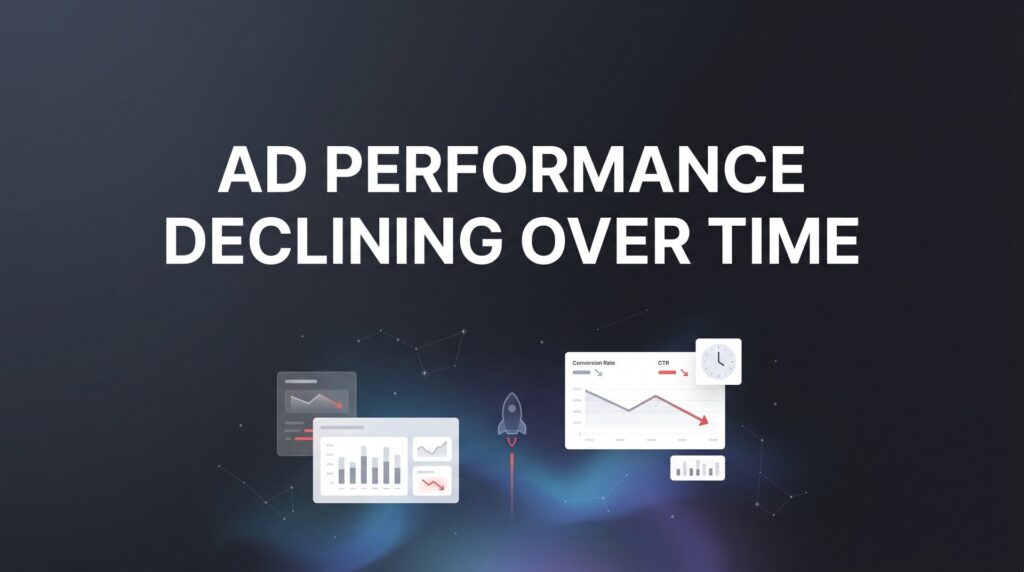
Week by week, your cost-per-lead crept upward—first to $48, then $57, then $71. Your click-through rate that started at 6.8% now hovers around 2.1%. The same ads that generated 47 conversions in month one now struggle to deliver 19. You’re spending the same budget but getting a fraction of the results, and you have no idea why.
Here’s the uncomfortable truth: this decline isn’t random bad luck or a temporary slump. It’s a predictable pattern driven by specific, identifiable forces that affect every paid advertising campaign. Ad fatigue, audience saturation, and competitive dynamics work together to systematically erode your campaign performance over time. The good news? Once you understand these mechanisms, you can diagnose exactly what’s happening and implement targeted fixes that restore—and often exceed—your original results.
This guide will walk you through the hidden dynamics that kill campaign performance, show you how to diagnose which specific issue is affecting your ads, and give you concrete strategies to reverse the decline. Think of this as your diagnostic manual for when campaigns stop working.
The Hidden Forces Eroding Your Campaign Results
Three invisible forces conspire to drain the life from your advertising campaigns, and most business owners don’t realize they’re under attack until performance has already tanked.
The first culprit is ad fatigue—the phenomenon where repeated exposure to the same creative causes your audience to mentally tune out. Picture scrolling through your Facebook feed and seeing the same plumbing company ad for the fourth time this week. By the third exposure, you’re barely registering it consciously. By the fifth, your brain has categorized it as visual noise to ignore.
This isn’t a hypothetical psychology concept. When audiences see the same ad creative repeatedly, their response rates decline measurably. The compelling headline that grabbed attention on first view becomes invisible wallpaper after the seventh impression. Your click-through rate drops not because your offer got worse, but because your audience’s brains have adapted to filter out the repetitive stimulus.
The second force is audience saturation, which happens when you’ve shown your ads to everyone in your targeting pool multiple times. Let’s say you’re targeting homeowners in a 15-mile radius around your service area. That might represent 47,000 households. Sounds like plenty, right?
But here’s what actually happens: your best prospects—the people actively searching for your service or who match your ideal customer profile—convert in the first few weeks. You’re left advertising to the remaining audience members who either aren’t interested, aren’t ready, or have already seen and rejected your offer. You’re essentially fishing in an increasingly depleted pond.
For local businesses with geographic constraints, this saturation accelerates rapidly. A restaurant targeting a 10-mile radius or a law firm serving a single county will exhaust their qualified audience pool far faster than a national e-commerce brand. The math is brutal: smaller targeting pools mean faster saturation, which means steeper performance declines. Understanding what performance marketing actually means helps you recognize when these patterns emerge.
The third force is competitive pressure and platform dynamics. Every quarter, more businesses discover paid advertising. More competitors enter your auctions. Each new advertiser bidding on your keywords or targeting your audience drives up the price you pay per click and per impression.
Meanwhile, platforms like Google and Meta constantly adjust their algorithms. These shifts can change how your ads are distributed, which audiences see them, and how much you pay. A campaign optimized for one algorithm version may perform poorly after an update, even if you haven’t changed a single setting.
What makes this particularly insidious is that these three forces often work in combination. Your creative gets stale (ad fatigue) just as you’re reaching the same saturated audience for the fifth time, while new competitors push your costs higher. The result is a performance death spiral that feels mysterious but follows a completely predictable pattern.
Diagnosing the Real Culprit Behind Your Declining Ads
Before you can fix declining performance, you need to diagnose which specific problem you’re facing. Treating ad fatigue with audience expansion won’t work, just like refreshing creative won’t solve a bidding problem. The good news is that your campaign data reveals exactly what’s wrong if you know which metrics to examine.
Start with frequency data—the average number of times each person has seen your ad. This metric is your canary in the coal mine for both creative fatigue and audience saturation. On Facebook and Instagram, you can find this in your ad set reporting. On Google Display Network, check your reach and frequency reports.
Here’s the diagnostic framework: if your frequency sits below 2.5 and performance is declining, creative fatigue probably isn’t your issue. If frequency has climbed above 4.0, you’re showing the same people your ads too many times, which indicates either creative exhaustion or audience saturation (or both).
Next, examine your click-through rate trend over time. Pull your CTR data by week for the past 90 days. If CTR has declined steadily while frequency increased, that’s classic ad fatigue. Your audience has seen your creative enough times that it no longer captures attention. The solution here is creative refresh, not audience changes.
Now look at conversion rate by audience segment. Break down your conversion data by how long people have been in your audience pool. Are newer audience members converting at higher rates than people who’ve been seeing your ads for weeks? That’s audience saturation. You’ve converted the low-hanging fruit, and you’re now advertising to less qualified prospects.
To distinguish campaign-specific problems from platform-wide issues, compare your cost-per-click or cost-per-thousand-impressions to historical benchmarks. If your CPCs have increased 40% while industry benchmarks show a 15% increase, you’re dealing with campaign-specific competition or quality score issues. Proper digital advertising performance tracking makes these comparisons possible.
Watch for this telltale pattern: if your impressions are increasing but clicks are declining, your creative has lost effectiveness. If both impressions and clicks are declining while your budget stays constant, you’re facing audience saturation or increased competition pushing you out of auctions.
One more diagnostic signal: check your conversion rate independent of traffic volume. If you’re still converting 4.2% of clicks into leads (the same rate as when you launched), but you’re just getting fewer clicks, your problem is top-of-funnel (creative or targeting). If your conversion rate has dropped from 4.2% to 1.8%, you’re attracting lower-quality traffic, which points to audience quality degradation.
This diagnostic process takes 15 minutes but saves you from implementing the wrong solution. I’ve seen businesses waste thousands of dollars expanding their audience when they actually needed new creative, or vice versa. Get the diagnosis right, and the fix becomes obvious.
Creative Refresh Strategies That Actually Move the Needle
Once you’ve diagnosed creative fatigue, you face a critical decision: do you iterate on what’s working, or blow it up and start fresh? The answer depends on how severe the fatigue is and how much performance has declined.
If your CTR has dropped 20-30% but you’re still seeing conversions, iteration is your friend. Start by changing the most visually prominent elements: swap your headline, update your image or video, modify your opening hook. Keep your core offer and value proposition the same—you’re not reinventing your message, just changing how you present it.
For example, if your original ad showed a before-and-after bathroom renovation with the headline “Transform Your Bathroom in 7 Days,” your iteration might show a different room with “Kitchen Remodels That Actually Fit Your Schedule.” Same core promise (fast renovations), different execution.
If performance has cratered—CTR down 50%+ and conversion rates tanking—you need a complete creative overhaul. This means new messaging angles, different visual approaches, and potentially even testing different offers. Maybe your original ad emphasized speed, and your new creative emphasizes quality or price. You’re looking for a fresh angle that re-engages your audience.
Here’s a testing framework that systematically finds winning variations: create three distinct creative approaches that emphasize different value propositions. Let’s say you run a local HVAC company. Version A emphasizes emergency service availability, Version B highlights financing options, and Version C focuses on energy savings. Run all three simultaneously with equal budget for one week.
Whichever version delivers the lowest cost-per-conversion becomes your control. Now create two variations of that winner—change the image, modify the headline, adjust the call-to-action. Test those variations against the control. Repeat this process every two weeks, and you’ll systematically improve performance while preventing creative fatigue.
The key is maintaining brand consistency while keeping content fresh. Your logo, color scheme, and core brand voice should remain constant. What changes is the specific message, visual composition, and emotional appeal. Following best practices for landing pages ensures your refreshed creative leads to pages that actually convert.
One practical tip: build a creative library with 8-12 different ad variations ready to deploy. When you notice frequency climbing above 3.5 or CTR declining, you can immediately swap in fresh creative without scrambling to produce new assets. This proactive approach prevents performance drops before they happen.
And here’s something most advertisers miss: retire creative that’s fatigued, but don’t delete it permanently. Archive your old ads and bring them back 60-90 days later. Audiences forget, and creative that stopped working in March might perform beautifully again in June. I’ve seen “retired” ads outperform new creative when reintroduced after a rest period.
Expanding Your Audience Without Sacrificing Quality
When you’ve saturated your core audience, expansion becomes necessary. But here’s the trap: expanding reach too aggressively floods your campaign with unqualified traffic that tanks your conversion rate and wastes budget. The art is expanding strategically while maintaining lead quality.
Lookalike audiences are your most powerful expansion tool, but most businesses use them wrong. Don’t just create a single lookalike from your customer list and call it done. Instead, build layered lookalikes based on your highest-value customer segments.
Start by segmenting your customer list by lifetime value. Export your top 20% of customers by revenue—these are your whales. Upload this segment to Facebook or Google and create a 1% lookalike audience. This finds people who most closely resemble your best customers, not just any customer.
Once that 1% lookalike is performing (give it two weeks of data), expand to a 2-3% lookalike of the same seed audience. This broader audience will have slightly lower match quality but dramatically more volume. Test it separately with its own budget allocation, and only scale if cost-per-acquisition stays within your target range.
For retargeting sequences, the key is preventing audience burnout through strategic segmentation and frequency caps. Don’t show the same ad to everyone who visited your website. Instead, create tiered sequences based on engagement depth. Mastering Facebook remarketing ads helps you build these sophisticated audience segments.
Tier 1 might be people who spent 3+ minutes on your site or visited your pricing page—these are hot prospects who get your most aggressive retargeting. Tier 2 is people who visited but bounced quickly—they get lighter-touch educational content. Tier 3 is people who engaged with your content but haven’t visited your site—they get awareness-focused ads.
Set frequency caps to prevent showing any single person your retargeting ads more than 4 times per week. Beyond that threshold, you’re just annoying them and wasting impressions. Rotate creative every 10 days within your retargeting campaigns to keep the content fresh even for people who keep seeing your ads.
Geographic expansion works particularly well for local businesses that have saturated their immediate area. If you’re a contractor who’s exhausted your 10-mile radius, test expanding to 15 miles with a separate campaign. Monitor your cost-per-lead closely—if it stays within 20% of your core area performance, the expansion is working.
Demographic expansion requires more caution. If you’ve been targeting 35-55 year old homeowners and want to expand to 25-34, understand that this new segment may have different needs, budgets, and conversion patterns. Don’t just add them to your existing campaign—create a separate campaign with messaging tailored to their specific situation.
The golden rule of audience expansion: never expand more than one variable at once. If you simultaneously expand geography, demographics, and interests, you won’t know which change caused your results to improve or decline. Test one expansion at a time, measure results for at least two weeks, then decide whether to scale or retreat.
Building Campaigns That Resist Performance Decay
The best defense against declining performance is building campaigns with built-in resilience from day one. This means structuring your campaigns for continuous optimization rather than set-it-and-forget-it execution.
Campaign structure matters more than most advertisers realize. Instead of cramming all your targeting into one massive campaign, create separate campaigns for different audience temperatures: cold traffic (people who’ve never heard of you), warm traffic (website visitors and engaged audiences), and hot traffic (people who’ve taken high-intent actions).
This segmentation allows you to optimize each campaign independently. Your cold traffic campaign might need frequent creative refresh because you’re constantly reaching new people. Your retargeting campaign might need audience expansion when you’ve exhausted your pixel pool. When performance declines, you can diagnose exactly which audience segment is underperforming instead of guessing.
Budget pacing prevents the feast-or-famine cycle that accelerates performance decay. If you dump your entire monthly budget into the first week, you’ll saturate your audience immediately and spend the rest of the month with terrible results. Instead, implement daily budget caps that spread spending evenly across the month.
For example, if you have a $3,000 monthly budget, set your daily budget at $100. This ensures consistent exposure throughout the month and prevents audience burnout from excessive frequency in short bursts. It also gives you time to notice performance issues and make adjustments before you’ve blown through your entire budget.
Bid strategy adjustments become critical as campaigns mature. Many businesses launch with manual bidding or maximize conversions, then never revisit their strategy. As your campaign accumulates data and competition shifts, your optimal bid strategy changes. If you’re new to pay per click advertising, understanding these bid dynamics is essential for long-term success.
If you started with manual CPC bidding and have 50+ conversions, test switching to Target CPA or Maximize Conversions with a target. The platform’s machine learning can often find optimization opportunities you’d miss manually. But make this switch gradually—don’t change your entire account’s bid strategy overnight.
Set up early warning systems that alert you to performance issues before they spiral. Create a simple spreadsheet or use your platform’s automated rules to flag when key metrics cross thresholds. For example: “Alert me when 7-day CTR drops below 3.5%” or “Notify me when cost-per-lead exceeds $75 for three consecutive days.”
These alerts let you intervene early. Instead of discovering two weeks later that your campaign tanked, you get notified within days and can implement fixes before you’ve wasted significant budget. Think of it like a smoke detector for your ad account—it catches problems while they’re still manageable.
Finally, build a testing calendar that schedules creative refreshes, audience expansions, and bid strategy reviews at regular intervals. Don’t wait for performance to decline before you act. If you know creative fatigue typically sets in after 30 days, schedule new creative launches every 25 days. If audience saturation becomes an issue after 60 days, plan audience expansion tests on day 50.
Proactive campaign management prevents decline rather than reacting to it. The businesses that maintain consistent performance aren’t lucky—they’ve built systems that resist the natural forces of decay.
When to Call It: Knowing If Your Campaign Needs Professional Help
There comes a point where DIY optimization hits a ceiling, and continuing to tinker yourself costs more than hiring expertise. Recognizing this inflection point saves you from months of frustration and wasted ad spend.
Here are the signs that you’ve maxed out what you can accomplish alone: You’ve implemented creative refreshes, audience expansions, and bid adjustments, but performance continues declining. You’re spending 10+ hours per week managing campaigns but seeing diminishing returns on that time investment. You understand the concepts but lack the technical depth to implement advanced strategies like proper conversion tracking, custom audiences, or attribution modeling.
Another telltale sign is when your cost-per-acquisition has increased 50%+ from your baseline, and you can’t identify the root cause through your own analysis. Understanding what customer acquisition cost really means helps you benchmark whether your increases are normal or alarming. Or when you’re generating leads but they’re increasingly low-quality—lots of form fills but few actual customers. These issues often require sophisticated diagnostic tools and expertise that goes beyond basic campaign management.
The ROI case for professional PPC management is straightforward: if a specialist can reduce your cost-per-lead by 30% while maintaining or increasing volume, their fee pays for itself. Let’s say you’re currently spending $5,000/month and generating 50 leads at $100 each. If an expert brings that down to $70 per lead, you’re now getting 71 leads for the same spend—21 extra leads monthly. If even 20% of those convert to customers worth $1,000 each, that’s $4,200 in additional monthly revenue.
Beyond immediate ROI, specialists bring systematic optimization that compounds over time. They implement tracking you didn’t know was possible, uncover audience segments you hadn’t considered, and structure campaigns for long-term scalability. Working with a performance-based marketing agency aligns incentives so you only pay when results improve. The difference between amateur and professional campaign management isn’t just performance—it’s sustainable growth versus constant firefighting.
Before hiring PPC support, ask these critical questions: What specific diagnostic process will you use to identify our performance issues? Can you show examples of how you’ve solved similar problems for other businesses in our industry? What does your reporting look like, and how will we measure success? How do you handle creative production—do we provide assets, or do you have resources?
Also ask about their approach to testing and optimization. Beware of anyone who promises specific results (“We’ll cut your cost-per-lead in half!”) without first auditing your account. Legitimate specialists will say something like, “We need to analyze your data before projecting outcomes, but here’s our typical process and what we’ve achieved for similar businesses.”
One more consideration: if you’re spending less than $2,000/month on ads, professional management may not make financial sense. The management fees often represent a significant percentage of smaller budgets. But if you’re spending $3,000+ monthly and struggling with performance, the expertise usually pays for itself within 60 days.
Turning Decline Into Sustainable Growth
Declining ad performance isn’t a death sentence for your marketing—it’s a signal that your campaigns need strategic intervention. The pattern is predictable: ad fatigue sets in, audiences saturate, competition intensifies, and costs creep upward. But now you have the diagnostic framework to identify exactly which force is eroding your results.
When creative fatigue is the culprit, systematic testing and refresh schedules restore performance. When audience saturation hits, strategic expansion through lookalikes and geographic targeting opens new opportunities. When competitive pressure drives up costs, campaign restructuring and bid strategy optimization maintain profitability.
The businesses that consistently generate leads and revenue from paid advertising aren’t doing anything magical. They’ve built systems that diagnose issues early, implement targeted fixes quickly, and prevent decline through proactive management. They understand that campaign optimization isn’t a one-time project—it’s an ongoing process of testing, measuring, and refining.
If you’ve been watching your campaign performance slide and aren’t sure where to start, the first step is getting a clear diagnosis of what’s actually broken. Maybe your tracking is misconfigured and you’re optimizing toward the wrong metrics. Maybe your audience targeting is too broad, or too narrow, or perfectly sized but completely saturated. Maybe your creative is brilliant but you’re showing it to people who will never buy from you.
Tired of spending money on marketing that doesn’t produce real revenue? We build lead systems that turn traffic into qualified leads and measurable sales growth. If you want to see what this would look like for your business, we’ll walk you through how it works and break down what’s realistic in your market. No generic promises—just a data-driven assessment of where your campaigns are bleeding money and exactly how to plug the leaks.
Your campaigns can perform better than they did in month one. But that requires moving beyond guesswork and implementing the systematic optimization approach that separates profitable advertising from expensive experiments. The question isn’t whether your performance will decline—it’s whether you’ll have the systems in place to catch it early and reverse it before it costs you thousands in wasted spend.