You check your ad account and feel your stomach drop. Another $2,000 spent this month. The clicks are there—hundreds of them. But your phone? Silent. Your contact form? Empty. Your sales pipeline? Bone dry.
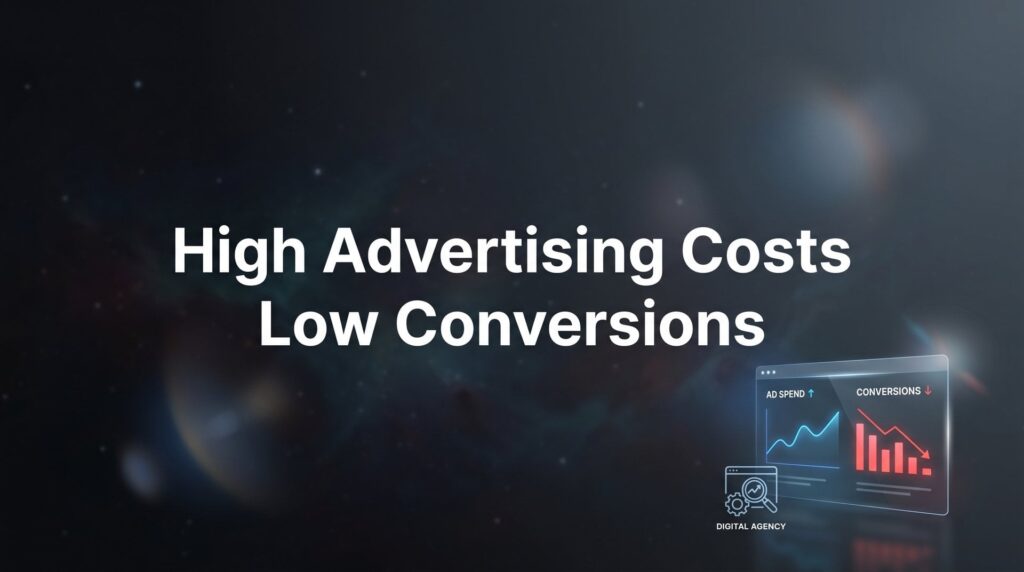
This is the nightmare scenario that keeps business owners up at night: high advertising costs with low conversions. You’re paying Google, Facebook, or whoever else every single day, watching the budget counter tick upward while your actual business results stay flat or worse.
Here’s what you need to know: this isn’t bad luck. It’s not because “ads don’t work for my industry.” It’s a technical problem with identifiable causes and fixable solutions. The gap between what you’re spending and what you’re getting back exists for specific reasons—and once you understand those reasons, you can actually do something about them.
Let’s dig into why your advertising budget is disappearing without delivering the customers you need, and more importantly, what you can do to fix it.
Why Your Ad Dollars Attract Clicks But Not Customers
The most common conversion killer? You’re advertising to the wrong people. Sounds simple, but it’s devastatingly common.
Picture this: You run a premium kitchen remodeling company. Your average project is $45,000. But your ads are showing up for searches like “cheap kitchen updates” and “DIY kitchen ideas.” You’re getting clicks—lots of them—from people who will never, ever become your customers. Every click costs you money. None of them will call. This is the classic low quality leads problem that plagues businesses across every industry.
This happens because of overly broad targeting. Maybe you’re using broad match keywords without enough controls. Maybe your audience targeting on Facebook casts too wide a net. The platform sees engagement (clicks) and keeps showing your ads to similar people, creating a cycle where you attract more and more of exactly the wrong audience.
The second major culprit? Message mismatch between your ad and what people find when they click.
Your ad promises “Free Kitchen Design Consultation.” They click. Your landing page immediately asks for their full name, email, phone number, project timeline, and budget range before mentioning anything about the consultation. That’s friction. That’s why they leave.
Or your ad highlights your 20 years of experience and premium craftsmanship, but your landing page leads with “Affordable Options for Every Budget.” The prospect clicked because they wanted premium. Now they’re confused about what you actually offer.
This disconnect creates what marketers call “scent loss”—the trail goes cold between the ad promise and the landing page delivery. When prospects can’t immediately confirm they’re in the right place, they bounce. You paid for the click. You got nothing in return.
Then there’s the keyword problem that drains budgets faster than almost anything else: bidding on expensive terms that attract researchers, not buyers.
Keywords like “how much does [service] cost” or “what is [product]” get expensive because lots of businesses bid on them. But the people searching these terms? They’re at the very beginning of their journey. They’re gathering information. They’re building a spreadsheet. They’re not ready to buy.
Meanwhile, you’re competing with everyone else for these clicks, driving up the cost, while the searcher has zero intention of making a decision today. You might get the click. You won’t get the conversion. Your cost per acquisition skyrockets while your actual acquisition rate stays in the basement.
The Budget Leaks You Don’t Even Know Exist
Quality Score is Google’s report card for your ads, and most businesses have no idea it’s quietly destroying their budget efficiency.
Google assigns every keyword a Quality Score from 1 to 10 based on expected click-through rate, ad relevance, and landing page experience. Here’s the part that matters: a higher Quality Score means you pay less per click for the same ad position. A lower Quality Score means you pay more—sometimes dramatically more—for worse positions.
If your competitor has a Quality Score of 8 and you have a Quality Score of 4, they might pay $3 per click while you pay $7 for the same keyword, and their ad shows up higher than yours. You’re literally paying more than double for worse results because your ads aren’t relevant enough or your landing pages don’t match search intent. Understanding pay per click advertising fundamentals is essential to avoiding these costly mistakes.
Most business owners never look at Quality Score. They just see their costs climbing and assume “ads are getting more expensive.” Sometimes they are. But often, you’re just paying a penalty for poor account structure and irrelevant ads.
The negative keyword problem is even more insidious because it’s invisible until you go looking for it.
Without negative keywords, you’re paying for every variation of your target terms—including the ones that have nothing to do with your business. A personal injury lawyer bidding on “car accident lawyer” might also show up for “car accident lawyer salary,” “car accident lawyer meme,” or “free car accident lawyer consultation template.” Those clicks cost money. None of them are potential clients.
The search terms report shows you exactly what people typed before seeing your ad. Most businesses never check it. When they finally do, they discover they’ve been paying for hundreds of irrelevant searches for months or years. All that wasted spend could have gone toward actual prospects.
Then there’s the mobile experience disaster that’s costing you conversions right now.
More than half of searches happen on mobile devices. If your landing page takes six seconds to load on a phone, most visitors are gone before they see anything. If your contact form requires typing in a tiny box with autocorrect fighting them the whole way, they’ll give up. If your phone number isn’t clickable so they can just tap to call, you’ve created an unnecessary barrier.
You’re paying the same amount for mobile clicks as desktop clicks. But if your mobile experience is terrible, you’re converting at a fraction of the rate. That’s budget waste you can’t afford.
Finding Where Your Money Actually Goes
The search terms report is your first stop for diagnosing budget waste. This report shows the actual phrases people typed before clicking your ad—and it’s almost always eye-opening.
Go into your Google Ads account, navigate to Keywords, then click on Search Terms. Sort by cost or impressions. Look at what you’re actually paying for. You’ll likely find searches that have nothing to do with your business, locations you don’t serve, or information-seeking queries from people who aren’t ready to buy.
Add the irrelevant terms as negative keywords immediately. For every dollar you stop wasting on bad traffic, that’s a dollar you can redirect toward prospects who actually matter. This is one of the most effective strategies to fix low ROI from digital advertising.
Next, audit the alignment between your ads and landing pages. This is where message mismatch lives.
Click through your own ads. Does the headline on your landing page echo the promise in your ad? If your ad says “Get a Free Quote in 24 Hours,” does your landing page lead with that same promise, or does it bury the quote form below three paragraphs about your company history?
Look at the first thing visitors see. Is it immediately clear they’re in the right place? Is the call-to-action obvious? Can they complete the desired action in under 30 seconds? If any answer is no, you’ve found friction that’s killing conversions.
Now identify your worst performers at the campaign, ad group, and keyword level.
Most ad platforms let you sort by metrics like cost per conversion or conversion rate. Do this ruthlessly. You’ll almost always find that 80% of your wasted spend comes from 20% of your keywords or campaigns. Maybe one campaign targeting a broad audience is burning budget with zero results while a tightly focused campaign converts beautifully but gets a fraction of the budget.
Kill the losers. Reallocate budget to winners. This sounds obvious, but most businesses keep funding underperformers month after month because they don’t actually look at the data. The money just keeps flowing to campaigns that haven’t worked in six months.
Check your conversion tracking setup while you’re at it. If you’re not tracking marketing conversions properly, you can’t possibly know what’s working. Many businesses discover they’ve been optimizing for clicks or impressions while having no idea which clicks actually turned into customers. You can’t fix what you can’t measure.
Building a Funnel That Actually Converts
Your landing page has one job: convert the click into a lead or sale. Every element should support that goal, and anything that doesn’t should be removed.
Start with search intent matching. If someone searches “emergency plumber near me,” they need help right now. Your landing page should have your phone number massive and clickable at the top, with text that says “Available Now” or “24/7 Emergency Service.” They don’t want to read about your company history or browse your service menu. They want to know you can help them immediately.
If someone searches “kitchen remodeling ideas,” they’re in research mode. Your landing page can offer a design consultation, a gallery of completed projects, or a guide download. They’re not ready to book a $40,000 project today, so asking for that commitment will fail. Match the page to where they are in the journey.
Reduce friction everywhere. Every form field you require is a barrier. Every extra click is a chance to lose them. Every second of load time costs you conversions. Learning how to create high converting landing pages is essential for turning expensive clicks into actual customers.
Conversion tracking is non-negotiable if you want to stop wasting money. You need to know which campaigns, keywords, and ads actually produce customers—not just clicks or form fills, but real revenue.
Set up tracking for every meaningful action: form submissions, phone calls, chat messages, purchases. Implementing call tracking for marketing campaigns is especially critical for service businesses where phone calls drive most conversions. If you can’t track it, you can’t optimize it. Many businesses optimize their ads for clicks because that’s the only thing they’re measuring, even though clicks don’t pay the bills. Track what matters, then optimize for that.
Remarketing captures the prospects who aren’t ready yet—and that’s most of them.
Someone visits your site, looks around, and leaves without converting. Without remarketing, they’re gone forever. With remarketing, they see your ads again over the next few weeks as they continue researching, comparing options, and moving closer to a decision.
The customer journey for most purchases involves multiple touchpoints. They see your ad, visit your site, leave, see you again on Facebook, come back, leave again, see a review, search for you specifically, and finally convert. Remarketing keeps you in front of them during that journey instead of losing them after the first visit.
This is especially crucial for higher-ticket services or considered purchases. Nobody hires a lawyer or books a $30,000 home renovation on their first visit to your website. But if you stay visible as they research, you’re top of mind when they’re ready to decide. Facebook remarketing ads are particularly effective for staying in front of warm prospects throughout their decision-making process.
Bidding Strategies That Stop Budget Bleeding
The manual versus automated bidding decision comes down to data volume and control needs.
Automated bidding strategies like Target CPA or Maximize Conversions use machine learning to adjust bids automatically. They work well when you have enough conversion data—generally at least 30 conversions per month in a campaign. Below that threshold, the algorithm doesn’t have enough information to make smart decisions, and you’re better off with manual control.
Manual bidding gives you precise control over what you’re willing to pay for each keyword. This matters when you’re working with limited budgets or when certain keywords have very different values to your business. You might be willing to pay $50 per click for “emergency roof repair” but only $5 for “roof maintenance tips.” Manual bidding lets you make those distinctions.
The key is matching your bidding strategy to your business reality. If you’re a local service business with 10 conversions per month, automated bidding will struggle. If you’re an e-commerce site with hundreds of daily conversions, automation can optimize faster than you ever could manually. Understanding what performance marketing is helps you choose the right approach for your specific situation.
Conversion-focused campaigns optimize for revenue, not vanity metrics. This is a mindset shift that saves massive amounts of money.
Stop optimizing for clicks. Stop optimizing for impressions. Stop caring about click-through rate unless it correlates with actual business results. Set up your campaigns to optimize for conversions—leads, sales, phone calls, whatever action actually matters to your business.
This means you might get fewer clicks. Your click-through rate might drop. But if your cost per customer acquisition drops by 40% because you’re only attracting serious prospects, who cares about the vanity metrics? You’re making more money while spending less. That’s the only metric that matters.
Geographic and dayparting adjustments focus your spend on high-converting windows, which is especially powerful for local businesses.
If you’re a local service business, you probably don’t want calls at 2 AM. Turn off your ads overnight. If you’ve analyzed your data and discovered that Tuesday afternoons convert at twice the rate of Saturday mornings, increase your bids on Tuesday afternoons and decrease them on Saturday mornings.
Geographic bid adjustments work the same way. If you serve a 30-mile radius but 80% of your customers come from within 10 miles, increase bids for the close-in areas and decrease them for the outer edges. You’ll get more of the high-value local traffic and less of the long-distance tire-kickers.
These adjustments compound over time. Small efficiency gains in bidding, scheduling, and geography add up to significant budget savings and better conversion rates.
Knowing When You Need Expert Intervention
Some conversion problems are DIY-fixable. Others require professional expertise. Here’s how to tell the difference.
If you’ve tried the basics—negative keywords, landing page improvements, better targeting—and you’re still hemorrhaging money without results, that’s a sign you need help. If your account has been running for months with minimal changes because you don’t know what to adjust, that’s another sign. If you’re spending more than $3,000 per month on ads but have never had a professional audit, you’re almost certainly leaving money on the table.
The complexity of your account matters too. Managing one campaign with ten keywords is straightforward. Managing fifteen campaigns across multiple platforms with hundreds of keywords, various audience segments, and complex conversion paths? That’s a full-time job that requires expertise most business owners don’t have time to develop. Many business owners find themselves asking why marketing isn’t working for their business when the real issue is account complexity exceeding their available time and expertise.
A proper PPC audit reveals exactly where your budget is leaking and what it’s costing you. A good audit will analyze your account structure, keyword selection, ad copy, landing pages, conversion tracking, and bidding strategies. It should identify specific wasted spend and quantify the opportunity cost of poor optimization.
The question isn’t whether you can afford professional management. It’s whether you can afford to keep losing money on poorly managed campaigns.
Do the ROI math honestly. If you’re spending $5,000 per month on ads that generate two customers when they should generate ten, you’re losing the revenue from eight potential customers every month. What’s that worth? If each customer is worth $3,000, you’re losing $24,000 in monthly revenue—$288,000 per year—because your ads aren’t optimized. This is the high cost per lead problem that silently destroys marketing budgets.
Professional management might cost $1,500 per month. If it fixes your conversion problem and you start getting those eight additional customers, you’re netting an extra $22,500 per month. That’s not an expense. That’s a 15x return on investment.
The businesses that succeed with paid advertising aren’t necessarily the ones with the biggest budgets. They’re the ones who understand that expertise matters, optimization is ongoing, and every dollar should work as hard as possible to generate actual business results.
Turning Budget Drain Into Revenue Engine
High advertising costs with low conversions isn’t a permanent condition. It’s a diagnosis—and diagnoses lead to treatment plans.
You’ve seen the common culprits: wrong audience targeting, message mismatch, poor Quality Scores, missing negative keywords, terrible mobile experiences, and bidding strategies that optimize for the wrong outcomes. You’ve learned how to audit your account to find the specific problems draining your budget. You understand how to build landing pages that convert, implement proper tracking, and adjust your bidding to focus spend where it actually matters.
The difference between advertising that wastes money and advertising that generates profit isn’t luck. It’s precision. It’s knowing exactly who you’re targeting, what message resonates with them, and how to remove every barrier between their click and your conversion.
Stop throwing money at advertising hoping something will work. Start treating your ad spend like the business investment it is—one that should generate measurable, predictable returns.
Tired of spending money on marketing that doesn’t produce real revenue? We build lead systems that turn traffic into qualified leads and measurable sales growth. If you want to see what this would look like for your business, we’ll walk you through how it works and break down what’s realistic in your market.
Your advertising budget should work for you, not against you. The question is whether you’ll keep accepting mediocre results or demand the performance your business deserves.
Want More Leads for Your Business?
Most agencies chase clicks, impressions, and “traffic.” Clicks Geek builds lead systems. We uncover where prospects are dropping off, where your budget is being wasted, and which channels will actually produce ROI for your business, then we build and manage the strategy for you.