You’ve spent the last hour collecting quotes from PPC agencies, and the numbers are all over the map. One agency quoted $800 per month. Another wants $4,500. A third sent over a proposal with a percentage-based fee structure that you’d need a calculator to decipher. Same services, wildly different prices, and nobody’s explaining why.
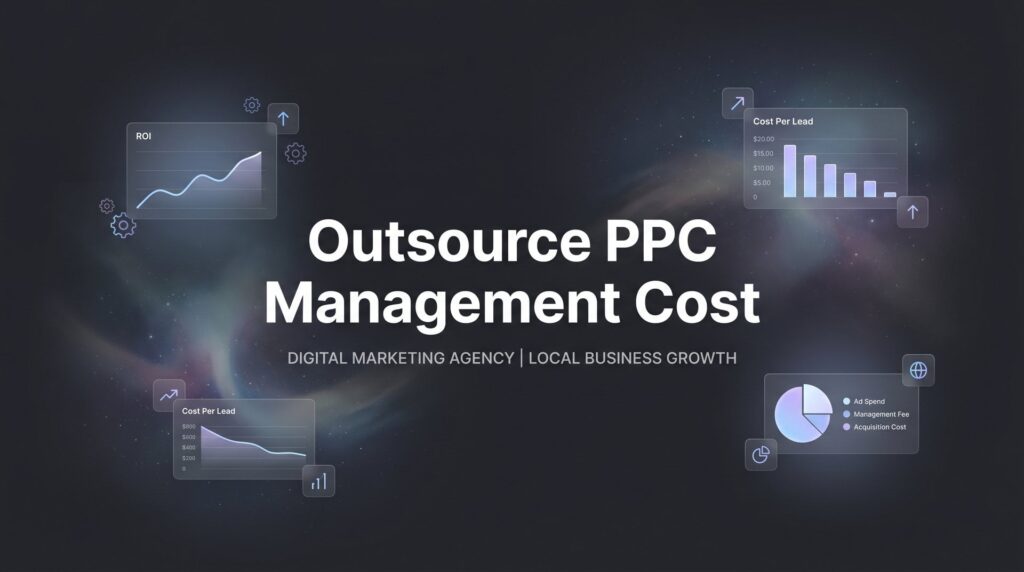
Understanding outsource PPC management cost isn’t just about finding a number that fits your budget. It’s about knowing what drives those price differences and whether the investment will actually improve your bottom line. A cheap agency that wastes your ad spend costs far more than a premium partner who cuts your cost-per-acquisition in half.
This breakdown cuts through the pricing confusion. You’ll see exactly how agencies structure their fees, what factors push quotes higher or lower, and how to evaluate whether you’re getting real value or just paying for someone to click buttons in your account. By the end, you’ll know what questions to ask and what red flags to watch for before signing anything.
The Three Pricing Models Every Agency Uses
PPC agencies typically structure their fees using one of three approaches, and understanding the difference helps you compare quotes accurately.
Flat Monthly Retainer: You pay the same amount every month regardless of your ad spend. A smaller agency might charge $1,200 monthly to manage your Google Ads account. A larger firm with specialized expertise might charge $3,500. The fee stays consistent whether you spend $5,000 or $15,000 on ads that month.
This model works well when you have predictable ad budgets and want cost certainty. You know exactly what you’re paying for management, making it easier to calculate your total marketing costs. The downside? If your ad spend fluctuates significantly or you scale up quickly, you might outgrow the service level included in your flat fee.
Percentage of Ad Spend: The agency takes a percentage of whatever you invest in advertising. Common rates range from 10% to 20% of your monthly ad budget. If you spend $10,000 on ads and your agency charges 15%, you’ll pay $1,500 in management fees that month.
This approach scales with your business. As you increase ad spend, the agency earns more, theoretically incentivizing them to help you grow. The challenge comes when agencies focus on spending more rather than spending smarter. A 15% fee on $20,000 in ad spend earns them more than 15% on $10,000, even if the smaller budget delivers better results.
Hybrid Structures: Many agencies combine both approaches—a base retainer plus a smaller percentage of ad spend. You might pay $1,500 monthly plus 8% of ad spend above a certain threshold. This creates a middle ground where the agency has guaranteed income to cover their baseline work while still benefiting from your growth. Understanding these PPC management pricing models helps you negotiate better terms.
Performance-based pricing exists but remains rare in the PPC world. Some agencies will tie a portion of their fee to hitting specific conversion targets or cost-per-acquisition goals. The challenge? PPC performance depends partly on factors outside the agency’s control, like your website conversion rate, sales process, and product-market fit. Most experienced agencies avoid pure performance pricing because they can’t control the entire conversion funnel.
When evaluating pricing models, consider your business situation. Startups with limited budgets often prefer flat fees for predictability. Growing businesses that plan to scale ad spend quickly might benefit from percentage-based pricing that grows with them. Established companies with stable budgets typically negotiate hybrid arrangements that balance both interests.
Why Your Quote Differs From Everyone Else’s
Two businesses in the same industry can receive drastically different quotes for PPC management, and the reasons go deeper than agency greed or random pricing.
Campaign Complexity Matters More Than You Think: Managing a single Google Ads campaign with one product and one geographic target requires far less work than coordinating campaigns across Google, Microsoft, Meta, and LinkedIn with different messaging for each platform. An agency managing just Google Search campaigns might charge $1,200 monthly. Add Meta advertising with dynamic product feeds, and that quote jumps to $2,800 for the same business.
The number of campaigns, ad groups, keywords, and creative variations directly impacts the time investment required. An e-commerce store with 500 products needs significantly more management than a service business with three core offerings. More complexity means more optimization work, more performance monitoring, and more strategic decisions every week.
Your Industry Changes the Game: If you’re in legal services, medical practices, or home services like HVAC or plumbing, expect higher quotes. These industries face intense competition, higher cost-per-click rates, and more sophisticated competitors. Managing PPC in these spaces requires deeper expertise and more aggressive optimization to stay profitable.
A personal injury attorney might pay $50-150 per click in competitive markets. Every wasted click costs real money, so the agency needs to monitor performance closely, adjust bids frequently, and refine targeting constantly. That intensity justifies higher management fees compared to a retail business where clicks cost $2 and small inefficiencies don’t immediately tank ROI. Learn more about Google Ads management pricing to understand what’s typical in your market.
Ad Spend Thresholds Trigger Pricing Tiers: Most agencies structure their pricing around ad spend ranges. You might get quoted $1,500 monthly for managing up to $10,000 in ad spend. But if you plan to spend $25,000 monthly, that same agency will quote $3,200 because you’ve crossed into a higher service tier requiring more attention and reporting.
These thresholds exist because larger budgets create more data to analyze, more optimization opportunities, and higher stakes if something goes wrong. An agency can’t apply the same level of attention to a $50,000 monthly budget that they give to a $5,000 budget and still deliver results.
Account history also influences pricing. If you’re bringing over a well-structured account with clean conversion tracking and months of performance data, the agency can hit the ground running. If your account is a mess with broken tracking, no conversion data, and poorly organized campaigns, expect higher setup costs and potentially higher ongoing fees to fix the foundation before optimization can even begin.
What You Should Actually Get at Each Price Level
Understanding what’s realistic at different price points prevents disappointment and helps you spot agencies overselling their capabilities.
Budget-Tier Services ($500-$1,500/month): At this level, you’re typically working with smaller agencies, freelancers, or junior account managers. The service focuses on basic campaign maintenance rather than strategic optimization. Expect monthly reporting, basic bid adjustments, and some keyword refinement.
What you won’t get: Weekly performance reviews, advanced audience testing, sophisticated remarketing strategies, or dedicated strategic planning sessions. The account manager likely handles 15-25 other clients, so your account receives limited attention. This tier works for businesses with simple campaigns, stable performance, and limited budgets who need someone to keep the lights on. If budget is your primary concern, explore affordable PPC management services that still deliver results.
You’ll probably communicate through email with monthly check-ins. Don’t expect the agency to proactively suggest major strategic shifts or spend hours testing new campaign structures. They’re maintaining what exists, not rebuilding your entire approach.
Mid-Market Management ($1,500-$5,000/month): This range represents the sweet spot for many growing businesses. You get experienced account managers, regular optimization, and actual strategic input. Weekly performance monitoring becomes standard, along with monthly strategy calls to review results and plan adjustments.
Deliverables typically include detailed monthly reports with insights beyond just numbers, A/B testing of ad copy and landing pages, audience expansion strategies, and competitive analysis. The account manager handles fewer clients—usually 8-12—giving your account more attention. You’ll see proactive recommendations for campaign improvements rather than just reactive maintenance.
At this level, agencies should provide transparent reporting dashboards, clear communication channels, and regular strategy discussions. You’re paying for expertise and strategic thinking, not just campaign babysitting. If you’re not getting monthly calls and detailed performance analysis, you’re overpaying for budget-tier service at mid-market prices.
Premium Agency Partnerships ($5,000+/month): High-end management brings dedicated resources and strategic expertise. You might get a senior strategist overseeing your account with a dedicated specialist handling day-to-day optimization. The agency becomes a true partner in your growth strategy, not just a vendor managing your ads.
Expect advanced testing frameworks, sophisticated attribution modeling, integration with your CRM and sales data, and custom reporting aligned with your business metrics. These agencies often have minimum ad spend requirements—typically $20,000+ monthly—because the service level requires significant resources. The best PPC management services offer this level of strategic partnership.
Premium partnerships include regular strategy sessions, quarterly business reviews, access to proprietary tools and technologies, and often white-glove service with rapid response times. You’re paying for deep expertise, proven processes, and the agency’s reputation. If results matter more than cost, and you have the budget to support serious ad spend, this tier delivers the highest potential ROI.
Warning Signs You’re Getting Ripped Off
Vague Contracts Without Clear Deliverables: If the proposal says “PPC management services” without specifying exactly what that means, walk away. You need to know the reporting frequency, communication schedule, what platforms they’ll manage, and what optimization activities they’ll perform monthly.
A legitimate agency provides detailed scope documents. They’ll specify whether they’re managing just Google Search or also Display, Shopping, and YouTube. They’ll outline how often they’ll optimize bids, test ad copy, and review performance. Vagueness gives them room to underdeliver while technically fulfilling the contract.
Excessive Setup Fees: Some agencies charge $2,000-5,000 in setup fees before starting ongoing management. While account setup does require work—building campaigns, implementing tracking, creating ad copy—excessive fees relative to monthly management costs signal a problem.
If an agency charges $1,000 monthly but wants $4,000 upfront for setup, they’re either overcharging for initial work or planning to deliver minimal ongoing value. Setup fees should roughly equal one to two months of management fees for most accounts. Anything beyond that needs clear justification. Watch out for the signs your PPC management company really sucks before committing.
Long-Term Contracts Without Performance Guarantees: Twelve-month contracts with no exit clauses trap you with underperforming agencies. While agencies need some commitment to justify their investment in learning your business, six months represents a reasonable trial period for most partnerships.
Watch for contracts that auto-renew without notification or require 90-day termination notices. These terms protect the agency, not you. A confident agency will offer quarterly reviews where both parties can evaluate fit and performance. If they’re demanding long-term commitments without proving results first, they’re more concerned with guaranteed revenue than your success.
Another red flag: agencies that won’t grant you admin access to your own ad accounts. Your business owns the account and all historical data. Any agency refusing to give you full access is hiding something—poor performance, sloppy account structure, or they’re planning to hold your account hostage if you leave.
The Real Cost of PPC Management Goes Beyond the Invoice
When calculating whether outsourcing makes financial sense, you need to factor management fees into your actual customer acquisition cost and compare that to the alternatives.
The True Cost-Per-Acquisition Calculation: If you spend $10,000 on ads and pay $1,500 in management fees, your total marketing investment is $11,500. If those ads generate 100 customers, your cost-per-acquisition isn’t $100—it’s $115. This matters when evaluating profitability and comparing different agencies.
An agency charging 20% of ad spend might seem expensive compared to one charging 12%. But if the expensive agency cuts your cost-per-click by 30% through better optimization, you’ll acquire more customers for less total investment even after their higher fees. Always calculate total cost per customer, not just management fees in isolation. Understanding how to reduce customer acquisition cost helps you evaluate agency performance more accurately.
Efficiency Gains That Offset Higher Fees: A skilled agency doesn’t just manage your existing performance—they improve it. Better keyword selection, refined audience targeting, improved ad copy, and optimized bidding strategies can reduce your cost-per-click by 20-40% in competitive industries.
Think of it this way: You’re currently spending $8,000 monthly on ads generating 80 leads at $100 each. You hire an agency for $2,000 monthly who optimizes your campaigns. Your ad spend stays at $8,000, but now you’re generating 125 leads at $64 each. Your total investment is $10,000 ($8,000 + $2,000), but your cost per lead dropped from $100 to $80. The agency’s fee paid for itself through improved efficiency.
This scenario plays out regularly with businesses moving from DIY management to professional agencies. The improvement in targeting precision, ad relevance, and bid optimization often delivers 25-50% better performance, making the management fee a profitable investment rather than an added cost.
When DIY Actually Costs More: Many business owners think managing PPC themselves saves money. But time has value, and opportunity cost is real. If you spend 15 hours monthly managing campaigns, and your time is worth $100 per hour, that’s $1,500 in opportunity cost—money you could earn focusing on your core business instead of tweaking keywords.
Add the cost of mistakes. Without deep PPC expertise, you’ll waste budget on poor keyword choices, weak ad copy, and suboptimal bidding strategies. A business owner learning PPC while running campaigns often wastes 20-30% of their ad budget on inefficiencies that an experienced agency would avoid. On a $10,000 monthly budget, that’s $2,000-3,000 in wasted spend—far more than most agency fees. If you’re struggling with lead costs, review these strategies to solve your high cost per lead problem.
The learning curve matters too. PPC platforms constantly change with new features, policy updates, and algorithm adjustments. Staying current requires ongoing education that agencies handle as part of their business. For a business owner, that’s additional time investment with no guarantee of expertise.
Choosing the Right Partner for Your Situation
Questions That Reveal Real Value: Before signing with any agency, ask specific questions that separate competent partners from pretenders. Start with: “What specific metrics will you track and report monthly?” Their answer should include conversion tracking, cost-per-acquisition, return on ad spend, and quality score metrics—not just clicks and impressions.
Ask about their optimization process: “How often will you review and adjust campaigns, and what triggers changes?” You want agencies that monitor performance at least weekly and make data-driven adjustments, not those who set campaigns and forget them until the monthly report. Review the 10 questions to ask before hiring a PPC management agency to prepare for these conversations.
Request case studies from similar businesses: “Can you share examples of results you’ve achieved for companies in my industry with comparable ad budgets?” Legitimate agencies have success stories. If they can’t provide relevant examples, they might lack experience in your market.
Clarify ownership and access: “Will I have full admin access to my ad accounts, and what happens to the account if we part ways?” The right answer is yes, you’ll have complete access, and all campaign data stays with you if the relationship ends.
Structuring a Trial Period That Protects You: Negotiate a 90-day trial period with clear performance benchmarks. Define what success looks like—perhaps a 20% reduction in cost-per-acquisition or a 30% increase in conversion volume. Both parties should agree on the metrics that matter before starting.
The trial period should include monthly check-ins to review progress and address concerns. If performance isn’t trending in the right direction by month two, you should have the option to exit without penalty. This protects your investment while giving the agency enough time to make meaningful improvements.
Document everything in writing. What platforms will they manage? What’s the reporting schedule? Who’s your point of contact? What response time can you expect for questions? Clear expectations prevent misunderstandings that damage the partnership later.
Benchmarks for Ongoing Success: After the trial period, evaluate your partnership quarterly using concrete metrics. Is your cost-per-acquisition trending down? Is conversion volume increasing? Are you getting strategic recommendations that improve results?
Compare your performance to industry benchmarks for your sector. If your cost-per-click is significantly higher than competitors, your agency should explain why and present a plan to improve. If conversion rates lag behind industry standards, they should be testing landing pages and refining targeting to close the gap.
Communication quality matters as much as performance metrics. Does your account manager respond promptly? Do they proactively share insights and opportunities? Are monthly reports detailed and actionable? A great agency partnership includes both strong results and strong collaboration.
Finding Your Right Investment Level
Outsource PPC management cost isn’t about finding the cheapest option or assuming the most expensive agency delivers the best results. It’s about finding the right value equation where the management fees pay for themselves through improved performance and freed-up time to focus on your business.
The businesses that win with outsourced PPC management understand that they’re not buying a service—they’re investing in expertise that improves their customer acquisition efficiency. A $3,000 monthly management fee stops feeling expensive when it cuts your cost-per-customer by 35% and generates an extra $15,000 in monthly profit.
Start by getting clear on your goals and budget. Know what you’re currently spending on ads, what your cost-per-acquisition is, and what improvement would meaningfully impact your business. Then find an agency whose pricing model, service level, and expertise align with your situation. Don’t stretch for premium services you don’t need, but don’t cheap out on expertise that could transform your results.
The best PPC partnerships are transparent from day one. You know exactly what you’re paying, what you’re getting, and how success will be measured. If an agency can’t provide that clarity upfront, they won’t provide it during your partnership either.
Tired of spending money on marketing that doesn’t produce real revenue? We build lead systems that turn traffic into qualified leads and measurable sales growth. If you want to see what this would look like for your business, we’ll walk you through how it works and break down what’s realistic in your market.
Want More Leads for Your Business?
Most agencies chase clicks, impressions, and “traffic.” Clicks Geek builds lead systems. We uncover where prospects are dropping off, where your budget is being wasted, and which channels will actually produce ROI for your business, then we build and manage the strategy for you.