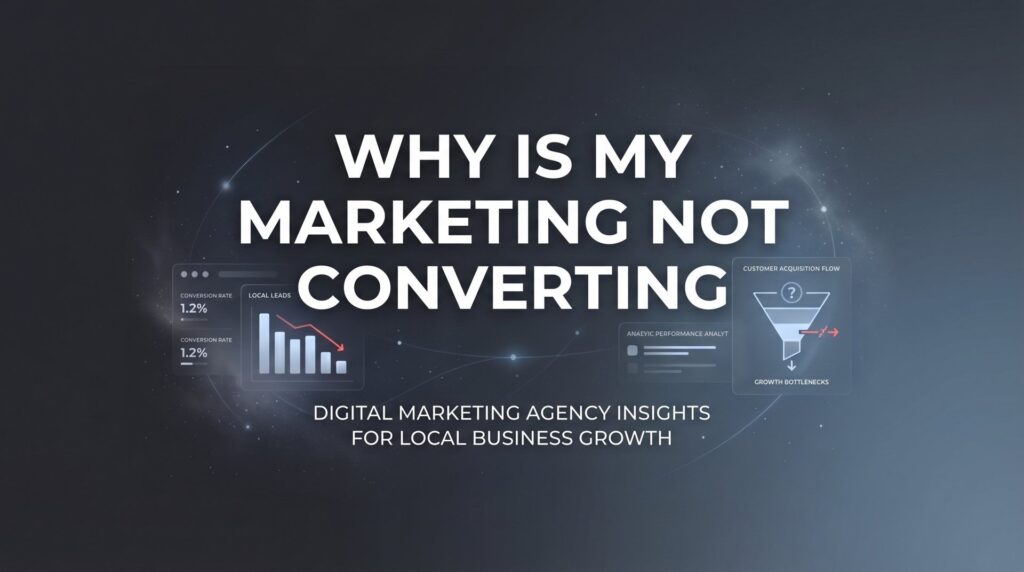
You check your ad account balance. Again. The number keeps dropping, but your phone isn’t ringing. Your inbox isn’t filling with inquiries. The leads that do come in? They’re tire kickers, people who were never going to buy, or folks asking questions that make it clear they didn’t even read what you’re selling.
You’re not alone in this nightmare. Every day, business owners watch thousands of dollars evaporate into digital advertising platforms while their actual revenue stays flat or worse, declines. The frustration builds. The second-guessing starts. Maybe digital advertising just doesn’t work for your industry. Maybe your competitors have some secret you don’t know about.
Here’s the truth: your ads aren’t failing because digital advertising doesn’t work. They’re failing because of specific, identifiable problems that are quietly destroying your return on investment. The good news? Every single one of these problems has a solution. By the time you finish reading this, you’ll know exactly why your campaigns underperform and what to do about it today.
The Real Reasons Your Ad Spend Isn’t Paying Off
The most expensive mistake in digital advertising isn’t spending too much. It’s spending anything at all on the wrong people.
Think about it this way: if you sell premium B2B software and your ads are showing to college students searching for free alternatives, every single click is pure waste. Yet this happens constantly. Advertisers cast impossibly wide nets, hoping to catch a few fish while paying for an ocean of irrelevant traffic.
Targeting problems manifest in dozens of ways. You might be advertising nationally when you only serve three states. Your ads could be reaching people in the awareness stage when your offer requires purchase-ready buyers. Geographic targeting might include areas where you can’t legally operate or logistically deliver. The platform algorithms are powerful, but they’re not mind readers.
Here’s where it gets worse: even when your targeting is perfect, a broken landing page will destroy everything.
Your ad promises a solution to a specific problem. The prospect clicks, excited to learn more. Then they land on a page that loads slowly, looks unprofessional, or worse—talks about something completely different than the ad promised. That disconnect kills trust instantly. The visitor hits the back button in three seconds, and you’ve just paid for nothing.
Landing page failures come in many forms. Slow load times trigger immediate abandonment. Confusing layouts make it impossible to find the call-to-action. Forms asking for too much information create friction. Missing trust signals like testimonials or security badges raise red flags. Understanding how to create high converting landing pages can eliminate these conversion killers.
The third silent killer is message misalignment. Your ad talks about “affordable pricing” but your landing page leads with “premium quality.” Your ad promises a free consultation but the page asks for credit card details. The headline in your ad doesn’t appear anywhere on the destination page.
This misalignment creates cognitive dissonance. The prospect’s brain registers something is off. They feel misled, even if unintentionally. Trust evaporates. They leave. You’ve paid for a click that had zero chance of converting from the moment they arrived.
Most business owners focus on the ad creative—the image, the headline, the description. They obsess over these elements while ignoring the fact that the ad is just the invitation. The landing page is where the actual sale happens. A mediocre ad with an excellent landing page will outperform a brilliant ad with a broken destination every single time.
Hidden Budget Killers Most Business Owners Miss
Let’s talk about the money leaks hiding in plain sight.
Broad match keywords are the single biggest budget drain in most accounts. You bid on “plumber” thinking you’ll reach people needing plumbing services. Instead, you’re paying for clicks from people searching for “plumber salary,” “plumber jobs,” “plumber memes,” and “how to become a plumber.” None of these searches will ever convert into customers.
Without a comprehensive negative keyword list, you’re essentially giving platforms permission to spend your money however they interpret relevance. The algorithms are optimizing for clicks, not for your business goals. Every irrelevant click costs the same as a qualified one, but delivers zero value. This is a common reason behind low ROI from digital advertising that plagues most accounts.
The solution sounds simple—add negative keywords. But most advertisers add five or ten obvious ones and call it done. A properly optimized account might have hundreds of negative keywords, continuously refined based on search term reports. This isn’t a one-time task. It’s ongoing maintenance that separates profitable campaigns from money pits.
Here’s an even more common problem: running ads without proper conversion tracking.
You can see clicks. You can see impressions. You can see your budget decreasing. But can you see which specific keywords, ads, and audiences are actually generating revenue? If not, you’re optimizing based on vanity metrics that mean nothing. Implementing call tracking for marketing campaigns is essential for understanding what’s actually driving results.
Platforms will happily optimize for clicks. They’ll show you improving click-through rates and celebrate your traffic growth. Meanwhile, your actual business results stay flat because none of that traffic is converting. Without tracking conversions properly, you can’t identify what’s working versus what’s burning money.
The third hidden killer lives in your campaign settings: ad scheduling and geographic targeting that doesn’t match your business reality.
Maybe your business only operates Monday through Friday, but your ads run 24/7. You’re paying for weekend clicks from people who can’t reach you until Monday—by which time they’ve already called your competitor. Perhaps you serve a specific metro area but your geographic radius is set too wide, capturing suburbs you can’t service profitably.
Or consider time zones. You’re on the East Coast. Your ads run nationwide. West Coast users see your ads at midnight their time, when your business is closed. They call, get voicemail, and move on. You paid for that click. You lost that opportunity.
These settings seem minor. They’re not. Collectively, they can waste 30-40% of your budget on traffic that has no possibility of converting, regardless of how good your ads or landing pages are.
The Conversion Rate Problem Nobody Talks About
Let’s do some simple math that will change how you think about advertising forever.
Imagine you spend $3,000 on ads. You get 1,000 clicks at $3 each. With a 1% conversion rate, you get 10 customers. If each customer is worth $500, you’ve made $5,000 from your $3,000 investment. Not bad.
Now imagine everything stays exactly the same—same ad spend, same traffic—but you improve your conversion rate to 3%. Suddenly those same 1,000 clicks produce 30 customers. That’s $15,000 in revenue from the same $3,000 investment. You just tripled your ROI without spending an extra dollar on advertising.
This is why conversion rate optimization is the most underrated strategy in digital marketing. Most businesses immediately jump to “we need more traffic” when campaigns underperform. They increase their ad budget, chase more clicks, and watch their problems scale proportionally. Exploring low website conversion rate solutions should be your first priority before scaling spend.
The smarter move? Fix what happens after the click first.
Think of it this way: if your bucket has holes in it, pouring more water in faster doesn’t solve the problem. You’re just wasting water more quickly. Patch the holes first. Then scale up the flow.
Conversion rate improvements often come from surprisingly simple changes. A faster loading page can increase conversions by 20% or more. Moving your call-to-action above the fold might double your results. Adding a trust badge or customer testimonial can eliminate the final objection holding people back.
These aren’t massive redesigns. They’re targeted improvements based on understanding where visitors drop off and why. Yet many businesses never make these changes because they’re too focused on the traffic side of the equation.
Here’s what this looks like in practice. You notice your mobile conversion rate is half your desktop rate. Instead of accepting this as normal, you investigate. You discover your form is nearly impossible to complete on mobile devices. You fix the form. Mobile conversions double overnight. You’ve just dramatically improved your overall ROI without touching your ad campaigns.
Or you realize visitors spend 30 seconds on your landing page but never scroll past the hero section. This tells you they’re not finding what they need immediately. You test a new headline that directly addresses their primary concern. Engagement increases. Conversions follow.
The businesses winning at digital advertising aren’t necessarily spending more. They’re converting more of the traffic they already have. This creates a compounding advantage: better conversion rates mean lower cost per acquisition, which means you can afford to bid more aggressively, which means you can capture more market share while maintaining profitability.
Your competitors stuck at 1% conversion rates can’t compete with you at 3% or 5%. You’re playing a different game entirely. The math becomes unbeatable.
How to Audit Your Campaigns in 30 Minutes
You don’t need fancy tools or a marketing degree to identify your biggest money leaks. You need 30 focused minutes and a systematic approach.
Start with your search term report. This shows exactly what people typed before clicking your ads. Open it right now. I’ll wait.
Scan through the list. How many searches are completely irrelevant to what you sell? Every one of those is wasted money. Add them as negative keywords immediately. Look for patterns—if you’re seeing lots of job-related searches, add “jobs,” “salary,” “career,” “hiring” as negatives. If you see informational searches, add “how to,” “what is,” “free,” “DIY.”
This alone might save you 20-30% of your budget overnight.
Next, check your conversion rate by device. Desktop, mobile, and tablet often perform dramatically differently. If mobile converts at half the rate of desktop, you have two options: fix your mobile experience or reduce mobile bids until you do. Don’t keep spending equally on a channel that’s destroying your ROI.
Now look at your geographic performance. Are certain cities or regions converting at much higher rates? Focus your budget there. Are some areas generating lots of clicks but zero conversions? Exclude them or reduce bids significantly.
Pull up your landing page analytics. What’s your bounce rate? If more than 60% of visitors leave immediately, your page is broken. They’re not even giving you a chance. Check your load time—anything over 3 seconds is costing you conversions. Test your page on mobile. Does it look professional? Is the form easy to complete?
Here’s a critical question: do you have conversion tracking properly set up? Can you see exactly which keywords and ads are generating actual business results, not just clicks? If not, stop everything and implement tracking before spending another dollar. You’re flying blind without it.
Check your ad schedule performance. When do your conversions actually happen? If you’re running ads 24/7 but 80% of conversions happen between 9 AM and 5 PM on weekdays, adjust your schedule. Why pay for clicks during hours that rarely convert?
Look at your quality scores. Scores below 5 mean you’re paying a premium for every click. Low quality scores usually indicate poor relevance between your keywords, ads, and landing pages. This is costing you real money—sometimes 50% more per click than competitors with better scores. Understanding pay per click advertising fundamentals helps you diagnose and fix these quality score issues.
Finally, review your ad copy against your landing page. Do they tell the same story? Does the primary benefit mentioned in the ad appear prominently on the page? If someone reads your ad and then lands on your page, should they feel they’re in the right place? If there’s any disconnect, fix it immediately.
These 30 minutes will reveal the obvious problems. The low-hanging fruit. The stuff that’s been quietly destroying your ROI for months. Fix these first before worrying about advanced optimization strategies.
Building Campaigns That Actually Convert
The difference between campaigns that burn money and campaigns that print it comes down to one principle: tight alignment.
Here’s how it works. Someone searches for “emergency plumber downtown Chicago.” Your keyword matches that intent. Your ad headline says “Emergency Plumber – Downtown Chicago – 24/7.” They click. Your landing page headline says “Emergency Plumbing Services in Downtown Chicago – Available 24/7.” The offer matches: “Call Now for Immediate Service.”
Every step confirms they’re in the right place. There’s no confusion, no disconnect, no reason to doubt. The path from search to conversion is frictionless.
Now contrast that with the broken version. Same search. Your ad says “Plumbing Services – Affordable Rates.” They click. Your landing page is your homepage with seven different services and no clear next step. The prospect has to hunt for emergency services, figure out if you serve their area, and wonder if you’re even available now.
That friction kills conversions. Every moment of confusion is an opportunity for them to leave.
This is why smaller, tighter ad groups outperform broad campaigns every time. Instead of one ad group with 50 keywords all pointing to your homepage, you create specific ad groups around specific intents, each with custom ads and dedicated landing pages.
Your “emergency plumbing” ad group only contains emergency-related keywords. The ads emphasize speed and availability. The landing page is built specifically for emergency calls with a prominent phone number and click-to-call button.
Your “water heater repair” ad group focuses on that specific service. Different keywords, different ad copy, different landing page. Someone searching for water heater help doesn’t want to wade through information about drain cleaning and pipe replacement.
This structure takes more work upfront. But it delivers dramatically better results because you’re matching intent at every stage. The person searching knows exactly what they want. Your ad confirms you offer it. Your landing page delivers on that promise. Conversion becomes the natural next step.
Testing is how you improve systematically rather than guessing. But most businesses test wrong. They change five things at once, see a difference, and don’t know which change mattered. Or they test for three days, see a small difference, and declare a winner before statistical significance.
Proper testing means changing one variable at a time. Test a new headline against your current one. Let it run until you have at least 100 conversions on each version. Then implement the winner and test the next element. This is slower but it actually teaches you what works. This approach is central to what performance marketing is all about—measuring and optimizing based on actual results.
The elements worth testing, in order of impact: headline, call-to-action, offer, page layout, form length, images. Start at the top of that list. A better headline can double conversions. A different button color might improve them 5%. Test what matters most first.
When to DIY and When to Call in Experts
Some problems you can solve yourself. Others require specialized expertise. Knowing the difference saves you time and money.
You can probably handle basic optimization if you’re seeing some conversions but want to improve efficiency. Adding negative keywords, adjusting bids, refining targeting—these are learnable skills. If your campaigns are fundamentally sound but need tuning, invest time in learning the platforms. Resources on paid search advertising for beginners can help you build foundational knowledge.
You need professional help when you’re spending significant money with minimal results and can’t identify why. When you’ve tried obvious fixes and nothing changes. When your cost per acquisition is higher than your customer value. When you’re losing money every month and don’t know where to start.
Red flags when evaluating agencies: they promise specific rankings or results. They won’t explain their strategy in terms you understand. They require long contracts with no performance guarantees. They focus entirely on traffic metrics instead of business outcomes. They’re reluctant to share data or explain what they’re doing.
Green flags: they start by asking about your business goals and profit margins. They want to understand your customer lifetime value. They explain how they’ll track actual conversions, not just clicks. They’re transparent about what’s realistic in your market. They focus on ROI and cost per acquisition, not vanity metrics. Learning how to hire a digital marketing agency that actually delivers results can save you from expensive mistakes.
The ROI math on hiring experts is straightforward. If you’re spending $5,000 monthly on ads with a 1% conversion rate, that’s 50 conversions. A good agency might charge $2,000 monthly but improve your conversion rate to 3%—that’s 150 conversions. You’re spending $2,000 more but getting 100 additional conversions. If each conversion is worth $100, you’re making an extra $10,000 while spending $2,000. That’s a 5X return on the management fee.
The break-even point is simple: if expert help costs less than the additional revenue it generates, it pays for itself. Most businesses reach this point quickly because professional optimization unlocks value that’s already there, hidden in wasted spend and poor conversion rates.
Consider this: if you’re spending $10,000 monthly on ads that aren’t working, you’re already losing that money. Spending $2,000 on expert help to fix the problem isn’t an additional expense—it’s salvaging the $10,000 you’re currently wasting. The question isn’t whether you can afford help. It’s whether you can afford to keep bleeding money.
Turning Wasted Spend Into Profitable Growth
High advertising costs with low results isn’t a permanent condition. It’s a diagnosis pointing to specific problems with specific solutions.
Your targeting might be too broad, sending ads to people who will never buy. Your landing pages might be killing conversions that your ads worked hard to generate. Message misalignment might be destroying trust before prospects even consider your offer. Hidden budget killers like broad match keywords without negatives might be hemorrhaging money to irrelevant searches.
The fix starts with proper tracking so you can see what’s actually working. Then audit your campaigns systematically—search terms, device performance, geographic data, quality scores. Identify the obvious money leaks and plug them first.
Focus on conversion rate before scaling spend. A 1% improvement in conversion rate often delivers more value than doubling your traffic. Build campaigns around tight alignment—keyword intent matching ad message matching landing page promise matching offer. Test systematically to improve rather than guessing.
Some of these fixes you can implement today. Others might require expertise you don’t have in-house. That’s okay. The important thing is recognizing that every dollar you’re currently wasting can be redirected toward results that actually grow your business.
Tired of spending money on marketing that doesn’t produce real revenue? We build lead systems that turn traffic into qualified leads and measurable sales growth. If you want to see what this would look like for your business, we’ll walk you through how it works and break down what’s realistic in your market.
Want More Leads for Your Business?
Most agencies chase clicks, impressions, and “traffic.” Clicks Geek builds lead systems. We uncover where prospects are dropping off, where your budget is being wasted, and which channels will actually produce ROI for your business, then we build and manage the strategy for you.