You check your marketing dashboard and see the numbers climbing. Website traffic is up 40% month-over-month. Social media engagement has never been better. Your latest email campaign hit a 25% open rate. You share the wins with your team, feeling good about the momentum.
Then you check your bank account.
Where’s the money? All those impressive numbers should translate to something, right? But your revenue hasn’t budged. Your profit margins look exactly the same as they did three months ago. You’re spending more on marketing, getting more activity, and somehow ending up in the same place financially.
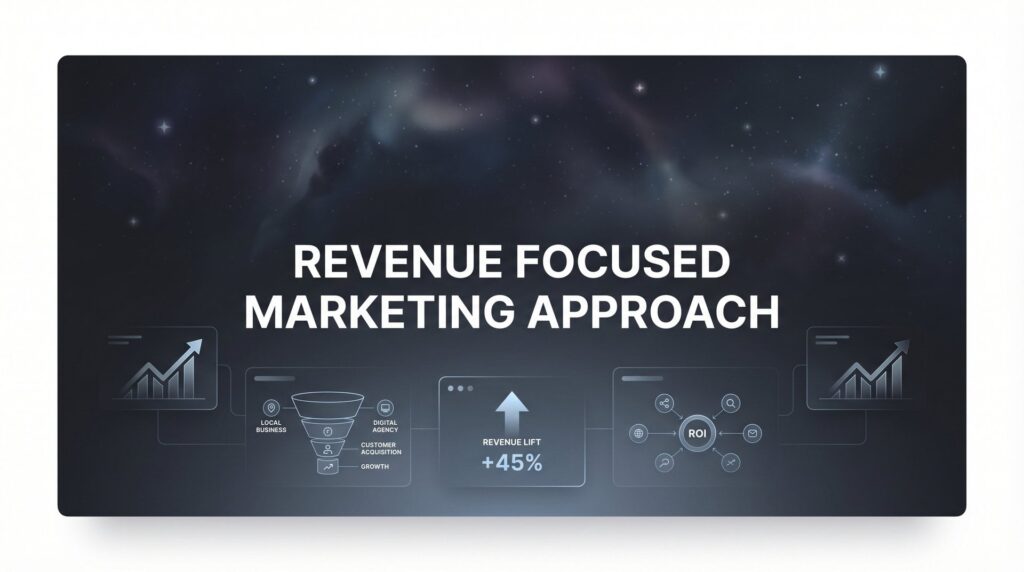
This is the gap that kills businesses. The chasm between marketing activity and actual revenue. And it’s not your fault for falling into it—the entire marketing industry has been built around metrics that look impressive in reports but don’t pay your bills. A revenue focused marketing approach flips this equation entirely. Instead of celebrating clicks and impressions, it demands one thing from every marketing dollar: measurable profit growth. This article will show you exactly how to build this framework, starting with the metrics that actually matter and ending with a system that connects every marketing decision directly to your bottom line.
The Vanity Metrics Trap (And Why Most Marketing Fails to Deliver)
Vanity metrics are measurements that make you feel good but don’t drive business decisions. They’re the marketing equivalent of empty calories—they fill up your reports without nourishing your business. Impressions, page views, social media followers, email list size, even website traffic—these numbers can climb indefinitely while your revenue stays flat.
Why are they so seductive? Because they’re easy to move. Running a campaign that generates 10,000 impressions is straightforward. Getting 500 new Instagram followers takes effort but follows a predictable playbook. These metrics respond quickly to your actions, creating the illusion of progress. Your brain gets the dopamine hit of “numbers going up” without the hard work of converting that attention into paying customers.
Here’s the brutal truth: you can have a million impressions and zero revenue. You can build a massive email list that never buys. You can drive enormous traffic to a website that doesn’t convert. The disconnect happens because these metrics measure attention, not action. They tell you people saw your message, not whether they valued it enough to open their wallets. Understanding why marketing isn’t working for your business often starts with recognizing this fundamental gap.
Most marketing fails to deliver because it optimizes for the wrong outcome. When your agency reports on clicks and impressions, they’re measuring their activity, not your results. When you celebrate traffic growth without tracking what that traffic does, you’re confusing motion with progress. The fundamental problem isn’t that these metrics are useless—it’s that they’re incomplete. A click means nothing if it doesn’t lead to a conversation. A conversation means nothing if it doesn’t lead to a sale.
Revenue-focused thinking represents a complete mindset shift. Instead of asking “How many people did we reach?” you ask “How much profit did we generate?” Instead of celebrating activity, you demand outcomes. This doesn’t mean impressions and clicks are worthless—it means they’re only valuable when they connect to revenue. A thousand clicks that generate zero customers is worse than ten clicks that generate two customers. One is activity. The other is business growth.
The shift starts with rejecting the idea that more is always better. More traffic, more followers, more engagement—these only matter if they lead to more revenue. A revenue focused marketing approach forces you to trace the line from every marketing action to actual money in the bank. If you can’t draw that line clearly, you’re probably wasting money on vanity.
Core Pillars of a Revenue Focused Marketing Approach
Two numbers form the foundation of revenue-focused marketing: customer acquisition cost and lifetime value. Everything else builds on this relationship. Customer acquisition cost (CAC) tells you how much you spend to acquire one paying customer. Lifetime value (LTV) tells you how much profit that customer generates over their entire relationship with your business. If your LTV exceeds your CAC by a healthy margin, you have a business model that works. If it doesn’t, you’re burning money.
Think of it like this: if you spend $200 to acquire a customer who generates $150 in profit, you’re slowly going out of business. If you spend $200 to acquire a customer who generates $1,200 in profit over two years, you’ve got a money-printing machine. The gap between these numbers determines whether your marketing is an expense or an investment. Learning how to track marketing ROI properly is essential for understanding this relationship.
Most local businesses have no idea what their actual CAC is. They know their monthly marketing budget. They might track how many new customers they got. But they rarely calculate the true cost per acquisition across all channels, including time, tools, and overhead. Without this number, you’re flying blind. You might be spending $500 to acquire customers worth $300, celebrating the new business while slowly bleeding out.
Attribution modeling connects the dots between marketing touchpoints and closed deals. In a perfect world, every customer would see one ad, click it, and buy immediately. In reality, customers interact with your brand multiple times across multiple channels before converting. They might see a Facebook ad, visit your website, read an email, see another ad, and finally call you. Which touchpoint gets credit for the sale?
Attribution modeling answers this question. First-touch attribution credits the initial touchpoint. Last-touch attribution credits the final interaction before conversion. Multi-touch attribution distributes credit across all touchpoints. The model you choose matters less than having one at all. Without attribution, you’re guessing which marketing channels actually drive revenue. With it, you can see which investments pay off and which ones waste money. Our guide on marketing attribution models explained breaks down each approach in detail.
Here’s where most businesses make a critical mistake: they track leads per channel instead of revenue per channel. Your Google Ads might generate 50 leads per month while your SEO efforts generate 20. Surface level, Google Ads looks like the winner. But what if those 50 PPC leads convert at 5% and average $1,000 in value, while the 20 SEO leads convert at 30% and average $3,000 in value? Suddenly, SEO is generating $18,000 in revenue versus PPC’s $2,500. Same marketing budget, completely different business impact.
Revenue per channel forces you to look past volume and focus on value. Some channels attract tire-kickers. Others attract serious buyers. Some channels generate quick wins. Others build relationships that pay off over time. You can’t know which is which until you track revenue, not just activity. This requires connecting your marketing data to your sales data—usually through CRM integration or at minimum, consistent tracking of where revenue actually comes from.
The final pillar is return on ad spend (ROAS). This metric is beautifully simple: for every dollar you spend on marketing, how many dollars in revenue do you generate? A 3:1 ROAS means every marketing dollar produces three dollars in revenue. A 10:1 ROAS means you’re printing money. A 0.5:1 ROAS means you’re burning it. ROAS cuts through all the complexity and answers the only question that matters: is this marketing making us money?
Building Your Revenue-First Marketing Framework
Start with an honest audit of your current marketing against revenue impact. Pull up every marketing channel you’re currently using—PPC, SEO, social media, email, content marketing, local advertising, whatever you’re investing in. For each channel, answer three questions: How much are we spending here monthly? How many customers did this channel generate last month? How much revenue did those customers produce?
If you can’t answer these questions, you’ve found your first problem. You’re spending money without knowing what it’s producing. This is where most businesses discover uncomfortable truths. That social media strategy you’ve been funding for six months? It generated engagement but zero trackable revenue. That expensive content marketing program? Lots of traffic, no conversions. The audit isn’t about feeling bad—it’s about getting clear on what’s working and what’s theater.
Next, set up proper tracking and CRM integration for revenue attribution. This is where theory meets reality. You need a system that connects marketing touchpoints to actual sales. For many local businesses, this means implementing a CRM like HubSpot, Salesforce, or even a simple system like Google Sheets if you’re just starting. If you’re not tracking marketing conversions properly, fixing this gap should be your immediate priority.
Here’s a practical implementation: when someone fills out a contact form, your system should capture where they came from (Google Ads, organic search, Facebook, email, etc.). When they become a customer, that source data should travel with them. When they generate revenue, you should be able to trace it back to the original marketing touchpoint. This isn’t complicated—it just requires intentional setup and consistent execution.
The third step is creating a scoring system that prioritizes high-intent, high-value prospects. Not all leads are created equal. Someone who downloads a free guide is different from someone who requests a quote. Someone asking about your cheapest service is different from someone asking about your premium offering. Your scoring system should reflect these differences and help your team focus energy where it matters most.
Build your scoring around two dimensions: intent and value. Intent measures how close someone is to buying. Did they just visit your homepage, or did they fill out a quote request form? Value measures how much revenue this customer could generate. Are they asking about a $500 service or a $5,000 project? High-intent, high-value prospects get immediate attention. Low-intent, low-value prospects get automated nurturing. This prevents your team from spending equal time on every lead regardless of revenue potential.
The framework also requires establishing clear revenue goals for each marketing channel. Instead of vague objectives like “increase brand awareness” or “grow our audience,” set specific revenue targets. Google Ads should generate $15,000 in revenue this month. Email marketing should drive $8,000 in repeat business. SEO should contribute $12,000 in new customer revenue. These targets create accountability and make it immediately obvious when a channel underperforms.
Finally, implement a monthly review process where you evaluate every marketing investment against its revenue contribution. This isn’t about micromanaging daily fluctuations—it’s about identifying trends over time. If a channel consistently underperforms for three months, you either fix it or kill it. If a channel consistently overperforms, you increase investment. The review process forces regular decision-making based on data, not hope or habit.
Channel Selection: Where Revenue-Focused Marketers Invest
Revenue-focused marketers evaluate channels based on revenue potential, not reach or engagement. This fundamentally changes how you think about marketing mix. A channel that reaches 100,000 people but converts none of them is worthless. A channel that reaches 500 people but converts 10% of them at high value is gold. The question isn’t “How big is the audience?” It’s “How many of these people will actually buy?”
For local businesses specifically, PPC advertising often outperforms organic strategies for immediate revenue impact. Why? Because PPC targets people actively searching for solutions right now. When someone Googles “emergency plumber near me” or “divorce attorney in Austin,” they’re not browsing—they’re buying. PPC puts you in front of high-intent prospects at the exact moment they’re ready to make a decision. The conversion timeline is measured in hours or days, not weeks or months. Understanding what performance marketing is helps clarify why this approach delivers faster results.
Compare this to organic social media, where you’re competing for attention against cat videos and political arguments. Your audience might see your post. They might even engage with it. But they’re not in buying mode—they’re in entertainment mode. The conversion timeline stretches into weeks or months, if it happens at all. This doesn’t make social media useless, but it does make it a poor choice if you need revenue this month.
SEO occupies middle ground. It takes months to build momentum, but once established, it generates consistent high-quality leads with excellent conversion rates. Someone who finds you through organic search often has higher intent than someone who saw a random social post. They searched for a specific solution, evaluated options, and chose to click your result. The timeline is longer than PPC, but the quality can be exceptional and the cost per acquisition drops over time.
Email marketing to existing customers often delivers the highest ROAS of any channel. These people already know you, trust you, and have bought from you before. The acquisition cost is zero—you already paid it. The conversion rates are typically 5-10x higher than cold traffic. Implementing strong customer retention marketing strategies through email can dramatically increase lifetime value without additional acquisition costs.
The key is balancing short-term revenue channels with long-term brand building. PPC and email deliver immediate results but require ongoing investment. SEO and content marketing take time to build but create compounding returns. A mature revenue-focused strategy includes both: PPC to generate revenue today, SEO to reduce acquisition costs over time, email to maximize customer lifetime value. A well-designed multi channel marketing strategy balances these elements based on your specific business model and growth timeline.
Here’s the trap to avoid: don’t chase the hot new channel just because everyone’s talking about it. TikTok might be exploding, but if your customers aren’t there or if the platform doesn’t support your conversion process, it’s a distraction. Revenue-focused marketers test new channels carefully, with clear success metrics and kill criteria. If a channel doesn’t show revenue potential within a defined test period, you move on. No emotional attachment to platforms or tactics—only to results.
Conversion Rate Optimization: The Revenue Multiplier
Small conversion improvements create exponential revenue gains because they amplify every other marketing investment. Think about the math: if you’re spending $10,000 monthly on PPC and converting 2% of traffic, you’re getting 20 customers. Improve that conversion rate to 3%—a seemingly modest 50% improvement—and you get 30 customers from the same ad spend. That’s 10 additional customers with zero increase in marketing budget. Your cost per acquisition just dropped by 33%.
This is why conversion rate optimization is the revenue multiplier. Every percentage point improvement in conversion rate increases revenue across all channels simultaneously. Better landing pages help your PPC campaigns and your SEO traffic. Better email copy improves results from both cold outreach and customer nurturing. Better phone scripts convert more leads from every source. CRO is the rising tide that lifts all boats.
Focus on key conversion points where small changes create maximum revenue impact. For most businesses, these are: the first landing page visitors see, the contact form or lead capture process, the initial sales conversation or consultation, and the proposal or quote presentation. Each of these represents a decision point where prospects either move forward or drop out. Optimizing these four points typically captures 80% of available revenue improvement. Exploring conversion focused marketing services can help you systematically address each of these critical touchpoints.
Landing page optimization starts with clarity and relevance. Does your page immediately answer “What is this and why should I care?” Can visitors understand your value proposition in five seconds? Is the next step obvious and easy? Many landing pages fail because they’re designed to impress rather than convert. They prioritize clever copy over clear communication, aesthetic beauty over functional simplicity. Revenue-focused landing pages are built around one question: what will make this visitor take action right now?
The lead capture process is where many businesses hemorrhage revenue. Forms that ask for too much information reduce completion rates. Unclear calls-to-action create confusion. Multiple competing options create decision paralysis. The goal is to make the next step as easy as possible while still qualifying the lead. For high-value services, a phone number and brief description might be enough. For lower-touch businesses, even just an email address can start the conversation. Test ruthlessly to find the balance between information gathering and conversion rate.
Testing strategies should focus on revenue outcomes, not just conversion rates. Here’s why this matters: you could increase form submissions by 50% by removing all qualification questions, but if those leads are lower quality and convert to sales at half the rate, you’ve actually decreased revenue. The metric that matters is revenue per visitor, not leads per visitor. Always track tests through to final sale to understand true impact.
Run tests on elements that could plausibly move the needle: headline variations that change the core value proposition, different call-to-action buttons that alter the commitment level, form length changes that affect completion rates, social proof elements that build credibility. Avoid testing trivial elements like button colors or font sizes unless you’ve already optimized everything else. Your time is finite—spend it on changes that could realistically improve revenue by 10% or more, not 0.5%.
The most overlooked conversion point is the human interaction—the sales call, the consultation, the proposal presentation. You can drive perfect traffic and capture perfect leads, but if your sales process converts 20% when it could convert 40%, you’re leaving massive revenue on the table. Record calls, analyze what works, train your team on high-converting approaches, and continuously refine. This is often where the biggest revenue gains hide.
Putting Revenue at the Center of Every Marketing Decision
Create a revenue-focused reporting cadence that drives ongoing optimization. Most businesses review marketing metrics monthly, which is fine for trend analysis but too slow for tactical adjustments. Implement a three-tier reporting system: daily monitoring of critical metrics like ad spend and lead volume, weekly reviews of conversion rates and revenue by channel, monthly deep dives into overall ROAS and strategic performance. This cadence keeps you close enough to the data to catch problems early while avoiding the noise of daily fluctuations.
Your daily dashboard should answer: Are we on track for our monthly revenue goal? Is any channel dramatically over or under-performing? Are there any obvious technical issues or anomalies? This isn’t about making daily strategy changes—it’s about maintaining situational awareness and catching fires before they burn down the house. Implementing call tracking for marketing campaigns ensures you capture phone conversions that often get missed in digital-only reporting.
Weekly reviews dig deeper into what’s working and what’s not. Which landing pages are converting best? Which ad sets are delivering the highest ROAS? Which lead sources are producing the most closed deals? Weekly reviews let you make tactical optimizations—pausing underperforming campaigns, increasing budget on winners, testing new approaches. This is where continuous improvement happens.
Before launching any campaign or spending any budget, ask these questions: What specific revenue outcome are we targeting? How will we measure whether this investment paid off? What’s our maximum acceptable cost per acquisition? What’s our kill criteria if this doesn’t work? These questions force clarity before you spend a dollar. If you can’t answer them confidently, you’re not ready to launch. You’re guessing, not strategizing.
Building a culture of revenue accountability means everyone involved in marketing understands how their work connects to business outcomes. Your content writer should know which articles drive the most qualified leads. Your social media manager should track which posts lead to conversations that become sales. Your PPC specialist should optimize for revenue, not just clicks or conversions. When the entire team focuses on the same north star—revenue growth—decisions become clearer and results improve.
This accountability also means being willing to kill sacred cows. That marketing channel you’ve used for years? If it’s not producing revenue, it goes. That creative campaign everyone loves? If it doesn’t convert, it gets replaced. Revenue-focused marketing is ruthlessly pragmatic. You optimize for outcomes, not opinions. You follow the data, not the trends. You invest in what works and abandon what doesn’t, regardless of how attached you are to it.
Your Path to Profitable Marketing
A revenue focused marketing approach isn’t about spending less—it’s about demanding more from every dollar. It’s the difference between marketing as an expense and marketing as an investment. When you shift from celebrating activity to measuring outcomes, from tracking impressions to tracking profit, everything changes. Your decisions get clearer. Your results get better. Your business grows faster.
The framework is straightforward: know your customer acquisition cost and lifetime value, implement attribution tracking that connects marketing to revenue, evaluate channels based on profit potential rather than reach, optimize conversion points that multiply your returns, and build a reporting system that keeps revenue at the center of every decision. These aren’t complicated concepts—they’re just rarely implemented with discipline and consistency.
Start with the audit. Look at your current marketing through the lens of revenue contribution. Which channels are actually making you money? Which ones are consuming budget without delivering profit? You’ll probably discover that 20% of your marketing drives 80% of your revenue. That clarity alone is worth the exercise. It tells you where to double down and where to cut losses.
Then build the tracking infrastructure. You can’t manage what you don’t measure. Set up systems that connect marketing activity to actual sales. It doesn’t need to be perfect or expensive—it just needs to exist. Even a simple spreadsheet that tracks lead source and revenue is infinitely better than flying blind.
Finally, commit to the mindset shift. Stop celebrating vanity metrics. Stop investing in marketing that “feels right” without proving itself. Stop accepting reports full of impressive numbers that don’t correlate with bank deposits. Demand revenue. Measure revenue. Optimize for revenue. Everything else is distraction.
Tired of spending money on marketing that doesn’t produce real revenue? We build lead systems that turn traffic into qualified leads and measurable sales growth. If you want to see what this would look like for your business, we’ll walk you through how it works and break down what’s realistic in your market.
Want More Leads for Your Business?
Most agencies chase clicks, impressions, and “traffic.” Clicks Geek builds lead systems. We uncover where prospects are dropping off, where your budget is being wasted, and which channels will actually produce ROI for your business, then we build and manage the strategy for you.