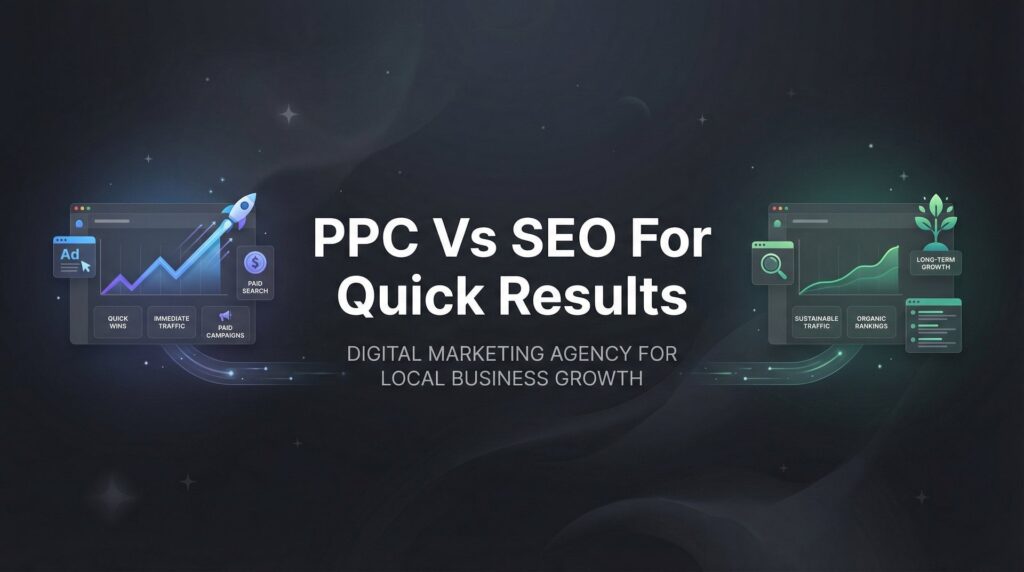
You’re three weeks from running out of operating cash. Your competitor just opened across town with a flashy new website. Your phone hasn’t rung in two days. When you’re in situations like these, the PPC vs SEO debate isn’t some marketing theory to ponder over coffee—it’s a business survival decision that needs to be made today.
Most marketing advice treats PPC and SEO like equally viable options you can casually choose between. But when you need leads fast, that’s not reality. One channel can have your phone ringing tomorrow morning. The other might take months before you see a single qualified call.
The problem? Most business owners make this decision based on what they’ve heard from other business owners, read in a blog post, or what some agency pitched them. They don’t have a systematic way to evaluate which approach actually makes sense for their specific situation, market, and timeline.
This guide gives you seven battle-tested strategies to make that call correctly. These aren’t theoretical frameworks—they’re decision tools that help you determine whether paid advertising, organic search, or a combination of both will generate revenue fastest for your business. Whether you’re launching a new service line, entering a competitive market, or simply need to fill your pipeline this quarter, you’ll know exactly which path to take.
1. The 72-Hour Revenue Test
The Challenge It Solves
When your business needs revenue immediately—not next month, not next quarter, but this week—you don’t have the luxury of building organic visibility. Maybe you’re launching a time-sensitive promotion, covering unexpected expenses, or capitalizing on seasonal demand that won’t wait. In these scenarios, the wrong channel choice doesn’t just slow growth—it can threaten business viability.
The Strategy Explained
The 72-Hour Revenue Test is a simple framework that determines whether your situation demands PPC as the only viable option. It evaluates three critical factors: your revenue timeline, profit margins, and existing market presence.
Start by asking: Do I need leads within the next 72 hours? If yes, PPC is your only option. SEO cannot deliver traffic that quickly under any circumstances. Even the fastest local SEO wins take weeks, not days.
Next, calculate your customer lifetime value and average profit per sale. PPC makes financial sense when your margins can absorb the cost-per-click in your industry while still generating profit. If you’re selling a $50 product with $10 margins in a market where clicks cost $8, PPC becomes mathematically challenging regardless of speed.
Finally, assess your current visibility. If you have zero online presence—no website ranking for anything, no Google Business Profile, no brand recognition—PPC provides the only path to immediate market entry while you build longer-term assets. Understanding the nuances of PPC vs SEO for lead generation helps you make this assessment more accurately.
Implementation Steps
1. Define your absolute revenue deadline. Be brutally honest about when you need cash in hand, not just leads in the pipeline. This determines whether SEO is even a consideration.
2. Calculate your break-even cost per lead. Take your average sale value, multiply by your close rate, subtract your cost of delivery, and divide by your acceptable customer acquisition cost. This number tells you how much you can afford to pay per click.
3. Research typical cost-per-click in your market using Google’s Keyword Planner. Compare this to your break-even number. If CPC is 50% or less of your break-even, PPC is financially viable. If it’s 80% or more, you’ll struggle to make the math work even with perfect conversion rates.
Pro Tips
Don’t confuse “wanting results fast” with “needing results within 72 hours.” True urgency means you’re solving an immediate business problem, not just being impatient with organic growth. If you can wait two weeks, hybrid approaches become viable. If you genuinely need leads tomorrow, PPC is your only answer—just make sure your margins support it.
2. The Competitive Saturation Assessment
The Challenge It Solves
Your market’s competitive landscape dramatically affects which channel delivers faster results. In some markets, organic rankings are so dominated by established players that PPC offers the only realistic path to visibility. In others, paid advertising is so expensive and competitive that SEO becomes the smarter play despite longer timelines. Making the wrong call wastes months and thousands of dollars.
The Strategy Explained
This strategy involves analyzing both the paid and organic competitive environments to identify which channel offers the faster path to meaningful visibility in your specific market.
For organic competition, search your primary service keywords and evaluate the top 10 results. Look at domain age, content depth, backlink profiles, and website authority. If the first page is dominated by national brands, massive content libraries, and websites that have been ranking for years, organic growth will be slow regardless of your SEO investment.
For paid competition, run searches during business hours and count how many ads appear above organic results. Click through to competitor landing pages and evaluate their offer quality, page optimization, and apparent sophistication. Markets with weak paid competition often deliver better ROI from PPC, even if organic rankings look achievable.
The key insight: sometimes the “slower” channel is actually faster in your specific market because the “faster” channel is oversaturated.
Implementation Steps
1. Create a list of your top 5-10 target keywords. Search each one and screenshot the results page. Count how many paid ads appear, and note how many organic results are dominated by national players versus local businesses.
2. Use a free tool like Moz’s Domain Authority checker or Ahrefs’ free backlink checker to evaluate the top 5 organic results for your main keyword. If they all have domain authority scores above 50 and thousands of backlinks, organic growth will be a long-term play. Leveraging the best SEO tools can help you conduct this competitive analysis more efficiently.
3. Analyze paid ad copy and landing pages for at least 10 competitors running ads. If you see generic ad copy, poor landing pages, and weak offers, PPC competition is soft—meaning you can win quickly with better execution. If ads are sophisticated with compelling offers and optimized landing pages, expect higher costs and tougher competition.
Pro Tips
Pay special attention to local pack results in Google Maps. If your Google Business Profile can rank in the top three local results, this often delivers qualified leads faster than traditional organic rankings—sometimes within weeks rather than months. Many businesses overlook this middle ground between PPC and traditional SEO that can deliver surprisingly quick results in local markets.
3. The Budget-to-Timeline Matching Framework
The Challenge It Solves
Business owners routinely mismatch their available budget with their timeline expectations, creating impossible situations. They want SEO results in 30 days or expect to dominate paid search with $500 monthly budgets in competitive markets. This framework prevents wasted investment by aligning realistic budget levels with achievable timelines for each channel.
The Strategy Explained
Different budget levels unlock different strategic options, and each channel has minimum viable investment thresholds below which success becomes unlikely regardless of timeline.
For PPC, calculate your minimum viable budget by multiplying estimated cost-per-click by the number of clicks needed to generate one lead, then multiply by your target number of leads per month. If you need 20 leads monthly, convert at 5% (requiring 400 clicks), and clicks cost $3, you need a $1,200 minimum monthly budget. Anything less means you’re not generating enough data to optimize or enough leads to sustain operations.
For SEO, consider that meaningful organic growth typically requires 3-6 months of consistent effort. If you have $2,000 monthly for six months, that’s $12,000 total investment. This budget level determines the scope of SEO work possible—technical fixes, content creation, link building—and therefore the realistic timeline for results.
The framework helps you avoid the classic mistake of spreading thin budgets across both channels, achieving mediocre results in each instead of winning decisively in one. Small business owners especially need to be strategic about where they allocate limited marketing dollars.
Implementation Steps
1. Calculate your total available marketing budget for the next 90 days. Be realistic about what you can actually invest, not what you wish you could spend. This is your strategic constraint.
2. Determine your lead volume requirement. How many qualified leads do you need monthly to hit revenue targets? Work backward from your sales goals through your close rate to arrive at required lead volume.
3. Map budget to timeline using these general guidelines: Under $1,000 monthly typically means PPC won’t generate sufficient volume in competitive markets, making SEO the better long-term play despite slower results. Between $1,000-$3,000 monthly opens PPC as viable for immediate leads while building SEO foundations. Above $3,000 monthly enables true hybrid strategies with meaningful investment in both channels.
Pro Tips
If your budget is constrained, resist the temptation to “test” both channels with inadequate investment in each. You’re better off dominating one channel with focused resources than generating weak results across both. Start with PPC if you need immediate pipeline activity and have sufficient margins, or commit fully to SEO if you can afford a 4-6 month runway before meaningful results materialize.
4. The Hybrid Launch Strategy
The Challenge It Solves
The PPC vs SEO debate creates a false dichotomy. Many businesses need leads today while building assets for tomorrow. Pure PPC strategies deliver immediate results but create ongoing costs without building equity. Pure SEO strategies build valuable assets but leave you with empty pipelines for months. The hybrid approach solves both problems when executed strategically rather than spreading resources too thin.
The Strategy Explained
The Hybrid Launch Strategy uses PPC for immediate lead generation and market learning while simultaneously building SEO foundations that reduce paid costs over time. The key is strategic resource allocation, not equal splitting.
Allocate 70-80% of your initial budget to PPC campaigns targeting your highest-intent keywords. This generates immediate leads, validates your offer, and produces conversion data that informs your SEO content strategy. You’re essentially paying for market research while generating revenue.
Use the remaining 20-30% for foundational SEO work: technical site optimization, Google Business Profile setup and optimization, and creating core service pages that target your primary keywords. This work won’t generate traffic immediately, but it compounds over time. Learning modern SEO techniques ensures your foundational work follows current best practices.
The strategy includes a critical transition point: as organic traffic begins materializing around month 4-6, gradually shift budget from PPC to more aggressive SEO investment. By month 12, the goal is flipping the ratio—70% SEO investment with 30% PPC maintaining visibility for highest-value terms.
Implementation Steps
1. Launch PPC campaigns immediately targeting bottom-of-funnel keywords with clear commercial intent. Focus on search campaigns, not display, to maximize lead quality. Set up conversion tracking from day one to capture data about which keywords and ad copy drive actual customers, not just clicks.
2. Simultaneously implement foundational SEO elements: fix technical issues, optimize title tags and meta descriptions, claim and fully optimize your Google Business Profile, and create or improve your core service pages. This work should take 2-4 weeks and doesn’t require ongoing content creation yet.
3. After 30 days of PPC data, identify your highest-converting keywords and search queries. Create comprehensive content targeting these topics—you now know these terms drive customers, not just traffic. This ensures your SEO investment focuses on revenue-generating keywords rather than vanity traffic.
Pro Tips
Use your PPC campaigns as a testing ground for messaging, offers, and positioning. The ad copy and landing pages that convert best in paid search will inform your organic content strategy. This approach eliminates guesswork from SEO—you’re building organic visibility around proven conversion drivers rather than hoping you picked the right keywords.
5. The Local Market Quick-Win Audit
The Challenge It Solves
Most business owners assume SEO means waiting 6-12 months for results, but local businesses often have opportunities for much faster organic visibility that get overlooked. Meanwhile, they overspend on PPC for searches where they could rank organically within weeks. This audit identifies those quick-win opportunities that bridge the gap between PPC’s immediate results and traditional SEO’s long timeline.
The Strategy Explained
Local markets contain specific opportunities where organic visibility can be achieved in 2-8 weeks rather than 6-12 months. These quick wins typically involve Google Business Profile optimization, local pack rankings, and low-competition geographic keywords that national competitors ignore.
The audit systematically identifies these opportunities by analyzing your local competitive landscape, Google Business Profile optimization status, and geographic keyword variations that have search volume but weak competition.
Many local businesses discover they’re paying $5-10 per click for searches like “plumber in [neighborhood name]” when they could rank organically for these terms within a month because only 2-3 competitors are actively targeting them. Meanwhile, they ignore their Google Business Profile, which could be generating free leads from local pack results. This is why understanding PPC vs SEO for local business specifically is so critical.
Implementation Steps
1. Audit your Google Business Profile completeness. Is every section filled out? Do you have 20+ recent photos? Are you posting weekly updates? Have you collected 15+ reviews in the past 90 days? These factors influence local pack rankings and can be improved within days, not months. An incomplete profile is leaving immediate visibility on the table.
2. Research geographic keyword variations for your services. Instead of just “roofing contractor,” search “roofing contractor [your neighborhood],” “roofer near [local landmark],” and “[city] roof repair.” Use Google’s autocomplete suggestions to find variations. Check the top 10 results for each—if you see weak content, thin pages, or businesses from other cities ranking, that’s a quick-win opportunity.
3. Analyze your PPC search query report to identify location-modified searches you’re paying for. If you’re spending money on clicks for “emergency plumber downtown [city]” and the organic results are weak, you could rank for this within weeks and eliminate that paid spend while maintaining the leads.
Pro Tips
Focus intensely on Google Business Profile optimization before investing heavily in traditional SEO. Many local businesses see their first organic leads from local pack rankings within 3-6 weeks of proper profile optimization, review generation, and consistent posting. This delivers results closer to PPC timelines while building a free traffic source that compounds over time.
6. The Conversion Infrastructure Checkpoint
The Challenge It Solves
Businesses routinely invest thousands in PPC or SEO to drive traffic to websites that aren’t ready to convert visitors into leads. They debate which channel generates faster results while ignoring that their broken contact forms, confusing navigation, and weak offers are sabotaging both. This checkpoint ensures your conversion infrastructure is ready before you invest in either traffic channel.
The Strategy Explained
Before spending a dollar on PPC or SEO, your website must be capable of converting cold traffic into leads at a reasonable rate. This means having clear calls-to-action, functional contact mechanisms, fast page load times, mobile optimization, and compelling offers that give visitors a reason to reach out.
The checkpoint involves systematically testing every conversion path on your website from a visitor’s perspective. Can someone on a mobile phone easily find your phone number and click to call? Does your contact form actually work and send notifications? Is your primary offer clear within 3 seconds of landing on your homepage?
Many businesses discover their “PPC doesn’t work” or “SEO isn’t generating leads” problems are actually conversion problems. They’re successfully driving traffic but failing to capture it because their website isn’t optimized for lead generation. Industries like restoration companies often face this exact challenge when their sites aren’t built to convert emergency searches.
Implementation Steps
1. Test every conversion path on mobile and desktop. Fill out your contact form. Click your phone number. Try your live chat if you have one. Submit a quote request. Time how long each process takes and note any friction points. If you find any broken elements, fix them before spending money on traffic.
2. Evaluate your page load speed using Google’s PageSpeed Insights tool. If your mobile score is below 50, you’re losing leads before the page even loads. Slow websites kill conversion rates for both paid and organic traffic. Address critical speed issues before launching campaigns.
3. Show your homepage to five people unfamiliar with your business for 5 seconds each. Then ask them: What does this company do? What action should I take? Who is this for? If they can’t answer clearly, your messaging needs work before you drive traffic. Confused visitors don’t convert regardless of traffic source.
Pro Tips
Your website doesn’t need to be perfect to start generating leads, but it needs to be functional. Prioritize mobile optimization, fast load times, and crystal-clear calls-to-action over visual design. A simple, fast website with obvious next steps will outperform a beautiful, slow website with confusing navigation every time. Fix the fundamentals before optimizing traffic channels.
7. The 90-Day Acceleration Roadmap
The Challenge It Solves
Even with the right strategic decision between PPC and SEO, most businesses fail in execution because they lack a week-by-week implementation plan with clear decision points. They start campaigns without knowing what to measure, when to optimize, or how to recognize whether their chosen approach is working. This roadmap provides a structured 90-day plan that maximizes speed while building toward sustainable growth.
The Strategy Explained
The 90-Day Acceleration Roadmap breaks down your chosen strategy into weekly action items with specific decision points where you evaluate performance and adjust course. It’s designed for businesses that need results quickly but want to build foundations for long-term growth rather than just renting temporary visibility.
The roadmap has three 30-day phases: Launch and Learn (Days 1-30), Optimize and Scale (Days 31-60), and Expand and Systematize (Days 61-90). Each phase has different goals, metrics, and action items based on whether you’re running PPC, SEO, or a hybrid approach.
Critical decision points occur at Day 14, Day 30, Day 60, and Day 90. At each checkpoint, you evaluate specific metrics to determine whether to continue your current approach, adjust tactics, or pivot strategy entirely. This prevents the common mistake of continuing ineffective campaigns for months because you lack clear success criteria.
Implementation Steps
1. Days 1-14 (Launch Phase): If running PPC, launch campaigns targeting your highest-intent keywords with conversion tracking implemented. Your only goal is generating data—don’t optimize yet. If running SEO, complete technical audit, optimize Google Business Profile, and create core service pages. Hybrid approach does both with budget split as outlined in Strategy 4.
2. Days 15-30 (Initial Optimization): First decision point at Day 14. For PPC, you should have generated at least 100 clicks and 5-10 leads. If not, evaluate whether budget is sufficient or if cost-per-click is higher than projected. For SEO, you should see Google Business Profile views increasing and pages getting indexed. Make first round of optimizations based on data collected.
3. Days 31-60 (Scale Phase): Second decision point at Day 30. PPC campaigns should show clear cost-per-lead numbers and positive ROI. If profitable, increase budget by 50%. If unprofitable, audit landing pages and conversion paths before spending more. For SEO, begin content creation targeting secondary keywords identified from PPC data if running hybrid approach. Local pack rankings should start improving if you’ve been optimizing Google Business Profile consistently. Healthcare practices like doctors’ offices often see significant local pack improvements during this phase.
4. Days 61-90 (Expansion Phase): Third decision point at Day 60. Evaluate overall results against initial goals. PPC should be generating consistent lead volume at predictable costs. Begin testing new keyword themes and ad variations. SEO should show early organic traffic growth, particularly for low-competition local terms. Decide whether to shift budget allocation based on what’s working best.
Pro Tips
Build in flexibility at each decision point rather than committing to a full 90-day plan upfront. If your Day 30 checkpoint shows PPC generating leads at $50 each when you need them under $100, double down on what’s working. If SEO is showing faster-than-expected progress, shift more resources there. The roadmap provides structure, but your specific market data should drive actual decisions. Don’t be rigid when the data tells you to adjust.
Putting It All Together
The PPC vs SEO debate isn’t about which channel is universally better for quick results—it’s about which approach makes sense for your specific business situation, market conditions, budget, and timeline. The seven strategies in this guide give you a systematic framework for making that decision correctly rather than guessing based on what worked for someone else’s business.
Start with the 72-Hour Revenue Test to determine if you’re in a true urgency situation that demands PPC as your only option. If you have more flexibility, run the Competitive Saturation Assessment to understand your market dynamics. Match your available budget to realistic timelines using the Budget-to-Timeline Framework, and don’t spread resources too thin trying to do everything at once.
For most local businesses, the Hybrid Launch Strategy offers the best balance—using PPC for immediate leads while building SEO assets that reduce costs over time. But before launching either channel, complete the Conversion Infrastructure Checkpoint to ensure your website can actually convert the traffic you’re about to generate. Many “channel performance” problems are really conversion problems in disguise.
Don’t overlook the Local Market Quick-Win Audit, especially if you’re a service-based local business. The gap between PPC’s immediate results and traditional SEO’s long timeline often contains quick-win opportunities through Google Business Profile optimization and low-competition local keywords that can generate organic leads within weeks rather than months.
Finally, use the 90-Day Acceleration Roadmap to move from strategy to execution with clear decision points and success metrics. The businesses that win aren’t necessarily the ones that pick the “right” channel from day one—they’re the ones that measure performance systematically and adjust quickly based on real data from their specific market.
The bottom line: if you need leads this week and your margins support it, start with PPC while fixing your website and Google Business Profile. If you can invest for 60-90 days before seeing returns, focus on local SEO quick wins and Google Business Profile optimization. If you have budget for both, use PPC to generate immediate revenue and market intelligence while building SEO foundations that compound over time.
Tired of spending money on marketing that doesn’t produce real revenue? We build lead systems that turn traffic into qualified leads and measurable sales growth. If you want to see what this would look like for your business, we’ll walk you through how it works and break down what’s realistic in your market. No generic advice—just specific strategies based on your competitive landscape, budget, and timeline that actually generate the leads you need.
Want More Leads for Your Business?
Most agencies chase clicks, impressions, and “traffic.” Clicks Geek builds lead systems. We uncover where prospects are dropping off, where your budget is being wasted, and which channels will actually produce ROI for your business, then we build and manage the strategy for you.