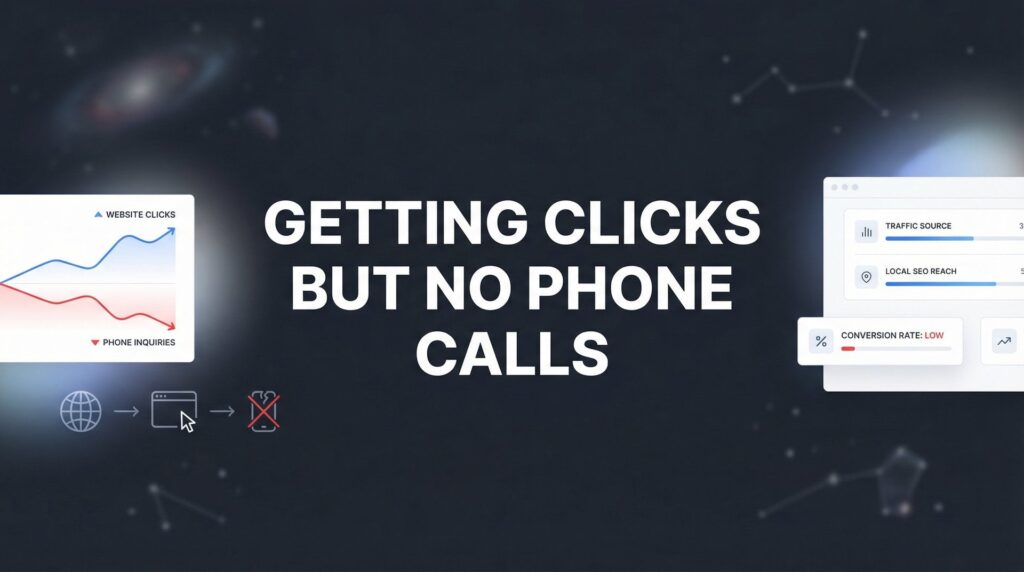
You check your Google Ads dashboard and see hundreds of clicks. Your credit card statement shows the charges. But when you look at your phone log, there’s nothing. Maybe one or two calls that went nowhere. The math doesn’t add up, and neither does your return on investment.
This is the most frustrating position for any local business owner: paying for traffic that disappears into thin air. You’re doing everything the marketing gurus said to do. You’re running ads, getting clicks, driving traffic to your website. But the phone stays silent, and your calendar stays empty.
Here’s the reality: getting clicks but no phone calls isn’t a mystery. It’s a symptom of specific, fixable problems in your marketing funnel. Somewhere between someone clicking your ad and picking up the phone to call you, something is breaking down. The good news? Once you identify where the breakdown is happening, you can fix it. And when you do, those clicks start turning into the conversations that actually grow your business.
Why Your Click Numbers Don’t Pay the Bills
Let’s start with an uncomfortable truth: clicks are a vanity metric. They make you feel like your marketing is working because the numbers go up. But clicks don’t pay your rent. They don’t cover payroll. They don’t keep your business running.
Revenue comes from customers. And for most local service businesses, customers start with a phone call.
Think about what actually has to happen between someone clicking your ad and becoming a paying customer. They click. They land on your page. They read your content. They decide you might be worth calling. They find your phone number. They actually dial it. They get through to someone. They schedule an appointment or request a quote. Then—and only then—do you have a shot at turning them into revenue.
That’s a lot of steps. Each one is a potential breaking point.
Many local business owners look at their click volume and assume they’re getting “good traffic” because people are visiting their site. But traffic quality isn’t measured by how many people show up. It’s measured by how many people are ready to buy what you’re selling. Understanding how to fix website traffic but no conversions starts with recognizing this fundamental distinction.
Someone researching options for next month is traffic. Someone with an urgent problem they need solved today is a lead. Your ads might be attracting plenty of the former while missing the latter entirely. When that happens, you get clicks that look impressive in your analytics but produce zero business results.
The disconnect between traffic and revenue isn’t about bad luck or a tough market. It’s about specific failures in your marketing system. And every one of those failures can be identified and corrected.
Your Landing Page Is Sabotaging Your Call Volume
Someone just clicked your ad. They’re on your landing page right now. They have their phone in their hand. Will they call you?
For most local business websites, the answer is no. And it’s not because the visitor isn’t interested. It’s because the landing page makes calling you harder than it should be.
The Phone Number Problem: Pull up your landing page on your phone right now. How long does it take you to find your phone number? Is it at the top of the page? Is it a clickable button that immediately opens your phone’s dialer? Or is it buried in the footer, typed out as plain text that requires someone to manually dial it?
If your phone number isn’t immediately visible and instantly clickable on mobile devices, you’re losing calls. Period. When someone is ready to call, they want to do it now. Making them scroll, search, or manually type in your number creates friction. Friction kills conversions.
The Trust Signal Gap: Now imagine you’re the visitor. You just clicked an ad for a business you’ve never heard of. You land on a page that shows… what, exactly? A generic stock photo? Some vague claims about quality service? Maybe a paragraph about how long you’ve been in business?
That’s not enough. People don’t call businesses they don’t trust. And trust isn’t built with claims—it’s built with proof.
Where are your Google reviews? Where are your credentials, licenses, or certifications? Where’s the guarantee that shows you stand behind your work? Where are the photos of your actual team, your actual work, your actual results?
Service businesses especially need these trust signals because you’re asking someone to let you into their home or business. Without visible proof that you’re legitimate, professional, and reliable, many potential customers will click away rather than take the risk of calling. This is a core reason why businesses aren’t getting customers online despite decent traffic numbers.
The Speed and Mobile Experience: Here’s what happens when your landing page loads slowly: nothing. Because the visitor is already gone.
Page speed matters more than almost anything else. If your page takes more than three seconds to load, you’re losing a significant portion of your traffic before they even see your content. On mobile connections, slow load times are even more deadly.
And speaking of mobile: if your landing page isn’t designed for phone screens, you’re sabotaging yourself. Tiny text that requires zooming. Buttons that are too small to tap accurately. Forms that are frustrating to fill out on a phone. These aren’t minor inconveniences—they’re conversion killers.
The landing page audit is simple: Can someone on a phone, in a hurry, with a problem they need solved, immediately find your phone number and feel confident enough to call you? If the answer is anything other than “absolutely yes,” you’ve found your first problem.
You’re Paying for the Wrong Traffic
Not all clicks are created equal. Some clicks come from people ready to hire someone today. Others come from people casually browsing with no intention of buying anything. Your ads might be attracting plenty of the second group while missing the first one entirely.
The Keyword Intent Problem: Let’s say you’re a plumber. Someone searches “how to fix a leaky faucet.” Your ad shows up. They click. They read your page. Then they leave without calling because they weren’t looking for a plumber—they were looking for a YouTube tutorial.
This is the keyword intent mismatch, and it’s one of the most common reasons for clicks without calls. Informational searches attract researchers. Transactional searches attract buyers. If your keyword targeting doesn’t distinguish between the two, you’re paying for traffic that was never going to convert.
“Emergency plumber near me” is a transactional search. Someone has an urgent problem and needs professional help now. “How much does plumbing cost” is informational. Someone is researching, comparing, and probably not ready to hire anyone yet.
When your keyword list is full of informational queries, you get clicks from people who aren’t ready to buy. Those clicks cost you money but produce zero revenue. The fix is ruthlessly cutting keywords that attract researchers instead of buyers. Learning how to improve ads starts with understanding this intent distinction.
Geographic Targeting Mistakes: You serve a specific area. Let’s say you cover a 20-mile radius from your location. But your ads are showing to people 50 miles away because your geographic targeting is set too wide.
Those distant clicks might look good in your reports, but they’re worthless. Someone who lives outside your service area isn’t going to hire you, no matter how good your landing page is. They might click out of curiosity or because your ad caught their attention, but the call will never happen because you can’t help them.
Geographic targeting needs to match your actual service area. Not aspirational coverage. Not “maybe we could go there if the job was big enough.” Your actual, realistic service radius where you can profitably do business.
Ad Copy That Attracts Tire-Kickers: Your ad copy is a filter. It should attract the right people and repel the wrong ones. But many local business ads do the opposite: they attract price shoppers and casual browsers while failing to speak to serious buyers.
Ad copy focused on “affordable,” “cheap,” or “discount” attracts people whose primary concern is price. These people are usually calling multiple businesses to compare quotes, and they’re often not the customers you want. Ad copy focused on urgency, expertise, and results attracts people who have a problem they need solved and are looking for someone qualified to solve it.
The wrong ad copy fills your click reports while leaving your phone silent. The right ad copy might generate fewer clicks, but those clicks come from people who are actually ready to hire someone.
Why Strangers Won’t Call You (Even When They Need What You Sell)
Someone just discovered your business 30 seconds ago. They clicked an ad, landed on your page, and now they’re deciding whether to call. What’s stopping them?
Trust. Or more accurately, the lack of it.
Think about your own behavior. When was the last time you called a business you’d never heard of before, with zero social proof, to let them come to your home or handle something important? Probably never. Because that’s not how normal people make decisions.
The Cold Traffic Problem: Everyone who clicks your ad is, by definition, cold traffic. They don’t know you. They’ve never worked with you. They have no reason to believe you’re any good at what you do. You’re asking them to take a leap of faith based on nothing but your ad and landing page.
That’s a big ask. And for many potential customers, it’s too big.
The trust gap is the space between “I need this service” and “I trust this specific business enough to call them.” For some businesses, that gap is small. For others, it’s a canyon. Service businesses that work in people’s homes, handle expensive equipment, or deal with urgent problems face a particularly large trust gap.
Social Proof Changes Everything: Here’s what happens when someone sees real reviews from real customers on your landing page: the trust gap shrinks. Dramatically.
Reviews are the most powerful trust signal available to local businesses. They’re proof that other people have hired you, worked with you, and been satisfied enough to recommend you. They transform you from “random business I found online” to “business that other people vouch for.”
But reviews only work if they’re visible. Having 50 five-star Google reviews doesn’t help you if visitors have to leave your landing page to find them. Your best reviews should be prominently displayed on the page where people are deciding whether to call you.
Beyond reviews, other trust signals matter too. Professional certifications. Industry licenses. Years in business. Guarantees or warranties. Photos of your team. Before-and-after examples of your work. Any proof point that demonstrates you’re legitimate, qualified, and reliable.
Your Online Reputation Directly Impacts Call Volume: Someone is on your landing page right now. Before they call, they’re going to Google your business name. What will they find?
If they find recent positive reviews, professional photos, and evidence that you’re active and responsive, they’ll probably call. If they find old negative reviews, no recent activity, or conflicting information about your business, they’ll probably leave.
Your online reputation isn’t separate from your conversion rate. It’s a direct factor in whether people call you. Businesses with strong, positive, recent online reviews get more calls from the same amount of traffic. Businesses with weak or negative online reputations get fewer calls, even when everything else about their marketing is working.
The trust gap explains why two businesses in the same industry, with the same ad spend and similar traffic levels, can have wildly different call volumes. One has built trust signals into their landing page and maintains a strong online reputation. The other hasn’t. The difference shows up in the phone logs.
You Might Be Getting Calls You Don’t Know About
Here’s a scenario that happens more often than you’d think: Your ads are actually working. People are calling. But you have no idea it’s happening because your tracking is broken.
This is the attribution problem, and it’s costing many local businesses a fortune in wasted ad spend on campaigns they think aren’t working.
Call Tracking Setup Failures: You can track clicks easily. Google Ads tells you exactly how many people clicked your ad, when they clicked, and how much each click cost. But calls? That’s a different story.
Many local businesses don’t have call tracking set up at all. They’re running ads that drive phone calls, but they have no system for connecting those calls back to their marketing. Someone calls, books an appointment, becomes a customer, and the business has no idea which ad or keyword generated that customer.
Without call tracking, you’re flying blind. You might be getting calls from your ads, but you can’t prove it. You can’t optimize for it. You can’t identify which campaigns are working and which ones aren’t. You’re making marketing decisions based on incomplete data. Understanding marketing attribution models is essential for connecting your ad spend to actual revenue.
Proper call tracking means using unique phone numbers for your ads that forward to your main business line. When someone calls that number, the system records where they came from, which ad they clicked, and which keyword triggered it. This data connects your online advertising to your offline conversions.
The Attribution Gap: Even with call tracking, attribution gets complicated. Someone might click your ad on Monday, research you for a few days, then call you on Thursday using the phone number they found on your Google Business Profile instead of the tracking number from your landing page.
Did your ad generate that call? Technically, yes. Will your tracking system show it? Probably not.
This attribution gap means you’re likely getting more value from your ads than your reports indicate. The problem is, you can’t see it. You look at your campaign data, see low conversion numbers, and assume your ads aren’t working. Meanwhile, your phone is ringing with customers who found you through those ads—you just can’t connect the dots.
Measuring the Full Conversion Picture: Proper measurement requires tracking multiple touchpoints. Someone might click your ad, visit your website, leave without calling, then search for your business name later and call from your Google listing. Or they might click your ad on their phone, then call from their office phone later using a number they wrote down.
These are real conversions that your basic tracking won’t capture. To get the full picture, you need to track website visits, form submissions, tracking number calls, main business line calls, and even in-person visits from people who mention finding you online.
The more complete your tracking, the more accurate your understanding of what’s actually working. And when you know what’s working, you can do more of it. When you don’t, you’re making decisions based on partial information—and often making the wrong decisions as a result.
The Fix: A Systematic Approach to Converting Clicks Into Calls
You’ve identified the problems. Now let’s talk about fixing them. This isn’t about making random changes and hoping for improvement. It’s about a systematic approach that addresses each breaking point in your conversion funnel.
Start With a Conversion Audit: Before you change anything, you need to know exactly where the problems are. A proper conversion audit examines every step of your customer journey from ad click to phone call.
Landing page audit: Test your page on mobile. Time how long it takes to load. Evaluate whether your phone number is immediately visible and clickable. Check for trust signals like reviews, credentials, and guarantees. Look at your content through the eyes of someone who’s never heard of your business before.
Targeting audit: Review your keyword list for intent mismatches. Check your geographic targeting against your actual service area. Analyze your ad copy to see if it’s attracting researchers or buyers. Look at your search term reports to identify wasted spend on irrelevant queries.
Tracking audit: Verify that your call tracking is properly set up and working. Test the tracking numbers to ensure they forward correctly. Review your conversion tracking in Google Ads to confirm it’s capturing the data you need. Identify any attribution gaps in your current system.
This audit gives you a prioritized list of problems to fix, starting with the issues that are costing you the most conversions.
Quick Wins That Improve Call Rates Fast: Some conversion improvements take time. Others can be implemented immediately and start producing results within days.
Add click-to-call buttons at the top of your landing page. This single change often produces an immediate increase in call volume because you’re removing friction from the conversion process. On mobile devices, a prominent click-to-call button is the difference between someone calling you and someone leaving your site.
Display your best reviews prominently on your landing page. Don’t make people hunt for social proof. Put your highest-rated reviews right where people can see them while they’re deciding whether to call. Include the reviewer’s name, their rating, and a quote that highlights what you do well.
Tighten your geographic targeting to match your actual service area. Stop paying for clicks from people you can’t help. This might reduce your click volume, but it will improve your conversion rate because every click comes from someone you can actually serve.
Add negative keywords to filter out informational searches. If you’re a plumber, add “how to,” “DIY,” and “tutorial” as negative keywords. These terms indicate someone looking for free information, not a professional service. Blocking them saves you money on clicks that will never convert. If you’re struggling with ads not converting to sales, negative keywords are often the fastest fix.
When to Bring in CRO Expertise: Some conversion problems require testing, analysis, and optimization expertise that most business owners don’t have. Knowing when to bring in help is just as important as knowing how to fix simple issues yourself.
If you’ve made the obvious fixes—mobile-friendly landing page, visible phone number, trust signals, proper targeting—and you’re still getting clicks but no calls, the problem is likely more complex. It might be your offer positioning. It might be subtle trust issues. It might be that your landing page messaging doesn’t match your ad messaging, creating confusion that kills conversions.
Professional conversion rate optimization involves systematic testing of different page elements, messaging angles, and offer structures. It’s about running controlled experiments to identify exactly what moves the needle for your specific business and audience. This level of optimization requires tools, expertise, and time that most local business owners don’t have.
The ROI threshold for bringing in help is simple: if the gap between your current conversion rate and a properly optimized conversion rate represents thousands of dollars in lost revenue per month, professional optimization pays for itself quickly. If you’re spending significant money on ads but getting minimal results, the cost of not fixing the problem is higher than the cost of hiring someone who knows how to fix it.
Turning Traffic Into Revenue That Actually Shows Up
Getting clicks but no phone calls isn’t just frustrating. It’s expensive. Every click you pay for that doesn’t turn into a call is money you’re spending with nothing to show for it. Over weeks and months, that wasted spend adds up to real money—money that could have been reinvested in your business, hired another employee, or simply stayed in your bank account.
The good news is that this problem is solvable. The issues we’ve covered—landing page problems, targeting mistakes, trust gaps, and tracking failures—are specific, identifiable, and fixable. You’re not dealing with bad luck or impossible market conditions. You’re dealing with technical and strategic problems that have technical and strategic solutions.
The businesses that win in local service markets aren’t the ones with the biggest ad budgets. They’re the ones with the tightest conversion funnels. They’re the ones who’ve eliminated the friction points that kill conversions. They’re the ones whose landing pages build trust instantly, whose targeting attracts ready-to-buy customers, and whose tracking systems show them exactly what’s working.
When you fix the disconnect between clicks and calls, everything changes. Your cost per customer drops. Your ROI improves. Your ad spend goes from feeling like a gamble to feeling like a predictable investment. The phone starts ringing with qualified prospects who are ready to hire someone, and you’re the business they’re calling.
Tired of spending money on marketing that doesn’t produce real revenue? We build lead systems that turn traffic into qualified leads and measurable sales growth. If you want to see what this would look like for your business, we’ll walk you through how it works and break down what’s realistic in your market.
Want More Leads for Your Business?
Most agencies chase clicks, impressions, and “traffic.” Clicks Geek builds lead systems. We uncover where prospects are dropping off, where your budget is being wasted, and which channels will actually produce ROI for your business, then we build and manage the strategy for you.