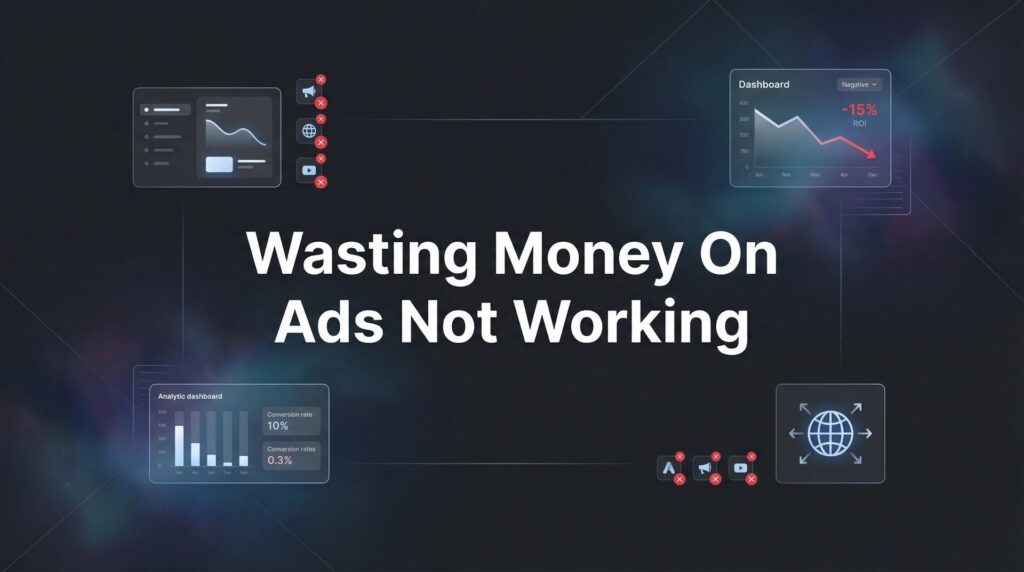
You log into your ad account. The number staring back at you makes your stomach drop: $2,847 spent this month. You scroll through the dashboard looking for good news—any good news. The clicks are there. The impressions look decent. But your phone? Silent. Your inbox? Empty. Your calendar? Wide open.
This is the moment when “digital marketing” stops feeling like an opportunity and starts feeling like a black hole swallowing your budget.
Here’s the truth: You’re not alone in this frustration. Local business owners across every industry face this exact problem. They’re told advertising works, they invest real money, and then… nothing. But here’s what most people don’t realize—the issue isn’t that advertising doesn’t work. The problem is specific, fixable mistakes in how campaigns are built and managed. And once you understand what’s actually going wrong, you can stop the bleeding and start seeing real returns.
This isn’t going to be another vague article about “optimizing your campaigns.” We’re going to walk through the exact reasons your ad spend disappears, the hidden settings working against you, and the concrete steps to fix it. No fluff. No theory. Just the real problems and real solutions.
The 5 Hidden Reasons Your Ad Spend Disappears Into Thin Air
Let’s start with the most common culprit: your ads are reaching the wrong people. Sounds simple, right? But this one mistake burns through more budgets than almost anything else.
Poor targeting is budget poison. When you set up a campaign without precise targeting parameters, you’re essentially paying to show your ads to anyone and everyone. Think about what that means in practice. If you’re a roofing company in Dallas, you don’t want to pay for clicks from people in Houston. If you offer premium services, you don’t want budget wasted on bargain hunters who’ll never convert. If you specialize in commercial work, residential searchers are just expensive noise.
Many platforms default to broader targeting than you’d expect. Google Ads will happily expand your geographic radius if it thinks it can get you more clicks. Facebook will show your ads to “people similar to your audience” even when those similarities are superficial at best. These expanded audiences feel helpful—more reach, more potential customers. But in reality? You’re paying for impressions and clicks from people who were never going to buy.
Generic ad copy is invisible ad copy. When someone searches for what you offer, they don’t just see your ad. They see yours plus three or four competitors, all crammed into the same screen space. If your ad reads like everyone else’s—”Quality Service,” “Affordable Prices,” “Free Consultation”—you’ve given them zero reason to click on you instead of the next guy.
The businesses that win in paid advertising understand differentiation. They lead with what makes them different, not what makes them the same. They speak to specific pain points. They make concrete promises. They give searchers a clear reason to choose them in that split-second decision.
Where you send traffic matters more than the ad itself. This one catches people off guard. You can have perfect targeting and compelling ad copy, but if you’re sending clicks to your homepage, you’re setting money on fire.
Here’s why: Someone clicks your ad because it promises a specific solution to their specific problem. They land on your homepage and suddenly they’re looking at your company history, your team photos, your mission statement, and seventeen different service offerings. The thing they actually wanted? Buried somewhere in a dropdown menu. The clear next step? Nowhere to be found. This is exactly why ads don’t convert to sales for so many businesses.
Every click costs money. Every visitor who lands on a confusing page and leaves is budget wasted. The fix is simple in concept—send people to a dedicated landing page that delivers exactly what your ad promised, with one clear action to take. But most businesses skip this step entirely, then wonder why their conversion rates are abysmal.
Bidding strategies that work against you. Ad platforms offer automated bidding options that sound great: “Maximize Clicks,” “Maximize Conversions,” “Target CPA.” The problem? These strategies optimize for what the platform can measure, not necessarily what matters to your business. “Maximize Clicks” will get you clicks, alright—from people who have zero intention of buying. “Maximize Conversions” optimizes for form fills, even if those form fills are from tire kickers and competitors doing research.
No conversion tracking means flying blind. This might be the most dangerous problem of all because you don’t even know it’s happening. You’re running ads, spending money, maybe even getting some leads. But you have no idea which ads produced which leads, which keywords are profitable, or which campaigns are actually worth the investment. Without proper tracking, every optimization decision is a guess. And guessing with your marketing budget is expensive.
Why ‘Set It and Forget It’ Is Killing Your ROI
Let’s address the most expensive myth in digital advertising: the idea that you can set up a campaign, turn it on, and let it run while profits roll in.
This fantasy gets sold hard. Ad platforms want you to believe their automation handles everything. Marketing gurus promise “passive income” from ads that run themselves. The reality? Campaigns left unmanaged don’t just underperform—they actively get worse over time.
Ad platforms optimize for their revenue, not yours. Think about the incentives at play. Google makes money when you spend money on clicks. Facebook profits when you pay for impressions. Their automated systems are brilliant at maximizing those metrics. What they’re not optimized for is your actual business results.
When you enable broad match keywords without active management, Google interprets your keywords liberally. You bid on “emergency plumber,” and suddenly you’re paying for clicks on “plumbing supplies,” “plumber salary,” and “how to become a plumber.” None of those searchers want to hire you. All of them cost you money. Understanding proper Google Ads optimization is essential to preventing this waste.
Automated placements work the same way. Facebook will show your ads wherever it can get cheap impressions—audience network apps, random websites, placements where nobody actually engages. Your budget gets spent. Facebook’s revenue goes up. Your results stay flat.
Search term reports reveal the bleeding. Here’s what happens when you actually look at where your clicks come from: You discover you’ve been paying for search terms that have nothing to do with your business. Competitor names. Job searches. How-to queries from DIYers who’ll never hire anyone.
Every experienced PPC manager has a story about inheriting a campaign and finding thousands of dollars wasted on irrelevant searches. The business owner had no idea because they never checked. The campaign kept running. The budget kept draining. The platform kept profiting.
Building a comprehensive negative keyword list isn’t a one-time task—it’s ongoing maintenance. You add negatives based on actual search terms. You refine them as you see new patterns. You protect your budget from waste systematically. Skip this step and you’re essentially handing money to the platform for clicks you never wanted.
Performance degrades without optimization. Even campaigns that start strong deteriorate over time. Competitors adjust their strategies. Audience behavior shifts. Market conditions change. What worked last month stops working this month. The campaigns that succeed long-term are the ones that get actively managed, tested, and refined based on real performance data.
The “set it and forget it” approach doesn’t just leave money on the table—it actively burns through budget on declining performance while you’re not looking.
The Landing Page Problem Nobody Talks About
Your ads might be perfect. Your targeting might be dialed in. And you could still be wasting every dollar if your landing page experience is broken.
This is the invisible problem that kills campaigns. Business owners focus all their attention on the ads themselves—the copy, the images, the targeting. They obsess over click-through rates and cost per click. Meanwhile, the real issue is what happens after the click.
Speed kills conversions. Someone clicks your ad on their phone while standing in line at the coffee shop. Your page starts loading. And loading. And loading. After three seconds, they’re gone. You just paid for that click. You got nothing for it.
Mobile page speed isn’t a nice-to-have anymore—it’s fundamental. People expect instant results. A slow page signals low quality, outdated business, not worth their time. They bounce before they even see your offer. The worst part? You have no idea this is happening unless you’re actively monitoring your site speed and bounce rates. If your website isn’t generating leads, page speed is often the hidden culprit.
Message match makes or breaks conversion. Your ad promises “Free Roof Inspection for Storm Damage.” The person clicks, expecting to schedule that inspection. They land on a page about your company’s 30-year history and full range of services. Where’s the free inspection? Buried in a contact form that asks for their home’s square footage, roof type, and project timeline.
The disconnect between ad promise and landing page delivery is conversion poison. When what people find doesn’t match what you promised, they leave. It’s that simple. Every element of your landing page should reinforce the specific promise that got them to click in the first place.
Unclear calls-to-action create decision paralysis. Your landing page needs to answer one question clearly: “What do I do next?” If visitors land on your page and have to hunt for the next step, most won’t bother. If they see multiple competing options—”Call Now,” “Request Quote,” “Schedule Consultation,” “Download Guide,” “Chat With Us”—they freeze. Too many choices equals no choice.
The highest-converting landing pages make the next step obvious and singular. One clear action. One compelling reason to take it. No distractions. No competing options. Just a straight path from click to conversion.
Mobile experience isn’t optional. The majority of clicks come from mobile devices now. If your landing page isn’t designed for mobile-first experience, you’re losing conversions by default. Tiny text that requires zooming. Buttons too small to tap accurately. Forms that are painful to fill out on a phone. Each friction point costs you conversions.
Simple fixes here can double your conversion rate without spending another dollar on ads. Faster loading. Clear message match. Single focused call-to-action. Mobile-optimized design. These aren’t advanced tactics—they’re fundamentals that most businesses get wrong.
How to Know If Your Campaign Is Actually Broken (Or Just Needs Time)
Here’s the question that keeps business owners up at night: Is my campaign failing, or does it just need more time to work?
This matters because making the wrong call here is expensive either way. Kill a campaign too early and you waste the learning investment. Let a broken campaign run too long and you burn through budget on something that will never work.
Learning phases are real—but they’re not infinite. When you launch a new campaign, ad platforms need data to optimize. Google needs to learn which searches convert. Facebook needs to understand which audiences respond. This learning period is legitimate. But it’s measured in days or weeks, not months.
For most local business campaigns, you should see meaningful signals within 7-14 days. Not necessarily profitable results yet, but signals. Are people clicking? Are they taking action on your site? Are the right types of searches triggering your ads? If you’re two weeks in with zero engagement, something is fundamentally wrong with your setup.
Red flags that demand immediate action. Some metrics tell you instantly that you have a problem. High impressions with zero clicks means your ad copy isn’t compelling or your offer isn’t relevant to the searches triggering it. Lots of clicks but zero conversions suggests your landing page experience is broken or you’re attracting the wrong traffic. Cost per click significantly higher than industry benchmarks indicates targeting problems or weak ad relevance scores.
These aren’t “wait and see” situations. These are “pause and fix” signals. Continuing to run campaigns with these metrics is just throwing money away while hoping something magically changes. Understanding why marketing isn’t working requires looking at these specific warning signs.
Good metrics in the wrong context. This one tricks people. You see decent click-through rates and think things are working. But if those clicks come from irrelevant searches, the metrics are meaningless. You see form submissions and celebrate conversions—until you realize they’re all from competitors doing research or people looking for jobs, not customers ready to buy.
Context matters more than the numbers themselves. A 2% conversion rate sounds good until you realize your competitor is converting at 8% with the same traffic source. Ten leads per month feels like progress until you discover only one of them is actually qualified.
When to optimize versus when to rebuild. If you’re getting clicks but not conversions, optimization makes sense. Test different landing pages. Adjust your offer. Refine your call-to-action. The fundamental campaign structure is working—you just need to improve conversion.
But if you’re getting impressions without clicks, or clicks from completely irrelevant searches, you don’t need optimization. You need to rebuild from the ground up. The targeting is wrong. The ad copy misses the mark. The keyword strategy is flawed. Tweaking won’t fix fundamental structural problems.
The businesses that succeed with paid advertising learn to read these signals accurately. They give campaigns enough time to gather meaningful data. They recognize red flags that demand immediate action. And they know the difference between a campaign that needs refinement and one that needs to be scrapped.
The Right Way to Fix Underperforming Ads (Step by Step)
Let’s get practical. Your campaigns aren’t working. You’ve identified the problems. Now what?
Start with targeting—everything else builds on this foundation. Before you touch your ad copy or landing pages, audit who actually sees your ads. Pull your demographic data. Check your geographic reports. Review your search term reports to see what queries trigger your ads.
Look for mismatches. Are you paying for clicks from locations you don’t serve? Are your ads showing for searches that indicate research intent rather than buying intent? Are you reaching demographics that don’t align with your actual customer base? Each mismatch represents wasted budget.
Fix the obvious problems first. Tighten geographic targeting to your actual service area. Add negative keywords for clearly irrelevant searches. Exclude audiences that consistently click but never convert. This isn’t about getting fewer clicks—it’s about getting better clicks from people who might actually become customers.
Rebuild your ad-to-landing-page connection. Map out the journey you’re creating. Someone sees your ad. What specific promise does it make? They click. What do they see first on your landing page? Does it match? Is the next step obvious?
The tighter this connection, the higher your conversion rate. If your ad promises “Same-Day Service,” your landing page headline should reinforce same-day service. If your ad targets emergency situations, your landing page should speak to that urgency. If your ad offers a specific promotion, that promotion should be front and center on the page.
This seems obvious when spelled out, but most campaigns violate this principle constantly. The ad makes one promise. The landing page makes a different pitch. The disconnect kills conversions even when everything else is working.
Implement tracking that actually tells you what’s working. You cannot optimize what you cannot measure. Proper conversion tracking means knowing which keywords produced which leads. Which ads generated which sales. Which campaigns delivered actual ROI versus which ones just generated activity.
Set up conversion tracking for every meaningful action: form submissions, phone calls, chat conversations, purchases. Connect your ad platforms to your CRM if possible, so you can track leads all the way through to closed sales. This level of visibility transforms how you manage campaigns. Instead of guessing which ads work, you know. Instead of optimizing for vanity metrics, you optimize for revenue.
Many businesses skip this step because it feels technical and complicated. But running ads without proper tracking is like driving with your eyes closed. You’re moving, but you have no idea if you’re headed in the right direction. Learning how to generate qualified leads online starts with proper measurement.
Test systematically, not randomly. Once your foundation is solid—targeting is tight, message match is strong, tracking is in place—then you can test improvements. But test one variable at a time. Change your headline and measure the impact. Adjust your offer and track the results. Test different calls-to-action and see what converts better.
Random testing produces random results. You change five things at once, performance improves, and you have no idea which change made the difference. Or performance drops, and you don’t know what broke. Systematic testing builds knowledge. You learn what works for your specific business, your specific audience, in your specific market.
Optimization is ongoing, not one-and-done. Markets shift. Competitors adjust. Audience behavior evolves. The campaign that crushes it today might underperform next quarter. Successful PPC management isn’t about finding the perfect setup and letting it run forever. It’s about continuous refinement based on real performance data.
This is why the “set it and forget it” myth is so dangerous. It sets completely wrong expectations. Effective campaigns require ongoing attention, regular optimization, and constant adaptation to changing conditions.
When DIY Isn’t Worth the Wasted Budget
Let’s talk about something nobody wants to admit: sometimes doing it yourself is the most expensive option.
The appeal of DIY is obvious. You save on management fees. You maintain control. You learn as you go. These benefits are real. But so are the costs—and they’re often invisible until you add them up.
The true cost of learning on your own dime. Every mistake you make costs real money. You set up broad match keywords wrong? That’s budget burned on irrelevant clicks while you figure it out. You send traffic to the wrong landing page? That’s wasted ad spend on visitors who never had a chance to convert. You miss negative keywords for three months? That’s thousands of dollars spent on searches that were never going to produce customers.
Think about what this means in practical terms. If you’re spending $2,000 per month on ads and operating at 50% efficiency because you’re still learning, you’re effectively wasting $1,000 every single month. Over a year, that’s $12,000 in wasted ad spend—money that went to the platforms instead of producing results for your business.
Now add the opportunity cost. While you’re learning PPC management, you’re not focusing on what you do best—running your actual business. The hours you spend trying to figure out campaign optimization are hours you’re not spending serving customers, improving operations, or growing revenue through channels you already understand.
What actually separates good PPC management from bad. Experience matters in paid advertising because the platforms are deliberately complex. Google and Facebook profit when advertisers make mistakes. They design their interfaces to encourage broad targeting and maximum spend. They default to settings that benefit them, not you. They make the profitable options hard to find and the expensive mistakes easy to make.
Someone who manages campaigns professionally knows these traps. They’ve seen the patterns. They understand which automated features actually help versus which ones just inflate costs. They’ve built negative keyword lists across dozens of industries. They know realistic benchmarks for your market. They can spot problems in minutes that might take you weeks to identify. Understanding Google Ads management pricing helps you evaluate whether professional help makes financial sense.
Questions to ask before hiring anyone. Not all PPC management is created equal. Some agencies are just as bad as going it alone—they set up campaigns, let them run, and collect management fees while your budget disappears. Before you trust anyone with your advertising investment, ask specific questions.
How often do they actually review and optimize campaigns? What specific actions do they take during optimization? How do they handle negative keywords and search term refinement? What reporting do they provide, and does it show actual business results or just platform metrics? Can they explain their strategy in plain language, or do they hide behind jargon?
A good PPC partner should be able to articulate exactly what they’ll do to protect your budget and improve your results. They should provide transparent reporting that shows not just clicks and impressions, but actual leads and revenue. They should communicate regularly and explain their decisions in terms you understand.
When DIY makes sense versus when it’s just expensive education. If you’re spending a few hundred dollars per month testing channels, DIY can make sense. The stakes are low enough that mistakes are affordable learning experiences. But once you’re investing serious money—$1,000+ per month—the cost of inefficiency quickly outweighs any management fees you’d pay for expertise.
The math is straightforward. If professional management costs $500 per month but improves your campaign efficiency by 30%, you’re not spending $500—you’re saving money. Better targeting means lower cost per click. Better conversion rates mean more leads from the same budget. Better optimization means sustained performance instead of gradual decline.
Stop the Bleeding, Start Getting Results
Wasting money on ads that don’t work isn’t inevitable. It’s not bad luck. It’s not that “advertising doesn’t work for my business.” It’s specific, fixable problems in how campaigns are set up and managed.
Poor targeting sends your budget to people who’ll never buy. Generic ad copy makes you invisible among competitors. Broken landing pages kill conversions even when everything else works. Lack of tracking leaves you flying blind. And the “set it and forget it” approach guarantees declining performance over time.
The good news? Every single one of these problems has a solution. Tighten your targeting to reach real prospects. Differentiate your ad copy to stand out. Build landing pages that match your ad promises and make conversion easy. Implement proper tracking so you know what’s actually working. And commit to ongoing optimization instead of hoping automation handles everything.
For some businesses, fixing these issues is a DIY project worth tackling. For others—especially those investing serious budget every month—the cost of learning through expensive mistakes makes professional management the smarter investment.
The question isn’t whether paid advertising can work for your business. It can. The question is whether you’re willing to fix what’s broken and implement what actually works.
Tired of spending money on marketing that doesn’t produce real revenue? We build lead systems that turn traffic into qualified leads and measurable sales growth. If you want to see what this would look like for your business, we’ll walk you through how it works and break down what’s realistic in your market.
Want More Leads for Your Business?
Most agencies chase clicks, impressions, and “traffic.” Clicks Geek builds lead systems. We uncover where prospects are dropping off, where your budget is being wasted, and which channels will actually produce ROI for your business, then we build and manage the strategy for you.