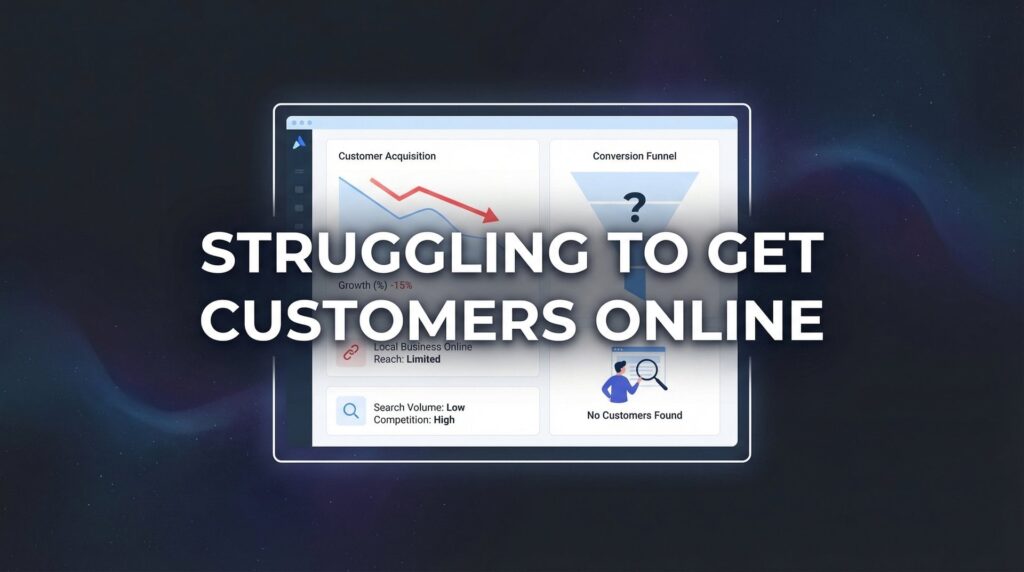
Most small businesses pour money into marketing that feels productive but delivers disappointing results. You’re posting on social media, maybe running some ads, perhaps even blogging occasionally—yet growth remains frustratingly flat.
The problem isn’t effort. It’s strategy.
Growth marketing differs fundamentally from traditional marketing because it focuses obsessively on measurable outcomes and rapid experimentation rather than brand awareness alone. For small businesses with limited budgets, this approach isn’t just preferable—it’s essential for survival.
The strategies ahead aren’t theoretical concepts from marketing textbooks. They’re battle-tested approaches that local businesses use to acquire customers profitably, scale what works, and cut what doesn’t. Whether you’re a service provider, retailer, or professional practice, these growth marketing strategies will help you stop guessing and start growing.
1. Build a Conversion-First Website
The Challenge It Solves
Your website might look beautiful, but if visitors aren’t converting into leads or customers, it’s just an expensive digital business card. Many small businesses treat their website as a brochure—information exists, but there’s no clear path to action. Traffic without conversion is just wasted opportunity.
Think of it like having a retail store where customers walk in, browse, then leave without anyone offering to help. That’s what happens when your website lacks strategic conversion elements.
The Strategy Explained
A conversion-first website is architected around one goal: turning visitors into leads or customers. Every element serves this purpose. Your homepage needs a clear value proposition above the fold—what you do, who you serve, and why someone should choose you—all visible within three seconds of landing.
Navigation should guide visitors toward conversion points, not overwhelm them with options. Service pages need to address objections, demonstrate value, and present clear calls-to-action. Mobile optimization isn’t optional anymore—most of your traffic comes from phones, and a clunky mobile experience kills conversions instantly.
The difference between a brochure site and a conversion machine comes down to intentional design. Every page should answer: “What action do I want visitors to take here?”
Implementation Steps
1. Audit your current site by tracking where visitors drop off—use tools like Microsoft Clarity to watch actual user sessions and identify friction points.
2. Simplify your navigation to essential pages only, removing anything that doesn’t support the conversion journey, and ensure your primary CTA appears in the header.
3. Create dedicated landing pages for each service or product with focused messaging, remove distracting navigation, and include multiple conversion opportunities throughout the page.
4. Optimize for mobile by testing every page on actual phones, ensuring buttons are thumb-friendly, forms are simple, and load times are under three seconds.
5. Add trust signals like customer reviews, credentials, case results, or recognizable client logos near conversion points to reduce hesitation.
Pro Tips
Place your phone number prominently in the header and make it clickable on mobile. Many local service businesses get more phone leads than form submissions. Also, use contrasting colors for CTA buttons—they should visually jump off the page. Test different CTA copy beyond generic “Submit” or “Contact Us”—specific language like “Get Your Free Quote” or “Schedule Your Consultation” typically converts better.
2. Deploy Strategic PPC Campaigns
The Challenge It Solves
Organic marketing takes time to build momentum. You need customers now, not six months from now. The challenge facing most small businesses is capturing demand that already exists—people actively searching for your services right this moment.
Without paid search, you’re invisible to high-intent prospects at the exact moment they’re ready to buy. Your competitors who do run PPC are capturing those customers while you wait for organic strategies to mature.
The Strategy Explained
Strategic PPC isn’t about blasting ads everywhere and hoping something works. It’s about identifying commercial-intent keywords—searches that indicate someone is ready to hire or buy—and positioning your business at the top of results for those specific queries.
Someone searching “emergency plumber near me” or “divorce attorney consultation” isn’t researching. They’re ready to take action. PPC captures that moment. The key is focusing budget on keywords that indicate purchase intent rather than informational searches, targeting geographic areas you actually serve, and creating ads that speak directly to the searcher’s immediate need.
For small businesses, Google Ads typically delivers better returns than social media advertising because you’re capturing existing demand rather than trying to create it. Understanding search engine marketing for small business fundamentals helps you avoid wasting budget on broad, low-intent keywords.
Implementation Steps
1. Start with Google Search campaigns targeting your core services with geographic modifiers like “service + city name” or “service + near me” variations.
2. Build tightly themed ad groups with 5-10 closely related keywords each, ensuring your ad copy directly mirrors the search terms to improve relevance and Quality Score.
3. Create dedicated landing pages for each campaign that match the ad messaging exactly—if your ad promises “same-day service,” that phrase should appear prominently on the landing page.
4. Set up conversion tracking from day one to measure which keywords actually produce leads and customers, not just clicks.
5. Implement negative keywords aggressively to avoid wasting budget on irrelevant searches—add terms like “jobs,” “salary,” “DIY,” or “free” unless they’re relevant to your business.
Pro Tips
Start with a modest daily budget and expand only after proving which campaigns work. Many businesses waste money by spreading budget too thin across too many campaigns. Focus is more profitable than coverage. Also, schedule ads to run during your business hours or when you can respond to leads immediately. A lead that waits 24 hours for response is often a lost lead.
3. Leverage Local SEO
The Challenge It Solves
National SEO is a bloodbath for small businesses. You can’t compete with enterprise companies and massive budgets for broad keywords. But local search? That’s your home turf advantage.
When someone searches for services in your city or neighborhood, you don’t need to outrank national brands—you need to dominate local results. The problem is most small businesses treat local SEO as an afterthought, leaving opportunity on the table.
The Strategy Explained
Local SEO focuses on appearing in the “map pack”—those three business listings that appear above organic results for local searches. This prime real estate captures the majority of clicks for service-based searches. Your Google Business Profile is the foundation. A complete, optimized profile with accurate information, regular posts, and consistent review generation signals to Google that you’re an active, legitimate business.
But local SEO extends beyond your GBP. Your website needs location-specific content, your business information must be consistent across directories, and you need to build local relevance through citations and links from other local businesses or organizations.
The compounding benefit of local SEO is that once you establish dominance, it becomes increasingly difficult for competitors to displace you. Rankings build on themselves. If you’re struggling to see results, exploring why marketing isn’t working for your business often reveals local SEO gaps as a root cause.
Implementation Steps
1. Claim and fully optimize your Google Business Profile with complete business information, service descriptions, regular photos, and posts at least twice weekly.
2. Build a systematic review generation process by asking satisfied customers immediately after service completion, making it easy with direct links, and responding professionally to every review.
3. Create location-specific service pages on your website for each area you serve, including unique content about serving that community rather than duplicate content with just the city name swapped.
4. Ensure your NAP (Name, Address, Phone) information is identical across your website, Google Business Profile, and all directory listings—inconsistency confuses search engines.
5. Build local citations by getting listed in industry-specific directories, local business associations, and chamber of commerce websites.
Pro Tips
Photos matter more than most businesses realize. Businesses with regular photo updates get more engagement and visibility. Take photos of your team, your work in progress, completed projects, and your location. Google rewards businesses that demonstrate active presence. Also, respond to reviews within 24 hours—response rate and speed are ranking factors.
4. Create a Referral Engine
The Challenge It Solves
Referrals happen naturally for good businesses, but natural referrals are inconsistent and unpredictable. You’re leaving growth to chance rather than building a system that generates referrals reliably.
The challenge is that even satisfied customers don’t think to refer you unless prompted at the right moment. They’re busy with their own lives. Without a systematic approach, you’re missing out on your highest-quality lead source.
The Strategy Explained
A referral engine transforms the occasional referral into a predictable lead channel through strategic timing, clear incentives, and friction-free processes. The key insight is that satisfied customers are usually willing to refer—they just need to be asked at the right moment with the right offer.
The best time to ask for referrals is immediately after delivering exceptional results, when satisfaction is highest. The best incentive structure rewards both the referrer and the new customer, creating mutual benefit. The best process makes referring as simple as forwarding an email or sharing a link.
Referred customers typically have higher lifetime value, lower acquisition costs, and better retention than customers from paid channels. This is one of the most profitable marketing strategies for business growth because acquisition costs approach zero while lead quality remains exceptionally high.
Implementation Steps
1. Identify your referral-worthy moment—the specific point in your customer journey when satisfaction peaks, whether that’s project completion, hitting a milestone, or receiving positive feedback.
2. Create a simple referral offer that benefits both parties, such as a discount or service upgrade for the referrer and an incentive for the new customer to take action.
3. Build an email sequence that triggers at your referral-worthy moment, thanking the customer for their business and making the referral ask with clear instructions.
4. Provide easy referral mechanisms like a unique referral link, a simple form to submit contact information, or a ready-to-forward email template they can send to friends.
5. Track referral sources in your CRM so you know who’s referring and can thank them personally, creating a positive feedback loop.
Pro Tips
Don’t wait until you have a formal program to start asking for referrals. Simply asking satisfied customers “Who else do you know who might benefit from this?” during your thank-you call can generate immediate results. Also, consider tiered incentives—customers who refer multiple people get increasing rewards, turning your best advocates into active promoters.
5. Implement Email Sequences
The Challenge It Solves
Most leads aren’t ready to buy the moment they first contact you. They’re researching, comparing options, or waiting for the right time. Without follow-up, these leads evaporate. You’ve paid to acquire them, but you’re not nurturing them toward a decision.
Manual follow-up is inconsistent and doesn’t scale. You forget to follow up, your team gets busy, or prospects slip through the cracks. Meanwhile, competitors with automated nurture sequences stay top-of-mind.
The Strategy Explained
Email sequences automate the nurture process, delivering value and building trust over time until prospects are ready to buy. The strategy is to segment leads based on where they are in the buying journey and deliver relevant content that moves them forward.
A new lead gets a welcome sequence introducing your business and establishing credibility. An engaged prospect who’s visited your pricing page multiple times gets a case study showcasing results. A past customer who hasn’t purchased in six months gets a re-engagement offer.
The power of sequences is that they work while you sleep. Every lead gets consistent follow-up regardless of how busy your team is. Implementing marketing automation for small business transforms sporadic outreach into a systematic revenue engine.
Implementation Steps
1. Build a welcome sequence for new leads that delivers immediate value—a helpful resource, answers to common questions, or a case study—across 5-7 emails over two weeks.
2. Create a nurture sequence for leads not yet ready to buy, providing educational content that addresses objections and demonstrates expertise without being pushy.
3. Develop a re-engagement sequence for past customers or cold leads, offering a special promotion, highlighting new services, or simply checking in with value.
4. Set up behavioral triggers so sequences adjust based on actions—if someone clicks a pricing link, they enter a sales-focused sequence; if they download a guide, they get related educational content.
5. Monitor open rates and click-through rates to identify which emails resonate, then optimize subject lines and content based on actual engagement data.
Pro Tips
Write emails like you’re talking to one person, not broadcasting to a list. Use “you” language, tell stories, and keep paragraphs short for easy mobile reading. Also, don’t be afraid to email your list regularly—businesses that email weekly typically see better results than those who email monthly because they stay top-of-mind.
6. Run Rapid Experiments
The Challenge It Solves
Traditional marketing operates on assumptions: “We think our customers want this,” or “This messaging should work.” You invest months and significant budget before discovering whether your assumptions were correct.
Small businesses can’t afford to wait months for results or waste budget on strategies that don’t work. You need to identify what works quickly and scale it, while cutting what doesn’t before it drains resources.
The Strategy Explained
The experimentation mindset treats every marketing decision as a hypothesis to test rather than a commitment to defend. You’re constantly running small tests across channels, messages, offers, and audiences to gather data about what actually drives results.
This isn’t about random trial and error. It’s structured testing with clear hypotheses, defined success metrics, and predetermined decision points. You might test two different ad headlines for a week, measure which drives more conversions, then invest more budget in the winner.
The businesses that grow fastest aren’t necessarily the ones with the best initial strategies—they’re the ones that learn and adapt fastest through systematic experimentation. Understanding growth marketing services for businesses can help you build this experimental framework into your operations.
Implementation Steps
1. Identify your biggest growth bottleneck right now—is it traffic, conversion rate, lead quality, or something else—and focus experiments there first.
2. Create a simple experiment tracking system documenting what you’re testing, your hypothesis, success metrics, and results so you build institutional knowledge.
3. Start with high-impact, low-effort tests like headline variations, CTA button colors, or email subject lines that you can execute quickly without major resource investment.
4. Run one experiment at a time in each channel so you can attribute results clearly—testing multiple variables simultaneously makes it impossible to know what drove the change.
5. Set predetermined decision criteria before starting each test—what result would make you scale this approach, and what result would make you kill it.
Pro Tips
Document your failures as thoroughly as your successes. Knowing what doesn’t work is just as valuable as knowing what does—it prevents you from wasting resources on similar approaches later. Also, give tests enough time to reach statistical significance. A test that runs for only two days with minimal traffic doesn’t tell you anything meaningful.
7. Double Down on CRO
The Challenge It Solves
Most small businesses focus obsessively on driving more traffic—more ads, more SEO, more social media. But if your website converts at two percent and your competitor converts at four percent, they’re getting twice the results from the same traffic investment.
Improving conversion rates has a multiplicative effect on every marketing channel. Better conversion means your PPC campaigns become more profitable, your SEO efforts generate more leads, and your referral traffic produces better results. It’s the highest-leverage activity you can focus on.
The Strategy Explained
Conversion rate optimization is the systematic process of improving the percentage of visitors who take your desired action. It combines analytics to identify where visitors drop off, hypothesis formation about why they’re dropping off, and testing to validate which changes actually improve results.
CRO isn’t about tricks or manipulation. It’s about removing friction, addressing objections, building trust, and making it crystal clear what action visitors should take next. Sometimes a simple change—clearer headlines, faster load times, or better mobile formatting—can dramatically improve conversion rates.
The beauty of CRO is that improvements compound. A five percent improvement in conversion rate plus a five percent improvement in traffic equals more than ten percent growth in results. If your marketing isn’t converting for your small business, CRO should be your first priority before spending more on traffic.
Implementation Steps
1. Install heat mapping and session recording tools to watch how real visitors interact with your site—where they click, how far they scroll, and where they abandon.
2. Analyze your conversion funnel to identify the biggest drop-off points—is it the homepage, service pages, contact form, or somewhere else.
3. Form hypotheses about why visitors are dropping off at each point—is it unclear value proposition, too much friction, missing trust signals, or confusing navigation.
4. Prioritize tests based on potential impact and ease of implementation—focus on high-traffic pages with clear problems before optimizing low-traffic pages.
5. Test one element at a time with clear before-and-after measurement, whether that’s headline variations, form length changes, or CTA button placement.
Pro Tips
Page speed is often the lowest-hanging fruit for conversion improvement. If your site takes more than three seconds to load on mobile, you’re losing conversions before visitors even see your content. Also, simplify your forms—every field you remove typically increases completion rates. Only ask for information you absolutely need at this stage.
Putting It All Together
Implementing all seven strategies simultaneously would overwhelm any small business owner. Instead, start with the foundation: ensure your website converts before driving traffic to it. A conversion-first site multiplies the effectiveness of everything else you do.
Then layer in one acquisition channel. Choose PPC if you need immediate results and have budget to invest. Choose local SEO if you’re playing the long game and want compounding returns. Don’t try to master both simultaneously—focus creates better results than scattered effort.
Add referral systems and email nurturing once you have consistent lead flow. These strategies maximize the value of customers you’re already acquiring. They’re force multipliers, not standalone channels.
Finally, adopt the experimentation mindset that separates growth marketers from traditional marketers. The businesses that win aren’t necessarily the ones with the biggest budgets. They’re the ones that measure everything, cut what doesn’t work fast, and scale what does.
That’s growth marketing in practice. It’s not about doing more marketing—it’s about doing marketing that actually produces measurable growth.
Tired of spending money on marketing that doesn’t produce real revenue? We build lead systems that turn traffic into qualified leads and measurable sales growth. If you want to see what this would look like for your business, we’ll walk you through how it works and break down what’s realistic in your market.
Want More Leads for Your Business?
Most agencies chase clicks, impressions, and “traffic.” Clicks Geek builds lead systems. We uncover where prospects are dropping off, where your budget is being wasted, and which channels will actually produce ROI for your business, then we build and manage the strategy for you.