You’re spending money on Facebook ads. You’ve hired someone to “do SEO.” Maybe you even tried Google Ads for a few months. But when you look at your bank account, nothing’s changed. The phone isn’t ringing more. The leads aren’t coming in. And you’re starting to wonder if marketing actually works at all—or if it’s just another expensive gamble that only pays off for everyone except you.
Here’s the truth: marketing absolutely works. But only when it’s done right. And most local businesses are unknowingly making critical mistakes that guarantee their campaigns will fail before they even start.
This isn’t about working harder or spending more money. It’s about understanding why your current approach isn’t delivering results—and fixing the specific problems that are sabotaging your success. Let’s diagnose exactly what’s going wrong and what you can do about it.
The Fatal Flaw of Trying to Reach Everyone
Ask most business owners who their ideal customer is, and you’ll hear something like: “Anyone who needs what we offer.” Or “Small to medium businesses in our area.” Or the classic: “Everyone could use our service.”
This sounds logical. More potential customers means more business, right? Wrong. This approach is precisely why your marketing dollars are evaporating without results.
When you target everyone, your message becomes so generic that it resonates with no one. Think about it: a 25-year-old entrepreneur shopping for marketing services has completely different concerns than a 55-year-old business owner looking for the same thing. Different pain points. Different objections. Different decision-making processes. A message that tries to speak to both ends up connecting with neither.
The businesses that dominate their markets do the opposite. They get uncomfortably specific about who they serve. Not “homeowners,” but “homeowners in their 50s preparing to downsize who are overwhelmed by the selling process.” Not “people who need accounting,” but “construction company owners who are profitable but have no idea what their actual numbers mean.”
Here’s what changes when you narrow your focus: Your ad targeting becomes surgical instead of scattered. Your messaging speaks directly to specific problems your ideal customer is actually experiencing. Your budget stops getting wasted on clicks from people who were never going to buy anyway.
But there’s a deeper issue here. Most businesses confuse demographic targeting with understanding buyer intent. Knowing someone is a 40-year-old business owner in your city tells you almost nothing about whether they’re ready to buy. What you really need to understand is what signals indicate someone is actively looking for your solution right now.
Are they searching for “best [your service] near me”? Are they comparing multiple providers? Did they just have a triggering event—like a competitor going out of business, a regulatory change, or hitting a growth milestone—that creates urgent need for what you offer? These intent signals matter infinitely more than basic demographics.
The fix starts with brutal honesty: Who are your absolute best customers? Not who could theoretically use your service, but who actually buys, pays on time, refers others, and makes your business profitable? Build your entire customer acquisition system around attracting more of those specific people. Yes, you’ll exclude potential customers. That’s the point. You’re trading volume for relevance—and relevance is what converts.
Why Your Message Blends Into the Background Noise
Pull up five competitor websites in your industry right now. Notice anything? They all say essentially the same thing. “Quality service.” “Competitive prices.” “Years of experience.” “Customer satisfaction guaranteed.” It’s marketing white noise—technically present, but completely forgettable.
Your potential customers are drowning in options. When every business claims the same benefits, those claims become meaningless. Saying you offer “quality service” is like a restaurant saying they serve “edible food”—it’s the baseline expectation, not a reason to choose you.
The brutal reality is that most business owners have no idea what actually makes them different. They think it’s their service quality or their prices or how long they’ve been in business. But here’s what’s really happening: you’re assuming customers care about what you think is important, rather than what actually motivates their buying decisions.
Let’s say you’re a plumber. You might think customers care that you’ve been in business for 20 years. What they actually care about is whether you’ll show up on time, give them an honest price before starting work, and not leave their bathroom looking like a construction zone. Those specific, tangible outcomes matter more than decades of experience.
Or maybe you run a marketing agency. You talk about “data-driven strategies” and “ROI-focused campaigns.” So does everyone else. What if instead you said: “We only take on clients when we’re confident we can generate at least 3x your investment in the first 90 days—and if we don’t, we work for free until we do”? Now you’re saying something different. Something that addresses the real fear keeping potential clients from hiring you.
The gap between what you think customers want to hear and what actually motivates action is often massive. You’re proud of your certifications. They want to know if you can solve their problem faster than the other guy. You emphasize your process. They want to understand what their life looks like after hiring you.
Finding your genuine competitive advantage requires uncomfortable self-examination. It’s not about inventing something fake or exaggerating your capabilities. It’s about identifying what you actually do differently—even if it seems small to you—and articulating it in terms of the outcomes your customers care about.
Maybe you’re not the cheapest, but you’re the only one who guarantees response within two hours. Maybe you’re not the biggest, but you’re the only one who specializes exclusively in your customer’s specific industry. Maybe your process isn’t revolutionary, but you’re the only one transparent enough to show customers exactly what they’re paying for before they commit.
Whatever makes you genuinely different, that’s what your marketing should scream from the rooftops. Not in vague terms, but in specific, concrete language that paints a picture of why choosing you is the obviously correct decision. When your message is truly differentiated, marketing becomes easier. Because you’re finally giving people a compelling reason to choose you instead of scrolling to the next option.
The Expensive Mistake of Mismatched Tactics and Goals
A local business owner decides they need to “do digital marketing.” They read an article about SEO being important, so they hire someone to optimize their website and write blog posts. Six months later, nothing’s changed. The business is frustrated. The SEO person is confused because rankings are improving. Everyone’s talking past each other.
Here’s what went wrong: The business needed leads this month to make payroll. SEO is a 6-12 month strategy. They chose a tactic based on what sounded important rather than what would actually solve their immediate problem.
This disconnect between strategy and tactics destroys more marketing budgets than almost anything else. Business owners latch onto whatever marketing channel is trending—maybe it’s Instagram right now, or TikTok, or whatever the latest guru is promoting—without asking the fundamental question: Is this where my actual customers are actively looking for solutions?
If you’re a B2B service provider and your ideal customer is a 50-year-old business owner, building a TikTok presence probably isn’t your fastest path to revenue. If you need immediate cash flow, investing heavily in content marketing that takes months to compound won’t save you. If your customers make buying decisions over weeks or months, expecting instant results from any channel is setting yourself up for disappointment.
The strategy-tactics mismatch shows up everywhere. A restaurant invests in SEO when their real opportunity is Google Business Profile optimization and getting more reviews. A consultant builds an elaborate social media presence when their best leads come from direct outreach and referrals. A retail store focuses on brand awareness campaigns when they desperately need foot traffic tomorrow.
Here’s how to align your approach with reality: Start with your actual business situation. Do you need leads immediately, or are you building for sustainable growth over time? Are your customers actively searching for solutions, or do they need to be educated that a problem exists? Do they make quick buying decisions, or is there a long consideration process?
If you need results fast, you need channels where buyers are already looking: Google Ads targeting high-intent search terms, optimized Google Business Profile, strategic local partnerships, or direct outreach to qualified prospects. These tactics connect you with people who have their wallet out right now. Understanding the difference between Google Ads and Facebook Ads for lead generation can help you choose the right platform for your goals.
If you’re building for the long term, then SEO, content marketing, email nurturing, and brand building make sense. But you need the patience and cash flow to wait for compounding results. Mixing up these timelines—expecting fast results from slow strategies or abandoning long-term tactics before they mature—guarantees frustration.
The smartest approach? Layer your tactics based on your timeline. Use high-intent channels like Google Ads to generate immediate revenue while simultaneously building long-term assets like SEO and content. This way you’re not choosing between eating today and eating next year—you’re doing both. A solid multi channel marketing strategy ensures you’re covering all your bases.
But whatever you do, choose tactics based on where your customers actually are and what timeline you’re working with. Not based on what sounds exciting or what worked for some completely different business in a completely different situation.
When Good Traffic Hits a Bad Website
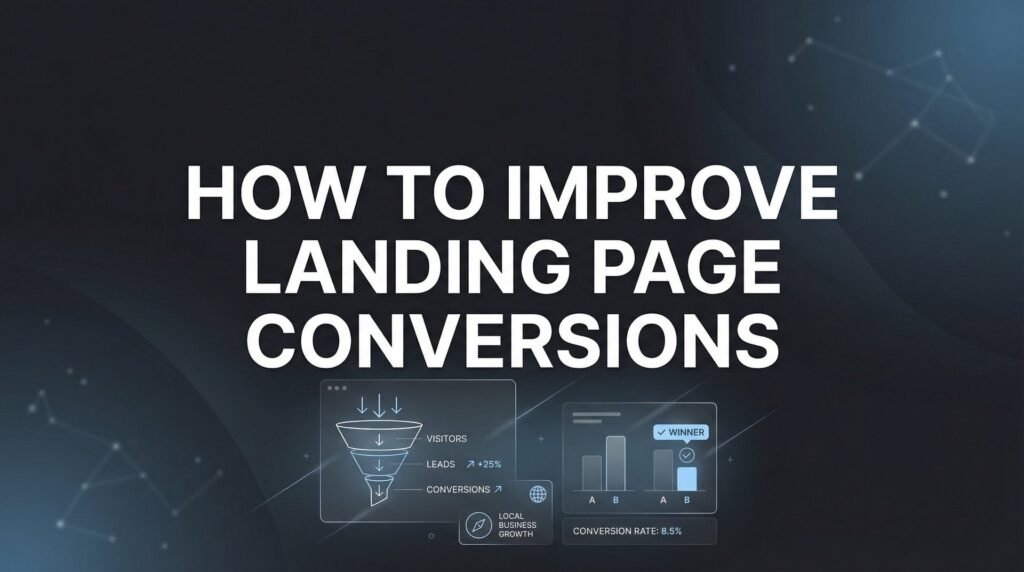
Imagine spending $2,000 driving 500 targeted visitors to your website. They’re perfect prospects—exactly the people you want to reach. But only 3 of them actually contact you. That’s a 0.6% conversion rate. You just burned $667 per lead.
This is the leaky bucket problem, and it’s killing your marketing ROI.
You can have the best targeting, the most compelling ads, and a perfectly differentiated message. But if your website doesn’t convert visitors into leads or customers, you’re pouring money into a broken system. It’s like filling a bucket with holes—no matter how much you pour in, nothing stays.
The most common leak is speed. Your site takes 8 seconds to load. The visitor’s gone in 3. They never even saw your offer. Many local business websites are built on bloated templates or haven’t been optimized in years. Every second of delay costs you conversions. If your site isn’t loading in under 3 seconds on mobile, you’re hemorrhaging potential customers before they even see your first headline.
Then there’s navigation confusion. Your visitor lands on your homepage and has no idea what to do next. There are seventeen different links, three different calls-to-action, and no clear path forward. They spend 10 seconds scanning, don’t immediately see what they’re looking for, and leave. Clear, obvious navigation isn’t about being fancy—it’s about making the next step so obvious a distracted person on their phone can’t miss it.
But the biggest conversion killer? Weak or missing calls-to-action. Your visitor is interested. They’re ready to take the next step. But your website just… ends. There’s no clear “Schedule a Consultation” button. No phone number prominently displayed. No compelling reason to act right now instead of later (which means never).
Or worse, your CTA is generic: “Contact Us” or “Learn More.” These phrases trigger zero urgency and communicate zero value. Compare that to: “Get Your Free Marketing Audit” or “Schedule Your Strategy Call” or “See Pricing and Availability.” These CTAs tell visitors exactly what they’ll get and what happens next. Implementing conversion focused marketing principles can dramatically improve these results.
Essential conversion elements most local business websites are missing: A clear value proposition above the fold that tells visitors exactly what you do and why it matters. Social proof—real reviews, testimonials, case studies, or results—that proves you actually deliver. A single, prominent call-to-action on every page that tells visitors the exact next step to take. Mobile optimization that makes your site usable on the device where most of your traffic actually comes from.
Here’s the thing about conversion optimization: small changes create massive results. Improving your conversion rate from 1% to 2% means you get twice as many leads from the same traffic. That’s the same impact as doubling your ad spend, except it costs you nothing.
Your website isn’t a digital brochure. It’s your hardest-working salesperson. And if that salesperson is slow, confusing, and doesn’t ask for the sale, your marketing will never work—no matter how much you spend driving traffic to it.
The Dangerous Distraction of Vanity Metrics
Your social media manager shows you the monthly report: 50,000 impressions, 2,000 engagements, 300 new followers. Looks impressive, right? Now answer this: How much revenue did those numbers generate? Most business owners have no idea. And that’s the problem.
Impressions don’t pay your bills. Followers don’t cover payroll. Engagement doesn’t keep the lights on. Revenue does. But most businesses are measuring the wrong things—or worse, measuring nothing at all—and wondering why their marketing feels like it’s not working.
Vanity metrics are numbers that make you feel good but don’t connect to business outcomes. They’re easy to track, they go up over time, and they look great in reports. They’re also almost completely useless for determining whether your marketing is actually working.
Think about it: You could have 10,000 followers on Instagram, but if none of them are potential customers in your area who could actually hire you, what’s the point? You could get 50,000 impressions on a Facebook post, but if those people scroll past without taking action, you’ve accomplished nothing except wasting time creating content.
Here’s what actually matters for local businesses: How many qualified leads did your marketing generate this month? What did it cost to generate each lead? How many of those leads converted into paying customers? What was the average revenue per customer? What’s your actual return on ad spend? Learning how to track marketing ROI properly transforms how you make decisions.
These numbers tell you whether your marketing is working. If you’re spending $1,000 on ads, generating 20 leads at $50 each, converting 4 of them into customers at $2,000 each, you made $8,000 from a $1,000 investment. That’s an 8x return. Your marketing is working. Do more of it.
But if you’re spending $1,000, getting 100 website visits (yay, traffic!), generating 2 leads, and closing zero customers, you just burned $1,000. Doesn’t matter how many people saw your ad or clicked your link. The business outcome was failure.
The specific numbers that indicate marketing success vary by business, but the principle is universal: Track metrics that connect directly to revenue. For service businesses, that’s usually leads, conversion rate, and customer acquisition cost. For e-commerce, it’s transactions, average order value, and return on ad spend. For local businesses, it might be phone calls, form submissions, and appointment bookings. Using call tracking for marketing campaigns helps you understand which channels actually drive phone leads.
Proper tracking reveals the truth about your marketing. It shows you which channels are profitable and which are vanity projects. It tells you whether your conversion rate problem is in your ads or your website. It helps you make smart decisions about where to invest more and what to cut.
Without tracking, you’re flying blind. You’re making decisions based on gut feeling and assumptions rather than data. You’re vulnerable to anyone who wants to sell you on the next shiny tactic because you have no way to measure whether your current approach is working.
The fix is straightforward: Set up proper conversion tracking. Use Google Analytics to see where your traffic comes from and what it does on your site. Use call tracking to know which marketing channels are generating phone calls. Use CRM systems to track leads through your entire sales process. Connect everything back to revenue so you can see the complete picture.
Once you’re measuring what matters, marketing decisions become obvious. You’re not guessing anymore. You’re looking at data that tells you exactly what’s working and what’s not. And you can finally answer the question that actually matters: Is this marketing generating more money than it costs?
Why Sporadic Efforts Never Gain Traction
January: You launch a new marketing campaign with enthusiasm. You’re posting on social media daily, running ads, sending emails. February: Still going strong, seeing some early results. March: Things got busy. You paused the ads to save money. Social media posting drops to once a week. April: You haven’t touched your marketing in two weeks. May: Panic sets in because leads have dried up. You restart everything from scratch.
Sound familiar? This feast-or-famine cycle destroys more marketing efforts than any other single factor. Because here’s what most business owners don’t understand: marketing is a compounding system, not a light switch.
When you start and stop, you never build momentum. Every time you pause, you lose the progress you’ve made. Your Google Ads quality scores reset. Your SEO rankings drop. Your audience forgets you exist. Then when you restart, you’re not picking up where you left off—you’re starting over from zero.
Compare that to consistent effort over time. A business that invests $1,000 per month in marketing for 12 months straight will dramatically outperform a business that invests $3,000 for four months and then stops. Why? Because marketing channels reward consistency. SEO compounds—each piece of content builds on the last. Paid ads improve as the algorithms learn from more data. Brand awareness grows as people see you repeatedly over time.
The realistic timeline for different marketing channels matters here. Google Ads can generate leads immediately, but it takes 2-3 months to fully optimize campaigns and bring costs down. SEO takes 6-12 months to show meaningful results, but then continues delivering for years. Email marketing needs time to build a list before it becomes a significant revenue driver. Social media requires months of consistent presence before you break through the noise.
When you quit after 6 weeks because you’re not seeing results, you’re stopping right before the breakthrough. When you pause and restart repeatedly, you’re resetting the clock every time. You never get to experience the compounding phase where marketing becomes dramatically more efficient and effective. Understanding how to optimize your marketing campaign helps you improve results without starting over.
The consistency problem has another dimension: sporadic execution looks unprofessional. When a potential customer checks out your business and sees your last social media post was three months ago, or your blog hasn’t been updated since last year, it raises questions. Are you still in business? Do you care about your online presence? If you can’t maintain consistency in your own marketing, why should they trust you to deliver consistent service?
Building sustainable marketing systems solves this. Instead of relying on bursts of motivated activity, you create processes that run whether you’re busy or not. You set aside a fixed marketing budget that doesn’t get raided when cash flow gets tight. You schedule content in advance. You commit to specific activities on specific days. You treat marketing like any other essential business function—not something you do when you feel like it. Implementing marketing automation for small business can help maintain consistency even when you’re busy.
This doesn’t mean you can’t adjust tactics or pause campaigns that aren’t working. It means you maintain a baseline level of marketing activity constantly. Even if that baseline is modest—maybe it’s just keeping your Google Ads running and posting once a week—it’s infinitely better than the on-off cycle that guarantees mediocre results.
The businesses that win with marketing are rarely the ones with the biggest budgets or the flashiest campaigns. They’re the ones that show up consistently, month after month, building momentum while their competitors are still stuck in the start-stop cycle wondering why nothing ever works.
Putting It All Together
If you’ve recognized yourself in any of these seven problems, you’re not alone. Most local businesses are making at least three or four of these mistakes simultaneously—and wondering why marketing feels like an expensive gamble rather than a reliable growth engine.
The good news? Marketing failures are almost always diagnosable and fixable. You don’t need a bigger budget or some secret strategy. You need to identify what’s actually broken and fix those specific problems.
Start with an honest audit: Are you targeting everyone or focusing on your ideal customer? Does your message differentiate you or blend into the background? Are your tactics aligned with your timeline and goals? Is your website converting the traffic you’re paying for? Are you measuring what matters or getting distracted by vanity metrics? Are you showing up consistently or stuck in the start-stop cycle?
Fixing even one of these issues can dramatically improve your results. Fixing all of them transforms marketing from a frustrating expense into your most reliable source of new business. But here’s the reality: diagnosing these problems yourself is hard when you’re inside the business. You’re too close to see the blind spots. You don’t know what you don’t know.
That’s where working with experts who’ve solved these exact problems hundreds of times makes all the difference. Not another agency that will take your money and deliver vague promises. A partner who can look at your specific situation, identify exactly what’s broken, and implement proven systems that deliver measurable results. A digital marketing consultant for small business can provide the outside perspective you need.
Stop wasting your marketing budget on strategies that don’t deliver real revenue—partner with a Google Premier Partner Agency that specializes in turning clicks into high-quality leads and profitable growth. Schedule your free strategy consultation today and discover how our proven CRO and lead generation systems can scale your local business faster.
Your marketing should work. When it doesn’t, there’s always a reason. Find it. Fix it. And finally experience the growth you’ve been working toward.
Want More Leads for Your Business?
Most agencies chase clicks, impressions, and “traffic.” Clicks Geek builds lead systems. We uncover where prospects are dropping off, where your budget is being wasted, and which channels will actually produce ROI for your business, then we build and manage the strategy for you.