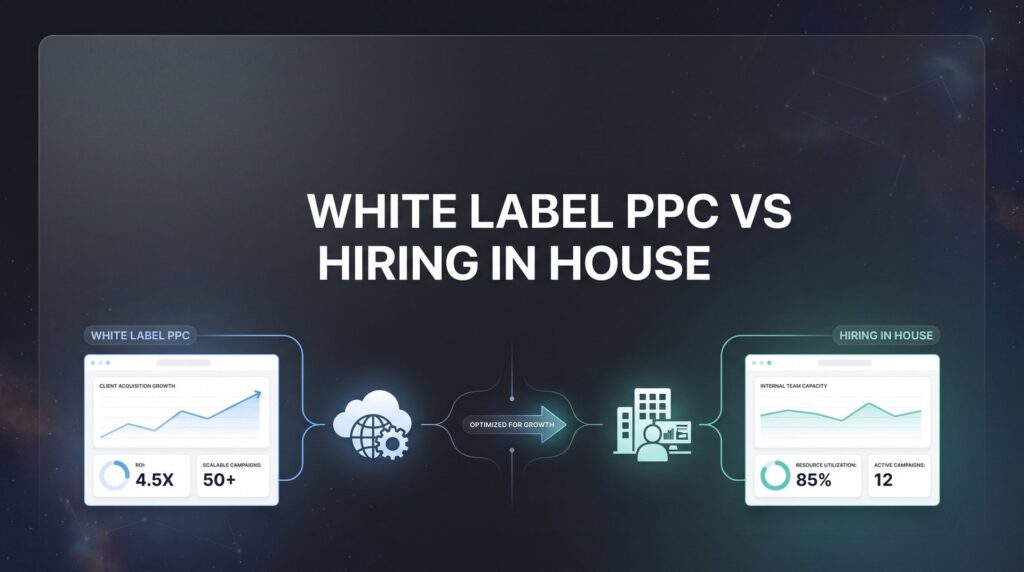
For agency owners and growing businesses, few decisions carry as much weight as choosing between white label PPC and hiring an in-house PPC specialist. Get it right, and you unlock scalable growth with healthy margins. Get it wrong, and you’re stuck with bloated overhead, inconsistent results, or both.
The frustrating truth? There’s no universal correct answer. The best path depends on your current revenue, client volume, growth trajectory, and operational goals. What works brilliantly for a 20-client agency might be a budget disaster for a 5-client shop still finding its footing.
This guide breaks down seven battle-tested strategies for evaluating white label PPC vs. hiring in-house, so you can make a decision rooted in real business math rather than gut instinct. Whether you’re a digital marketing agency looking to scale your PPC offerings or a business owner deciding how to staff your paid advertising function, these frameworks will help you avoid the costly mistakes that trap most decision-makers.
No fluff. No vague advice. Just the frameworks that actually move the needle.
1. Run the True Cost-Per-Client Calculation
The Challenge It Solves
Most agency owners make the white label vs. in-house decision by comparing a salary number to a monthly service fee. That’s like comparing the sticker price of a car to the cost of a lease without factoring in insurance, maintenance, and fuel. The real cost picture looks completely different once you account for everything involved in employing a specialist.
The Strategy Explained
Start with the base salary for a competent PPC specialist in your market. Then layer on the loaded costs that most people forget. Benefits, payroll taxes, and employer contributions typically add roughly 20 to 30 percent on top of base salary, according to general HR and business operations guidance. Then add software subscriptions (bid management tools, reporting platforms, competitor research tools), ongoing training and certifications, and the management time you’ll spend overseeing their work.
Now divide that total annual cost by the number of PPC clients that one specialist can realistically manage well. That gives you your true cost-per-client under the in-house model. Compare that figure to your white label fee per client. The gap between those two numbers is where your decision lives. Understanding the full breakdown of monthly PPC management cost is essential to making this comparison accurately.
Don’t forget idle time. If you have 8 active PPC clients but your specialist can handle 20, you’re paying for 12 clients worth of capacity you’re not using yet.
Implementation Steps
1. List every cost associated with a full-time hire: salary, benefits, payroll taxes, tools, training, and a realistic estimate of management overhead per week multiplied by your hourly rate.
2. Estimate the realistic maximum client load for one specialist without compromising quality, then calculate your break-even client count.
3. Get a firm quote from a white label PPC provider and calculate what your cost-per-client would be at your current volume and at your projected 12-month volume.
4. Compare both models at three client volumes: current, 6-month projection, and 12-month projection.
Pro Tips
Build a simple spreadsheet with these numbers rather than doing the math in your head. The visual comparison alone often makes the decision obvious. Also factor in the ramp-up period: a new hire typically takes 3 to 6 months to reach full productivity, meaning you’re paying full cost for partial output during that window.
2. Audit Your Current Capacity and Pipeline Reality
The Challenge It Solves
Many agency owners make staffing decisions based on where they want to be rather than where they actually are. Hiring in anticipation of growth that hasn’t materialized yet is one of the fastest ways to destroy your margins. Before you decide anything, you need an honest snapshot of your current operational reality.
The Strategy Explained
Pull up your active PPC account list right now. How many accounts are you actively managing? What are the average monthly ad spend levels across those accounts? How consistent is your new client pipeline over the past six months?
If your pipeline is volatile or inconsistent, an in-house hire creates fixed overhead against variable revenue. That’s a dangerous combination. White label PPC, by contrast, scales with your actual client volume. You pay for what you use, and you’re not carrying dead weight during slow months. Many agencies find that outsourced PPC management services provide the flexibility they need during these uncertain growth phases.
Also assess your current team’s bandwidth. Are you personally managing PPC campaigns because you have no other option? Is that pulling you away from business development and client relationships? Sometimes the capacity audit reveals that the real problem isn’t headcount but rather time allocation.
Implementation Steps
1. Document your active PPC client count, average monthly spend per client, and total managed spend across your portfolio.
2. Review your new client acquisition over the last six months. Is it consistent growth or feast-and-famine cycles?
3. Calculate how many hours per week PPC management currently consumes across your team, including yourself.
4. Identify your 90-day pipeline: how many PPC clients are likely to close in the next three months based on current conversations?
Pro Tips
Be ruthlessly honest about your pipeline. Counting “likely to close” deals that are actually wishful thinking will skew your decision. Use only clients with active proposals or signed LOIs in your near-term projection. The audit is only useful if the data is accurate.
3. Evaluate Expertise Depth vs. Breadth for Your Client Mix
The Challenge It Solves
Not all PPC work is the same. A specialist who’s exceptional at Google Search campaigns for local service businesses might be mediocre at YouTube advertising or Meta retargeting. The staffing model you choose should match the actual complexity and diversity of your client portfolio, not a generic idea of what “PPC management” looks like.
The Strategy Explained
Think about your current and target client mix. Do your clients primarily need one platform done exceptionally well, or do they need multi-platform strategies across Google, Meta, Microsoft, YouTube, and programmatic channels?
White label PPC providers typically bring broad multi-platform expertise because they manage hundreds of accounts across diverse industries. A quality provider like a white label PPC agency with Google Premier Partner status has access to platform-level insights and benchmarks that individual in-house hires rarely develop. That breadth is a genuine advantage when your clients have diverse needs.
In-house hires, on the other hand, can develop deep niche specialization over time. If your agency serves a very specific vertical, say HVAC contractors or personal injury law firms, an in-house specialist who becomes the definitive expert in that niche can create a real competitive moat for your agency. For example, agencies focused on legal clients often benefit from specialized knowledge in PPC for law firms that takes years to develop.
Implementation Steps
1. List the platforms your current clients actively use or want to use for paid advertising.
2. Identify whether your client base skews toward one industry niche or spans multiple verticals.
3. Honestly assess whether your current PPC results are suffering from a depth problem (not specialized enough in one area) or a breadth problem (can’t cover multiple platforms).
4. Match your answer to the model that solves your actual gap.
Pro Tips
If you’re building a niche agency with a defined vertical focus, the case for eventually bringing PPC in-house gets stronger over time. If you’re a generalist agency serving diverse client types, white label almost always wins on the expertise dimension because no single hire can be elite across every platform simultaneously.
4. Stress-Test Scalability with the Double-Your-Clients Thought Experiment
The Challenge It Solves
Growth is the goal, but rapid growth can break a business just as surely as stagnation if your operational model can’t handle it. Before you commit to a staffing structure, you need to know whether it can absorb a significant surge in demand without causing quality failures or client churn.
The Strategy Explained
Here’s the thought experiment: imagine your PPC client count doubles within the next 90 days. What happens?
Under the in-house model, you’d likely be scrambling. Hiring takes time. Finding qualified candidates, interviewing, negotiating offers, and onboarding a new specialist realistically takes 60 to 90 days minimum. Then add the 3 to 6 month ramp-up period before they’re fully productive. By the time your new hire is operating at full capacity, you’ve potentially had to turn away clients or compromise quality on existing ones.
Under a white label model, doubling your client count typically means a conversation with your provider and an adjustment to your service agreement. The infrastructure to handle that volume already exists. This is a core advantage of white label PPC services for scaling agencies: the capacity is elastic. Exploring the full range of agency white label solutions can help you understand just how much operational flexibility is available.
Run this thought experiment in reverse too. What if you lost 30 percent of your PPC clients in 60 days? With an in-house hire, you still have full fixed costs. With white label, your costs contract with your revenue.
Implementation Steps
1. Write down what would actually happen operationally if your PPC client count doubled tomorrow. Be specific about who does the work, how long it takes to staff up, and what the quality risk is.
2. Repeat the exercise for a 30 percent client loss scenario and calculate the financial exposure under each model.
3. Identify your realistic growth ceiling under each model before quality breaks down.
4. Choose the model whose failure points align with risks you can actually manage.
Pro Tips
The scalability test isn’t just about upside. Downside protection matters just as much. Agencies that lock themselves into fixed overhead during volatile growth phases often find themselves making desperate decisions, like underpricing to fill capacity or cutting corners on service quality. Build the model that gives you flexibility in both directions.
5. Map the Profit Math Under Best, Average, and Worst Case Scenarios
The Challenge It Solves
Most financial projections for staffing decisions are built on optimistic assumptions. Decision-makers model the best case, convince themselves it’s the likely case, and are blindsided when reality lands somewhere in the middle or worse. A rigorous margin analysis requires you to stress-test your assumptions across multiple scenarios.
The Strategy Explained
For each model, build three scenarios: best case (you hit your growth targets and retain all clients), average case (modest growth with normal churn), and worst case (flat growth with higher-than-expected churn or a key client loss).
Under the in-house model, your fixed costs remain constant across all three scenarios. Your margins compress dramatically in the average and worst case because you’re paying full salary regardless of revenue. Also factor in turnover costs. General business research consistently points to replacing a salaried employee as a significant expense when you account for recruiting fees, lost productivity during the vacancy, and the ramp-up cost for the replacement. That’s a hidden risk most agencies don’t price into their models. A thorough PPC agency cost comparison can help you benchmark realistic numbers for both models.
Under white label, your costs flex with revenue. Margins are more consistent across scenarios because your cost of delivery moves with your income. The trade-off is that your gross margin per client may be lower than with an in-house hire at full utilization, but your risk-adjusted return is often better.
Implementation Steps
1. Define your best, average, and worst case client count and revenue projections for the next 12 months.
2. Calculate gross margin under each scenario for both models using your actual cost numbers from Strategy 1.
3. Add a turnover scenario to the in-house model: what does the business look like if your specialist leaves at month 8?
4. Identify which model produces acceptable margins across all three scenarios, not just the best case.
Pro Tips
The worst-case scenario is the most important one to model. Any staffing model can look good in the best case. The model that protects your business in the worst case is the one worth choosing. Many agencies that partner with a white label PPC provider cite margin stability as the primary reason they made the switch, especially during the early scaling phase.
6. Define Your Quality Control and Communication Non-Negotiables
The Challenge It Solves
Quality control is where many white label relationships go sideways, and it’s also where in-house hires can disappoint if not managed well. Before you choose a model, you need to define exactly what quality looks like in your operation so you can evaluate whether each model can actually deliver it.
The Strategy Explained
Start by documenting your non-negotiable standards. What does a well-managed PPC campaign look like in your agency? What reporting cadence do your clients expect? How quickly must campaign issues be resolved? What level of strategic input do clients receive beyond basic campaign management?
With an in-house hire, you have direct control over all of these elements. You can build processes, enforce standards, and course-correct in real time. The downside is that your quality is entirely dependent on one person’s skill level and work ethic. Understanding PPC management contract terms can also help you structure accountability whether you’re hiring internally or engaging a provider.
With white label, quality depends heavily on the provider you choose. This is where vetting matters enormously. Look for providers with verifiable credentials, such as Google Premier Partner status, which requires meeting specific performance and spend thresholds set by Google. Review their reporting templates, communication protocols, and escalation procedures before signing anything. Ask for a sample report. Ask how they handle underperforming campaigns. Ask what their average response time is for urgent issues.
The right white label partner can actually deliver more consistent quality than a single in-house hire because they have redundancy built into their team. The wrong one will cost you clients.
Implementation Steps
1. Write down your quality standards in concrete terms: reporting frequency, campaign review cadence, response time expectations, and strategic deliverables.
2. Create a vetting checklist for white label providers that maps directly to those standards.
3. If evaluating in-house candidates, build an interview process that tests for the specific skills your client mix demands, not just general PPC knowledge.
4. Define your escalation process for quality failures under each model before you commit.
Pro Tips
Don’t assume a white label provider’s standard process matches your client expectations. Customize the engagement from the start. Define reporting templates, communication norms, and deliverable formats upfront. The agencies that struggle with white label relationships are usually the ones that never clearly communicated their standards in the first place.
7. Build a Hybrid Model That Evolves With Your Business
The Challenge It Solves
The white label vs. in-house debate is often framed as a binary choice, but the most successful agencies treat it as a spectrum. A hybrid model lets you capture the strengths of both approaches while minimizing the weaknesses of each. It’s not a compromise. Done right, it’s a competitive advantage.
The Strategy Explained
The hybrid model works by separating strategy and client relationships from execution and production. Keep the high-value, relationship-intensive work in-house. Outsource the execution, overflow capacity, and new service testing to a white label partner.
In practice, this might look like having an in-house strategist or account manager who owns the client relationship, sets campaign direction, and communicates results, while a white label provider handles the actual campaign builds, optimizations, and reporting. Your client gets a dedicated point of contact and feels the personal touch of your agency. Your white label partner handles the technical execution at scale. This approach aligns closely with how white label marketing for agencies is designed to work at its best.
This model also works well for testing new service lines. Before you commit to hiring a specialist in, say, YouTube advertising or Microsoft Ads, you can test demand and refine your offering through a white label provider. Once you’ve proven the revenue and built the client base, you can evaluate whether bringing that function in-house makes financial sense.
Agencies that use white label PPC management as part of a hybrid approach often find they can offer a broader service menu without the overhead risk of staffing for every capability upfront.
Implementation Steps
1. Map your current PPC workflow and identify which tasks require direct client interaction or strategic judgment vs. which are execution-oriented.
2. Assign execution-heavy tasks to a white label partner while retaining strategy, client communication, and quality oversight in-house.
3. Define clear handoff protocols so nothing falls through the cracks between your team and your white label provider.
4. Set a quarterly review cadence to assess whether the balance between in-house and white label still makes sense as your business grows.
Pro Tips
The hybrid model requires strong internal project management. Use a shared workspace or project management tool to maintain visibility across both teams. The biggest failure point in hybrid models isn’t quality or expertise. It’s communication gaps between your internal team and your white label partner. Build the workflow infrastructure first, then scale within it.
Your Implementation Roadmap
The white label PPC vs. hiring in-house debate doesn’t have a one-size-fits-all answer, but it absolutely has a right answer for your specific situation right now. The key is making that decision based on numbers and operational reality rather than ego, assumptions, or what another agency owner told you worked for them.
Start with Strategy 1 and run the real cost math. Then audit your actual capacity in Strategy 2 and stress-test your scalability in Strategy 4. Those three exercises alone will point you in a clear direction for most situations.
If you’re in the early or scaling phase, white label PPC typically delivers the best combination of quality, flexibility, and margin protection. As you grow and stabilize your client base, selectively bringing functions in-house makes increasing sense, especially for high-value accounts or niche verticals where deep specialization creates a competitive edge. The smartest operators don’t pick a lane and stay in it forever. They use a hybrid model that evolves as their business matures.
Whatever you decide, build it on real numbers. Your profitability depends on it.
If you want to see what this would look like for your specific agency or business, we’ll walk you through how our white label PPC model works and break down what’s realistic given your current client volume, margins, and growth trajectory. No pressure, just a straight conversation about the numbers.