You just landed a dream client. They love your work, trust your judgment, and have budget to spend. Then they ask: “Can you handle our Google Ads?” Your stomach drops. You’re a web design agency. You’ve never run a paid campaign in your life. You face an impossible choice: turn down revenue that could fund your next hire, or scramble to deliver something you’re completely unqualified to handle.
This scenario plays out in agencies every single week. A client needs SEO. Another wants Facebook advertising. Someone else asks about conversion optimization. Each request represents revenue—and each one you decline sends that client shopping for an agency that can say yes to everything.
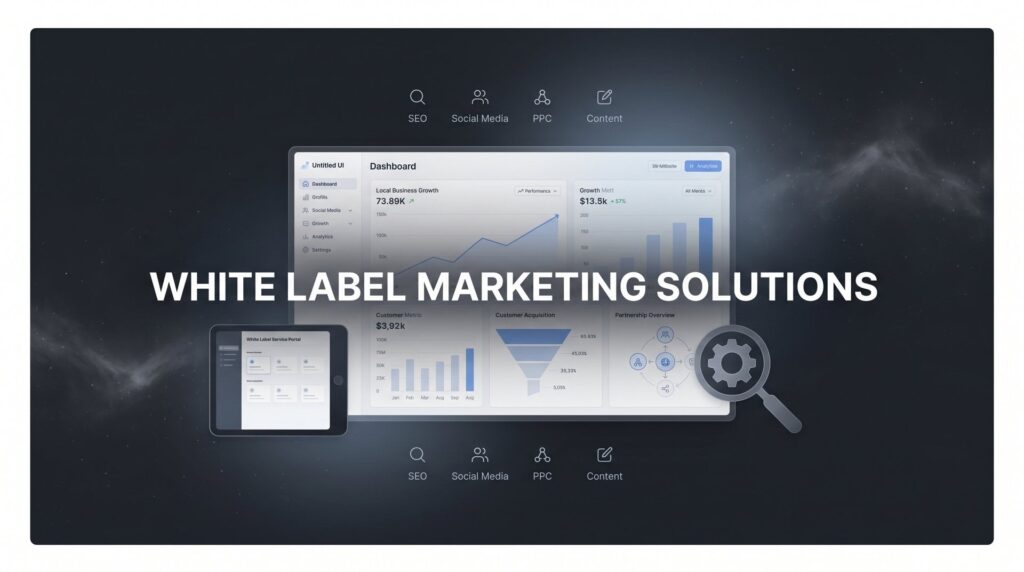
White label marketing solutions solve this problem without forcing you to become an expert in everything. These partnerships let you expand your service menu, increase revenue, and keep clients from ever needing to look elsewhere—all without hiring specialists, building new departments, or pretending to know things you don’t.
How White Label Marketing Actually Works Behind the Scenes
Think of white label marketing as having a secret weapon your clients never see. You maintain the relationship, set the strategy, and present all the work under your brand. Meanwhile, a specialized provider handles the execution completely behind the scenes.
The three-party relationship works like this: your client hires your agency for specific services. Your agency partners with a white label provider who does the actual work. The provider delivers everything under your branding, and your client only ever interacts with you. They see your logo on reports, communicate through your team, and pay your invoices. The white label partner remains invisible.
Here’s what the typical workflow looks like in practice. Your client requests a service—let’s say PPC management. You discuss their goals, budget, and expectations just like any other project. Then you brief your white label partner with those details. The partner builds the campaigns, manages the daily optimization, and generates performance data. They send you branded reports that look like they came from your agency. You review the numbers, add your strategic recommendations, and present everything to the client as your work.
Communication protocols matter enormously here. The best white label partnerships establish clear channels: your client talks only to you, you talk to the white label provider through designated account managers, and everyone knows exactly when updates happen and what format they take. Quality checkpoints get built into the process—usually weekly performance reviews and monthly strategy sessions where you and the provider align on what’s working and what needs adjustment.
This differs fundamentally from simple outsourcing or subcontracting. When you outsource, you’re just hiring help to reduce your workload. When you subcontract, the client typically knows about the third party. White label means complete invisibility—the provider never appears in client communications, never gets mentioned in meetings, and never has their name on any deliverable. You’re not just buying execution; you’re buying the ability to offer expertise you don’t have while maintaining complete brand control.
Services You Can Add to Your Menu Tomorrow
PPC advertising management tops the list of white-labeled services for good reason. Running profitable paid campaigns requires constant attention, technical platform knowledge, and experience reading data patterns that only come from managing thousands of dollars in ad spend. Most agencies don’t have someone who lives and breathes Google Ads or Facebook advertising. White labeling lets you offer this high-value service immediately through a white label Google Ads agency.
The numbers make sense too. PPC clients typically spend consistently month after month, creating predictable recurring revenue. The results show up quickly—usually within weeks rather than months—which makes clients happy and renewals easy. And because the platforms constantly change, having a partner who stays current with new features and best practices means you never fall behind.
SEO and content marketing represent another massive opportunity. Clients understand they need search visibility, but building an in-house SEO team means hiring technical specialists, content writers, and link builders. That’s three different skill sets before you even start. White label SEO providers handle everything: technical audits, keyword research, content creation, link building, and monthly reporting. You position it as your agency’s SEO service, they do the work, and your client climbs search rankings with your name on the success.
Social media advertising deserves its own category because it’s become essential for most businesses but requires platform-specific expertise. Facebook advertising works completely differently from LinkedIn campaigns. Instagram has its own rules. TikTok advertising is its own universe. A white label Facebook ads partner lets you offer all these platforms without becoming an expert in each one’s constantly evolving algorithm.
Then you have the premium services that command serious pricing: conversion rate optimization and lead generation systems. These aren’t commodity offerings—they require deep analytical skills and testing experience. When you can tell a client “We’ll analyze your site, identify conversion barriers, and systematically test improvements,” you’re offering something most agencies can’t deliver. White labeling these specialized services lets you compete at a higher level and charge accordingly.
The Business Case: Numbers That Make Agency Owners Pay Attention
Here’s the financial reality that makes white label partnerships compelling: you expand revenue without expanding overhead proportionally. Hiring a PPC specialist costs you their salary, benefits, training, management time, and the risk they might leave taking their knowledge with them. A white label partnership costs you a percentage of the service revenue with none of the employment overhead.
Let’s say you land a client who wants to spend $5,000 monthly on Google Ads management. Your white label partner charges you $1,500 to manage it. You charge the client $2,500 for management. That’s $1,000 monthly profit on a service you couldn’t offer before. Multiply that across five clients and you’ve added $5,000 in monthly profit without hiring anyone. Understanding white label marketing agency pricing helps you calculate these margins accurately.
Client retention improves dramatically when you become a one-stop solution. Think about your current clients. How many of them work with multiple agencies because you only offer certain services? Each additional vendor relationship represents a chance for them to find someone who offers everything under one roof. When you can handle their website, their SEO, their paid advertising, and their conversion optimization, they have zero reason to look elsewhere.
The opportunity cost comparison reveals the real advantage. Building a PPC department from scratch means hiring someone with experience, giving them time to learn your clients’ businesses, accepting the learning curve mistakes, and hoping they stay long enough to justify the investment. Meanwhile, you’re turning down client requests for services you can’t deliver. A white label partnership eliminates that opportunity cost immediately. You say yes to every qualified request, capture revenue that would have gone elsewhere, and build a more valuable agency in the process.
Your agency’s valuation increases too. Buyers pay premiums for agencies with diverse revenue streams and recurring service contracts. An agency that only offers web design has limited growth potential. An agency that offers web design, SEO, PPC, and conversion optimization has multiple revenue engines and commands higher multiples when it’s time to sell.
Choosing a White Label Partner That Won’t Embarrass You
Your white label partner’s work appears under your brand, which means their mistakes become your reputation problems. The vetting process matters more than almost any other agency decision you’ll make. A thorough white label marketing provider comparison can save you from costly mistakes.
Communication standards sit at the top of non-negotiable criteria. You need a partner who responds within hours, not days. Someone who proactively alerts you to issues before clients notice them. A team that understands they’re supporting your client relationships and acts accordingly. Ask potential partners about their communication protocols: How quickly do they respond to urgent issues? Who’s your primary contact? What happens if that person is unavailable? The answers reveal whether they understand the stakes.
Reporting capabilities make or break the relationship. You need reports that can be fully branded with your logo, your colors, and your agency’s voice. The data should be clear enough that you can explain it to clients without needing a decoder ring. Look for partners who offer customizable reporting templates, regular reporting schedules, and the ability to add your own strategic commentary. If their reports look generic or require extensive reformatting, keep looking.
Proven track records mean actual results you can verify. Ask for case studies with specific numbers. Request references from other agencies they work with. Look for evidence they’ve managed accounts similar to what your clients need. A partner who specializes in e-commerce won’t necessarily excel at local service business campaigns. Match their expertise to your client base.
Red flags that should end conversations immediately: providers who can’t show you sample reports, partners who hesitate to provide references, companies that promise unrealistic results, and anyone who doesn’t ask detailed questions about your clients and processes. If they’re not curious about how you work, they won’t integrate well with your operations.
The questions that reveal true operational quality dig into specifics. Ask: “Walk me through what happens when a campaign underperforms.” Their answer shows how they handle problems. Ask: “How do you stay current with platform changes?” This reveals their commitment to ongoing education. Ask: “What’s your typical response time for client questions?” You’ll learn whether they match your service standards. Ask: “Can you show me three different client reports you’ve created?” You’ll see the quality and customization options firsthand.
Pricing transparency matters too. You need clear pricing structures that let you calculate margins accurately. Avoid partners with hidden fees, surprise charges, or pricing that changes based on factors you can’t predict. The best partnerships have straightforward pricing: a percentage of ad spend, a flat monthly fee, or a per-project rate that you can mark up consistently.
Making the Transition Seamless for Your Clients
Your clients don’t need to know you’re partnering with specialists behind the scenes. They need to know you’re expanding capabilities to serve them better.
Position new services as natural extensions of what you already do. If you’ve been building websites, offering SEO makes perfect sense—you’re helping those sites get found. If you’ve been managing SEO, adding PPC creates a complete search strategy. Frame it as evolution rather than dramatic change: “We’ve been getting great results with organic search for our clients. We’re now offering paid search management so you can dominate search results completely.”
Set up reporting workflows that maintain your agency’s voice from day one. When your white label partner sends you performance data, don’t just forward it. Add your strategic interpretation. Explain what the numbers mean. Recommend next steps. The report should read like it came from someone who knows the client’s business intimately—because you do, even if someone else ran the campaigns. Proper marketing conversion tracking ensures you can demonstrate real results to clients.
Communication protocols need clear definition before you launch any white-labeled service. Decide whether clients email you directly or use a project management system. Establish regular check-in schedules—weekly, biweekly, or monthly depending on the service. Make sure your team knows how to answer common questions without needing to ping the white label provider for every detail. The smoother the communication feels to clients, the more it seems like a natural extension of your existing relationship.
Pricing strategies require careful thought to protect margins while staying competitive. Research what other agencies charge for similar services in your market. Your pricing should reflect the value you provide—client management, strategic oversight, and integrated service delivery—not just the execution cost. Many agencies mark up white label services 100% or more, which sounds aggressive until you account for your time managing the relationship, reviewing work, and maintaining quality standards.
Don’t underprice trying to win business. Clients who choose agencies based solely on lowest price create headaches regardless of how you deliver the service. Price for the value you provide, communicate that value clearly, and attract clients who appreciate quality over bargain hunting.
Putting It All Together: Your White Label Growth Roadmap
Start with one service that fills your biggest capability gap or addresses the client request you hear most often. If three clients asked about Google Ads this quarter, that’s your signal. If you keep losing website projects because you can’t offer ongoing SEO, there’s your answer. Trying to white label everything at once creates operational chaos. Master one service, build the systems, then expand.
Build systems before you scale. Document how client requests flow to your white label partner. Create templates for branded reports. Establish quality check processes so you review work before clients see it. Set up communication protocols so everyone knows who handles what. These systems prevent the disasters that happen when you’re moving fast and something falls through the cracks.
Your onboarding process for new white-labeled services should mirror how you onboard any new capability. Train your team on what the service includes, what results clients can expect, and how to answer common questions. Create sales materials that explain the offering clearly. Develop pricing guidelines so everyone quotes consistently. The more structured your onboarding, the smoother the client experience.
Quality checks matter more with white label services than with in-house work because you’re one step removed from execution. Review every report before it goes to clients. Spot-check campaign settings periodically. Jump on calls with your white label partner to discuss strategy. Stay involved enough to catch problems early while trusting your partner to handle the daily details.
Your next step is evaluating current service gaps against actual client requests. Pull up your declined project list from the past six months. What services did clients ask for that you couldn’t provide? How much revenue did you turn away? Which services came up repeatedly? That analysis tells you exactly where white label partnerships create the most immediate value. You’re not guessing about what services to add—you’re responding to documented client demand you’ve already proven exists.
White label marketing solutions transform how agencies grow because they eliminate the traditional constraints of hiring and training. You expand capabilities immediately, capture revenue that would have gone elsewhere, and build a more valuable business without proportional increases in overhead or risk. The agencies winning long-term aren’t the ones trying to build every capability in-house. They’re the ones strategically partnering to offer comprehensive solutions while maintaining the lean operations that make agencies profitable.
If you want to see what this would look like for your business, we’ll walk you through how it works and break down what’s realistic in your market. Clicks Geek provides white label PPC, Facebook advertising, and SEO services specifically designed for agencies that want to expand without the overhead of building specialized teams. We handle the execution, you maintain the client relationship, and your brand gets all the credit. If you want to see what this would look like for your agency, let’s talk about which services fill your biggest gaps and how the partnership would actually work day-to-day.