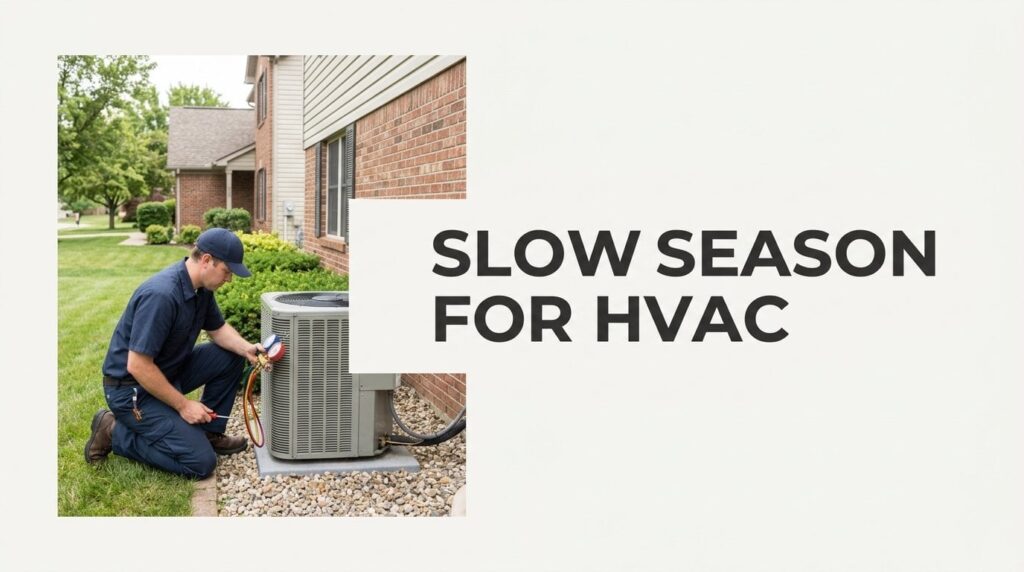
You already know which months hurt. Spring hits and the emergency calls dry up. Fall arrives and the summer rush is gone. Your techs are available, your overhead is fixed, and the phone is quiet. The instinct most HVAC owners follow is to cut ad spend, reduce hours, and wait for the weather to turn again.
That instinct costs you more than the slow season does.
The shoulder months are not a problem to survive. They are a window to build the infrastructure that makes your next peak season more profitable than the last. Some of the strategies below generate revenue this week. Others take six months to pay off but will lower your cost per lead for years. The mix matters.
An HVAC company that only advertises when demand is already high will always pay peak CPCs. One that builds SEO authority in October and keeps a warm maintenance customer base year-round will have lower acquisition costs across the board. These seven strategies are ordered by how fast they produce results, so you know where to start.
1. Turn Your Maintenance Agreement List Into a Revenue Engine
The Challenge It Solves
When demand drops, most HVAC companies go looking for new customers. That is the expensive path. The cheaper, faster path is already sitting in your CRM: the homeowners who have paid you before, trust your brand, and have equipment that needs attention. Maintenance customers convert faster on replacement conversations and tend to schedule without the same friction as cold leads. The slow season is the right time to work that list deliberately.
The Strategy Explained
Build a structured outreach sequence, not a single email blast, but a multi-touch campaign across email, text, and phone. Start with customers whose tune-ups are overdue. Follow with filter replacement reminders. Flag accounts where the system is getting older and schedule those for an in-home visit that naturally opens a replacement conversation.
The goal is not to hard-sell anyone. It is to give your existing customers a reason to call you before they call a competitor. A homeowner who gets a personalized reminder from your company in October is far more likely to book with you in November than one who hears nothing until their furnace fails in January.
Implementation Steps
1. Pull your full customer list and segment it by last service date, system age, and agreement status. Anyone more than 12 months out from their last visit is overdue.
2. Write a three-touch sequence: an email with a specific offer (tune-up, filter service, or inspection), a follow-up text three days later, and a personal call from a tech or CSR for high-value accounts.
3. Flag any customer with a system over 10 years old for a separate sequence that includes information about efficiency, reliability, and your current financing options. This primes the replacement conversation without forcing it.
Pro Tips
Personalize where you can. Mentioning the specific system you serviced last time, or the date of the last visit, makes the outreach feel like a reminder from a trusted contractor rather than a mass marketing email. That distinction changes response rates. Also, track which outreach method produces bookings so you can refine the sequence before next slow season.
2. Shift Your Ad Spend Toward Indoor Air Quality and Duct Services
The Challenge It Solves
Heating and cooling demand is weather-dependent. Indoor air quality, duct cleaning, and humidity control are not. If your Google Ads campaigns are built entirely around “AC repair” and “furnace replacement,” your cost per lead will spike in peak season and your campaigns will go dark in the shoulder months. That creates gaps in account history that hurt your Quality Scores when you need them most.
The Strategy Explained
Restructure your campaigns during slow months to prioritize year-round service categories. IAQ services like air purifiers, UV systems, and whole-home dehumidifiers have consistent search volume that does not spike and crash with the weather. Duct cleaning searches tend to pick up in fall when homeowners are thinking about air quality before heating season. These categories often carry lower CPCs than peak-season emergency terms, which means your budget goes further.
Maintaining active campaigns year-round also keeps your account healthy. Google’s algorithm rewards accounts with consistent data. A campaign that runs continuously builds a stronger performance history than one that pauses for four months and restarts cold.
Implementation Steps
1. Audit your current campaign structure. Identify which ad groups are tied to seasonal demand and which could run profitably year-round.
2. Build dedicated campaigns for IAQ and duct services with their own budgets, separate from your heating and cooling campaigns. This lets you scale them independently without cannibalizing your peak-season spend.
3. Write ad copy that speaks to the homeowner’s actual concern: air quality for families, allergen reduction, odors, or humidity problems. These are year-round pain points, not seasonal ones. Our HVAC marketing hub covers campaign structure in more depth if you want to go further on this.
Pro Tips
Home services Google Ads CPL typically runs $18 to $35. If your IAQ campaigns are running well above that, check your landing pages first. A page built for “AC repair” that you are sending IAQ traffic to will hurt your Quality Score and your conversion rate. Match the page to the campaign.
3. Use Slow Months to Build the SEO Foundation That Pays Off in Peak Season
The Challenge It Solves
SEO does not respond to urgency. You cannot turn it on in May when demand spikes. Work done in October shows up in rankings by spring, which means the slow season is the highest-leverage time to invest in organic search. Most of your competitors are not doing this. They are cutting budgets and waiting. That gap is your opportunity.
The Strategy Explained
There are four categories of SEO work that make the most sense during the shoulder months: service area page development, system-specific content, Google Business Profile optimization, and citation cleanup. None of these require a large budget. All of them take real time and produce compounding returns.
Service area pages target the specific cities and towns in your market where you want to rank. A well-built page for “HVAC repair in [City]” can capture Map Pack traffic, which accounts for roughly 42% of local clicks according to our published benchmarks. System-specific content answers the questions homeowners are already searching: how long does a heat pump last, what does a dirty coil do to efficiency, when should I replace versus repair. These pages build topical authority and pull in traffic that your competitors are ignoring.
Implementation Steps
1. Audit your Google Business Profile. Confirm your service categories are accurate, your photos are current, and your Q&A section has real answers. Add posts regularly. GBP activity signals relevance to Google’s local algorithm.
2. Identify the top five to ten cities in your service area where you want more work. Build or improve a dedicated page for each one. These pages need real content, not spun text with the city name swapped in.
3. Run a citation audit using a tool like BrightLocal or Whitespark. Inconsistent NAP (name, address, phone) data across directories suppresses local rankings. Cleaning this up is slow, unglamorous work, which is exactly why the slow season is the right time to do it.
Pro Tips
Local SEO CPL at the 12-month mark typically runs $7 to $15, which is the lowest cost per lead of any channel we manage. The catch is the timeline. SEO starts producing results in 30 to 90 days, but the real compounding happens at six to twelve months. Start in October and you are well-positioned for the spring rush.
4. Run Targeted Facebook Campaigns Toward Homes With Aging Systems
The Challenge It Solves
Google Ads captures people who are already searching. Facebook reaches people before they search. That distinction matters for replacement-focused campaigns, because most homeowners do not search for a new HVAC system until their current one fails. If you can reach them while the system is still running, you get the conversation before the emergency and before your competitors do.
The Strategy Explained
Facebook’s targeting options let you reach homeowners by location, home age, and household income. Home age is a practical proxy for system age. A house built in 2005 is likely running original equipment that is now past the 15-year mark where replacement becomes a serious conversation. You cannot target “homeowners with old HVAC systems” directly, but you can get close by combining home age, ownership status, and geography.
Slow-season CPCs on Facebook tend to be lower because fewer advertisers are competing for the same audience. Facebook CPL for home services typically runs $10 to $25, and shoulder-month campaigns can come in at the lower end of that range. This makes fall and spring a practical time to test replacement-focused creative before you need it to work at peak-season volume.
Implementation Steps
1. Build a custom audience targeting homeowners in your service area with homes built between 2000 and 2010. Adjust the range based on your market’s housing stock.
2. Write ad creative that speaks to the cost of running an inefficient older system, not the fear of a breakdown. Efficiency framing tends to outperform fear-based messaging for planned replacement conversations.
3. Send traffic to a landing page built specifically for replacement, not your homepage. Include your financing options prominently. Homeowners who are on the fence about a $12,000 system replacement often need to see monthly payment options before they will book a consultation.
Pro Tips
Test two or three creative variations before scaling budget. Video tends to outperform static images for higher-ticket services because it gives you more time to explain the value. A 30-second video showing what an aging system costs in monthly energy bills can do more work than a static image with a discount offer.
5. Offer Shoulder-Season Pricing on Replacements to Move Jobs Off the Waitlist
The Challenge It Solves
Many homeowners know their system is on borrowed time. They are just waiting for the breakdown that forces the decision. That breakdown tends to happen in July or January, when you are already slammed and your install schedule is backed up. A structured shoulder-season offer pulls those decisions forward, fills your install calendar now, and gives you a smoother revenue curve without the peak-season chaos.
The Strategy Explained
The offer does not need to be a blanket discount. Discounting labor sets a bad precedent and cuts into margins you cannot afford to lose. Instead, structure the offer around value-adds that cost you less than their perceived worth: extended warranties, free smart thermostat installation, priority service membership for the first year, or a free duct inspection with every replacement.
Connect the offer to financing. A homeowner sitting on a 15-year-old system who sees a $189-per-month payment option is more likely to act than one looking at a $14,000 sticker price. Most HVAC financing partners offer dealer programs with promotional rates. If you are not using them, you are leaving close rate on the table.
Implementation Steps
1. Define the offer clearly before you promote it. What is included, what is excluded, and when does it expire. Vague offers produce vague responses.
2. Promote the offer through your maintenance outreach sequence first. Your existing customers are the most likely to act, and it costs you nothing in ad spend to reach them.
3. Run the offer in your Google Ads and Facebook campaigns with a specific end date. Urgency works when it is real. A promotion that “ends October 31” is more compelling than one that is always available.
Pro Tips
Train your CSRs and techs to mention the offer during every service call in the shoulder months. A tech who finishes a tune-up and says “by the way, we have a fall replacement program that includes a free thermostat and priority service for the first year” is doing sales work that no ad can replicate. Script it, practice it, and track how many replacement consultations come from field conversations.
6. Fix the Conversion Problems That Will Cost You Jobs When Demand Returns
The Challenge It Solves
Here is a pattern that repeats in almost every HVAC company we audit: the owner increases ad spend, the phone rings more, and the revenue does not grow proportionally. The problem is not the leads. It is what happens after the phone rings. Call handling issues, slow callback times, poor booking processes, and no follow-up on unsold estimates are silent revenue killers that get masked by peak-season volume. The slow season is the only time you have the bandwidth to actually fix them.
The Strategy Explained
Start with call recordings. If you are not recording calls, set that up today. Most call tracking platforms make this straightforward. Listen to 20 to 30 calls from the past 90 days. You will find patterns: calls going to voicemail during business hours, CSRs who cannot answer basic pricing questions, missed opportunities to book a follow-up when the caller is not ready to schedule immediately.
Then look at your callback time on web form submissions and missed calls. The research is consistent across industries: the faster you respond, the higher the conversion rate. A lead that gets a callback within five minutes converts at a significantly higher rate than one that waits two hours. If your process does not have a system for immediate follow-up, build one now before peak season demand makes it impossible to think clearly.
Implementation Steps
1. Set up call tracking if you do not have it. This is the baseline for knowing your actual cost per lead, not just your cost per click. You cannot manage what you cannot measure.
2. Listen to call recordings and score them against a simple rubric: did the CSR answer within three rings, did they capture contact information, did they attempt to book an appointment, did they follow up on calls that did not convert.
3. Build a follow-up sequence for unsold estimates. Most HVAC companies send a quote and wait. A two or three-touch follow-up sequence, email plus a personal call, can recover a meaningful portion of the jobs that went quiet after the estimate.
Pro Tips
Check where your leads are actually coming from before peak season, not during it. If you are spending money on ads and cannot tell which campaigns are producing phone calls versus form fills versus walk-ins, you are flying blind. Getting your attribution clean now means you will make better budget decisions when CPCs spike in summer. Between 40 and 70% of HVAC leads come in by phone, so call tracking is not optional.
7. Build a Commercial HVAC Pipeline to Smooth Out Residential Seasonality
The Challenge It Solves
Residential HVAC demand is weather-driven. Commercial HVAC is not, at least not in the same way. Property managers, building owners, and facility directors operate on planned maintenance schedules and capital budgeting cycles that are largely independent of the temperature outside. Adding even a handful of commercial accounts can meaningfully reduce the revenue swings that make shoulder seasons painful.
The Strategy Explained
This is a longer-term play, and it is worth being honest about that. Commercial work requires a different sales process, different licensing in some states, and often a different crew configuration than residential service. If you are not set up for commercial work, do not start here. But if you have the capacity and the licensing, the slow season is the right time to build the pipeline because you have the time to do outreach properly.
Property managers are the primary decision-makers for multi-unit residential and commercial buildings. They are reachable on LinkedIn, through local property management associations, and through referral partnerships with commercial real estate brokers. A single property manager who controls 20 buildings is worth more to your revenue stability than 20 individual homeowners.
Implementation Steps
1. Confirm your licensing and insurance coverage for commercial work in your state before pursuing any commercial accounts. Requirements vary, and the last thing you want is a liability gap on a commercial job.
2. Build a list of property management companies in your service area. LinkedIn is a practical tool for identifying the right contacts. A short, direct message explaining what you do and what markets you serve works better than a formal sales pitch.
3. Develop a commercial maintenance agreement offer that fits the way property managers think: predictable costs, documented service history, and priority response time. These are the levers that matter to commercial buyers, not the same value-adds that work for residential homeowners.
Pro Tips
Ask your current residential customers if they own or manage commercial property. This is the lowest-friction path into commercial work because the trust is already established. A homeowner who has used your company for five years and also manages a small office building is a natural referral opportunity that most HVAC companies never pursue. For more on building a commercial pipeline alongside residential growth, our HVAC industry resources cover the channel mix in more detail.
Putting It All Together
The worst version of slow season is doing nothing and hoping the summer rush covers the gap. The best version is treating these months as the time when you get ahead of competitors who are also sitting on their hands.
Start with what produces revenue fastest. Work your maintenance agreement list this week. Shift your ad targeting toward IAQ and duct services. Run a structured shoulder-season replacement offer to your existing customer base. These three moves can generate real revenue before the weather changes.
Then use the bandwidth your team has right now to fix the problems that will cost you jobs when demand returns. Audit your call handling. Set up proper call tracking. Build your follow-up sequences for unsold estimates. These are not glamorous tasks, but they are the difference between a company that scales well and one that stays flat despite increasing its ad spend.
The SEO work and the commercial pipeline are slower burns, but they compound. Work done on your service area pages and GBP this fall will show up in your spring rankings. A property manager relationship built in October can produce a maintenance contract by January.
None of this requires a large budget. Most of it requires attention and follow-through, which you have more of right now than you will in July.
If your marketing has been inconsistent or you are not sure where your leads are actually coming from, that audit is the right first step before you spend another dollar on ads. Clicks Geek has worked with HVAC companies across all 50 states since 2015, manages over $100 million in ad spend, and builds campaigns specifically structured around the seasonal patterns in this industry. If you want to see what this would look like for your business, we will walk you through what we see and tell you honestly what is worth doing in your market.