If you run an HVAC company without a physical storefront customers walk into, Google treats you differently than a shop with a front door. You’re a service area business, and the rules for showing up in the Map Pack, ranking across dozens of zip codes, and converting local searches into booked jobs are genuinely different from what brick-and-mortar competitors deal with.
The wrong setup costs you visibility in the neighborhoods you actually serve. A homeowner whose AC dies at 9pm on a Tuesday isn’t scrolling past the first three results. They’re calling whoever shows up first. The right tools help you claim your territory, keep your business information consistent across the web, and make sure those emergency calls go to you instead of the competitor one zip code over.
Here are the tools HVAC operators and their marketing teams rely on to do exactly that, from GBP management and citation cleanup to call tracking and grid-based rank scanning.
1. Clicks Geek HVAC Marketing
Best for: HVAC service area businesses that want a full marketing system built and managed for them
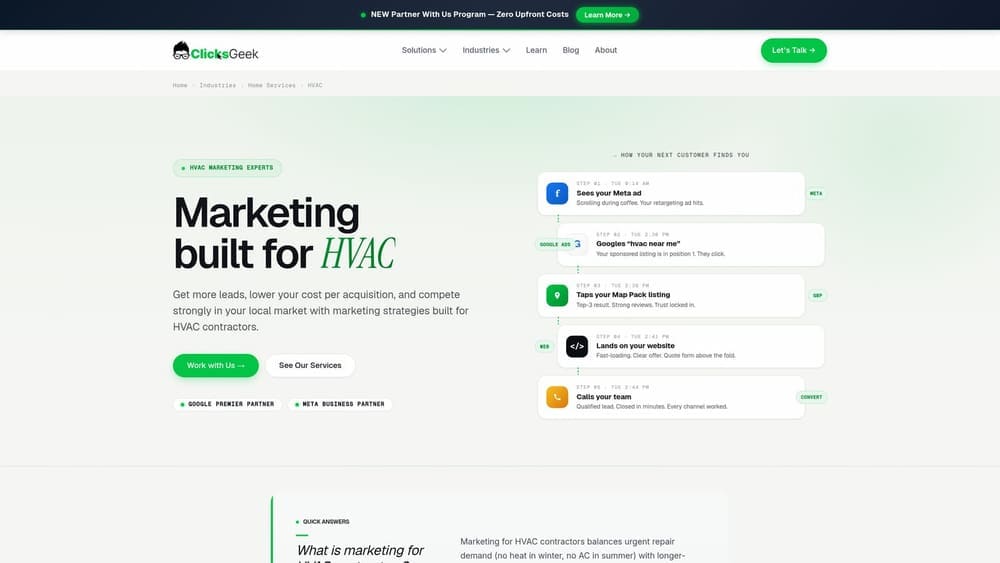
Clicks Geek is a Google Premier Partner and Meta Business Partner that has been running local service business campaigns since 2015, with 298 industry-specific playbooks built from over 10,000 campaigns and more than $100M in managed ad spend.
Where This Tool Shines
Most agencies run the same Google Ads structure for a plumber, a roofer, and an HVAC contractor. Clicks Geek doesn’t. The HVAC campaign structure is built specifically for service area operators, which means ad targeting, landing pages, and GBP optimization are all set up around the way SABs actually rank and convert, not borrowed from a retail playbook.
The no-lock-in contract model matters more than it might sound. If the results aren’t there, you’re not stuck. That’s a different posture than most agencies take, and it reflects how they approach the relationship: ROI-focused reporting, not vanity metrics like impressions or traffic.
Key Features
HVAC-Specific SAB Campaign Structure: Google Ads and Local SEO built around service area targeting, not adapted from generic templates.
Google Premier Partner Status: Access to beta features, direct Google support, and campaign benchmarks most agencies don’t see.
GBP Optimization Included: Service area definition, category management, and profile health are managed alongside paid and organic campaigns.
298 Industry Playbooks: HVAC-specific intelligence drawn from campaigns across all 50 states and dozens of market types.
No Lock-In Contracts: Engagement is month-to-month with reporting tied to leads and revenue, not soft metrics.
Best For
HVAC operators who want the whole system handled: Google Ads, Local SEO, GBP, and attribution reporting all under one roof. Also a strong fit for operators who’ve tried DIY marketing or generalist agencies and want someone who already knows the HVAC market.
Pricing
Custom pricing based on scope and market. No lock-in contracts. Reach out directly for a breakdown specific to your service area and goals.
2. Google Business Profile Manager
Best for: Any HVAC SAB that wants to control how it appears in Google Search and Maps
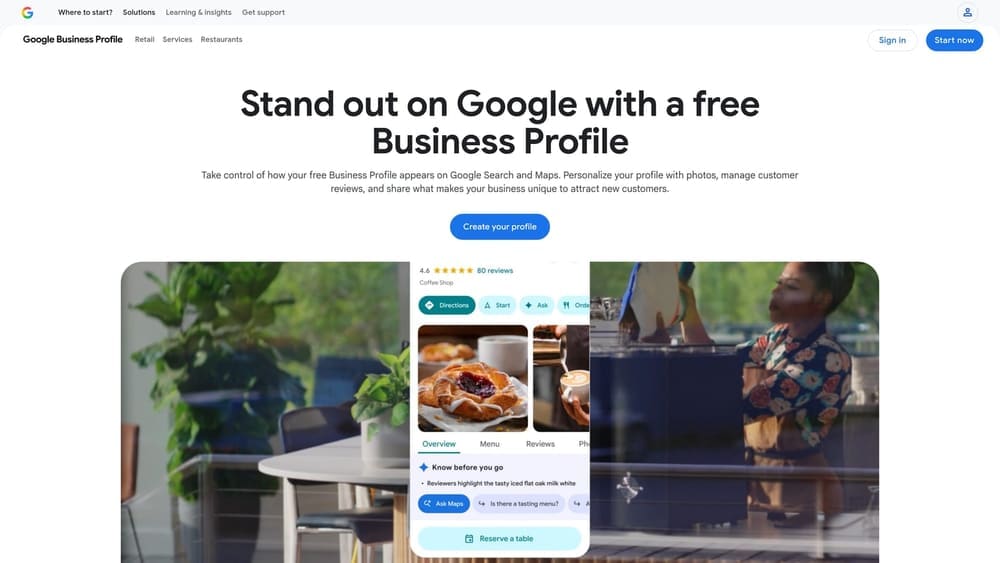
Google Business Profile Manager is the free platform Google provides for managing your HVAC business listing, including service area definition, category selection, posts, and performance data.
Where This Tool Shines
Nothing else on this list works properly if your GBP is misconfigured. For HVAC SABs specifically, the service area setup is where most operators leave visibility on the table. Defining your area by zip code rather than a vague radius gives Google cleaner signals about where you actually serve, which feeds directly into Map Pack placement.
The platform also connects directly to Local Services Ads, meaning a well-maintained GBP with strong reviews and accurate information can reduce your cost per lead across both organic and paid channels simultaneously.
Key Features
Service Area Definition: Set coverage by zip code or radius; critical for SABs that don’t display a public address.
Category Management: Primary category should be “HVAC Contractor” for most operators; secondary categories can cover specific services.
Q&A and Posts: Publish seasonal offers, service updates, and FAQs directly on your listing.
Performance Insights: See which search queries surface your listing and how many people request directions or call.
LSA Integration: A verified GBP with strong signals supports Local Services Ads eligibility and performance.
Best For
Every HVAC operator. This is the non-negotiable foundation. All other tools on this list build on top of it.
Pricing
Free.
3. BrightLocal
Best for: HVAC operators and agencies that need grid-based rank tracking and citation management in one platform
BrightLocal is a local SEO platform designed for agencies and in-house teams managing service area businesses, with particular strength in rank tracking and citation auditing.
Where This Tool Shines
The grid-based rank tracker is the headline feature for HVAC SABs. Instead of showing you a single ranking position, it maps your Map Pack visibility block by block across your service area. You can see exactly which neighborhoods you own and where your coverage drops off, which turns a vague “we need to rank better” problem into a specific, addressable gap.
The citation audit tool is thorough and practical. Inconsistent NAP data across directories is one of the most common reasons HVAC businesses underperform in local search, and BrightLocal surfaces those inconsistencies clearly enough that you can actually fix them.
Key Features
Grid-Based Rank Tracker: Shows Map Pack position by neighborhood rather than a single aggregate rank.
Citation Audit: Identifies inconsistent or missing NAP data across major and niche directories.
GBP Monitoring: Alerts you to unauthorized edits or listing changes on your Google Business Profile.
Review Monitoring: Tracks reviews across Google, Facebook, and industry-specific directories.
White-Label Reporting: Agencies can brand reports for HVAC clients without rebuilding data manually.
Best For
HVAC operators running their own local SEO, and agencies managing multiple HVAC clients who need consolidated reporting and rank data across service areas.
Pricing
Plans start at $39/month. Agency plans are available at higher tiers with more locations and users.
4. Whitespark
Best for: HVAC companies that need citation building done right and a GBP audit with SAB-specific checks
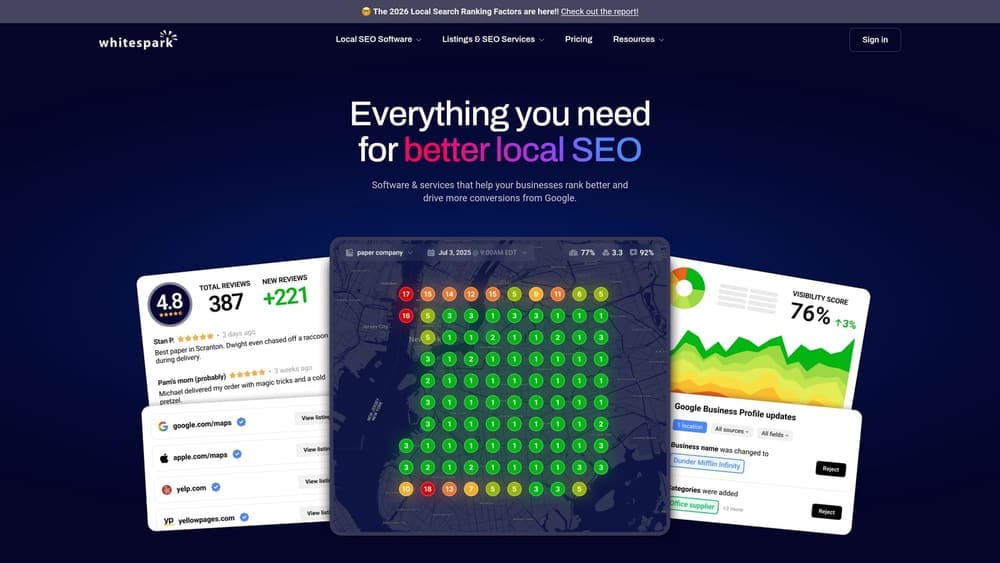
Whitespark is a Canadian local SEO company known for citation building, the Local Citation Finder, and a GBP audit tool that’s particularly useful for service area businesses.
Where This Tool Shines
Whitespark’s competitive citation analysis is genuinely useful. The Local Citation Finder shows you exactly which directories your top-ranking competitors appear in that you don’t, so you’re building citations based on what actually moves the needle in your market rather than guessing.
The done-for-you citation building is worth mentioning because HVAC SABs face a specific challenge: maintaining consistent business information across directories without a public-facing address. Whitespark handles that correctly, which isn’t something every citation service gets right.
Key Features
Local Citation Finder: Compares your citation profile against top-ranking competitors in your market.
Done-for-You Citation Building: Submissions to HVAC-relevant directories with accurate SAB information.
GBP Audit Tool: Includes SAB-specific checks that generic SEO audits miss.
Reputation Builder: Review generation tool for building volume on Google and industry directories.
Local Rank Tracker: City-level and neighborhood-level rank data for Map Pack and organic positions.
Best For
HVAC operators whose citation profiles are inconsistent or thin, and teams that want competitive citation intelligence before deciding where to build.
Pricing
Citation Finder starts at $33/month. Done-for-you citation building is priced per submission; costs vary based on the number of directories targeted.
5. CallRail
Best for: HVAC businesses that need to know which marketing channels are actually producing booked jobs
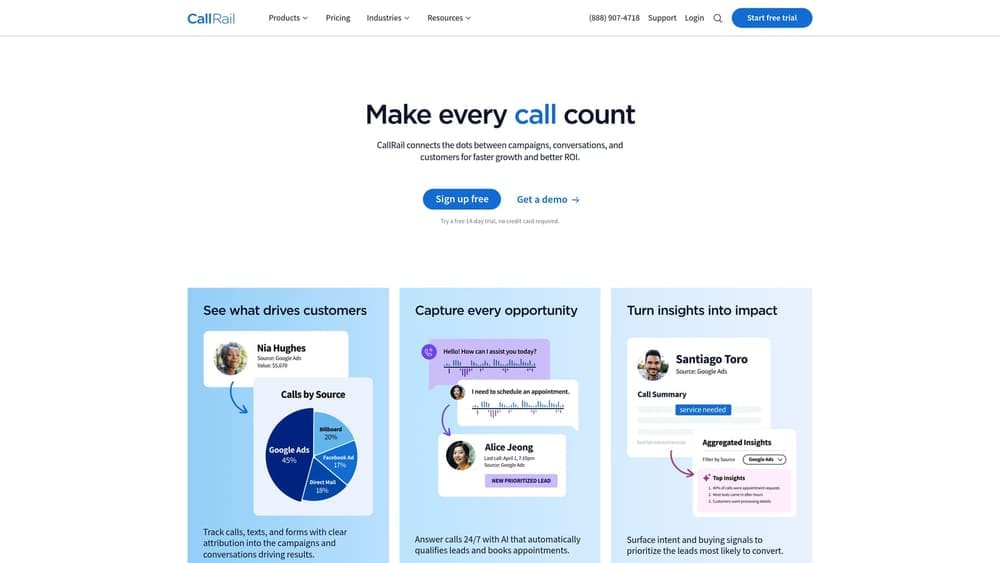
CallRail is the leading call tracking and analytics platform for local service businesses, connecting inbound phone calls back to the specific ad, keyword, or organic source that generated them.
Where This Tool Shines
Between 40 and 70% of HVAC leads come in by phone. If you’re spending money on Google Ads, Local SEO, and GBP and you don’t have call tracking in place, you have no idea what’s working. CallRail closes that gap with dynamic number insertion, meaning each traffic source gets a unique number and every call gets attributed correctly.
The call recording and transcription features go further than attribution. You can listen to calls and confirm whether leads are actually converting to booked jobs or getting dropped somewhere in the intake process. That’s a different kind of insight than most marketing tools offer.
Key Features
Dynamic Number Insertion: Tracks calls by traffic source and keyword, including organic, paid, and direct.
Call Recording and Transcription: Review lead quality and identify intake problems without manually logging every call.
Form Tracking: Captures web form submissions alongside calls for complete lead attribution.
Google Ads and GA4 Integration: Pushes call conversion data into your ad accounts for closed-loop bidding.
Lead Scoring: Separates booked jobs from unqualified calls so your conversion data reflects actual revenue.
Best For
Any HVAC operator spending money on marketing who isn’t currently tracking which channels produce calls. This is often the first tool to add when attribution is unclear.
Pricing
Starts at $45/month for call tracking. Higher tiers unlock the full analytics suite including conversation intelligence and lead scoring.
6. Local Falcon
Best for: Diagnosing Map Pack coverage gaps across an HVAC service area
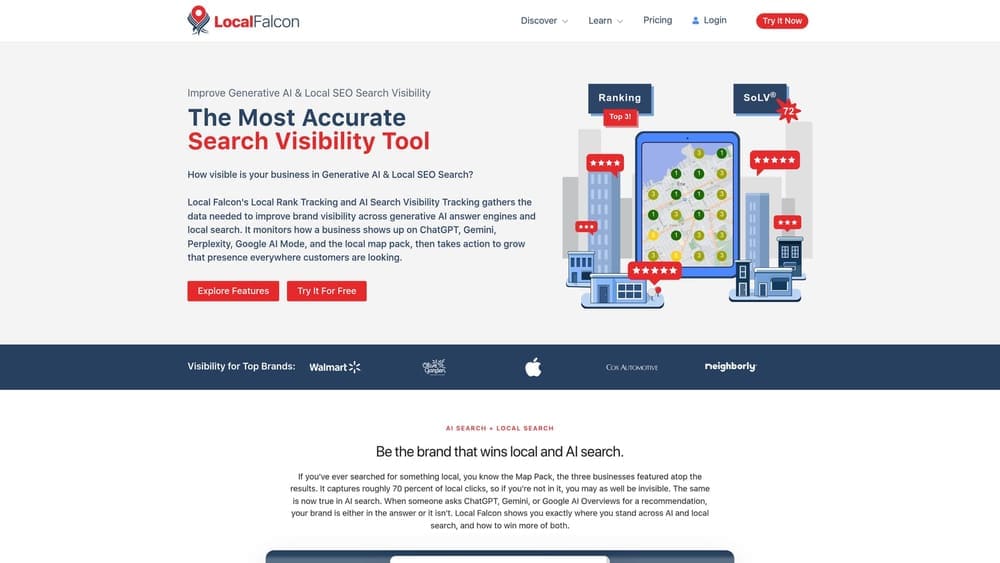
Local Falcon is a specialized GBP rank-checking tool that generates a geographic grid showing exactly where your HVAC business ranks in the Map Pack across your entire service area.
Where This Tool Shines
The visual output is what makes Local Falcon different from standard rank trackers. You get a color-coded grid laid over your service area showing your Map Pack position at each point on the map. A neighborhood where you rank 1 shows up clearly. A neighborhood where you’re not appearing at all shows up just as clearly. That kind of visual makes it easy to prioritize where to focus citation work, review generation, or GBP optimization efforts.
The competitor overlay is particularly useful for HVAC operators trying to understand who’s beating them in specific parts of their territory and by how much.
Key Features
Grid-Based GBP Rank Scans: Shows Map Pack position by street and neighborhood across your defined service area.
Competitor Comparison: Overlays competitor rankings on the same grid for direct comparison.
Scheduled Automated Scans: Tracks ranking changes over time without manual re-scanning.
Share of Local Voice: Quantifies overall service area visibility as a single benchmark metric.
Credit-Based Pricing: Pay for scans rather than a flat monthly fee, which keeps costs manageable for smaller operators.
Best For
HVAC operators who suspect they have coverage gaps in their service area but need data to confirm it before deciding where to invest. Also useful for agencies reporting Map Pack progress to clients.
Pricing
Credit-based model; plans start around $24/month for regular scanning. Costs scale with scan frequency and grid size.
7. Semrush Local Toolkit
Best for: Teams already using Semrush for SEO who want local listing management and rank tracking in the same platform
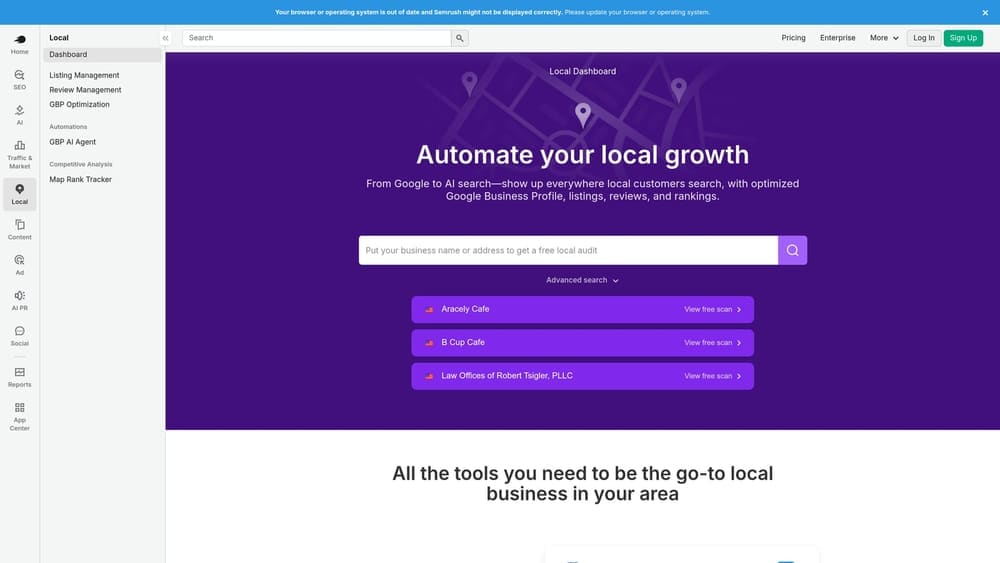
Semrush’s Local Toolkit consolidates listing management, review monitoring, and local keyword research into the broader Semrush platform, which makes it practical for teams that are already paying for Semrush’s SEO tools.
Where This Tool Shines
The integration point is the main argument for this tool. If your team is already using Semrush for keyword research, backlink analysis, and SEO tracking, adding the local module means you don’t have to manage a separate platform for local rank data and listing management. Everything lives in one dashboard.
The local keyword research with city-level search volume is genuinely useful for HVAC operators trying to understand demand patterns across their service area, particularly for seasonal planning around AC tune-up season and furnace check campaigns.
Key Features
Listing Management: Syncs HVAC business information across major directories from one interface.
Local Keyword Research: Search volume data at the city level for HVAC service terms.
Map Pack Visibility Reporting: Tracks position in local pack results alongside organic rankings.
Review Monitoring and Response: Centralized review management across Google and other platforms.
GBP Post Scheduling: Publish and schedule GBP posts without leaving the Semrush platform.
Best For
HVAC marketing teams or agencies already on Semrush who want to add local management without adopting another standalone tool. Less compelling if you’re not already paying for Semrush’s base subscription.
Pricing
Local add-on starts at $20/month on top of the Semrush base subscription, which starts at $139.95/month. Total cost is higher than single-purpose local tools.
8. Yext
Best for: HVAC businesses that need accurate listing data pushed to 100+ directories simultaneously
Yext is an enterprise-grade listings management platform that syncs your HVAC business information across more than 100 directories, search engines, and voice assistants at once.
Where This Tool Shines
NAP consistency is a known local ranking factor, and for HVAC SABs it’s harder to maintain than it is for businesses with a single public address. Yext’s publisher network is the broadest available, which means a single update to your business name, service area, or phone number propagates across the web without you manually correcting each directory.
The duplicate listing suppression is worth calling out specifically. Duplicate GBP and directory listings are a common problem for HVAC companies that have been in business for years or have gone through rebrands, and Yext handles suppression at scale rather than requiring manual cleanup.
Key Features
100+ Publisher Network: Syncs NAP and service area data across directories, search engines, and voice platforms simultaneously.
Structured Data Management: Manages schema markup and structured data for AI-driven and voice search results.
Duplicate Listing Suppression: Identifies and suppresses duplicate listings across the publisher network.
Review Monitoring and Response: Centralized review management across multiple platforms.
Performance Analytics: Dashboard showing listing performance and visibility by source.
Best For
Established HVAC companies with inconsistent listing data across the web, multi-location operators, and businesses that want hands-off listing maintenance after an initial cleanup.
Pricing
Plans start around $199/year for basic listings management. Full feature access, including duplicate suppression and analytics, requires higher tiers.
9. Podium
Best for: HVAC operators that want to automate review requests after each job without manual follow-up
Podium is a customer communication platform that sends automated SMS review requests after HVAC job completion, helping service area businesses build review volume consistently without relying on technicians to remember to ask.
Where This Tool Shines
Review velocity and recency are real factors in Map Pack ranking, and the biggest obstacle for most HVAC companies isn’t that customers won’t leave reviews. It’s that no one asks them at the right moment. Podium automates the ask via SMS within minutes of job completion, which is when customer satisfaction is highest and the friction to leaving a review is lowest.
The integration with field service platforms like ServiceTitan and Housecall Pro is what makes this practical for HVAC operations at scale. The review request triggers automatically when a job is marked complete, which removes the dependency on individual technician behavior entirely.
Key Features
Automated SMS Review Requests: Sent after technician closes a job, with direct-to-Google review links for minimal friction.
Field Service Software Integration: Connects with ServiceTitan, Housecall Pro, and other platforms to trigger requests automatically.
Centralized Inbox: Consolidates reviews, SMS conversations, and web chat in one place.
Review Monitoring and Benchmarking: Tracks review volume and average rating against local competitors.
Web Chat: Converts website visitors to SMS conversations for faster lead response.
Best For
HVAC operators with active field teams who want review generation to happen automatically rather than depending on technicians or manual follow-up. Particularly effective for companies running 10+ jobs per week.
Pricing
Custom pricing; typically starts around $299/month for small teams. Enterprise pricing available for larger operations.
Which Tool Fits Your Situation
The right starting point depends on what’s actually broken in your current setup.
If your Map Pack coverage has holes across your service area, start with Local Falcon to see exactly where you’re invisible, then use BrightLocal or Whitespark to fix the citation inconsistencies that are likely contributing to those gaps.
If you’re spending money on ads and organic but can’t tell which channel is producing booked jobs, CallRail is the first tool to add. The Map Pack captures roughly 42% of local clicks, and 40 to 70% of HVAC leads still arrive by phone. Without call tracking, you’re making budget decisions blind.
If your business information is scattered and inconsistent across the web, Yext handles that cleanup and ongoing maintenance at a scale that’s hard to match manually.
If your review volume is thin or stagnant, Podium’s automated SMS requests after job completion are the most friction-free way to build it consistently.
If you want someone to run the whole system, including Google Ads, Local SEO, GBP optimization, and attribution reporting built specifically around HVAC service area businesses, that’s what Clicks Geek does. We’ve been doing this since 2015 across 298 industry verticals, and the HVAC playbook reflects what we’ve learned running campaigns in markets across all 50 states.
If you want to see what this would look like for your specific service area and market, we’ll walk you through how it works and give you an honest read on what’s realistic where you operate.