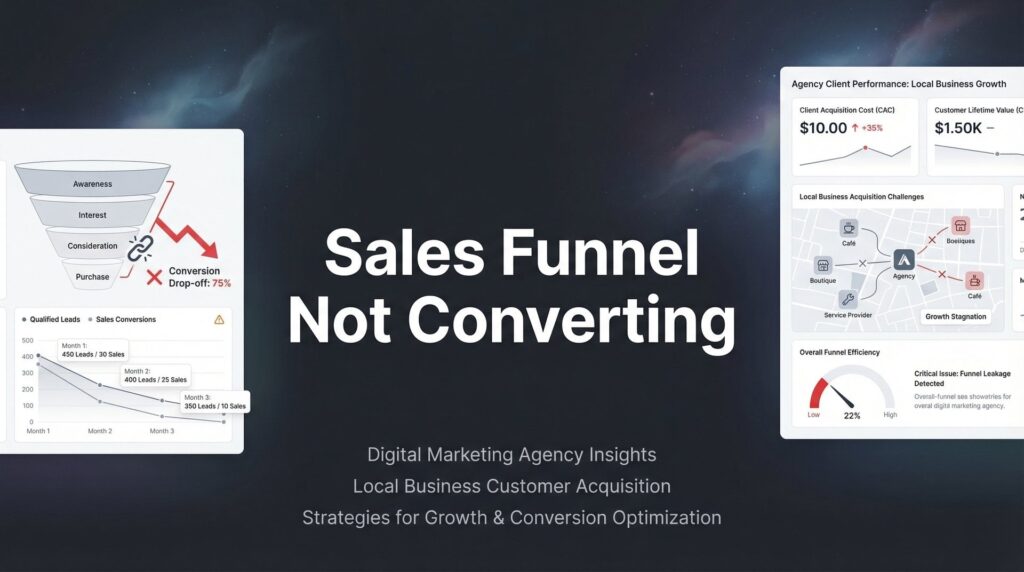
You’re driving traffic, leads are entering your funnel, but conversions? Crickets. A sales funnel not converting is one of the most frustrating problems local business owners face—you’re spending money on ads, your website looks good, yet the revenue doesn’t match the effort.
The truth is, funnel failures rarely happen for a single reason. It’s usually a combination of friction points, messaging mismatches, and trust gaps that compound at each stage.
This guide breaks down the seven most common funnel killers we see at Clicks Geek and gives you the exact diagnostic process and fixes to turn your leaky funnel into a conversion machine. Whether you’re losing people at the landing page, the consideration stage, or right before checkout, you’ll walk away with actionable strategies you can implement this week.
1. Audit Your Traffic-to-Offer Match
The Challenge It Solves
Your ad promises one thing, but your landing page delivers something completely different. This disconnect creates immediate confusion and drives visitors away before they even understand what you’re offering. When someone clicks an ad about “emergency plumbing services” and lands on a page about bathroom remodeling packages, they bounce. The expectation-reality gap is the fastest way to kill conversions before they start.
The Strategy Explained
Message matching means your ad copy, landing page headline, and offer need to speak the same language. If your ad talks about solving a specific pain point, your landing page should immediately acknowledge that pain and present your solution in the same terms.
Think of it like a conversation. Your ad is the opening line, and your landing page is the response. If those two don’t connect naturally, the conversation ends. Review every ad campaign and trace the path from ad copy to landing page headline to the actual offer presentation.
Look for language shifts, tone changes, or focus pivots. If your ad emphasizes speed and your landing page emphasizes quality, you’ve created friction. If your ad targets homeowners but your landing page speaks to contractors, you’ve missed the mark. This is a common reason why ads are not converting to sales for many businesses.
Implementation Steps
1. Screenshot every active ad and place it side-by-side with its corresponding landing page. Read them as if you’re seeing them for the first time and note any disconnect in messaging, tone, or promised outcome.
2. Align your landing page headline to mirror the core promise from your ad. If your ad says “Get Your Roof Inspected in 24 Hours,” your landing page headline should reinforce that same timeframe and urgency.
3. Audit the visual consistency between ads and landing pages. If your ad shows residential homes, don’t use commercial building images on the landing page. Visual continuity reinforces message match.
Pro Tips
Create dedicated landing pages for each major ad campaign rather than sending all traffic to your homepage. The more specific the match between ad and landing page, the higher your conversion rate. Test using the exact ad headline as your landing page H1—it’s often the fastest way to eliminate message mismatch.
2. Eliminate Landing Page Friction
The Challenge It Solves
Every unnecessary element, slow-loading image, or confusing navigation option creates friction that gives visitors a reason to leave. Most visitors decide within seconds whether to stay on a page, and anything that slows them down or makes them think too hard becomes an exit point. Friction accumulates—a slow page plus a cluttered layout plus too many form fields equals a conversion killer.
The Strategy Explained
Friction elimination is about creating the clearest, fastest path from arrival to action. This means ruthlessly cutting anything that doesn’t directly support conversion. Your landing page exists for one purpose: to get the visitor to take the next step.
Start by analyzing load speed. Pages that take more than a few seconds to fully load lose visitors before they even see your offer. Then look at visual hierarchy—can someone understand what you’re offering and what action to take within five seconds of landing? If not, you have a clarity problem.
Form length is another major friction source. Every field you add to a form reduces completion rates. Ask only for information you absolutely need at this stage. Learning how to create high converting landing pages starts with understanding these friction points and systematically eliminating them.
Implementation Steps
1. Run your landing page through Google PageSpeed Insights and implement the top three recommendations for improving load time. Compress images, eliminate render-blocking scripts, and leverage browser caching.
2. Remove all navigation menus from your landing pages. Every link away from your conversion goal is a potential exit point. If someone came from an ad, they don’t need to browse your entire site—they need to convert.
3. Cut your form fields in half. If you’re asking for ten pieces of information, identify the five you actually need right now. Name, email, and phone are often sufficient for initial lead capture.
Pro Tips
Use heat mapping tools to see where visitors are clicking and how far they’re scrolling. Dead zones and rage clicks reveal friction points you might not notice otherwise. Test single-column layouts against multi-column designs—single columns typically reduce cognitive load and improve conversion rates.
3. Fix Your Trust Gap
The Challenge It Solves
Visitors don’t know you, and they’re being asked to share information or spend money with a business they’ve never worked with before. Without credibility indicators and social proof, you’re asking for a leap of faith most people won’t take. The trust gap is especially wide for local businesses competing against established brands or when the offer involves significant commitment.
The Strategy Explained
Trust building isn’t about adding generic testimonials at the bottom of your page. It’s about strategically placing credibility signals throughout your funnel at the exact moments when doubt creeps in. Different stages require different types of proof.
Early in the funnel, you need authority signals: certifications, years in business, recognizable client logos, industry partnerships. These establish baseline credibility. Mid-funnel, you need social proof that shows others have successfully used your service: specific testimonials with names and faces, case study summaries, review counts.
Late in the funnel, right before conversion, you need risk reversal: guarantees, clear refund policies, transparent pricing, easy cancellation terms. This is where you remove the final objections preventing someone from taking action. Understanding the customer acquisition funnel helps you place these trust signals at exactly the right moments.
Implementation Steps
1. Add a trust bar immediately below your headline featuring your most impressive credentials: Google Premier Partner status, years in business, number of clients served, or relevant certifications. Make it visually distinct but not overwhelming.
2. Place a specific testimonial near your call-to-action that addresses the main objection for that stage. If you’re asking for a phone number, include a testimonial about how easy the consultation was. If you’re asking for a purchase, include a testimonial about results.
3. Create a simple guarantee statement that removes the perceived risk. “If we don’t generate qualified leads in the first 30 days, we’ll refund your investment” is more powerful than “Satisfaction guaranteed.”
Pro Tips
Video testimonials outperform text testimonials significantly, but they need to be short and specific. A 30-second clip of a real customer describing a specific result beats a five-minute generic endorsement. Include the customer’s business name and location to add authenticity—vague testimonials raise suspicion rather than building trust.
4. Rebuild Your Follow-Up Sequence
The Challenge It Solves
Most visitors aren’t ready to buy on their first interaction with your business. They’re researching, comparing options, or simply not at the decision point yet. Without a strategic follow-up system, these warm leads go cold, and you’ve wasted the money you spent acquiring them. The gap between initial interest and purchase decision is where most revenue gets lost.
The Strategy Explained
Effective follow-up isn’t about bombarding people with generic emails. It’s about creating a multi-touch sequence that provides value, builds relationship, and moves people toward a buying decision at their own pace. Considered purchases typically require multiple touchpoints before someone converts.
Your sequence should address different stages of awareness and different objections. Early emails focus on education and establishing expertise. Middle emails provide social proof and address common concerns. Later emails create urgency and present compelling reasons to act now. This is often where leads fail to convert to customers—the follow-up simply isn’t strategic enough.
The key is varying your communication methods and providing genuine value in each touchpoint. Mix educational content with case studies, direct offers with helpful resources, email with SMS or retargeting ads. Each touch should have a clear purpose beyond “buy now.”
Implementation Steps
1. Map out a seven-touch sequence over 14 days for new leads who don’t immediately convert. Touch 1: Welcome and set expectations. Touch 2: Educational content addressing their main pain point. Touch 3: Case study or success story. Touch 4: Address the most common objection. Touch 5: Limited-time offer or incentive. Touch 6: Final value-add piece. Touch 7: Direct ask with clear next steps.
2. Segment your follow-up based on how far someone got in your funnel. Someone who abandoned a form halfway through needs different messaging than someone who visited your pricing page three times but didn’t purchase.
3. Implement behavioral triggers that send relevant follow-up based on actions taken. If someone downloads a guide about PPC advertising, your next email should acknowledge that interest and provide related value, not pitch a completely different service.
Pro Tips
The most effective follow-up sequences include at least one piece of unexpected value—a free audit, a personalized video, a custom recommendation. This pattern interrupt stands out from typical drip campaigns and re-engages people who’ve tuned out promotional messages. Test sending follow-up messages from a real person’s email address rather than a generic company address—reply rates typically improve significantly.
5. Optimize Your Offer Positioning
The Challenge It Solves
Your service might be excellent, but if you’re presenting it as a commodity purchase competing solely on price, you’ll struggle to convert. Poor offer positioning makes your solution seem generic, risky, or not worth the investment. When prospects can’t clearly see the value difference between you and competitors, they default to choosing the cheapest option or not choosing at all.
The Strategy Explained
Offer positioning is about framing what you’re selling in terms of outcomes and value rather than features and process. Instead of “We provide PPC management services,” you position it as “We build lead systems that turn ad spend into predictable revenue growth.” The second version tells someone what they actually get, not just what you do.
Value stacking means breaking down everything included in your offer so the total perceived value far exceeds the price. You’re not charging for your time—you’re providing a complete solution that includes strategy, implementation, optimization, reporting, and ongoing support. When itemized properly, the investment becomes obviously worthwhile. This approach directly addresses the high cost per acquisition problem many businesses struggle with.
Risk reversal flips the traditional buying dynamic. Instead of asking prospects to take all the risk, you shoulder some of it through guarantees, trial periods, or performance-based elements. This dramatically lowers the barrier to trying your service.
Implementation Steps
1. Rewrite your primary offer to lead with the outcome, not the service. Replace “Monthly PPC Management – $2,000/month” with “Predictable Lead Generation System – $2,000/month investment typically generates 40-60 qualified leads.” The second version helps prospects calculate ROI immediately.
2. Create a value stack that itemizes everything included in your offer with individual values. List out strategy sessions, campaign setup, ad creative, landing page optimization, conversion tracking, weekly reporting, and ongoing optimization as separate line items with their standalone values, then show your actual price as significantly lower than the sum.
3. Add a clear risk reversal element to your offer. A 30-day money-back guarantee, a trial period, or a performance guarantee that puts some of your compensation at risk based on results. Make it specific and easy to understand.
Pro Tips
Create tiered offers rather than a single option. When presented with three choices, most buyers select the middle option, and the presence of a premium tier makes your standard offering seem more reasonable by comparison. Name your tiers based on outcomes rather than size: “Growth Package” and “Scale Package” work better than “Basic” and “Premium.”
6. Close the Mobile Experience Gap
The Challenge It Solves
Mobile traffic now dominates most industries, yet many funnels are still designed primarily for desktop users. The result is a massive conversion gap where mobile visitors bounce at significantly higher rates than desktop users. Buttons that are easy to click on desktop become frustrating on mobile. Forms that seem reasonable on a large screen feel overwhelming on a phone. This mobile experience gap quietly kills conversions without showing up in obvious ways.
The Strategy Explained
Mobile optimization isn’t just about responsive design—it’s about fundamentally rethinking the conversion path for someone using a phone. Mobile users have different behaviors, constraints, and expectations. They’re often multitasking, they have limited screen space, and they’re more likely to be interrupted.
Your mobile funnel needs to be even simpler than your desktop version. Fewer fields, larger buttons, clearer hierarchy, faster load times. Every element that works on desktop needs to be tested on an actual phone to see if it still functions well in that context. When your digital marketing is not generating revenue, mobile experience is often the hidden culprit.
Consider mobile-specific conversion paths. Click-to-call buttons often convert better than forms on mobile. SMS opt-ins can work better than email captures. The goal is to reduce friction specifically for the mobile context.
Implementation Steps
1. Conduct a mobile audit by completing your entire conversion process on your phone. Fill out forms, click buttons, read copy. Note every moment of friction: buttons too small to tap accurately, text too small to read, forms that require excessive typing, pages that load slowly on cellular connections.
2. Implement mobile-specific CTAs that take advantage of phone functionality. Add click-to-call buttons prominently for service businesses. Use SMS opt-in options for quick lead capture. Enable autofill for form fields so users don’t have to type as much.
3. Reduce your mobile form fields even further than your desktop version. If your desktop form has five fields, your mobile version should have three maximum. Consider multi-step forms that show one question at a time rather than overwhelming users with a long form on a small screen.
Pro Tips
Test your landing pages on multiple devices and browsers, not just your personal phone. Android users often have different experiences than iPhone users. Older devices struggle with heavy pages that newer phones handle fine. Use tools like BrowserStack to test across various configurations without buying multiple devices.
7. Implement Stage-by-Stage Tracking
The Challenge It Solves
You know your funnel isn’t converting, but you don’t know exactly where it’s breaking. Without granular tracking, you’re guessing about which fixes to prioritize. You might spend weeks optimizing your landing page when the real problem is your follow-up sequence. Or you might rebuild your offer when the issue is actually traffic quality. This diagnostic blindness leads to wasted effort fixing the wrong problems.
The Strategy Explained
Micro-conversion tracking means measuring every significant action in your funnel, not just the final conversion. Track landing page views, scroll depth, video plays, form starts, form completions, email opens, link clicks, page revisits—every interaction that indicates progress toward a sale.
This granular data reveals exactly where your funnel leaks. If 1,000 people land on your page but only 100 scroll past the fold, you have a hook problem. If 500 people start your form but only 50 complete it, you have a form friction problem. If 200 people enter your email sequence but only 10 click through to your offer, you have a follow-up content problem. Businesses that aren’t tracking marketing conversions properly waste significant budget on the wrong optimizations.
The goal is to turn your funnel from a black box into a transparent system where you can see drop-off rates at every stage and prioritize improvements based on data rather than assumptions.
Implementation Steps
1. Set up event tracking for every major interaction point in your funnel. In Google Analytics 4 or your analytics platform, create events for: landing page scroll to 50%, video play, form field interaction, form submission, email link clicks, return visits, and any other action that indicates engagement.
2. Create a conversion funnel visualization that shows drop-off rates between each stage. Start with traffic source, then landing page view, scroll depth, form start, form completion, email open, email click, and final conversion. Calculate the percentage that moves from each stage to the next.
3. Identify your biggest leak—the stage with the highest drop-off rate—and focus your optimization efforts there first. If you’re losing 80% of visitors before they scroll, fix your above-the-fold content before worrying about your form design.
Pro Tips
Set up automated alerts for significant changes in your funnel metrics. If your form completion rate suddenly drops by 20%, you want to know immediately, not discover it weeks later. Use session recording tools like Hotjar or Microsoft Clarity to watch actual user sessions and see exactly where people get stuck or confused—sometimes the data shows you there’s a problem, but watching recordings shows you why.
Your Implementation Roadmap
A sales funnel not converting isn’t a death sentence—it’s a diagnostic opportunity. The businesses that win aren’t the ones with perfect funnels from day one; they’re the ones who measure, test, and optimize relentlessly.
Start with stage-by-stage tracking to identify your biggest leak. Once you know where people are dropping off, you can prioritize which fix to implement first. If you’re losing people immediately on the landing page, start with traffic-to-offer match and friction elimination. If people are engaging but not converting, focus on trust signals and offer positioning. If you’re getting initial conversions but no follow-through, rebuild your follow-up sequence. For a deeper dive into systematic improvements, explore conversion funnel optimization strategies.
The key is systematic improvement, not random changes. Pick the one strategy above that addresses your biggest suspected leak and implement it this week. Then measure the impact before moving to the next fix. Document what you change and what results you see so you can build on what works.
At Clicks Geek, we’ve helped local businesses transform underperforming funnels into consistent lead-generation machines through CRO-focused strategies and systematic optimization. We don’t just drive traffic—we build complete systems that turn that traffic into qualified leads and measurable revenue growth.
Tired of spending money on marketing that doesn’t produce real revenue? We build lead systems that turn traffic into qualified leads and measurable sales growth. If you want to see what this would look like for your business, we’ll walk you through how it works and break down what’s realistic in your market.
Want More Leads for Your Business?
Most agencies chase clicks, impressions, and “traffic.” Clicks Geek builds lead systems. We uncover where prospects are dropping off, where your budget is being wasted, and which channels will actually produce ROI for your business, then we build and manage the strategy for you.