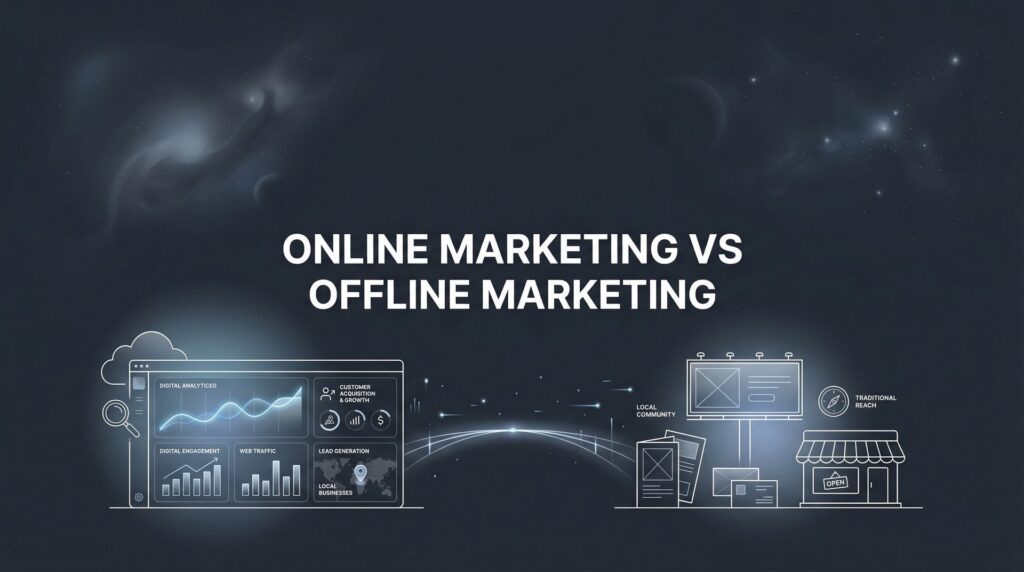
The debate between online marketing vs offline marketing isn’t really a debate at all—it’s a strategic decision that depends on your business goals, audience, and budget. Local businesses often get caught up choosing one over the other, when the real winners are those who understand how to leverage both channels effectively.
Whether you’re running a service business, retail operation, or professional practice, knowing when to invest in digital channels versus traditional methods can mean the difference between wasted ad spend and profitable growth.
The truth is, most successful businesses don’t choose between online and offline marketing. They understand which channels drive the best results for their specific situation and build a marketing mix that maximizes return on investment. Some businesses thrive with a heavy digital focus. Others find that strategic offline efforts combined with digital conversion paths produce the strongest results.
This guide breaks down seven actionable strategies to help you make smarter marketing decisions that actually drive revenue. You’ll learn how to assess your customer journey, allocate budget intelligently, and create a marketing approach that works for your business—not just what’s trendy or what everyone else is doing.
1. Map Your Customer Journey to Identify Channel Fit
The Challenge It Solves
Most businesses waste marketing budget because they’re promoting in channels that don’t match how their customers actually make buying decisions. A high-ticket B2B service follows a completely different path than an impulse retail purchase, yet many businesses apply the same marketing approach to both.
Understanding your specific customer journey reveals where prospects need information, what triggers their decision, and which touchpoints actually influence the sale. Without this clarity, you’re essentially guessing where to spend your marketing dollars.
The Strategy Explained
Start by interviewing your recent customers to understand how they found you and what convinced them to buy. Ask specific questions: What were they searching for? Who did they talk to? What information did they need before making a decision? How long did the process take?
Map out the stages from initial awareness through final purchase. For each stage, identify which channels your customers actually used versus which ones you’re currently investing in. You’ll often find significant gaps between where you’re spending and where customers are actually looking.
Consider a local HVAC company. Their customer journey might start with a Google search during an emergency, but the decision often involves checking reviews, getting multiple quotes, and asking neighbors for recommendations. That journey requires a different channel mix than a restaurant trying to fill tables tonight.
Implementation Steps
1. Survey or interview 10-15 recent customers about how they discovered your business and what influenced their decision to buy.
2. Create a visual map showing each stage of the journey (awareness, consideration, decision) and list the channels customers used at each stage.
3. Compare your current marketing spend allocation against where customers actually engage, then identify the biggest gaps.
Pro Tips
Pay special attention to the consideration stage—this is where many businesses lose opportunities. If customers are researching online but you’re only investing in offline brand awareness, you’re missing the conversion window. The goal isn’t to be everywhere, it’s to be present at the moments that matter for your specific buying process.
2. Allocate Budget Based on Trackability and Intent
The Challenge It Solves
One of the biggest frustrations local businesses face is not knowing which marketing actually produces customers. You run ads, sponsor events, send mailers, and post on social media—but when someone calls or walks in, you often can’t trace them back to a specific source.
This lack of visibility leads to continued investment in channels that might be generating zero return while underfunding channels that are actually driving revenue. Without clear attribution, you’re making marketing decisions blind.
The Strategy Explained
Digital channels generally offer better tracking and attribution capabilities compared to traditional offline methods. When someone clicks a Google ad, fills out a form, or calls from a landing page, you can measure exactly what you spent and what you got in return.
This doesn’t automatically make digital better—it makes it more accountable. Your budget allocation should prioritize channels where you can measure cost per lead and cost per customer. Once you establish baseline performance in trackable channels, you can strategically test offline methods with proper tracking mechanisms in place.
Think of it this way: If you can’t measure it, you can’t improve it. Start with channels that give you data, establish what good performance looks like, then expand into channels with less precise tracking only when you have budget to test. Understanding marketing attribution models is essential for making sense of which touchpoints actually drive conversions.
Implementation Steps
1. Audit your current marketing channels and categorize them by trackability—can you measure leads and sales from each source with confidence?
2. Allocate 60-70% of your budget to high-trackability channels (PPC, SEO, email marketing, retargeting) where you can measure performance weekly.
3. Reserve 20-30% for strategic offline or brand-building efforts, using unique tracking mechanisms (dedicated phone numbers, custom URLs, promo codes) to measure impact.
Pro Tips
High intent matters as much as trackability. A Google search for “emergency plumber near me” shows dramatically higher purchase intent than someone seeing a billboard. Prioritize channels where you can capture people actively looking for what you sell, not just building passive awareness. Once you master high-intent digital channels, you’ll have the revenue and data to expand strategically.
3. Use Offline Marketing for Brand Building, Online for Conversions
The Challenge It Solves
Many businesses try to force channels into roles they weren’t designed for. They expect a billboard to generate immediate phone calls or assume Facebook ads will build the same brand recognition as consistent community presence. This mismatch between channel strength and marketing goal leads to disappointing results and wasted spend.
Each channel has natural advantages. Trying to make a sponsorship drive direct response or a PPC campaign build brand awareness means you’re fighting against the channel’s inherent characteristics rather than leveraging them.
The Strategy Explained
Offline marketing excels at creating broad awareness and establishing local credibility. When you sponsor a little league team, host a community event, or run radio ads, you’re building familiarity and trust within your market. People see your name repeatedly in their daily lives, which matters when they eventually need your service.
Digital marketing shines at capturing existing demand and converting ready-to-buy prospects. When someone searches for what you offer or clicks on a targeted ad, they’re already in buying mode. Your digital presence should focus on being found at that critical moment and converting that interest into a customer.
The most effective approach uses offline efforts to build market presence while digital channels capture the demand that presence creates. Your community sponsorships make people familiar with your brand. Your Google ads ensure you’re the one they find when they’re ready to buy. This is the core difference between performance marketing and traditional marketing.
Implementation Steps
1. Identify your offline marketing efforts and reframe their purpose as brand building and credibility rather than immediate lead generation.
2. Build a strong digital conversion infrastructure (optimized website, Google Business Profile, PPC campaigns) to capture people who’ve become aware of you through offline channels.
3. Stop measuring offline brand efforts by immediate leads—instead track brand search volume, direct website traffic, and overall market awareness over time.
Pro Tips
If you’re investing in offline brand building, make sure your digital conversion paths are rock solid. There’s nothing worse than creating awareness through community presence only to lose those potential customers because your website doesn’t rank or your Google Business Profile is incomplete. Brand building only works when people can easily find and contact you when they’re ready.
4. Target Demographics That Match Each Channel’s Reach
The Challenge It Solves
Not every audience lives in the same places or consumes media the same way. A business targeting 25-year-old professionals shouldn’t use the same channel mix as one serving 65-year-old retirees. Yet many businesses default to either “we need to be on social media” or “traditional marketing still works” without considering where their specific customers actually spend attention.
This demographic mismatch leads to marketing that technically runs but never reaches the right people. You’re advertising in channels your audience doesn’t use while ignoring the ones where they’re highly engaged.
The Strategy Explained
Younger demographics tend to spend more time on digital platforms, while certain older demographics may still respond well to traditional media. But these are generalizations—your specific audience might behave differently based on industry, location, and lifestyle factors.
A financial advisor serving pre-retirees might find that a combination of local newspaper advertising and targeted Facebook ads works better than Instagram or TikTok. A boutique fitness studio targeting young professionals might waste money on direct mail while missing opportunities on Instagram and local search.
The key is matching your channel selection to where your specific audience actually spends their time and attention. This requires knowing your customer demographics in detail and understanding their media consumption habits, not just making assumptions based on age alone.
Implementation Steps
1. Define your ideal customer demographics precisely—age range, income level, occupation, lifestyle characteristics, and location.
2. Research where this specific demographic spends time both online and offline—ask current customers directly about their media habits.
3. Build your channel mix around the top 3-4 places where your audience is most concentrated and engaged, ignoring channels that might work for other businesses but don’t match your customer base.
Pro Tips
Don’t confuse where you spend time with where your customers spend time. Just because you don’t use Facebook doesn’t mean your 50-year-old target customer isn’t active there daily. Let customer behavior drive channel selection, not your personal preferences or what feels trendy. The best channel is always the one where your specific audience is paying attention.
5. Create Integrated Campaigns That Bridge Both Worlds
The Challenge It Solves
Running online and offline marketing as completely separate efforts means you’re missing the opportunity to amplify results through integration. When your radio ad says one thing and your website says another, or when your direct mail piece doesn’t connect to a relevant landing page, you’re creating friction instead of a cohesive customer experience.
Integration gaps also make tracking nearly impossible. Without clear connections between offline touchpoints and digital conversion paths, you can’t measure the true impact of your multi-channel efforts.
The Strategy Explained
The most effective campaigns connect offline touchpoints to digital conversion paths using tracking mechanisms and unified messaging. When someone sees your billboard, hears your radio spot, or receives your direct mail piece, there should be a clear, trackable path to engage digitally.
This might mean using unique URLs on print materials, QR codes that lead to specific landing pages, or dedicated phone numbers for different offline campaigns. Implementing call tracking for marketing campaigns allows you to attribute phone leads to specific offline efforts. The goal is creating seamless transitions from offline awareness to online conversion while maintaining the ability to track which offline efforts are actually working.
Your messaging should also remain consistent across channels. If your direct mail emphasizes your 20 years of experience, your landing page should reinforce that credibility. If your radio ad promotes a specific offer, the website experience should deliver on that promise immediately.
Implementation Steps
1. For each offline marketing piece, create a dedicated digital destination—custom landing pages with unique URLs that match the offline message exactly.
2. Add tracking mechanisms to all offline materials—QR codes, vanity URLs, unique promo codes, or dedicated phone numbers that identify the source.
3. Ensure visual and message consistency across channels so customers experience one cohesive brand whether they encounter you offline or online.
Pro Tips
Make the digital connection obvious and easy. Don’t just put your homepage URL on a mailer—create a specific landing page that continues the conversation you started offline. A well-executed multi channel marketing strategy ensures every touchpoint works together rather than in isolation. Use QR codes that work reliably and lead somewhere relevant. The easier you make it for someone to move from offline interest to online action, the better your integration will perform.
6. Test, Measure, and Shift Budget to Winners
The Challenge It Solves
Many businesses set their marketing budget once and run the same mix month after month, regardless of performance. They keep paying for the newspaper ad because “we’ve always done it” or continue social media campaigns that generate likes but zero customers. Without systematic testing and measurement, you have no idea which channels deserve more investment and which are quietly draining your budget.
This static approach means you’re likely overspending on underperformers while underfunding your best opportunities. The businesses that win are the ones that treat marketing as an ongoing optimization process, not a set-it-and-forget-it expense.
The Strategy Explained
Run controlled experiments across channels and reallocate spend based on actual performance data. This means testing new channels in small, measurable doses while continuously monitoring the performance of existing efforts. Learning how to track marketing ROI is fundamental to making data-driven budget decisions.
Set clear performance benchmarks for each channel. If Google Ads generates leads at $50 each and Facebook Ads produces them at $150, you know where to shift budget. If your direct mail campaign costs $2,000 and generates three customers worth $5,000 each, that’s a winner worth scaling.
The key is making decisions based on actual results rather than assumptions, industry trends, or what competitors are doing. Your market, audience, and business model are unique—what works for someone else might not work for you, and vice versa.
Implementation Steps
1. Establish clear metrics for each marketing channel—at minimum, track cost per lead and cost per customer where possible.
2. Run new channel tests with small budgets first (10-15% of total marketing spend) and measure performance over 60-90 days before scaling.
3. Review performance monthly and shift 20-30% of budget from underperforming channels to top performers, continuously optimizing your mix.
Pro Tips
Give new channels enough time and budget to produce meaningful data before making decisions. A $200 Facebook Ads test over two weeks doesn’t tell you much. But a $1,000 test over 60 days with proper targeting and creative gives you real information. Once you identify winners, scale aggressively—if something’s working at $1,000 per month, test $2,000 and see if performance holds. The fastest way to grow is doubling down on what’s already proven to work.
7. Scale What Works While Maintaining Channel Diversity
The Challenge It Solves
Once you identify high-performing channels, the temptation is to go all-in and put every dollar into what’s working right now. While this seems logical, it creates dangerous vulnerability. Channels change—algorithm updates happen, costs increase, competition intensifies, or audience behavior shifts. Businesses that rely entirely on one channel often face sudden revenue drops when that channel’s performance changes.
The challenge is balancing aggressive scaling of proven channels with maintaining enough diversity to protect against market shifts and capture opportunities across different customer segments.
The Strategy Explained
When you find a channel that consistently delivers profitable customers, scale it hard—but not exclusively. Allocate the majority of your budget to proven performers while keeping 20-30% invested in secondary channels that provide backup and reach different segments of your audience.
This approach gives you the growth that comes from focusing resources on what works while maintaining insurance against channel-specific disruptions. If your primary channel experiences sudden cost increases or performance drops, you have established presence in other channels that can absorb some of that impact.
Think of it like an investment portfolio. You put most of your money in your highest-performing assets, but you maintain some diversification to manage risk. The same principle applies to marketing—concentrate resources on winners while keeping enough diversity to weather changes.
Implementation Steps
1. Identify your top-performing channel based on cost per customer and overall revenue contribution, then allocate 50-60% of your budget there.
2. Maintain presence in 2-3 secondary channels that reach different audience segments or serve different stages of the customer journey, allocating 15-20% to each.
3. Reserve 10-15% for testing new channels or seasonal opportunities, ensuring you’re always exploring potential new winners without risking your core performance.
Pro Tips
Watch for diminishing returns as you scale. Sometimes a channel performs brilliantly at $2,000 per month but efficiency drops at $5,000. When you hit that point, that’s your signal to increase investment in your secondary channels rather than pushing the primary channel past its optimal point. The goal is maximum total return, not maximum spend in any single channel.
Putting It All Together: Your Marketing Mix Action Plan
The question isn’t whether online marketing or offline marketing is better—it’s about building the right mix for your specific business, audience, and goals. The businesses that win are the ones that understand their customer journey, invest in trackable channels first, and continuously optimize based on real performance data.
Start by mapping where your customers actually make buying decisions. Are they searching online when they need your service? Are they asking neighbors for recommendations? Do they need to see your brand multiple times before they’re ready to buy? Your channel mix should match this reality, not generic best practices.
Prioritize channels where you can measure results clearly. Build your foundation on digital channels that offer precise tracking and high intent, then layer in strategic offline efforts that build brand presence and credibility. If you’re not tracking marketing conversions properly, you’re essentially flying blind with your budget allocation. Use integration to bridge both worlds—connect every offline touchpoint to a digital conversion path with proper tracking in place.
Most importantly, treat your marketing mix as dynamic, not static. Test new approaches with controlled budgets. Measure everything you can. Shift resources from underperformers to winners. Scale what works while maintaining enough diversity to protect against channel-specific disruptions.
The businesses that grow profitably are the ones that make marketing decisions based on their own data, not industry trends or competitor activity. Your market is unique. Your audience behaves differently. What works for you might surprise you—but you’ll only discover it through systematic testing and measurement.
If you want to see what this would look like for your business, we’ll walk you through how it works and break down what’s realistic in your market. Tired of spending money on marketing that doesn’t produce real revenue? We build lead systems that turn traffic into qualified leads and measurable sales growth.
Want More Leads for Your Business?
Most agencies chase clicks, impressions, and “traffic.” Clicks Geek builds lead systems. We uncover where prospects are dropping off, where your budget is being wasted, and which channels will actually produce ROI for your business, then we build and manage the strategy for you.