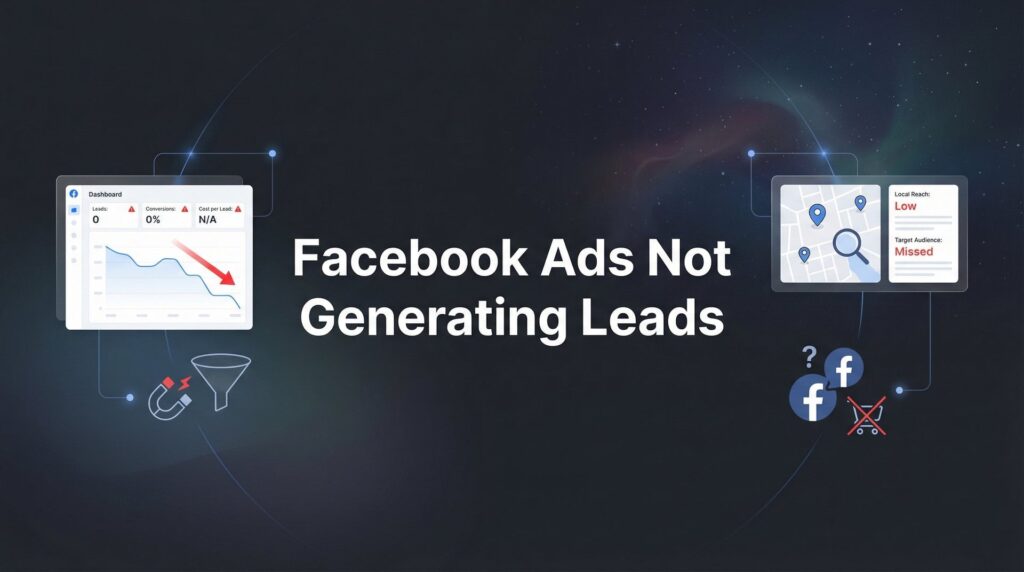
You’ve poured thousands into marketing—maybe tens of thousands—and the results are… crickets. No new leads. No sales bump. Just a dwindling bank account and growing frustration. If you’re experiencing no return on marketing investment, you’re not alone, and you’re definitely not stuck.
The truth is, most marketing doesn’t fail because the channels are broken. It fails because of fixable problems: wrong audience targeting, weak conversion paths, or campaigns that generate clicks but not customers.
This guide walks you through exactly how to diagnose why your marketing spend isn’t converting and, more importantly, how to turn things around. These aren’t theoretical suggestions—they’re the same steps we use at Clicks Geek to help local businesses stop bleeding money and start seeing real revenue from their marketing.
Let’s get your investment working for you.
Step 1: Audit Your Current Marketing Spend and Performance Data
Before you can fix anything, you need to know exactly where you stand. Think of this like a financial health check for your marketing—no guessing, no assumptions, just cold, hard numbers.
Start by pulling complete performance data from every marketing channel you’re currently using. That means Google Ads, Facebook Ads, your SEO tools, your CRM, and any other platform where you’re spending money. You need at least the last 90 days of data, though six months gives you a clearer picture of trends.
Calculate Your Real Cost-Per-Lead: For each channel, divide your total spend by the number of leads generated. But here’s the critical part—count only qualified leads, not just form submissions or clicks. That email from someone asking if you serve a city 500 miles away? That doesn’t count. Understanding the low quality leads problem helps you distinguish between vanity metrics and actual business opportunities.
Determine Your Cost-Per-Acquisition: This is where most businesses get uncomfortable, because the numbers are often worse than expected. Take your total marketing spend and divide it by the number of actual customers you acquired. Include all costs—ad spend, agency fees, software subscriptions, everything.
Now identify which campaigns are consuming budget without generating qualified leads. You’ll often find that 80% of your spend is going to campaigns that deliver maybe 20% of your results. That Google Ads campaign targeting broad keywords? It might be eating half your budget while generating zero sales.
Create a simple spreadsheet documenting all of this. You need this baseline snapshot so you can measure improvement as you implement changes. Without knowing where you started, you can’t prove what’s working. For a comprehensive framework, consider investing in digital marketing audit services to uncover hidden inefficiencies.
This audit isn’t fun. You’ll probably discover you’ve been wasting money on channels or campaigns that never had a chance of working. But that’s exactly why this step is so valuable—you can’t fix what you can’t see.
Step 2: Verify You’re Targeting the Right Audience
Here’s a question that makes most business owners squirm: Are you actually targeting people who want to buy what you sell, or are you just targeting people who might be vaguely interested in your industry?
Pull up your current audience targeting settings across all platforms. Now compare them against your actual customer profiles—not who you think your customers are, but who’s actually buying from you. The disconnect is often shocking.
Keyword Intent Matters More Than Volume: If you’re running PPC campaigns, review your keyword list with brutal honesty. Keywords like “what is digital marketing” attract researchers, not buyers. Keywords like “digital marketing agency near me” or “PPC management services” attract people ready to hire someone. The difference in conversion rates can be 10x or more. If you’re new to paid search, our guide on search engine marketing for beginners covers these fundamentals.
Check whether your geographic targeting aligns with your actual service area. We’ve seen businesses targeting entire states when they only serve three counties, wondering why their cost-per-lead is astronomical. Every wasted click to someone you can’t serve is money down the drain.
Message-to-Market Match: Look at your ad copy and landing page content. Does it speak directly to the pain points your ideal customers actually have? Or is it generic marketing speak that could apply to anyone?
For example, if you’re a local plumber, “Professional plumbing services” is generic. “Emergency pipe burst repair—available 24/7 in [City]” speaks to a specific, urgent need. The second message will always outperform the first because it targets someone with a problem they need solved right now.
Test your targeting by asking: If I were my ideal customer, would this ad make me stop scrolling? Would this message make me think “That’s exactly what I need”? If the answer is no, your targeting needs work.
The goal isn’t to reach more people. It’s to reach the right people—those who have the problem you solve, the budget to pay for it, and the intent to buy soon.
Step 3: Examine Your Conversion Path from Click to Customer
You’re getting clicks. Maybe even decent traffic. But those visitors are vanishing into thin air instead of becoming customers. This is where the money gets lost for most businesses.
Map out the complete journey from the moment someone clicks your ad to the moment they become a paying customer. Write down every single step: ad click → landing page → form submission → thank you page → sales contact → proposal → close. Now identify where prospects are dropping off.
Your Landing Page Is Usually the Culprit: Does your landing page load in under three seconds on mobile? Does the headline match the promise in your ad? Is the offer crystal clear within the first five seconds of arrival?
Here’s what kills conversions: slow load times, confusing navigation, weak headlines, unclear value propositions, and forms that ask for too much information. If your landing page takes six seconds to load and asks for 12 fields of information before someone can even talk to you, you’re bleeding potential customers. Businesses focused on conversion focused marketing obsess over these details because they know every friction point costs money.
Test your own conversion path on your phone right now. Click your ad, land on your page, and try to complete the desired action. Is it smooth and obvious, or frustrating and confusing? Your prospects experience the same friction you just felt—except they leave instead of pushing through.
The Call-to-Action Makes or Breaks Everything: What action are you asking people to take? “Contact us” is weak. “Get your free roof inspection—available this week” is specific and compelling. The easier and more valuable you make that next step, the more people will take it.
Check your form abandonment rate if you have the tracking set up. If 80% of people who start filling out your form don’t finish it, your form is the problem. Reduce fields, remove optional questions, and make the submit button impossible to miss.
Don’t forget mobile optimization. More than half your traffic probably comes from mobile devices. If your landing page isn’t mobile-friendly, you’re automatically losing half your potential customers before they even have a chance to convert.
The conversion path should feel like a gentle downhill slope, not an obstacle course. Every point of friction costs you money.
Step 4: Implement Proper Tracking and Attribution
If you can’t measure it, you can’t improve it. And if you’re experiencing no return on marketing investment, there’s a good chance you’re not measuring the right things—or not measuring at all.
Start with conversion tracking in Google Ads and Facebook Ads. These platforms need to know when someone completes a valuable action on your site—form submission, phone call, purchase, whatever counts as a conversion for your business. Without this data, you’re flying blind.
Call Tracking Changes Everything for Service Businesses: If most of your leads come through phone calls, you need call tracking for marketing campaigns that attributes each call to the specific campaign that generated it. Otherwise, you have no idea which marketing channels are actually working.
Set up Google Analytics to track meaningful events, not just pageviews. Track form submissions, button clicks, phone number clicks, and any other action that indicates interest. Configure goals so you can see which traffic sources generate the most conversions.
Closed-Loop Reporting Connects Spend to Revenue: This is the holy grail of marketing measurement. You need to track not just which campaigns generate leads, but which campaigns generate customers and how much revenue those customers bring in. Understanding marketing attribution models helps you assign credit accurately across your entire funnel.
This requires connecting your marketing platforms to your CRM and your CRM to your sales data. Yes, it takes effort to set up. But without it, you’re making decisions based on incomplete information. You might be cutting campaigns that generate your most profitable customers while scaling campaigns that generate tire-kickers.
Why does this matter so much? Because flying blind with incomplete data guarantees wasted spend. You’ll keep investing in channels that feel like they’re working while ignoring channels that are actually generating revenue. Our detailed guide on how to track marketing ROI walks you through the complete setup process.
Proper tracking isn’t sexy. It’s not the fun part of marketing. But it’s the foundation that makes everything else work. Without it, you’re just guessing—and guessing with your marketing budget is expensive.
Step 5: Optimize or Eliminate Underperforming Campaigns
Now that you have real data, it’s time to make some tough decisions. Not every campaign deserves to keep running just because you set it up months ago.
Look at your audit data from Step 1. Which campaigns have high costs and low conversion rates? Which ones consistently generate leads that never turn into customers? Those campaigns need to be paused immediately. Not “optimized later” or “given more time”—paused right now.
Reallocate Budget Toward What’s Working: Take the money you were wasting on underperformers and redirect it to campaigns showing positive signals. If one campaign generates leads at $50 each while another generates them at $200 each, and the quality is similar, the choice is obvious. Our guide on marketing budget allocation provides a framework for making these decisions strategically.
But don’t just throw more money at winners and call it a day. Test systematically. Create new ad variations with different headlines, different offers, different calls-to-action. Build new landing pages that emphasize different benefits. Test one variable at a time so you know what actually moves the needle.
Set Clear Performance Thresholds: Decide in advance what metrics a campaign needs to hit to keep running. For example: “Any campaign with a cost-per-lead above $150 gets paused after 30 days unless we see improvement.” Having these rules prevents emotional attachment to campaigns that aren’t performing.
This doesn’t mean being trigger-happy with the pause button. New campaigns need time to gather data and optimize. But if you’ve given something a fair shot—enough budget, enough time, enough optimization attempts—and it’s still not working, cut it loose. Learn more about marketing campaign optimization to systematically improve your results.
The goal is to create a portfolio of campaigns where you know exactly what each one costs and what it delivers. When you find something that works, scale it. When you find something that doesn’t, kill it fast and move on.
Your marketing budget is finite. Every dollar spent on a losing campaign is a dollar you can’t spend on a winning one.
Step 6: Align Your Sales Process with Marketing Efforts
Here’s an uncomfortable truth: Your marketing might actually be working fine. The problem might be what happens after the lead comes in.
Check your lead response time. How quickly are inquiries being contacted? Companies that respond within five minutes are 100 times more likely to connect with the lead than companies that wait 30 minutes. If your leads are sitting in an inbox for hours or days before anyone reaches out, your conversion rate will be terrible no matter how good your marketing is.
Sales and Marketing Must Speak the Same Language: Does your sales team understand which campaigns generate which types of leads? A lead from a “free consultation” offer has different expectations than a lead from a “get pricing” form. If sales treats them all the same, conversion rates suffer.
Create a simple lead source tracking system so sales knows where each lead came from. This helps them tailor their approach and gives you data on which campaigns generate the easiest-to-close leads versus the ones that require more nurturing.
Not Everyone Is Ready to Buy Today: Set up follow-up sequences for leads who aren’t ready to purchase immediately. Email marketing for lead generation, retargeting ads, and periodic check-ins keep you top-of-mind until they’re ready to move forward.
Marketing generates opportunities. Sales closes them. Both must work together, or you’ll keep experiencing no return on marketing investment even when you’re generating plenty of leads. A great lead that never gets followed up properly is worthless.
Schedule a meeting between your marketing and sales teams. Review lead quality, discuss what’s working and what isn’t, and create a shared definition of what counts as a qualified lead. This alignment alone can dramatically improve ROI.
Step 7: Establish Ongoing Measurement and Continuous Improvement
You’ve done the audit, fixed the targeting, optimized the conversion path, implemented tracking, cut the losers, and aligned sales and marketing. Congratulations—you’re now ahead of 90% of businesses. But here’s the thing: marketing isn’t a “set it and forget it” activity.
Set up a weekly or bi-weekly performance review cadence. Block time on your calendar to actually look at the data and make decisions based on what you see. This doesn’t need to be a three-hour deep dive—30 minutes of focused review is often enough.
Define Your Key Metrics: Focus on the numbers that actually matter. Return on ad spend (ROAS), cost-per-acquisition, lead quality scores, and conversion rates at each stage of your funnel. Track them consistently and watch for trends, not just daily fluctuations.
Create a testing calendar for ongoing optimization experiments. Maybe this month you test three new ad headlines. Next month you test a different landing page layout. The month after that you test a new offer. Continuous small improvements compound over time into massive results. Marketing automation tools can help you systematize this testing process.
Know When to Scale and When to Cut: When you find a winning campaign, don’t be afraid to increase budget quickly. When something stops working, cut it just as quickly. The businesses that win at marketing are the ones that can identify winners and losers fast and act decisively.
Document what you learn. Keep a simple log of what you tested, what happened, and what you learned. This prevents you from repeating failed experiments and helps you build on successful ones.
Marketing that delivers real ROI isn’t about finding one magic campaign and riding it forever. It’s about building a system of measurement, testing, and optimization that consistently improves over time. The businesses seeing the best returns are the ones treating marketing as an ongoing process, not a one-time project.
Your Path to Profitable Marketing Starts Now
Let’s recap what you need to do to fix no return on marketing investment:
Complete Your Spend Audit: Pull data from all channels and calculate real cost-per-lead and cost-per-acquisition numbers. No guessing—just hard data on what you’re spending and what you’re getting.
Verify Your Targeting: Confirm you’re reaching people who actually want to buy what you sell, not just anyone vaguely interested in your industry. Check keyword intent, geographic targeting, and message-to-market match.
Map and Optimize Your Conversion Path: Identify where prospects are dropping off between click and customer. Fix your landing pages, simplify your forms, and make your call-to-action impossible to resist.
Implement Proper Tracking: Set up conversion tracking, call tracking, and closed-loop reporting so you know exactly which campaigns generate revenue, not just clicks.
Cut the Losers, Scale the Winners: Pause underperforming campaigns immediately and reallocate budget to what’s actually working. Test systematically to find more winners.
Align Sales and Marketing: Ensure fast lead response times, create lead source tracking, and set up nurture sequences for leads who aren’t ready to buy today.
Establish Ongoing Measurement: Create a regular review cadence, define your key metrics, and build a testing calendar for continuous improvement.
Getting no return on marketing investment isn’t a permanent condition—it’s a solvable problem. Most businesses we work with at Clicks Geek discover that a few strategic fixes dramatically change their results. Sometimes it’s targeting. Sometimes it’s tracking. Sometimes it’s just a landing page that’s killing conversions.
If you’ve worked through these steps and still aren’t seeing the ROI you need, sometimes fresh eyes and specialized expertise make all the difference. The goal isn’t just to spend less—it’s to make every dollar you spend generate real, measurable revenue.
Stop wasting your marketing budget on strategies that don’t deliver real revenue—partner with a Google Premier Partner Agency that specializes in turning clicks into high-quality leads and profitable growth. Schedule your free strategy consultation today and discover how our proven CRO and lead generation systems can scale your local business faster.
Want More Leads for Your Business?
Most agencies chase clicks, impressions, and “traffic.” Clicks Geek builds lead systems. We uncover where prospects are dropping off, where your budget is being wasted, and which channels will actually produce ROI for your business, then we build and manage the strategy for you.