You check your phone for the third time this morning. Still no new inquiry forms. Last month was incredible—you couldn’t handle all the business coming in. This month? Crickets. You’re staring at a calendar full of gaps, wondering if you should call back that lead from two weeks ago who seemed lukewarm at best. Your team is asking about next week’s schedule, and you’re making reassuring sounds while your stomach churns.
This is the feast-or-famine cycle that keeps business owners up at night. One month you’re turning away work. The next, you’re discounting services just to keep the lights on. You’re not running your business—you’re being whipped around by forces that feel completely outside your control.
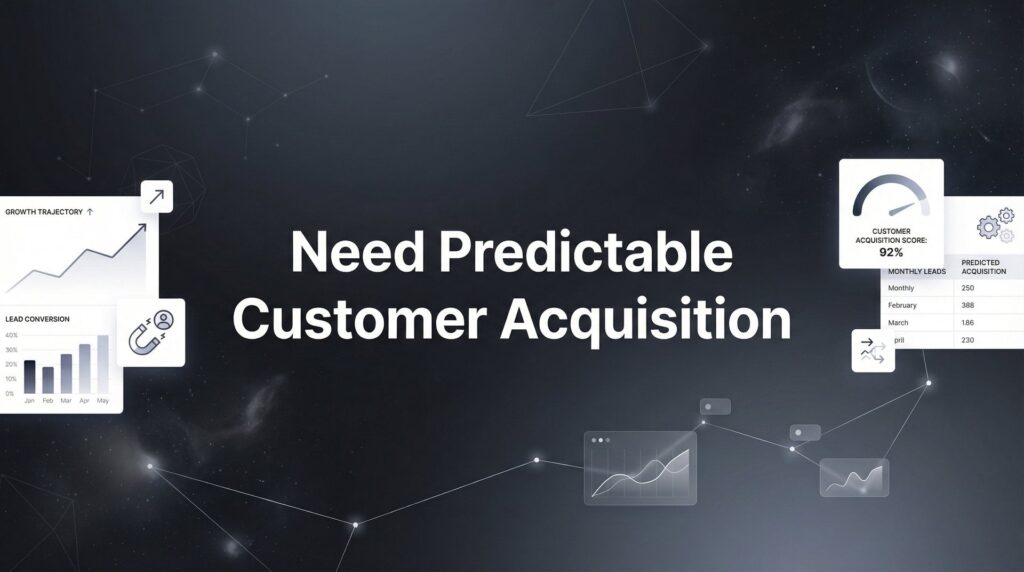
Meanwhile, there’s a different breed of business owner. They wake up knowing exactly how many leads will come in this week. They can forecast revenue three months out with reasonable accuracy. When someone asks about growth plans, they don’t hedge—they have numbers. They’ve cracked the code on something most businesses never figure out: predictable customer acquisition.
The difference between these two scenarios isn’t luck, market conditions, or some secret advantage. It’s a systematic approach to bringing customers through the door. This article breaks down why predictability matters more than you think, what it actually looks like in practice, and how to build it for your business—regardless of your industry or market size.
The Hidden Cost of Revenue Rollercoasters
The unpredictable customer flow problem creates damage far beyond just inconsistent revenue. Think about what happens when you don’t know if next month will be busy or dead. You can’t hire confidently. That talented person you wanted to bring on? You hesitate because what if things slow down? So you stay understaffed, which means when business does pick up, you’re scrambling and delivering subpar service.
Cash flow becomes a constant anxiety. You’re profitable on paper, but the timing is all wrong. Big expenses hit during slow months. You delay equipment purchases or necessary investments because you can’t predict when money will actually be in the account. Your business stays stuck in survival mode instead of growth mode.
The planning problem compounds everything else. You can’t commit to that commercial lease upgrade. You can’t negotiate better terms with suppliers because you can’t guarantee volume. You can’t take that family vacation because what if a bunch of leads come in while you’re gone? Your entire life gets held hostage by the uncertainty.
There’s also a psychological toll that doesn’t show up on any financial statement. The constant low-grade stress of not knowing where next month’s customers will come from wears you down. You make reactive decisions instead of strategic ones. You chase whatever seems to be working this week, abandoning last month’s approach before it had time to mature. You become the hamster on the wheel, running faster but never getting anywhere.
Here’s the trap most businesses fall into: they rely almost entirely on referrals and word-of-mouth. These are great—when they happen. But you’re completely dependent on factors outside your control. Did your best customer move out of town? There goes 30% of your referrals. Did a competitor open up and start poaching your sources? You don’t find out until the leads stop coming. These are classic small business customer acquisition challenges that plague companies of every size.
The businesses that break free from this cycle recognize a fundamental truth: you cannot build a real business on hope. Hoping customers will find you, hoping referrals will keep coming, hoping next month will be better. Hope is not a strategy. Predictable customer acquisition is.
What Predictable Customer Acquisition Actually Looks Like
Let’s get specific about what we mean by “predictable.” It’s not about guaranteeing exact numbers down to the decimal point. It’s about knowing your ranges with enough confidence to make business decisions.
Predictable acquisition has three core components. First, consistent lead volume. You know that barring major disruptions, you’ll generate between X and Y leads per month. Not hoping for leads—engineering them. You have systems that produce leads as reliably as your operations deliver your service.
Second, known conversion rates. You understand what percentage of leads become paying customers. This isn’t a guess—it’s based on actual data from your business. You know that for every 10 qualified leads, roughly 3 become customers. These numbers let you work backwards from revenue goals to required lead volume. Understanding your customer acquisition funnel is essential for mapping these conversion points.
Third, measurable cost per acquisition. You know what it costs to acquire a customer through each of your channels. This isn’t just ad spend—it includes all the costs involved in converting that lead into a paying customer. With this number, you can make rational decisions about scaling. If a customer is worth $5,000 to your business and costs $800 to acquire, you have a machine you can feed.
The difference between hoping for customers and engineering customer flow is the difference between gambling and investing. When you hope, you’re at the mercy of circumstances. When you engineer, you have levers you can pull. Lead volume drops? You know which channels to increase spend on. Conversion rate dips? You know to look at your sales process or lead qualification.
This is where real metrics become your competitive advantage. Customer Acquisition Cost (CAC) tells you what you’re paying to get a customer. Customer Lifetime Value (LTV) tells you what that customer is worth over their relationship with your business. The ratio between these numbers determines whether you have a sustainable business model or a money-burning operation. If you’re unclear on these fundamentals, start by learning what customer acquisition cost actually means for your business.
Your lead-to-customer conversion rate reveals the health of your entire funnel. A low conversion rate might mean you’re attracting the wrong leads, your sales process needs work, or your offer doesn’t match market expectations. A high conversion rate suggests you might be able to spend more on acquisition and still maintain profitability.
But here’s what makes this truly powerful: these metrics interact. Improve your conversion rate by 20%, and suddenly you can afford to pay 20% more per lead while maintaining the same CAC. That expanded budget lets you outbid competitors and capture more market share. Better leads improve conversion rates, which improves CAC, which allows more aggressive acquisition. It becomes a flywheel.
Businesses with predictable acquisition don’t just know these numbers—they actively manage them. They have weekly dashboards showing lead volume by source, conversion rates by channel, and cost per acquisition trending over time. They spot problems early and capitalize on opportunities fast. They make decisions based on data, not gut feelings or panic.
Building Your Acquisition Engine: The Framework
Building predictability starts with accepting a hard truth: you need multiple acquisition channels working together. Relying on a single source—whether that’s referrals, one ad platform, or organic search—leaves you vulnerable. Markets shift. Algorithms change. Referral sources dry up. Diversification isn’t optional.
Think of your acquisition channels as a portfolio. Some channels deliver immediate results but require ongoing investment. Others build slowly but compound over time. The businesses that achieve true predictability balance both types rather than betting everything on one approach. Choosing the right customer acquisition platforms is critical to building this diversified foundation.
Paid advertising platforms like Google Ads and Facebook Ads provide the fastest path to baseline predictability. Why? Because they’re controllable and scalable. You can turn budget up or down based on capacity. You get data quickly—within days or weeks rather than months. You can test different messages, offers, and targeting to find what resonates with your market.
This doesn’t mean paid advertising is the only answer. It means it’s the foundation that gives you breathing room to build everything else. When you have a reliable flow of leads from paid channels, you’re not desperate. You can be selective about which leads you pursue. You can invest in longer-term strategies without the panic of an empty pipeline.
Those longer-term strategies matter tremendously. Search engine optimization builds equity in your market. Every piece of optimized content, every quality backlink, every technical improvement compounds over time. Six months from now, you’re getting leads from work you did today—at zero marginal cost. That’s powerful economics.
The key is sequencing. Many businesses try to build everything at once and end up doing nothing well. Start with one paid channel that can deliver results within 30-60 days. Get that dialed in until it’s producing consistent, profitable leads. Then layer in the next channel while the first one continues running. This staged approach builds momentum rather than spreading resources too thin.
Your acquisition engine also needs infrastructure that most businesses overlook. Proper tracking that connects leads back to their source. CRM systems that don’t let leads fall through cracks. Follow-up sequences that nurture leads who aren’t ready to buy immediately. Landing pages optimized for conversion rather than just looking pretty.
This infrastructure transforms random marketing activities into a system. You can see which channels produce the best leads, not just the most leads. You can calculate actual ROI by source. You can identify bottlenecks in your conversion process and fix them systematically.
The businesses that do this right treat their acquisition engine like any other critical business system. They have documented processes. They have someone responsible for monitoring performance. They have regular optimization cycles where they review data and make improvements. It’s not set-and-forget—it’s actively managed for continuous improvement.
One critical element: your acquisition channels should complement each other, not compete. Someone who sees your Google Ad might check your website and read blog content before converting. That’s not a failure of the ad—it’s how modern buying behavior works. Multi-touch attribution matters. The last click doesn’t tell the whole story.
Turning Data Into Predictive Power
Having data isn’t the same as using data. Most businesses collect metrics they never actually analyze. They have Google Analytics installed but couldn’t tell you their top conversion paths. They track leads in a spreadsheet but don’t calculate trends. Data without analysis is just noise.
Building predictive power requires tracking the right metrics at the right intervals. Weekly metrics should focus on leading indicators—things that predict future results. How many new leads came in this week? What’s the cost per lead trending? How many leads entered your sales pipeline? These numbers tell you if you’re on track or need to make adjustments before the month ends.
Monthly metrics zoom out to patterns and performance. What’s your overall conversion rate this month versus last month? How did each acquisition channel perform? What’s your customer acquisition cost by source? Which lead sources produced customers that actually paid and stayed? Monthly reviews catch trends that weekly noise might obscure.
Quarterly metrics drive strategic decisions. Are your acquisition costs trending up or down over time? Is your customer lifetime value improving as you get better at serving clients? Which channels showed consistent performance versus which ones were flukes? Quarterly data reveals whether your acquisition engine is getting stronger or needs structural changes. If your numbers are heading the wrong direction, you’ll want to explore how to reduce customer acquisition cost before it erodes your margins.
This is where conversion rate optimization becomes your force multiplier. Small improvements in conversion rates create massive impacts on your overall acquisition efficiency. If you’re currently converting 2% of website visitors into leads, improving that to 3% means you get 50% more leads from the same traffic. Same ad spend, same effort—dramatically better results.
CRO isn’t about random tweaks. It’s systematic testing of elements that research shows impact conversion. Better headlines that speak to actual customer pain points. Clearer calls-to-action that tell people exactly what to do next. Simplified forms that don’t ask for information you don’t need. Social proof that builds trust with skeptical visitors. Each improvement compounds with the others.
The businesses that excel at this create feedback loops between their acquisition and conversion efforts. They don’t just run ads and hope. They analyze which ad messages produce leads that actually convert into customers. They test landing page variations to see which ones produce not just more leads, but better leads. They track the entire journey from first click to final sale.
These feedback loops create institutional learning. Your business gets smarter over time about what works in your specific market. You’re not starting from zero with each campaign—you’re building on proven foundations. This accumulated knowledge becomes a competitive moat that’s hard for others to cross.
The predictive power comes from having enough data to spot patterns. After three months of consistent tracking, you start seeing reliable trends. After six months, you can forecast with reasonable confidence. After a year, you have seasonal patterns mapped and can plan for them. The longer you maintain consistent measurement, the more accurate your predictions become.
Common Pitfalls That Destroy Predictability
The fastest way to kill predictability is constantly chasing the next shiny tactic. A competitor mentions they’re getting great results from TikTok, so you abandon your working Google Ads campaigns to jump on the trend. You hear about some new AI tool that promises to revolutionize lead generation, so you shift resources away from proven channels to experiment.
This tactic-hopping destroys the consistency you need for predictability. Every channel requires time to optimize. Google Ads campaigns need 30-60 days of data to really dial in. SEO efforts need months to show results. When you constantly switch approaches, you never give anything enough time to work. You’re always starting over, always in the learning phase, never in the optimization phase.
The businesses that build predictable acquisition pick their channels based on strategic fit, then commit to making them work. They resist the temptation to chase every new opportunity. They understand that depth beats breadth—doing three channels excellently outperforms doing ten channels poorly. A solid customer acquisition strategy provides the framework to stay focused when distractions arise.
Another predictability killer: cutting marketing during slow periods. The logic seems sound—business is slow, so let’s conserve cash by reducing ad spend. But this creates a self-fulfilling prophecy. You cut marketing, which reduces lead flow, which makes next month even slower, which makes you cut more. You’ve turned a temporary dip into an extended drought.
The counterintuitive reality is that consistent marketing spend through ups and downs creates more stable revenue over time. When your competitors cut back during slow periods, that’s when your ads get cheaper and more effective. You’re buying market share while others retreat. When demand picks back up, you’re already positioned while they’re scrambling to restart their engines.
Poor lead qualification creates perhaps the most insidious problem. You’re generating plenty of leads—your numbers look great. But those leads aren’t converting into customers, or worse, they’re converting into nightmare customers who demand refunds and leave bad reviews. You’ve built volume without value. If this sounds familiar, you may need to investigate why your digital marketing isn’t converting properly.
This happens when you optimize for the wrong metrics. You focus on cost per lead without considering lead quality. You target broad audiences to maximize volume instead of specific audiences likely to buy. You use clickbait messaging that attracts attention but not actual buyers. Your funnel is full, but your bank account isn’t.
The fix requires brutal honesty about what a good lead actually looks like for your business. Not everyone who could theoretically use your service is a good fit. Some customer segments are profitable; others aren’t. Some lead sources consistently produce buyers; others produce tire-kickers. You need to qualify leads before you count them as successes.
Another trap: optimizing individual channels in isolation without considering the overall system. You might improve your Google Ads cost per click, but if those cheaper clicks produce lower-quality leads, you’ve made things worse. You might boost your organic traffic, but if that traffic doesn’t convert, you haven’t actually improved acquisition.
The businesses that avoid these pitfalls think systemically. They optimize for customer acquisition cost and customer lifetime value—the metrics that actually matter for business health. They’re willing to pay more per lead if those leads convert better. They prioritize quality over quantity at every stage of the funnel.
Putting Your Predictable System Into Action
Building predictable customer acquisition starts with honest assessment of your current reality. Most businesses don’t actually know their numbers. They have a vague sense that “Facebook works pretty well” or “we get some leads from Google,” but they can’t tell you conversion rates, cost per acquisition, or customer lifetime value by source.
Your first step is auditing what you have. For the past 90 days, where did your customers actually come from? Not where leads came from—where paying customers came from. What did those customers cost to acquire when you factor in all expenses? What’s the lifetime value of customers from each source? This baseline reveals where you’re starting and what needs to improve.
Next, identify the gaps in your current approach. Do you have channels that could scale but aren’t being fully utilized? Are you tracking everything properly so you can make data-driven decisions? Do you have the infrastructure—landing pages, follow-up systems, CRM—to handle more leads effectively? Most businesses discover they have significant gaps in basic foundations. Learning how to build a customer acquisition system can help you identify and close these gaps systematically.
Set realistic timelines. True predictability typically takes 90-180 days to build. The first 30 days are setup and initial testing. Days 30-90 are optimization based on early data. Days 90-180 are refinement and scaling. Anyone promising overnight predictability is selling fantasy. This is systematic work that compounds over time.
During the first month, focus on getting one primary acquisition channel running with proper tracking. Don’t try to launch five channels simultaneously. Pick the one most likely to deliver results in your market—often paid search for service businesses with clear intent-driven searches. Get it live, get data flowing, get leads coming in.
Months two and three are about optimization. You’re analyzing which keywords, audiences, and messages produce the best results. You’re improving landing pages based on actual conversion data. You’re refining your sales process based on which leads close. You’re building the feedback loops that make your system smarter.
By month four, you should have enough data to forecast with reasonable accuracy. You know roughly how many leads you’ll generate at different budget levels. You know your conversion rates with confidence. You can calculate whether scaling up makes economic sense. This is when you start layering in additional channels while maintaining the foundation you’ve built. Once you’ve proven the model works, you can focus on how to scale customer acquisition profitably.
The question of building internal capabilities versus bringing in expertise depends on your situation. If you have someone with genuine expertise in digital marketing and the time to focus on this full-time, building internally can work. But most local businesses don’t have that luxury. The owner is already wearing too many hats, and hiring someone competent enough to build this system is expensive and risky.
Working with agencies that specialize in customer acquisition—particularly those with Google Premier Partner status and documented track records—often provides faster results and lower risk. You’re leveraging systems and expertise they’ve built across dozens or hundreds of businesses. You’re not paying for their learning curve because they’ve already climbed it.
The key is finding partners who focus on your actual business outcomes, not just marketing metrics. Agencies that talk about impressions and clicks without connecting them to revenue aren’t focused on what matters. You need partners who understand that the goal isn’t traffic—it’s profitable customer acquisition that scales.
Building the Business You Actually Want
Predictable customer acquisition isn’t a nice-to-have feature for businesses that have everything else figured out. It’s the foundation that makes everything else possible. Without it, you’re constantly firefighting. With it, you can actually build something sustainable.
Think about what becomes possible when you solve this problem. You can hire confidently because you know revenue is coming. You can invest in equipment, training, and improvements because you can forecast ROI. You can take that vacation without your phone welded to your hand. You can make strategic decisions instead of reactive ones.
The businesses thriving in competitive markets have all solved this problem first. They’re not smarter or luckier—they’ve built systems that deliver customers predictably. Those systems give them the stability to outmaneuver competitors still stuck in feast-or-famine cycles.
Your current approach is either building toward predictability or keeping you trapped in uncertainty. If you’re relying primarily on referrals and hope, you’re in the latter category. If you’re running random marketing tactics without proper tracking and optimization, you’re burning money without building an asset. If you’re getting leads but they’re not converting into profitable customers, you’ve got volume without value.
The path forward requires commitment to building proper systems rather than chasing quick fixes. It means tracking the right metrics and actually using that data to make decisions. It means consistent execution over time rather than sporadic bursts of activity. It means treating customer acquisition as the critical business function it is, not an afterthought you handle when you have spare time.
Most importantly, it means recognizing when you need expertise you don’t currently have. Building predictable acquisition systems requires specific knowledge about paid advertising platforms, conversion optimization, tracking infrastructure, and data analysis. These aren’t skills you pick up from a weekend YouTube binge—they’re developed through years of hands-on experience across multiple businesses and markets.
Tired of spending money on marketing that doesn’t produce real revenue? We build lead systems that turn traffic into qualified leads and measurable sales growth. If you want to see what this would look like for your business, we’ll walk you through how it works and break down what’s realistic in your market.
The difference between where you are now and where you want to be isn’t some mysterious secret. It’s systematic customer acquisition that delivers predictable results. The question isn’t whether you need it—you do. The question is whether you’re ready to build it.
Want More Leads for Your Business?
Most agencies chase clicks, impressions, and “traffic.” Clicks Geek builds lead systems. We uncover where prospects are dropping off, where your budget is being wasted, and which channels will actually produce ROI for your business, then we build and manage the strategy for you.