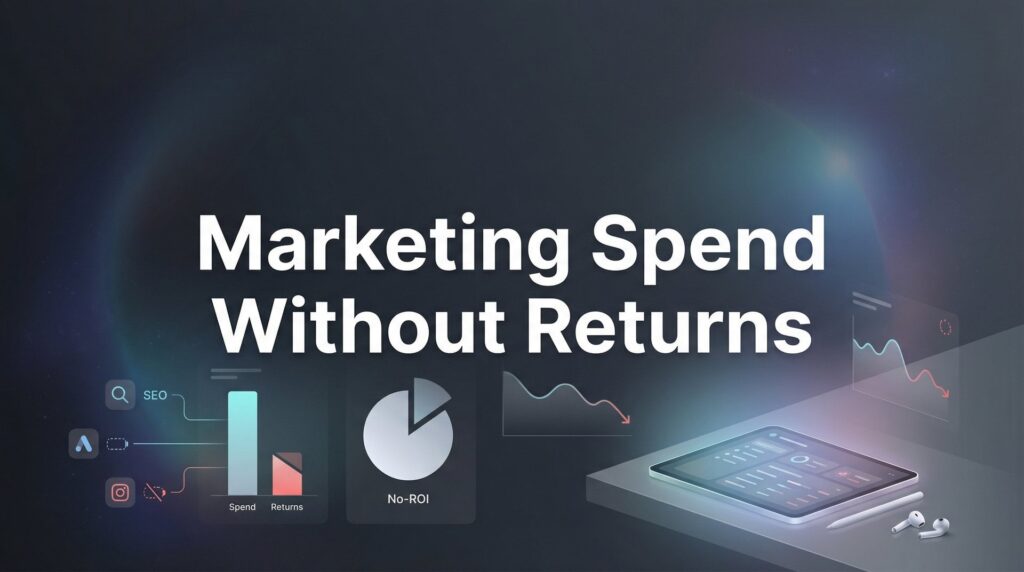
You check your bank statement and feel that familiar knot in your stomach. Another $3,000 gone to Facebook ads. Another $1,500 to Google. Your website traffic looks decent in the dashboard, but your phone isn’t ringing more. Your calendar isn’t filling up. The revenue needle hasn’t budged.
You’re not alone in this frustration. Marketing spend without returns is the silent killer of local business growth—the monthly drain that feels necessary but delivers nothing concrete. You keep paying because stopping feels like giving up, but continuing feels like throwing money into a black hole.
Here’s what most business owners don’t realize: when your marketing budget disappears without producing results, it’s not bad luck or a tough market. It’s a diagnosable problem with specific, fixable causes. The businesses that thrive aren’t spending more on marketing—they’re spending smarter, with systems that turn every dollar into measurable customer acquisition.
This article will expose the hidden reasons marketing budgets fail and give you a clear roadmap to transform your marketing from an expensive gamble into a reliable profit engine.
The Real Cost of Wasted Marketing Dollars
Let’s talk about what wasted marketing spend actually costs you—because it’s far more expensive than the line item on your credit card statement.
The direct financial loss is obvious. Three thousand dollars a month on ads that don’t convert is $36,000 annually. That’s real money that could have hired another team member, upgraded your equipment, or simply stayed in your bank account. But the direct cost is just the beginning.
Opportunity cost is where the real damage happens. While you’re burning money on ineffective marketing, your competitors who’ve figured out profitable customer acquisition are growing. They’re capturing market share. They’re building brand recognition. They’re filling their calendars with the exact customers you’re trying to reach.
Every month you spend without returns is a month you’re not building momentum. In business, momentum compounds. The company that acquires ten new customers this month has ten people who might refer others next month. The company that acquires zero customers has zero potential referrals. This gap widens exponentially over time.
Then there’s the psychological toll—the part nobody talks about in marketing webinars. When you’ve been burned by marketing spend that produced nothing, you start to doubt everything. Should you try a different platform? A different agency? A different message? Or is marketing just not going to work for your business?
This erosion of confidence is dangerous because it often leads to either paralysis (stopping all marketing investment) or desperation (jumping to the next shiny tactic without fixing underlying problems). Both responses guarantee continued failure.
The compounding effect of small inefficiencies multiplies the damage. A landing page that converts at two percent instead of five percent doesn’t sound dramatic—until you calculate that over 10,000 visitors, you’re losing 300 potential leads. If your close rate is twenty percent and your average customer value is $2,000, that three-percentage-point conversion gap just cost you $120,000 in revenue. From one small inefficiency.
When you stack multiple inefficiencies—poor targeting plus weak landing pages plus no follow-up system plus tracking gaps—the waste becomes catastrophic. This is why some businesses spend five figures monthly on marketing and see almost nothing, while others spend the same amount and generate predictable, profitable growth.
Five Hidden Culprits Draining Your Marketing Budget
Most marketing waste comes from five specific problems. The good news? Once you identify which ones are affecting your business, they’re fixable.
Targeting the wrong audience: This is the most common budget killer. You’re paying for clicks from people who will never become customers. Sometimes this means geographic targeting that’s too broad—a local service business advertising to an entire state instead of a tight radius around their service area. Sometimes it means demographic targeting that misses the mark—advertising premium services to budget-conscious audiences, or vice versa.
The “wide net” approach feels safer because it generates more traffic and more leads. But those leads don’t convert. You end up with a full pipeline of unqualified prospects who waste your sales team’s time and never buy. You’re paying to attract the wrong people. Understanding why you’re getting poor quality leads is the first step to fixing this problem.
Platform mismatch creates similar waste. If your ideal customers are business owners making decisions during work hours, late-night Facebook ads might generate cheap clicks that never convert. If you’re targeting retirees, LinkedIn advertising is probably burning money. The channel has to match where your customers actually spend time and how they make buying decisions.
Weak conversion infrastructure: Picture this scenario: You’re running Google Ads that are actually well-targeted. People searching for exactly what you offer are clicking your ads. But they land on a generic homepage with no clear next step, or a contact form that asks for fifteen fields of information, or a page that takes eight seconds to load on mobile.
You’re paying for traffic that could convert, but your infrastructure kills it before it has a chance. This is like spending thousands on a billboard that directs people to a store with a locked door. The marketing worked—it got them there. The conversion infrastructure failed.
Common conversion killers include: pages that don’t match the ad promise, unclear calls-to-action, forms that ask for too much information too soon, slow page load speeds, mobile experiences that don’t work, and lack of trust signals for first-time visitors.
Lack of tracking and attribution: You’re running three different marketing channels—Google Ads, Facebook, and maybe some local sponsorships. Leads come in through your website form, phone calls, and walk-ins. But you have no systematic way to know which marketing source generated which lead, or which leads actually became paying customers.
This tracking gap means you’re making budget decisions blind. You might be cutting the one channel that’s actually profitable while doubling down on the one that’s never generated a single customer. You literally cannot improve what you cannot measure.
Chasing vanity metrics instead of revenue: Your Facebook ads are getting great engagement—hundreds of likes, dozens of comments, impressive reach numbers. Your website traffic is up. Your social media following is growing. None of this is paying your bills.
Vanity metrics feel good but mean nothing if they don’t connect to revenue. A thousand website visitors who don’t convert is worse than a hundred visitors who do, because the thousand cost you more to acquire. High engagement on social media from people who will never buy is just expensive entertainment.
The metrics that matter are: cost per qualified lead, lead-to-customer conversion rate, customer acquisition cost, and lifetime customer value. Everything else is noise.
No testing or optimization cycle: You launched a marketing campaign, and now it just runs. Month after month, the same ads, the same landing pages, the same targeting. Whether it’s working or not, nothing changes because there’s no system for testing and improving.
Profitable marketing isn’t a “set it and forget it” operation. It’s a continuous cycle of testing, measuring, and optimizing. The businesses that win are the ones constantly running small experiments—testing different headlines, different offers, different targeting parameters—and scaling what works while cutting what doesn’t.
The Tracking Gap: What You Can’t Measure, You Can’t Improve
Let’s get specific about what you actually need to track to turn marketing from a mystery into a science.
At minimum, every local business needs to know: which marketing source generated each lead, what that lead cost to acquire, how many leads converted to customers, and what revenue those customers generated. Without these four data points, you’re guessing.
Source attribution means knowing exactly where each lead came from. Not just “online” or “referral”—but specifically: Google Ads search campaign for “emergency plumber,” Facebook ad campaign targeting homeowners 35-55, organic search for “best HVAC company near me,” or referral from John Smith who’s a customer. Learning how marketing attribution models work helps you understand which channels deserve credit for your conversions.
This requires tracking infrastructure. For phone calls, that means call tracking numbers unique to each marketing source. For web forms, that means UTM parameters or hidden form fields that capture the traffic source. For walk-ins, that means training your team to ask “How did you hear about us?” and actually record the answer systematically.
Cost per lead reveals which channels are efficient and which are burning money. If your Google Ads are generating leads at $45 each while your Facebook ads cost $180 per lead, you have clear data to guide budget allocation—assuming lead quality is comparable.
But cost per lead is meaningless without conversion tracking. A $45 lead that never becomes a customer is more expensive than a $180 lead that converts at three times the rate. You need to track the entire funnel: lead → qualified prospect → customer → revenue generated. If you’re struggling with this, our guide on fixing your marketing conversion tracking walks you through the exact steps.
Proper attribution reveals surprising truths. You might discover that the marketing channel you were about to cut is actually your most profitable source—it just takes longer to convert. Or that the channel generating the most leads produces customers with half the lifetime value of another source.
Setting up basic tracking doesn’t require enterprise software or a data science degree. Google Analytics with goal tracking, a simple CRM that records lead source, and call tracking through services that cost under $100 monthly will give most local businesses the visibility they need.
The key is consistency. Every lead gets tagged with its source. Every customer gets connected back to their original lead source. Every month, you review: cost per lead by source, conversion rate by source, customer acquisition cost by source, and revenue generated by source.
This data transforms decision-making. Instead of “Should we increase our ad budget?” the question becomes “Should we increase spend on Google Ads that are generating customers at $200 acquisition cost with $2,000 average revenue, or Facebook ads generating customers at $350 acquisition cost with $1,500 average revenue?” The answer is obvious when you have the data.
Conversion Rate: The Multiplier Most Businesses Ignore
Here’s a question that reveals everything: Would you rather double your website traffic or double your conversion rate?
Most business owners instinctively answer “traffic” because more visitors feels like progress. But doubling your conversion rate is almost always easier and more profitable than doubling traffic—and it makes every marketing dollar you spend twice as effective.
Think about the math. If you’re currently converting two percent of visitors into leads, and you’re getting 1,000 visitors monthly, that’s twenty leads. To get forty leads, you could drive 2,000 visitors (requires doubling your ad spend) or improve your conversion rate to four percent (requires fixing your website).
Doubling traffic is expensive and ongoing. You pay for those extra clicks every single month. Improving conversion rate is often a one-time fix that benefits you forever. Every visitor—from ads, organic search, referrals, everywhere—converts better. This is why conversion focused marketing delivers better ROI than simply buying more traffic.
Yet most businesses obsess over traffic while ignoring conversion optimization entirely. They’ll spend $5,000 monthly on ads driving people to a landing page that hasn’t been tested or improved in two years. That’s like buying a high-performance engine for a car with flat tires.
Common conversion killers are usually obvious once you look for them. Your landing page doesn’t match what the ad promised—the ad talks about “free consultation” but the page leads with “our company history.” Your call-to-action is buried at the bottom of a wall of text. Your contact form asks for information people aren’t ready to give (annual revenue, detailed project scope, budget range) before they’ve even had a conversation.
Mobile experience destroys conversions for many local businesses. Your desktop site might look fine, but sixty percent of your traffic is on phones where your text is tiny, your buttons are hard to tap, your forms are frustrating to complete, and your page takes ten seconds to load. Every second of load time costs you conversions.
Quick wins that dramatically improve lead capture: Make your primary call-to-action impossible to miss—big, bold, above the fold, and repeated throughout the page. Reduce form fields to the absolute minimum—name, email, phone number is often enough for initial contact. Add trust signals near your CTA—customer testimonials, years in business, certifications, guarantees. Create urgency with limited-time offers or appointment availability.
Test your mobile experience by actually trying to convert on your own site using your phone. If it’s annoying for you, it’s costing you leads. Fix the mobile experience first because that’s where most traffic comes from.
For local businesses, phone calls often convert better than forms. Make your phone number clickable on mobile. Consider click-to-call buttons as your primary CTA. Some businesses see fifty percent of their conversions come through phone calls, yet they bury their number in the header and push form fills. Implementing call tracking for your campaigns helps you measure which ads actually drive phone leads.
The businesses that dominate their markets aren’t necessarily spending more on marketing—they’re converting traffic at two to three times the rate of competitors, which means their customer acquisition costs are two to three times lower. That efficiency lets them outbid competitors for the best traffic and still maintain healthy margins.
Building a Marketing System That Actually Produces Returns
Profitable marketing isn’t about finding the perfect tactic or the magic channel. It’s about building a system—a repeatable process that consistently turns budget into customers.
The test-measure-optimize cycle is how profitable businesses operate. They start with a hypothesis: “We think this audience will respond to this message on this platform.” They test it with a small budget. They measure real results—not impressions or clicks, but leads and customers. They optimize based on data. They scale what works and kill what doesn’t.
This is the opposite of how most struggling businesses operate. They launch a big campaign based on gut feeling or what worked for someone else. They commit large budgets without testing. They let it run for months without measuring real results. They either give up entirely or keep doing the same thing hoping results will magically improve.
Start small and scale what works. If you’re considering a new marketing channel, don’t commit $5,000 monthly. Commit $500 to test whether the channel can generate qualified leads at an acceptable cost. If it can, gradually increase budget while maintaining performance. If it can’t, you’ve learned that for $500 instead of burning months of large budgets. This performance marketing approach ensures you only pay for results that matter.
This approach requires patience, which is hard when you need customers now. But the alternative—gambling big on unproven tactics—leads to the exact problem this article addresses: marketing spend without returns.
Testing doesn’t mean changing everything constantly. It means running controlled experiments. Test one variable at a time: different headlines, different offers, different landing pages, different targeting parameters. Measure the impact. Implement winners. Test the next variable.
Many local business owners ask: should I manage marketing myself or hire specialists? The honest answer depends on your skills, time, and business complexity. If you’re a solo operator or very small team, you probably need to understand marketing fundamentals yourself. You don’t need to be an expert, but you need to know enough to make smart decisions and avoid obvious waste.
As you grow, bringing in specialists makes sense—but only if you maintain visibility into results. An agency or consultant should make your tracking better, not worse. They should be able to show you exactly what you’re getting for your investment. If someone tells you “marketing takes time” without showing you concrete metrics improving month over month, you’re probably being taken for a ride. Understanding whether to hire an agency or build in-house depends on your specific situation and growth stage.
The right marketing partner makes the system more efficient, not more mysterious. They should increase your understanding of what’s working, not decrease it. They should be able to explain in plain language why they’re recommending specific tactics and what results you should expect.
Turning Your Marketing From Cost Center to Profit Engine
The difference between businesses that see marketing as an expense and businesses that see it as an investment is accountability. Profitable businesses run marketing like any other part of the operation—with clear KPIs, regular performance reviews, and continuous improvement.
Create accountability by establishing clear metrics you review monthly: cost per lead by channel, lead-to-customer conversion rate, customer acquisition cost, and revenue generated from marketing. These aren’t vanity metrics—they’re business metrics that connect directly to profit.
If you can’t answer “What did we spend on marketing last month and what revenue did it generate?” you don’t have a marketing system. You have a spending habit.
The mindset shift from spending to investing is crucial. When you spend money, it’s gone. When you invest money, you expect a return. Marketing should be an investment with measurable ROI. If you invest $3,000 and it generates $15,000 in customer revenue, that’s a good investment. If it generates $1,000 or nothing, that’s a bad investment you should stop making.
This week, audit your current marketing spend. List every platform and channel where you’re spending money. For each one, answer: How much are we spending monthly? How many leads does it generate? How many of those leads become customers? What revenue do those customers generate? Our guide on why marketing isn’t working can help you diagnose specific issues in your current approach.
For any channel where you can’t answer those questions, your first priority is implementing tracking so you can. For channels where the answers reveal poor performance, you have a decision to make: fix the underlying problems (targeting, messaging, conversion infrastructure) or cut the spend and reallocate to channels that work.
Many business owners discover during this audit that they’re spending money on channels they forgot about—old ad campaigns still running, directory listings that auto-renew, social media ads that nobody’s optimized in months. Cutting obvious waste is the fastest way to improve marketing ROI.
The businesses that thrive treat marketing budget like inventory investment. A retailer wouldn’t keep ordering products that don’t sell. They’d cut the losers and order more of what moves. Apply the same logic to marketing: cut what doesn’t produce returns and invest more in what does.
Your Next Steps: Stop the Bleeding, Start the Growth
Marketing spend without returns isn’t a mystery or bad luck—it’s a fixable problem with specific causes. You’ve now seen the five hidden culprits that drain budgets, the tracking gaps that keep you blind, the conversion opportunities most businesses ignore, and the system that turns marketing from gambling into predictable customer acquisition.
The path forward is clear. Implement tracking so you know what’s working. Fix conversion infrastructure so the traffic you’re paying for actually becomes leads. Test small before committing big budgets. Measure real results—leads and customers, not vanity metrics. Scale what works and kill what doesn’t.
This isn’t complicated, but it does require discipline and systems. The businesses dominating your market right now aren’t smarter or luckier—they’ve simply built marketing systems that consistently produce returns. They know their numbers. They optimize relentlessly. They invest in what works and cut what doesn’t.
You can do the same, starting this week. Audit your current spend. Identify the tracking gaps. Fix the obvious conversion killers. Start measuring what matters.
Tired of spending money on marketing that doesn’t produce real revenue? We build lead systems that turn traffic into qualified leads and measurable sales growth. If you want to see what this would look like for your business, we’ll walk you through how it works and break down what’s realistic in your market.
The difference between wasted marketing spend and profitable customer acquisition is a system. Build the system, and the returns follow.
Want More Leads for Your Business?
Most agencies chase clicks, impressions, and “traffic.” Clicks Geek builds lead systems. We uncover where prospects are dropping off, where your budget is being wasted, and which channels will actually produce ROI for your business, then we build and manage the strategy for you.