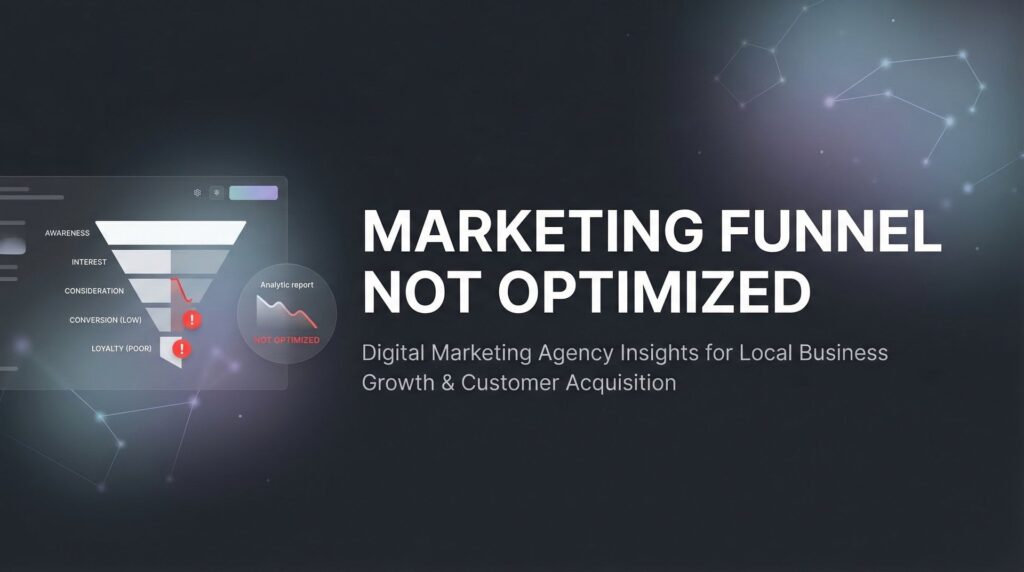
You’re spending money on ads, driving traffic to your website, and generating what looks like decent interest—but conversions are disappointing and your cost per acquisition keeps climbing. Sound familiar? The culprit is almost always the same: a marketing funnel not optimized for how your customers actually behave. Most local businesses build funnels based on assumptions rather than data, creating friction points that silently kill conversions at every stage.
The good news? Fixing an underperforming funnel doesn’t require starting from scratch. It requires systematic diagnosis and targeted improvements at each stage.
In this guide, we’ll walk through exactly how to identify where your funnel is leaking leads, then fix each problem with actionable steps you can implement this week. By the end, you’ll have a clear roadmap to transform a funnel that’s costing you money into one that consistently converts prospects into paying customers.
Step 1: Map Your Current Funnel and Identify the Biggest Drop-Off Points
You can’t fix what you can’t see. The first step in optimizing a marketing funnel not optimized is understanding exactly where people are falling out of your process.
Start by documenting every single touchpoint a prospect encounters from the moment they see your ad to the moment they become a paying customer. This includes your ad, landing page, thank you page, follow-up emails, phone calls, and final conversion point. Write it all down in a simple flowchart.
Next, pull the actual numbers. If you’re using Google Analytics, navigate to your conversion funnels or goal flow reports. If you’re using a CRM, export the data showing how many leads entered at each stage and how many progressed to the next. The key metric you’re looking for is the conversion rate between each stage.
Let’s say you’re running Google Ads for your HVAC business. Your funnel might look like this: 1,000 people click your ad, 300 land on your page and stay longer than 10 seconds, 50 fill out your contact form, 20 answer when you call them back, and 5 book a service appointment. Calculate the conversion rate at each transition point.
Here’s where it gets interesting. You might discover that 70% of people who land on your page leave immediately—that’s your biggest leak. Or maybe your form completion rate is strong, but only 40% of leads answer their phone when you call back. That’s a different problem requiring a different solution.
The stage with the biggest percentage drop represents your highest-impact opportunity. If you’re losing 80% of visitors before they even read your landing page, fixing that will deliver far better results than optimizing your email sequence. Understanding how to track marketing ROI helps you identify exactly where these breakdowns occur.
Document everything in a spreadsheet. You’ll reference these baseline numbers later to measure whether your improvements actually worked.
Step 2: Audit Your Top-of-Funnel Messaging for Clarity and Relevance
If people are clicking your ads but bouncing from your landing page, you’ve got a message mismatch problem. This is one of the most common reasons for a marketing funnel not optimized properly.
Pull up your ad copy and your landing page side by side. Does the headline on your landing page directly reflect what your ad promised? If your ad says “Same-Day AC Repair in Phoenix,” but your landing page headline reads “Full-Service HVAC Solutions,” you’ve created confusion. People clicked expecting one thing and got something else.
The fix is simple: make sure your landing page headline echoes the exact promise from your ad. If someone clicked an ad about emergency plumbing, your landing page better lead with emergency plumbing—not your company history or a generic services overview.
Next, evaluate whether your value proposition passes the five-second test. When someone lands on your page, can they understand what you offer and why they should care in under five seconds? Most businesses bury their value proposition under corporate fluff and industry jargon.
Your headline should answer one question: “What’s in it for me?” Not “We’re a family-owned business serving the community since 1987.” Instead, try “Get Your AC Fixed Today—Guaranteed 2-Hour Response Time.” See the difference? One talks about you. The other talks about solving their problem.
Now audit your targeting. Are you actually reaching people ready to buy, or just people who might be vaguely interested someday? If you’re targeting broad keywords or demographics, you’re paying for traffic that was never going to convert. Tighten your audience to people showing active buying intent—searching for “near me” terms, visiting competitor sites, or using high-intent keywords. If you’re struggling with this, understanding why you’re not getting customers online can reveal targeting issues.
When you make changes, test one variable at a time. Change your headline this week. If conversions improve, keep it. If not, revert and test a different offer next week. Testing multiple changes simultaneously makes it impossible to know what actually worked.
Step 3: Eliminate Friction in Your Lead Capture Process
Think about the last time you filled out a form asking for your name, email, phone, address, company name, job title, company size, budget range, and preferred contact method. You probably didn’t. Most people don’t.
Every form field you add reduces your conversion rate. The psychology is simple: people mentally calculate whether the value they’re getting is worth the effort required. When you ask for ten pieces of information just to download a guide or get a quote, you’ve tipped the scales toward “not worth it.”
Strip your forms down to the absolute minimum you need for follow-up. For most local businesses, that’s name, phone number, and maybe email. That’s it. You can gather additional information later during the sales conversation when trust is already established.
But here’s the thing—people are skeptical. They’re wondering if you’re legitimate, if you’ll spam them, or if you’ll sell their information. That’s why trust signals near your call-to-action buttons matter so much.
Add elements that reduce anxiety: customer reviews, certifications, guarantees, or security badges. A simple line like “We respect your privacy and never share your information” can lift conversion rates. So can displaying your Google rating or showing logos of recognizable clients you’ve worked with.
Now check your mobile experience. Pull out your phone right now and go through your own funnel. Can you easily tap the form fields? Is the text readable without zooming? Does the page load in under three seconds? The majority of local searches happen on smartphones, so if your mobile experience is clunky, you’re losing a significant portion of potential customers.
Test different CTA button placements and copy. “Get Your Free Quote” typically outperforms “Submit” because it reminds people of the value they’re receiving. Adopting conversion focused marketing principles ensures every element of your page drives action. Place your primary CTA above the fold so people don’t have to scroll to find it, then repeat it at the bottom for people who need more information before converting.
Step 4: Build a Nurture Sequence That Actually Moves Leads Forward
Here’s what happens at most businesses: someone fills out a form, gets a generic “Thanks, we’ll be in touch” email, and then… silence. Or worse, they get bombarded with daily emails asking if they’re ready to buy yet.
A marketing funnel not optimized usually lacks a proper nurture sequence. People rarely buy the first time they hear from you. They need time to evaluate options, overcome objections, and build trust in your business.
Your nurture sequence should address the common objections you hear during sales conversations. If prospects typically worry about price, send an email explaining your pricing structure and what makes it fair. If they’re concerned about quality, share case studies or examples of your work. If timing is an issue, explain your scheduling flexibility.
The key is providing value in each touchpoint rather than just asking for the sale. Think of it like this: if every email you send is “Are you ready to buy yet?” you’re that pushy salesperson everyone avoids. But if each email teaches something useful, answers a question, or solves a small problem, you’re building a relationship. Learning email marketing for lead generation helps you craft sequences that nurture without annoying.
Timing matters. For local businesses with shorter buying cycles, your sequence might span a week or two. Someone searching for emergency plumbing isn’t going to nurture for six months—they need help now. But someone considering a kitchen remodel might need several weeks of education before they’re ready to commit.
Here’s where segmentation becomes powerful. Not all leads are the same. Someone who downloaded your pricing guide is further along than someone who just visited your homepage. Someone who called but didn’t book is different from someone who filled out a form and went silent. Customize your messaging based on their behavior.
Set up automated sequences triggered by specific actions. When someone downloads a resource, they enter one sequence. When they request a quote, they enter another. When they abandon a form halfway through, they get a different message. Exploring the best marketing automation tools can help you implement this level of personalization without requiring manual effort.
Step 5: Optimize Your Conversion Point for Maximum Close Rate
You’ve gotten people to your website, captured their information, and nurtured them through your sequence. Now comes the moment of truth: actually closing the sale.
Review your sales process or checkout flow for unnecessary steps. Every additional click, form, or decision point gives people another opportunity to change their mind. If booking an appointment requires filling out three forms and waiting for a confirmation call, you’re creating friction.
Streamline everything. Can people book directly from your website? Can they choose their own appointment time instead of waiting for you to call back? Can they pay a deposit online to secure their spot? The easier you make it to say yes, the more people will.
Social proof becomes critical at this stage. People want to know that others have made this decision and been happy with it. Display recent reviews prominently near your booking button. Show how many customers you’ve served this month. Include photos of real projects you’ve completed.
Urgency elements can push fence-sitters over the edge, but only if they’re genuine. “Only 2 appointment slots left this week” works if it’s true. “Limited time offer ends tonight” works if you actually end the offer. Fake urgency damages trust and hurts long-term conversions.
Now here’s something most businesses miss: retargeting people who reached this stage but didn’t convert. These are your warmest leads. They’ve shown clear buying intent but something held them back. Set up retargeting ads specifically for people who visited your booking page but didn’t complete the process. If your ads aren’t converting to sales, this retargeting strategy often delivers the highest ROI.
Your retargeting message should address common last-minute objections. Maybe they’re worried about the investment—your ad could highlight financing options. Maybe they’re not sure about your expertise—show your certifications or years in business. Maybe they just got distracted—a simple reminder might be all they need.
Finally, train your team on handling the specific objections your leads raise. If your sales team or customer service reps don’t know how to confidently address concerns about price, timing, or quality, you’ll lose deals at the finish line. Role-play common scenarios and develop clear, honest responses that move conversations forward.
Step 6: Set Up Tracking and Continuous Testing Systems
Everything we’ve discussed so far is useless if you’re not measuring results. A marketing funnel not optimized stays that way because businesses make changes based on gut feeling rather than data.
Configure proper conversion tracking in Google Ads and Google Analytics. Set up goals for each important action: form submissions, phone calls, appointment bookings, purchases. If you’re not tracking marketing conversions properly, you’re flying blind—spending money on ads with no idea which ones actually generate revenue.
Create a simple dashboard to monitor your key metrics weekly. You don’t need fancy software. A spreadsheet tracking your ad spend, leads generated, conversion rate, cost per lead, and revenue works perfectly. The goal is having one place where you can quickly see whether your funnel is improving or declining.
What should you track? Start with these core metrics: traffic to your landing page, form completion rate, lead-to-opportunity conversion rate, opportunity-to-customer conversion rate, average deal size, and customer acquisition cost. These numbers tell you exactly where your funnel is strong and where it needs work.
Establish a regular testing cadence. Pick one element to test each week or month depending on your traffic volume. This week, test a new headline. Next week, test a different CTA button color. The following week, test a shorter form. Small improvements compound over time into dramatic results.
Document what works so improvements compound over time. Keep a running log of every test you run, what you changed, and what the results were. This becomes your playbook for future optimization. Implementing call tracking for marketing campaigns adds another layer of insight, especially for businesses where phone calls drive revenue.
The businesses that dominate their markets aren’t lucky. They’re systematic. They test, measure, learn, and improve continuously. Your funnel is never “done”—it’s always evolving based on what your data tells you.
Putting It All Together: Your Funnel Optimization Roadmap
A marketing funnel not optimized is essentially a leaky bucket—you can pour in all the traffic you want, but you’ll never fill it up. The six steps above give you a systematic approach to finding and fixing those leaks.
Start by mapping your funnel and identifying your biggest drop-off point. This tells you where to focus your energy for maximum impact. Then work through each stage methodically: tighten your messaging to eliminate confusion, reduce friction in your lead capture process, build nurture sequences that address real objections, optimize your conversion point to make buying easy, and set up tracking to measure everything.
The businesses that win aren’t necessarily spending more on ads—they’re converting a higher percentage of the traffic they already have. When your funnel is properly optimized, your cost per acquisition drops, your customer lifetime value increases, and your marketing becomes predictable rather than a gamble.
Here’s your action plan for this week: Pull your current funnel data and identify your biggest leak. Make one change to address that specific problem. Measure the results. Then move to the next stage. Progress beats perfection.
When you’re ready to stop guessing and start optimizing your funnel with data-driven strategies, Clicks Geek specializes in helping local businesses turn underperforming funnels into predictable customer acquisition systems. Tired of spending money on marketing that doesn’t produce real revenue? We build lead systems that turn traffic into qualified leads and measurable sales growth. If you want to see what this would look like for your business, we’ll walk you through how it works and break down what’s realistic in your market.
Want More Leads for Your Business?
Most agencies chase clicks, impressions, and “traffic.” Clicks Geek builds lead systems. We uncover where prospects are dropping off, where your budget is being wasted, and which channels will actually produce ROI for your business, then we build and manage the strategy for you.