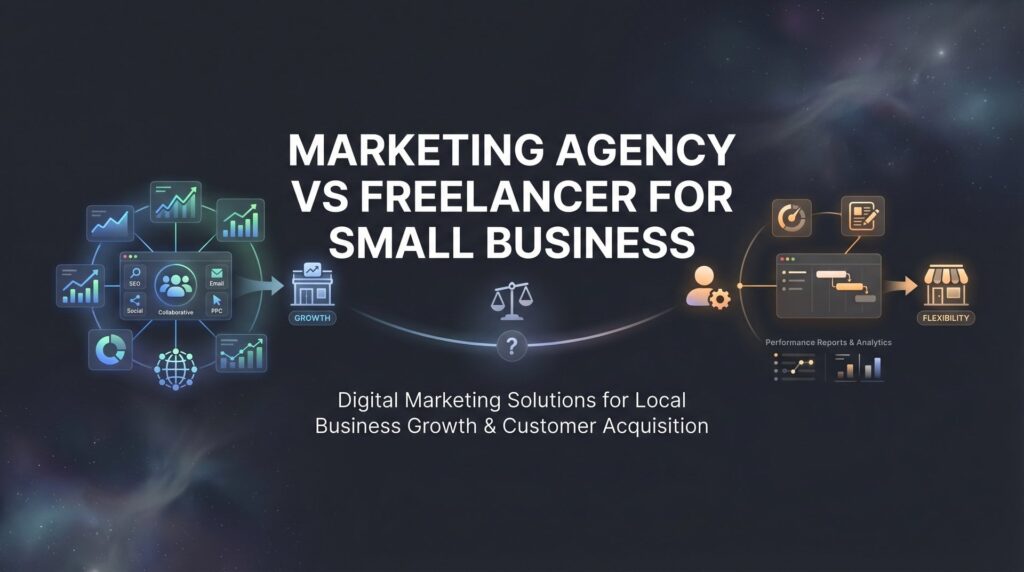
The marketing decision that keeps small business owners up at night isn’t about which ad platform to use or what content to create—it’s about WHO should handle it all. Should you hire a marketing agency with a full team and established processes, or bring on a freelancer who offers flexibility and potentially lower costs? The wrong choice can drain your budget, waste precious time, and leave you with lackluster results. The right choice can transform your customer acquisition and fuel sustainable growth.
This guide cuts through the noise with 7 proven strategies to help you make the smartest decision for your specific situation. Whether you’re a local service business looking to dominate your market or an established company ready to scale, these frameworks will help you evaluate your options with clarity and confidence.
1. Audit Your Marketing Complexity
The Challenge It Solves
Most small business owners underestimate how interconnected modern marketing has become. You might think you just need “someone to run Facebook ads,” but effective customer acquisition requires coordinated messaging across multiple touchpoints. Without understanding your true complexity level, you’ll either overpay for capabilities you don’t need or hire someone who can’t deliver what you actually require.
The Strategy Explained
Start by mapping every marketing channel you currently use or plan to use in the next six months. Include paid advertising, SEO, content creation, email marketing, social media management, and conversion optimization. Then categorize each as either “single-skill” (one specialist can handle it) or “multi-skill” (requires coordination across disciplines).
If most of your needs fall into single-skill categories and you’re focused on one or two channels, a skilled freelancer can likely handle everything. If you’re running campaigns across three or more channels that need to work together strategically, an agency’s coordinated team approach becomes valuable.
Local service businesses often discover they need more complexity than expected. Running effective PPC requires landing page optimization, which requires conversion tracking, which connects to your CRM, which feeds into email follow-up sequences. That’s not a one-person job—it’s a system. Understanding the best marketing channels for small business helps you map this complexity accurately.
Implementation Steps
1. List every marketing channel you’re currently using or plan to launch within 90 days.
2. For each channel, write down the specific skills required (copywriting, design, analytics, technical setup, ongoing optimization).
3. Identify which channels must coordinate with each other for your strategy to work (for example, your Google Ads need to align with your landing page messaging and conversion tracking).
4. Count how many distinct skill sets you need and how much cross-channel coordination is required—this reveals whether you need a specialist or a team.
Pro Tips
Don’t confuse “doing marketing on multiple platforms” with needing an agency. If you’re just posting on Facebook, Instagram, and LinkedIn with the same content, that’s still single-channel social media management. True multi-channel complexity means different strategies working together—like PPC driving traffic to SEO-optimized content that builds your email list.
2. Calculate True Cost Beyond the Invoice
The Challenge It Solves
The sticker shock of agency pricing often drives small business owners straight to freelancers without calculating what that “savings” actually costs them. A freelancer charging $50 per hour looks attractive compared to an agency’s $3,000 monthly retainer—until you factor in the 15 hours per month you spend managing them, explaining your business repeatedly, and fixing mistakes because they don’t understand your customer journey.
The Strategy Explained
Build a total cost comparison that includes your time investment, opportunity cost, and cost-per-result rather than just the hourly rate or monthly fee. Your time has a dollar value—if you’re spending 10 hours per month managing a freelancer instead of closing sales or serving customers, that’s real money leaving your business.
Calculate what you’re actually buying with each option. An agency charging $4,000 per month that generates 50 qualified leads delivers a cost-per-lead of $80. A freelancer charging $2,000 per month who generates 15 leads costs you $133 per lead. The “cheaper” option just became more expensive when measured by results. Learning to calculate marketing ROI for small business makes these comparisons much clearer.
Implementation Steps
1. Estimate how many hours per month you’ll spend managing, directing, and reviewing work from a freelancer versus an agency (agencies typically require less hand-holding).
2. Multiply those hours by your effective hourly rate (annual salary divided by 2,000 working hours, or your target hourly billing rate).
3. Add this management cost to the freelancer or agency fee to get your true monthly investment.
4. Divide your total monthly cost by realistic performance metrics (leads generated, sales closed, revenue attributed) to calculate cost-per-result for each option.
Pro Tips
Include the cost of mistakes and delays in your calculation. When a freelancer disappears for two weeks or delivers work that misses the mark, you’re not just losing their fee—you’re losing the revenue those two weeks of effective marketing could have generated. Agencies typically have backup systems and account managers who prevent these gaps.
3. Match Growth Stage to Partner Type
The Challenge It Solves
Your business growth stage dramatically affects which marketing partner structure serves you best, but most owners don’t consider this timing element. Hiring an enterprise-focused agency when you’re still validating product-market fit wastes money on capabilities you can’t leverage yet. Conversely, relying on a generalist freelancer when you’re ready to scale aggressively creates a bottleneck that stalls your growth.
The Strategy Explained
Startup and early-stage businesses (under $500K annual revenue) often benefit from freelancers who can execute specific tactics while you’re still figuring out what works. You need speed, flexibility, and low overhead—not comprehensive strategy and multi-channel coordination.
Growth-stage businesses ($500K to $2M revenue) typically hit the inflection point where an agency makes sense. You’ve validated what works and now need to scale it systematically across multiple channels. Exploring growth marketing services for businesses can help you understand what this scaling phase requires.
Established businesses (over $2M revenue) usually require agency partnerships or in-house teams because marketing complexity increases with revenue. You’re managing brand consistency, multiple customer segments, and sophisticated attribution models that freelancers rarely handle well.
Implementation Steps
1. Identify your current annual revenue and your 12-month growth target to determine your growth stage.
2. Assess whether your primary need is experimentation (testing what works) or execution (scaling what’s proven)—freelancers excel at the former, agencies at the latter.
3. Consider your hiring timeline—if you plan to build an in-house marketing team within 12 months, a freelancer bridges the gap; if you want external expertise long-term, invest in an agency relationship.
4. Evaluate your internal marketing knowledge—if you can direct strategy yourself, freelancers execute your plans; if you need strategic guidance, agencies provide it.
Pro Tips
Many businesses successfully transition from freelancer to agency as they grow. Start with a freelancer specialist to validate your channel and approach, then graduate to an agency when you’re ready to scale beyond what one person can handle. This staged approach minimizes risk while building toward sustainable growth infrastructure.
4. Evaluate Accountability Systems
The Challenge It Solves
The difference between marketing that feels busy and marketing that drives revenue often comes down to accountability systems. Without clear performance tracking, regular reporting, and documented processes, you’re flying blind—spending money without knowing what’s working or why. Many small businesses choose based on personality and price, then struggle to hold their partner accountable for actual results.
The Strategy Explained
Before committing to either a freelancer or agency, examine their accountability infrastructure. How do they track performance? What metrics do they report on? How often do you review results together? What happens when campaigns underperform?
Strong agencies typically have established reporting systems, regular review meetings, and clear performance benchmarks built into their process. You’ll receive monthly dashboards showing leads generated, cost-per-acquisition, conversion rates, and ROI attribution. A performance based marketing agency takes this even further by tying their compensation directly to results.
Freelancers vary widely in their accountability approaches. Some provide detailed weekly reports and maintain transparent tracking systems. Others send occasional updates and expect you to ask for data. The freelancer’s accountability system matters more than their hourly rate—without it, you can’t evaluate whether you’re getting value.
Implementation Steps
1. Ask potential partners to show you sample reports from current clients (with identifying information removed)—this reveals their standard accountability practices.
2. Request a detailed breakdown of which metrics they’ll track, how often they’ll report, and what tools they’ll use for measurement.
3. Clarify who owns performance tracking setup—will they implement conversion tracking and analytics, or do they expect you to provide access to existing systems?
4. Establish upfront what constitutes success and what triggers a strategy pivot—define specific KPIs and the timeline for achieving them.
Pro Tips
Beware of partners who focus exclusively on vanity metrics like impressions, clicks, or social media followers. Demand accountability for business outcomes—qualified leads, sales conversions, and revenue attribution. If a partner can’t connect their work to your bottom line, they’re not worth hiring regardless of their pricing structure.
5. Assess Speed and Scalability Needs
The Challenge It Solves
Business opportunities don’t wait for slow marketing execution. When you need to launch a new service, respond to seasonal demand, or capitalize on a market shift, your marketing partner’s speed and scalability become critical. The wrong choice here means watching competitors capture market share while you’re stuck waiting for your freelancer to finish other client projects or for your agency to schedule your work into their queue.
The Strategy Explained
Evaluate how quickly each option can launch new campaigns and how easily they can scale up during high-demand periods. Freelancers often move faster on initial setup because there’s no internal approval process—you work directly with the person doing the work. However, they hit capacity limits quickly and can’t scale when you need to double your ad spend or launch across multiple new channels simultaneously.
Agencies may take longer to initiate projects due to onboarding processes and team coordination, but they scale dramatically better. When you’re ready to expand from one market to five, or increase your ad budget from $5,000 to $20,000 monthly, agencies can deploy additional team members and resources without missing a beat.
Consider your business model’s predictability. If you have consistent, steady marketing needs, either option works. If you experience seasonal spikes, promotional events, or rapid growth phases, you need a partner who can flex up and down without quality suffering. Understanding why marketing isn’t working for my business often reveals scalability mismatches as a root cause.
Implementation Steps
1. Map your next 12 months of anticipated marketing needs, including any seasonal peaks, product launches, or expansion plans that will require marketing support.
2. Ask potential partners about their capacity and turnaround times—how quickly can they launch a new campaign from approval to live?
3. Inquire about their scalability process—if you need to double your marketing activity in 30 days, how would they handle it?
4. Request examples of how they’ve handled rapid scaling or urgent launches for other clients—this reveals their actual capabilities beyond promises.
Pro Tips
Local service businesses often experience predictable seasonal patterns (HVAC companies in summer, tax preparers in spring, landscapers in growing season). If this describes your business, prioritize partners who understand these cycles and can ramp up aggressively during your peak season without requiring long-term commitments during slow periods.
6. Test the Hybrid Approach
The Challenge It Solves
The agency versus freelancer debate assumes you must choose one or the other, but many growing businesses discover that a hybrid model delivers the best of both worlds. You’re not limited to a single solution—you can combine agency strategic oversight with freelancer specialists to maximize flexibility while maintaining accountability and coordination.
The Strategy Explained
The hybrid approach typically positions an agency as your strategic partner and primary coordinator while engaging freelance specialists for specific deliverables. For example, an agency might handle your overall marketing strategy, PPC management, and performance tracking while you hire a freelance content writer for blog posts or a freelance designer for creative assets.
This structure gives you agency-level strategic thinking and accountability systems without paying agency rates for every execution task. You benefit from coordinated multi-channel strategy while controlling costs on high-volume, lower-complexity work that freelancers handle efficiently. Hiring a digital marketing consultant for small business can serve as the strategic coordinator in this hybrid model.
The key is clear role definition. Your agency must understand they’re coordinating with freelancers and should provide those specialists with creative direction, brand guidelines, and performance requirements. The freelancers must understand they’re executing within a larger strategy, not operating independently.
Implementation Steps
1. Identify which marketing functions require strategic coordination and ongoing optimization (typically paid advertising, conversion optimization, analytics) versus which are more execution-focused (content creation, graphic design, social media posting).
2. Assign strategic and optimization-heavy functions to an agency partner who will serve as your primary marketing coordinator.
3. Engage freelance specialists for execution-focused tasks, but route their work through your agency for quality control and strategic alignment.
4. Establish a communication structure where your agency provides direction to freelancers and reviews their deliverables before implementation—this prevents disconnected execution.
Pro Tips
Make sure your agency is comfortable with the hybrid model before committing. Some agencies prefer controlling all deliverables in-house, while others regularly coordinate with client-hired specialists. The right agency partner will see freelancers as extensions of the team rather than threats to their scope, and they’ll provide clear direction that makes those specialists more effective.
7. Run a 90-Day Pilot First
The Challenge It Solves
Committing to a long-term contract with either an agency or freelancer before seeing actual results is like buying a car without a test drive. You’re making a significant financial decision based on promises, portfolios, and chemistry—but you won’t know if they can actually deliver for your specific business until they start doing the work. A structured pilot period lets both parties prove the relationship works before making bigger commitments.
The Strategy Explained
Structure a 90-day pilot engagement with clearly defined objectives, deliverables, and success metrics. This timeframe is long enough to see meaningful results from most marketing initiatives but short enough that you’re not locked into an underperforming relationship. Both agencies and freelancers increasingly recognize the value of proving results before asking for long-term commitments.
Your pilot should focus on one or two high-impact channels where you can measure performance clearly. For most small businesses, this means starting with paid advertising (Google Ads or Facebook Ads) with conversion tracking properly implemented, or a focused SEO campaign targeting specific local keywords with measurable ranking improvements. Reviewing the best online marketing services for small business helps you identify which channels to prioritize in your pilot.
Define what success looks like upfront. Set specific targets for leads generated, cost-per-acquisition, conversion rates, or revenue attributed. Include both performance metrics and process metrics—you’re evaluating not just the results they deliver but how they communicate, report, and collaborate with your team.
Implementation Steps
1. Propose a 90-day pilot project to your top agency or freelancer candidates, focusing on one primary marketing channel where results are measurable.
2. Establish 3-5 specific success metrics with target numbers (for example: generate 30 qualified leads, achieve $100 cost-per-lead, maintain 3% conversion rate on landing pages).
3. Set up weekly or bi-weekly check-ins during the pilot to review progress, discuss optimizations, and ensure communication works smoothly.
4. Schedule a comprehensive review at day 75 to evaluate results against targets and decide whether to continue, adjust scope, or part ways—this gives you 15 days to transition if needed.
Pro Tips
Be realistic about 90-day expectations, especially for channels like SEO that require longer timeframes to show results. If you’re piloting SEO, measure leading indicators (content published, technical improvements completed, keyword rankings improving) rather than just traffic and conversions. For paid advertising, 90 days should absolutely demonstrate lead generation and ROI trends even if you’re still optimizing for maximum efficiency.
Putting It All Together
The agency versus freelancer decision isn’t about which option is universally better—it’s about which structure aligns with your specific business situation, growth stage, and marketing complexity. A freelancer who’s perfect for a startup testing its first ad campaigns becomes a bottleneck for that same business 18 months later when it’s ready to scale across multiple channels. An agency that’s overkill for simple social media management becomes essential when you need coordinated campaigns driving measurable revenue.
Start with the marketing complexity audit. If you’re running or planning multi-channel campaigns that require strategic coordination, you likely need agency infrastructure. If you’re focused on executing well-defined tactics in one or two channels, a skilled freelancer can deliver excellent results at lower cost.
Then calculate true cost including your management time and opportunity cost. The cheapest hourly rate often becomes the most expensive option when you factor in the hours you spend directing work, fixing mistakes, and dealing with availability gaps. Focus on cost-per-result rather than cost-per-hour.
Match your choice to your growth stage and scalability needs. Early-stage businesses benefit from freelancer flexibility while they’re still figuring out what works. Growth-stage businesses need agency systems to scale what’s proven. Established businesses require sophisticated coordination that agencies provide consistently.
Demand accountability systems regardless of which route you choose. Without clear performance tracking, regular reporting, and defined success metrics, you’re spending money on hope rather than investing in measurable growth. The partner who can’t show you exactly what you’re getting for your investment isn’t worth hiring.
Consider the hybrid approach if you want strategic oversight with cost-effective execution. Let an agency handle your high-stakes coordination and optimization while freelancers execute specific deliverables under that strategic direction.
Most importantly, don’t commit long-term without proof. Run a 90-day pilot with clear success criteria. See actual results from your specific business before signing annual contracts or making significant budget commitments. The right partner will welcome this approach because they’re confident in their ability to deliver.
Tired of spending money on marketing that doesn’t produce real revenue? We build lead systems that turn traffic into qualified leads and measurable sales growth. If you want to see what this would look like for your business, we’ll walk you through how it works and break down what’s realistic in your market.