You’re spending $3,000 a month on Google Ads. Another $1,500 on Facebook. Maybe you hired someone to run your social media for $800. The invoices keep coming, the campaigns keep running, but when you look at your bank account at the end of the month, you can’t point to where that money actually came back to you.
Sound familiar?
You’re not alone. Thousands of local business owners are trapped in this exact cycle—investing in marketing because they know they need it, but watching their budgets evaporate with little to show for it. The frustration builds month after month. You start questioning whether digital marketing actually works, or if it’s just another expensive gamble that only pays off for someone else.
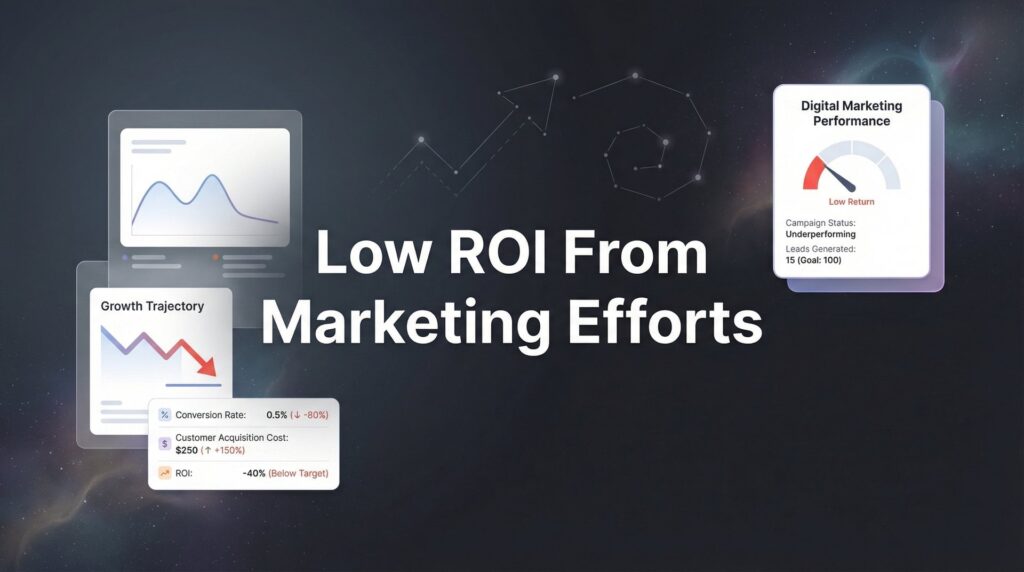
Here’s the truth: low ROI from marketing efforts isn’t a mystery. It’s not bad luck. It’s a symptom of specific, identifiable problems—and every single one of them can be fixed.
This article will show you exactly what’s going wrong with your marketing, why it’s costing you more than just ad spend, and how to transform those underperforming campaigns into a predictable customer acquisition system that actually delivers revenue. No guesswork. No vague advice. Just the practical framework that separates businesses drowning in marketing costs from those turning every dollar into three.
What Poor Marketing Performance Actually Costs You
Let’s start with the number you can see: wasted ad spend. If you’re spending $5,000 monthly on marketing that generates maybe one or two qualified leads, that’s $60,000 a year you’re essentially lighting on fire. That part hurts, but it’s just the beginning.
The real damage runs deeper.
Every month you operate with poor marketing ROI, you’re falling further behind competitors who figured this out. While you’re burning through budget on campaigns that don’t convert, they’re building customer databases, refining their targeting, and scaling what works. The gap widens exponentially because marketing success compounds—good data leads to better targeting, which generates more conversions, which provides more data to optimize further.
You’re also bleeding opportunity cost. That $5,000 monthly marketing budget could be hiring another technician, upgrading equipment, or expanding your service area. Instead, it’s disappearing into campaigns that generate clicks but not customers. Your team sees it too, which creates another hidden cost: morale damage. When your sales team watches marketing dollars vanish while they struggle to find qualified leads, they lose confidence in the entire growth strategy.
Then there’s the most dangerous cost of all: the moment business owners give up on marketing entirely.
After six months or a year of disappointing results, many entrepreneurs conclude that digital marketing doesn’t work for their industry or “isn’t worth it for local businesses.” They pull the plug completely, returning to referrals and hoping the phone rings. Meanwhile, their competitors who solved the ROI equation are capturing every customer searching for their services online.
The compounding losses don’t just affect this quarter—they determine whether you’re still competitive three years from now. Every month of poor ROI isn’t just wasted money. It’s lost market position you may never recover.
Why Your Marketing Keeps Underperforming: The Five Critical Breakdowns
Most business owners with low marketing ROI assume they need to spend more or try different platforms. The real problem usually lives in one of five fundamental breakdowns—and you can’t fix what you haven’t diagnosed.
Targeting Mismatch: You’re paying to reach people who will never become customers. This happens when your Google Ads target overly broad keywords like “plumber” instead of “emergency plumber near me,” or when your Facebook campaigns target entire metro areas instead of the specific neighborhoods where your ideal customers actually live. Every click from someone outside your service area or searching for something you don’t offer burns money while training the algorithm that these are valuable prospects. The result? Your campaigns optimize toward cheaper, irrelevant traffic instead of qualified buyers.
Messaging That Misses: Your ads might be reaching the right people, but your message doesn’t connect with what they actually care about. You’re talking about your 20 years of experience when they want to know if you can fix their problem today. You’re listing features when they need to understand the outcome. Weak messaging creates a disconnect—people click because they’re curious, but bounce immediately because nothing on your landing page speaks to their specific pain point or buying intent. The gap between what your ad promises and what your page delivers kills conversions before they start.
Conversion Bottlenecks: Traffic arrives at your website, but your landing page experience actively prevents them from becoming leads. Maybe your contact form asks for twelve fields of information when three would work. Perhaps your phone number isn’t clickable on mobile, or your page takes eight seconds to load. You might be sending paid traffic to your homepage instead of a dedicated landing page that matches the ad’s promise. These friction points leak qualified prospects who were ready to engage but encountered too many obstacles. You’re paying for traffic that your own website is rejecting.
The Tracking Blindspot: You genuinely don’t know which marketing activities produce revenue because you’re not measuring correctly. Phone calls aren’t tracked. Form submissions don’t connect to closed deals. You can see that you got 47 clicks yesterday, but you have no idea if any of them turned into paying customers. Without proper attribution, you’re making marketing decisions based on feelings and assumptions instead of data. You might be killing your best-performing campaigns while doubling down on channels that generate zero actual revenue.
Wrong Channel Selection: Not every marketing channel works for every business model. If you’re a high-ticket B2B service provider, Instagram ads showing your team at work probably won’t drive qualified leads. If you’re an emergency service, SEO content about industry trends won’t capture people who need help right now. Many businesses spread their budget thin across every available platform instead of dominating the one or two channels where their customers actually make buying decisions. The result is mediocre performance everywhere instead of strong ROI somewhere.
Here’s what makes this frustrating: you might have all five problems simultaneously, and each one multiplies the damage of the others. Bad targeting sends the wrong people to a poorly optimized landing page, while broken tracking prevents you from realizing which channel is the biggest waste. The entire system works against itself.
The good news? Once you identify which breakdown is killing your ROI, the fix becomes obvious. You’re not failing at marketing—you’re succeeding at the wrong things.
Measuring What Actually Drives Revenue
Open your ad platform right now. What metrics are you looking at? Impressions? Click-through rate? Cost per click?
None of those numbers pay your bills.
The measurement problem is why so many businesses think their marketing is “working” while their bank account tells a different story. You’re tracking vanity metrics—numbers that look impressive in reports but have zero correlation with actual revenue. Your Facebook ads got 50,000 impressions last month. Great. How many of those impressions became paying customers? If you can’t answer that question instantly, you’re optimizing for the wrong thing.
Revenue metrics tell you what actually matters. Cost per acquisition shows you exactly how much you’re paying to get a new customer. Customer lifetime value reveals whether that acquisition cost makes sense. Return on ad spend connects your marketing investment directly to the revenue it generates. These numbers don’t make you feel good about “brand awareness”—they tell you whether your marketing is profitable or not.
Setting up proper conversion tracking means connecting every marketing touchpoint to actual business outcomes. When someone calls from your Google Ad, that call needs to be tracked, recorded, and attributed to the specific campaign and keyword that drove it. Implementing call tracking for marketing campaigns is essential for understanding which ads actually generate phone leads. When someone fills out your contact form, you need to know which ad they clicked, what page they landed on, and whether they eventually became a customer. This isn’t optional infrastructure—it’s the foundation of every profitable marketing system.
The attribution puzzle gets even more complex when you realize that customers rarely convert on their first interaction. Someone might see your Facebook ad on Tuesday, Google your company name on Thursday, and call you on Saturday. Which channel gets credit for that customer? If you’re only tracking last-click attribution, you’re probably killing campaigns that introduce customers to your business while rewarding channels that simply capture demand you already created.
Many local businesses operate in complete darkness because they never set up the tracking infrastructure to measure true ROI. They know they spent $4,000 on ads last month. They know they got some calls and a few form submissions. But they can’t connect specific marketing dollars to specific customer revenue, so they’re making decisions based on gut feel instead of data. Learning how to track marketing ROI properly is the first step toward fixing this blindspot.
This is why two businesses in the same industry can spend the same amount on marketing and get completely different results. One is measuring what matters and optimizing toward revenue. The other is celebrating high click-through rates while wondering why their bank account isn’t growing.
The shift from vanity metrics to revenue metrics changes everything. Suddenly you’re not asking “How many people saw our ad?” You’re asking “What does it cost us to acquire a customer, and what is that customer worth?” That second question is the only one that determines whether your marketing is profitable.
The ROI Multiplier Hiding in Your Current Traffic
Here’s a question that reveals where most businesses leave money on the table: What’s your current conversion rate?
If 100 qualified prospects visit your landing page, how many become leads? For most local businesses, the answer is somewhere between 2-5%. That means 95-98% of the traffic you’re paying for leaves without taking action. You’re not just losing those visitors—you’re losing the entire cost of acquiring them.
Now imagine doubling that conversion rate from 3% to 6%. You didn’t increase your ad spend. You didn’t expand to new channels. You didn’t hire a bigger team. But you just doubled the number of leads you get from the exact same traffic. Your cost per lead dropped by 50%. Your marketing ROI just doubled.
This is why conversion rate optimization is the highest-leverage activity in your entire marketing system. Improving your conversion rate makes every marketing dollar work harder—across every channel simultaneously. Better Google Ads performance. Better Facebook results. Better SEO returns. All from the same traffic you’re already paying for. Businesses focused on conversion focused marketing consistently outperform those chasing more traffic.
High-converting landing pages share specific elements that consistently outperform generic website pages. They match the message and promise from the ad that drove the traffic—no disconnect between what you promised and what they see. They focus on one clear action instead of offering seventeen different navigation options. They address the specific objection or concern that prevents people from converting: “Will this cost too much?” “Can you help me today?” “Are you actually qualified?”
The headline immediately confirms they’re in the right place. The copy speaks directly to their problem and desired outcome. Social proof shows them that people like them got results. The call-to-action is obvious, repeated, and friction-free. On mobile, the phone number is one tap away. Forms ask for the minimum information needed—not your life story.
But here’s what separates businesses that steadily improve ROI from those that plateau: systematic testing. You don’t guess what will improve conversions—you test it. Does a video increase conversions or distract people? Does showing pricing upfront help or hurt? Does a longer form qualify leads better even if it reduces volume? You test one variable at a time, measure the impact on actual conversions, and keep what works.
This testing framework compounds over time. A 10% improvement this month, another 8% next month, 12% the month after. Small gains stack into transformative results. A landing page that converts at 3% today might convert at 7% six months from now through continuous optimization—and that improvement flows through to every marketing campaign you run.
Most businesses obsess over getting more traffic while ignoring the fact that they’re converting less than 5% of the traffic they already have. It’s like drilling for more water while your bucket has holes in it. Fix the bucket first. Double your conversion rate, and you’ve effectively doubled your marketing budget without spending another dollar on ads.
Creating a Marketing System That Delivers Predictable Growth
The difference between marketing that drains your budget and marketing that drives growth isn’t luck—it’s systems. Businesses with strong ROI aren’t running random campaigns and hoping for the best. They’ve built feedback loops that continuously improve performance based on real data.
This feedback loop works like this: You run campaigns, measure what happens, identify what’s working and what’s failing, make adjustments based on that data, and measure again. Every cycle makes your marketing smarter. Your cost per acquisition drops because you’re cutting waste and doubling down on what converts. Your messaging sharpens because you see which angles resonate. Your targeting tightens because data shows you exactly who your best customers are.
But this only works if your marketing channels align with your actual sales process and customer economics. If your average customer is worth $500 and your sales cycle is one phone call, you can afford aggressive paid advertising with quick conversion tactics. If your average deal is worth $15,000 but requires three meetings and a proposal, your marketing needs to feed a nurture sequence, not drive immediate purchases. Misalignment here kills ROI—you’re using tactics designed for one business model while operating a completely different one.
Customer lifetime value determines how much you can afford to spend acquiring customers. If you know that the average customer stays with you for three years and spends $8,000 total, you can justify spending $800 or even $1,200 to acquire them—even if that looks expensive compared to competitors who only calculate first-purchase value. They’re optimizing for the wrong number and leaving growth on the table. Understanding how to allocate your marketing budget based on these economics is crucial for sustainable growth.
This is also where the DIY versus specialist decision becomes critical. You can absolutely learn to run profitable marketing campaigns yourself. Many business owners do. But the learning curve costs you months of trial and error, and the opportunity cost of your time might exceed what you’d pay an expert who can deliver results in week one instead of month six.
The question isn’t whether you’re capable of doing it yourself—it’s whether that’s the highest-value use of your time. If spending 15 hours a week learning Google Ads prevents you from closing three additional deals, you’re losing money even if you eventually figure out the platform. Specialists who live in these systems daily can often accelerate your results by 6-12 months, which compounds into significantly higher revenue over time. When evaluating options, understanding the tradeoffs between a digital marketing agency vs in-house marketing helps you make the right choice for your situation.
The businesses seeing predictable returns from marketing have built systems where data informs decisions, channels align with customer behavior, and continuous optimization is baked into the process. They’re not hoping their marketing works—they know it works because they can see exactly which activities drive revenue and which ones don’t.
Your 90-Day Turnaround Blueprint
You don’t fix low marketing ROI overnight, but you can create dramatic improvement in 90 days with a structured approach. Here’s the framework that turns underperforming campaigns into profitable customer acquisition systems.
Week 1-2: The Diagnostic Phase
Audit every active marketing campaign. Where is money going? What results is each channel actually producing? Pull reports for the last 90 days and calculate true cost per lead and cost per customer for each platform. You’re looking for the biggest leaks—campaigns burning budget with zero return, targeting that’s too broad, messaging that doesn’t match landing pages, tracking gaps that prevent you from seeing what’s working. A comprehensive digital marketing audit can reveal problems you didn’t know existed.
Check your conversion funnel for obvious friction. How long does your landing page take to load on mobile? Is your phone number clickable? Does your contact form work? Are you sending paid traffic to your homepage or to dedicated landing pages? Identify the top three bottlenecks preventing conversions.
Month 1: Stop the Bleeding
Pause or kill campaigns with the worst ROI. You’re not guessing here—you have data from your audit showing which channels produce zero customers. Cut them immediately and reallocate that budget to your highest-performing campaigns. Tighten targeting on remaining campaigns. If you’re running Google Ads, shift budget from broad keywords to high-intent search terms. If you’re on Facebook, narrow your audience to the specific demographics and locations that actually convert.
Implement proper tracking infrastructure. Set up call tracking so you know which campaigns drive phone calls. Configure conversion tracking so you can see which ads produce form submissions. Connect your CRM so you can track which leads become customers and attribute revenue back to specific marketing sources.
Month 2: Optimize What’s Working
Focus all energy on your best-performing channel. If Google Ads is generating leads at $80 each while Facebook costs $240 per lead, pour resources into improving Google Ads performance. Test new ad copy, try different landing pages, expand into related keywords that match your best performers. The goal is to scale what’s already working before you try to fix what’s broken. Follow a structured approach to marketing campaign optimization to maximize your results.
Launch systematic conversion rate optimization. Pick your highest-traffic landing page and run your first A/B test. Test one element: headline, call-to-action button, form length, or social proof placement. Measure the impact on conversions. Keep the winner, test the next element. Even a 15% improvement in conversion rate dramatically improves your overall ROI.
Month 3: Scale and Systematize
Increase budget on campaigns that are now profitable. If your Google Ads are generating customers at $150 cost per acquisition and those customers are worth $800, scale that campaign aggressively. The constraint isn’t budget—it’s how much profitable traffic you can capture before costs rise.
Establish ongoing optimization rhythms. Schedule weekly reviews of campaign performance. Set monthly goals for cost per lead reduction. Create a testing calendar for conversion optimization. The businesses that maintain strong ROI don’t set up campaigns and forget them—they continuously improve based on fresh data.
By day 90, you should have clear visibility into what drives revenue, significantly improved conversion rates, and at least one marketing channel producing predictable, profitable customer acquisition. You’re not hoping marketing works anymore—you’re watching it deliver measurable growth.
From Guesswork to Growth
Low ROI from marketing efforts isn’t a permanent condition. It’s a solvable problem that thousands of businesses have already fixed. The companies seeing strong returns from their marketing spend aren’t necessarily investing more money—they’re investing smarter. They know exactly what each channel costs and what it delivers. They’ve eliminated waste through proper targeting. They’ve multiplied results through conversion optimization. They’ve built systems that turn data into decisions instead of running campaigns based on hope.
The gap between struggling with marketing and succeeding with it isn’t about your industry being “too competitive” or digital marketing “not working for local businesses.” It’s about whether you’re measuring what matters, optimizing the right variables, and building feedback loops that compound improvement over time.
Every month you continue operating with poor marketing ROI, you fall further behind competitors who figured this out. But the moment you shift from guessing to measuring, from random tactics to systematic optimization, from vanity metrics to revenue tracking—that’s when your marketing transforms from an expense into a growth engine. Working with a results driven marketing service can accelerate this transformation significantly.
You don’t need a bigger budget. You need a better system.
Tired of spending money on marketing that doesn’t produce real revenue? We build lead systems that turn traffic into qualified leads and measurable sales growth. If you want to see what this would look like for your business, we’ll walk you through how it works and break down what’s realistic in your market.
Want More Leads for Your Business?
Most agencies chase clicks, impressions, and “traffic.” Clicks Geek builds lead systems. We uncover where prospects are dropping off, where your budget is being wasted, and which channels will actually produce ROI for your business, then we build and manage the strategy for you.