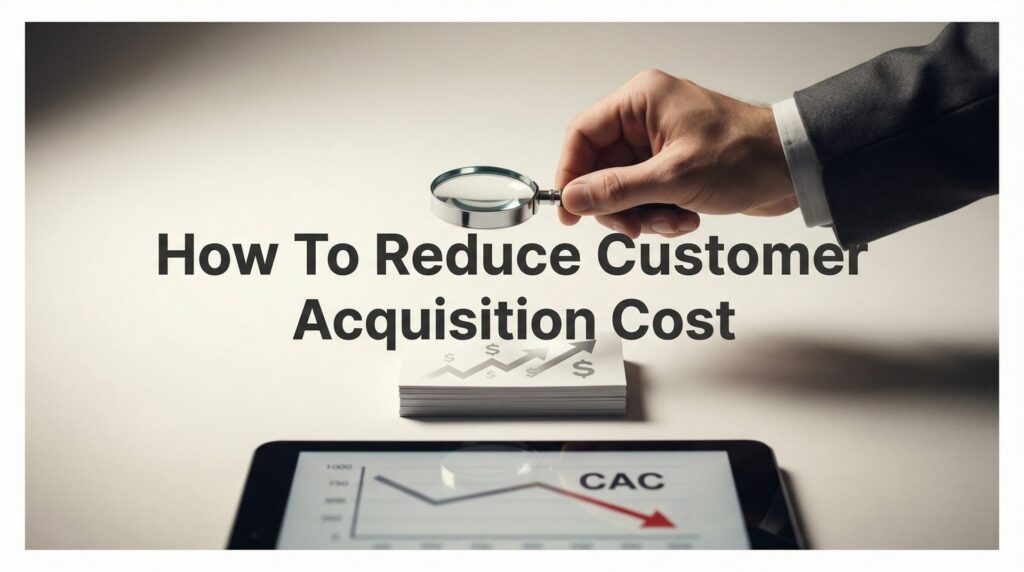
Every dollar you spend acquiring a customer either builds your business or bleeds it dry. For local business owners watching their marketing budgets disappear into campaigns that barely break even, high customer acquisition costs aren’t just frustrating—they’re existential threats to growth.
The good news? Reducing your CAC isn’t about spending less on marketing. It’s about spending smarter.
In this step-by-step guide, you’ll learn exactly how to audit your current acquisition costs, identify the leaks draining your budget, and implement proven strategies that attract better customers for less money. Whether you’re running a service business, managing a local storefront, or scaling an e-commerce operation, these six steps will help you build a more profitable customer acquisition engine.
Let’s cut the waste and start growing.
Step 1: Calculate Your True Customer Acquisition Cost (Most Businesses Get This Wrong)
You can’t improve what you don’t measure. Yet most business owners have only a vague sense of what it actually costs to acquire a customer.
The basic formula is straightforward: divide your total sales and marketing costs by the number of new customers acquired during that period. Simple enough, right?
Here’s where most businesses go wrong. They only count the obvious expenses—ad spend, maybe some agency fees—and ignore the hidden costs that inflate their true CAC by 40% or more.
Hidden costs you’re probably forgetting: Your marketing software subscriptions (CRM, email platform, analytics tools). The hours your team spends managing campaigns, creating content, and following up with leads. Design and copywriting costs. Event sponsorships. That “free” social media marketing that requires someone’s salary to execute.
Add it all up. Every dollar that touches your customer acquisition process counts.
But here’s the real breakthrough: calculating your overall CAC is just the starting point. The businesses that actually reduce acquisition costs break down CAC by individual channel.
Track Google Ads separately from Facebook Ads. Measure SEO leads differently from referral customers. When you know that one channel delivers customers at $150 each while another costs $600, you suddenly have a roadmap for where to invest more and where to cut. Understanding how to track your AdWords ROI is essential for this channel-level analysis.
Set up a simple spreadsheet with columns for each marketing channel, monthly costs, and new customers acquired. Update it monthly. Within three months, you’ll have enough data to make intelligent reallocation decisions that can cut your blended CAC by 20-30%.
Success indicator: You can state your exact CAC for each marketing channel without having to look anything up. The number is burned into your brain because you track it religiously.
Step 2: Audit Your Conversion Funnel for Expensive Leaks
Think of your marketing funnel as a bucket with holes. You’re paying to fill it with leads, but many are leaking out before they become customers.
Every leak costs you money. A lead that clicks your ad, visits your website, and leaves without converting represents wasted acquisition spend. The more leaks you plug, the lower your effective CAC becomes.
Start by mapping your complete customer journey. What happens after someone clicks your ad? Do they land on a dedicated page or your generic homepage? How many steps stand between their first interaction and becoming a customer? If you’re experiencing website traffic but no conversions, your funnel likely has significant leaks that need immediate attention.
Now identify the drop-off points. Where are you losing people? Check your analytics for pages with high bounce rates. Look at form abandonment rates. Track how many leads make it from initial contact to sales conversation to closed deal.
Common conversion killers that inflate CAC: Landing pages that load slowly or look unprofessional on mobile. Weak calls-to-action that don’t create urgency. Contact forms asking for too much information. Follow-up that happens days later instead of minutes later. Unclear value propositions that don’t differentiate you from competitors.
Here’s the thing: many of these fixes require zero additional budget. Rewriting your headline to focus on customer outcomes instead of your features? Free. Setting up automated email responses for new leads? One hour of work. Reducing your contact form from 12 fields to 4? Ten minutes.
These quick wins can improve conversion rates within 48 hours, effectively reducing your CAC without spending a dollar less on marketing. For a deeper dive into fixing these issues, explore proven low website conversion rate solutions that turn visitors into customers.
The math is simple. If you’re currently converting 2% of website visitors into leads, and you improve that to 3%, you’ve just reduced your cost per lead by 33%. Your ad spend stayed the same, but you got 50% more leads from it.
Success indicator: You’ve identified at least three specific funnel improvements to implement this week, and you’ve assigned someone to own each fix.
Step 3: Double Down on Your Highest-Performing Channels
Now that you know your CAC by channel, you’re about to make a decision that feels counterintuitive but changes everything.
Stop spreading your budget evenly. Stop trying to “maintain a presence” on every platform. Stop letting ego or personal preference dictate where you advertise.
The 80/20 rule applies ruthlessly to customer acquisition. In most businesses, roughly 80% of profitable customer acquisition comes from 20% of channels. Your job is to find that 20% and feed it aggressively.
Look at your channel-specific CAC data from Step 1. Which channel delivers customers at the lowest cost? That’s your winner. Now ask yourself: what would happen if you doubled your budget there?
Many business owners resist this because they fear putting all their eggs in one basket. That’s a valid concern for long-term strategy, but in the short term, you need to optimize for profitability. If Google Ads delivers customers at $200 each and Facebook delivers them at $550, you should be pouring budget into Google until you hit diminishing returns.
Test scaling your best channel before you give up on underperformers. Increase budget by 25-50% and watch what happens to your CAC. If it stays stable or even improves, you’ve found your growth engine. If it increases significantly, you’ve found the channel’s ceiling. Learning how to scale customer acquisition profitably requires understanding these channel dynamics.
When should you cut a channel completely? When it consistently delivers CAC that’s higher than your customer lifetime value, and when optimization efforts over 90 days haven’t improved performance. Until then, consider it an optimization opportunity rather than a failure.
Success indicator: You’ve reallocated at least 20% of your marketing budget toward your lowest-CAC channel, and you’re tracking the results weekly.
Step 4: Implement Retargeting to Convert Warm Traffic Cheaper
Here’s a reality that should change how you allocate budget: retargeting campaigns typically cost substantially less per conversion than cold prospecting because you’re marketing to people who already know you exist.
Someone who visited your website, watched your video, or opened your email has demonstrated interest. Converting them doesn’t require building awareness from scratch—it requires strategic reminders and addressing objections.
The basics of retargeting are straightforward. You create audiences of people who’ve interacted with your business but haven’t converted yet. Then you show them targeted ads designed to bring them back and complete the action.
Essential retargeting audiences to build: Website visitors from the past 30 days who didn’t fill out your contact form. People who started but didn’t complete a purchase. Video viewers who watched at least 50% of your content. Email subscribers who haven’t responded to your offers.
The key is creating ad sequences that nurture rather than annoy. Don’t just show the same ad repeatedly. Build a sequence that addresses common objections, showcases social proof, and creates urgency over time.
Your first retargeting ad might remind them what they were looking at. The second could share a customer testimonial. The third might offer a limited-time incentive to take action now. Understanding the complete customer acquisition funnel helps you design retargeting sequences that move prospects through each stage.
Budget allocation matters here. Many businesses make the mistake of spending 90% on prospecting and 10% on retargeting. Flip that ratio closer to 70/30. You’ll often find that the 30% spent on retargeting delivers 50% or more of your conversions at a fraction of the cost.
Success indicator: You have at least one active retargeting campaign running, and you’re tracking its CAC separately from your prospecting campaigns.
Step 5: Build a Referral Engine That Acquires Customers for Nearly Free
Referred customers represent the holy grail of customer acquisition. They cost almost nothing to acquire, convert at higher rates, and typically stay longer because they come with built-in trust from someone they know.
Yet most businesses treat referrals as happy accidents rather than systematic growth engines. They wait for customers to refer people organically instead of creating a process that generates referrals consistently.
Let’s fix that.
Start by designing a referral incentive that motivates action without destroying your margins. The best referral programs offer value to both the referrer and the new customer. This could be a service discount, an account credit, or even a simple gift card.
The incentive doesn’t need to be massive—it just needs to be clear and immediate. A $50 credit that arrives within 24 hours works better than a $100 credit that takes three weeks to process.
Timing is everything: Don’t ask for referrals when someone first becomes a customer. Wait until they’ve experienced real value from your service. The sweet spot is usually right after a major win, positive feedback, or successful project completion.
That’s when satisfaction is highest and your business is top of mind. A simple message like “We’re thrilled this worked so well for you! Do you know anyone else who might benefit from similar results?” feels natural rather than pushy. Having effective solutions for managing online customer reviews also helps generate the social proof that makes referrals more likely.
Make the referral process absurdly easy. Don’t require them to fill out forms or remember details. Send them a unique referral link they can forward. Better yet, ask for permission to reach out directly to people they mention.
Track everything. Who referred whom? Which customers are your best referral sources? What incentives drive the most action? This data helps you double down on what works.
Success indicator: You have a documented referral process, and you’ve personally asked at least ten satisfied customers for referrals this week.
Step 6: Increase Customer Lifetime Value to Offset Acquisition Costs
Here’s a perspective shift that changes everything: reducing CAC isn’t just about lowering acquisition costs. It’s also about making each customer more valuable.
The CAC to LTV ratio matters more than CAC alone. Generally, businesses aim for a lifetime value that’s at least three times their customer acquisition cost to maintain healthy unit economics. This means you can actually afford a higher CAC if you increase how much each customer is worth to your business.
Think about it this way: if your CAC is $300 and your average customer generates $600 in profit, you’re breaking even at best. But if you increase that customer’s lifetime value to $1,200 through repeat purchases and longer retention, your effective CAC just dropped to $150 relative to the value you’re capturing.
Quick strategies to increase average order value: Bundle complementary services together. Offer premium tiers with additional features. Create package deals that make higher-value purchases feel like better deals. Use strategic upsells at the point of purchase.
For increasing purchase frequency, focus on creating natural reasons for customers to come back. Subscription models, maintenance plans, and seasonal services all build predictable recurring revenue that dramatically improves LTV.
Retention is your secret weapon here. It costs far less to keep an existing customer than to acquire a new one. Simple retention tactics like proactive check-ins, loyalty programs, and exceptional service experiences keep customers coming back without expensive re-acquisition campaigns. If you’re a small business struggling to find customers, focusing on retention while you fix acquisition can stabilize cash flow.
Even small improvements compound quickly. Increasing your average customer value by 20% effectively reduces your CAC by the same percentage relative to the return you’re getting. Extending customer lifespan from 12 months to 18 months increases LTV by 50%.
Success indicator: You’ve implemented at least one LTV improvement strategy this month and you’re tracking average customer value monthly to measure progress.
Putting It All Together: Your CAC Reduction Action Plan
Reducing customer acquisition cost isn’t a one-time project—it’s an ongoing discipline that separates profitable businesses from those constantly chasing the next lead.
You now have a clear six-step framework: calculate your true CAC, audit your funnel, concentrate on winning channels, leverage retargeting, build referral systems, and boost lifetime value.
Start with Step 1 this week. Know your numbers before you try to improve them. You can’t make intelligent decisions about where to cut, where to invest, and where to optimize without accurate data on what each channel actually costs you.
Then work through each step systematically, measuring results as you go. Don’t try to implement everything simultaneously. Pick one step, execute it completely, measure the impact, then move to the next.
The businesses that master CAC reduction don’t just survive—they scale profitably while competitors burn through budget on inefficient campaigns and hope for the best.
Your action checklist for the next 30 days: Calculate CAC by channel and update your tracking spreadsheet. Identify three funnel leaks and assign someone to fix each one. Reallocate 20% of budget toward your lowest-CAC channel. Launch one retargeting campaign targeting website visitors. Ask ten satisfied customers for referrals using your new process. Implement one LTV improvement strategy and track the results.
Each of these steps compounds with the others. Better conversion rates make your best channels even more efficient. Retargeting captures leads that would have been lost. Referrals bring in customers at almost zero cost. Higher LTV means you can afford to invest more in acquisition while maintaining profitability. Learning how to improve website conversion rate amplifies every dollar you spend on traffic.
The math becomes powerful quickly. A 15% improvement in conversion rate, a 20% budget shift toward your best channel, and a 25% increase in customer lifetime value can collectively reduce your effective CAC by 40% or more—without spending a dollar less on marketing. If you’re dealing with a high cost per lead problem, these combined strategies address the root causes rather than just the symptoms.
Stop wasting your marketing budget on strategies that don’t deliver real revenue. Partner with a Google Premier Partner Agency that specializes in turning clicks into high-quality leads and profitable growth. Schedule your free strategy consultation today and discover how proven CRO and lead generation systems can scale your local business faster while reducing the cost of every customer you acquire.