You invest in SEO for your roofing company, wait three months, and then check your rankings. Nothing. Maybe a small blip on a keyword nobody searches. You start wondering if the agency you hired actually knows what they’re doing, or if SEO is just a slow-burning money pit with no guaranteed payoff.
That frustration is real, and it’s incredibly common among roofing contractors. The problem isn’t that SEO doesn’t work for roofers. It absolutely does. The problem is that most business owners go into it without a clear picture of what “working” looks like at different stages, and what timeline is actually realistic given how competitive the roofing space is.
SEO is one of the most powerful long-term lead generation channels available to roofing companies. A well-ranked roofing site can generate a steady stream of inbound calls from homeowners actively searching for services, without paying for every click. But it’s also the marketing channel most frequently misunderstood when it comes to timeline expectations. If you go in expecting PPC-style results, you’ll bail out right before the compound returns start kicking in.
This guide gives you a straight, honest breakdown of how long SEO takes for roofing companies, what’s happening behind the scenes during those early months, and what variables will either accelerate or delay your results. Understanding the timeline doesn’t just set expectations. It helps you make smarter decisions about your entire marketing mix.
Why Roofing SEO Moves at Its Own Pace
Roofing is not a forgiving niche for SEO beginners. It consistently ranks among the most competitive local service categories in Google Search, and for good reason. Roof replacements carry high job values, homeowners don’t buy often, and storm-driven demand creates intense competition for visibility at exactly the right moment. Every serious roofer in your market knows that being on page one means capturing jobs worth thousands of dollars. That’s why many of them have been investing in SEO for years.
When you launch a new SEO campaign, you’re not competing against fresh websites. You’re competing against roofing companies that have accumulated years of domain authority, hundreds of citations across local directories, and backlink profiles built through legitimate local press, supplier relationships, and industry associations. That gap doesn’t close overnight, and Google isn’t going to shortcut the process just because you optimized a few title tags.
Google’s algorithm is fundamentally built around trust signals that take time to accumulate. Consistent NAP data (your name, address, and phone number appearing accurately across dozens of directories), a steady velocity of genuine customer reviews, and content that demonstrates real depth and expertise in roofing topics. None of these can be faked, bought in bulk, or rushed. Google has seen every shortcut in the book, and its systems are specifically designed to discount signals that appear artificially accelerated.
There’s also the seasonal dimension that makes timeline planning especially critical for roofers. Roofing demand spikes during storm season and in the spring and fall when homeowners tackle home improvement projects. If your SEO campaign starts in January and you’re hoping to rank for competitive terms by April, you need to understand exactly where you’ll realistically be in that window. Missing a peak season because your rankings weren’t ready yet has direct revenue consequences. This is why roofing contractors need a clear-eyed view of the timeline before they start, not six months in when it’s too late to course-correct.
The pace of roofing SEO isn’t a flaw in the system. It’s a feature that ultimately protects you once you’re established. The same barriers that make it hard to climb to the top make it hard for competitors to knock you off once you’re there.
The Roofing SEO Timeline: Month by Month
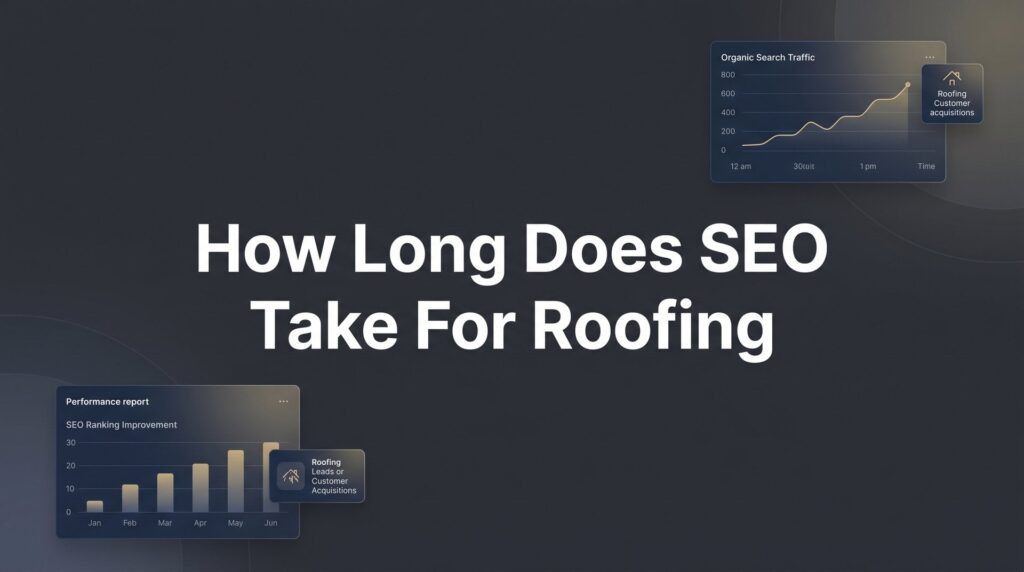
Experienced SEO professionals broadly agree that meaningful organic results typically begin appearing between four and six months for less competitive keywords, and six to twelve or more months for competitive local terms. That’s not a Clicks Geek-specific estimate. It reflects how Google’s indexing and trust-building processes actually work. Here’s what’s happening inside each phase.
Months 1–3: The Foundation Phase
This is the phase where most roofing business owners get nervous. You’re spending money and nothing visible is happening in the rankings. That’s completely normal, and it’s also the most critical phase to get right.
During these first three months, a competent SEO team is conducting a full technical audit of your website, fixing crawlability issues, improving site speed, and ensuring Google can properly index your pages. Your Google Business Profile gets fully built out with accurate service listings, service area definitions, and initial photo uploads. Citation building begins across the major directories that matter for local search. And initial content creation starts, whether that’s location-specific service pages, foundational blog posts, or FAQ content targeting informational keywords.
Little to no ranking movement is normal here. Google is watching, indexing, and beginning to evaluate the new signals. Think of it like planting seeds in winter. Nothing is visible above the ground yet, but the root system is forming.
Months 4–6: The Traction Phase
This is where things start getting interesting. Google has been indexing your new content and testing it in search results. Early rankings begin appearing, typically on lower-competition keywords first. Terms like “roof repair [your city]” or “roof inspection [nearby town]” start showing up in positions 10 through 30, and some may crack the top ten.
Local map pack visibility starts improving during this phase, often faster than traditional organic rankings. If your Google Business Profile work was done correctly in months one through three, you may start appearing in the three-pack for searches in your immediate service area. That visibility can translate into calls even before your organic rankings are fully competitive.
This phase requires patience and continued investment. The temptation to declare victory on a few early rankings or, conversely, to panic because you’re not ranking for “roof replacement [major city]” yet, is something every roofing business owner navigates. Stay the course.
Months 7–12 and Beyond: The Compounding Phase
This is where roofing SEO starts to deliver the returns that justify the investment. Competitive keywords gain real traction. Your site’s topical authority has been building for the better part of a year, and Google’s trust in your domain has grown alongside it. Lead volume from organic search increases meaningfully, and for most roofing markets, the ROI of SEO begins to clearly outpace its monthly cost.
The compounding effect is the key concept here. Each new piece of content, each new backlink, and each new review adds to a foundation that makes all your existing rankings stronger. A site that has been consistently optimized for twelve months doesn’t just rank for more keywords. It ranks for them more durably. Understanding how similar timelines play out in comparable trades can help set realistic benchmarks for your own campaign.
Factors That Speed Up or Slow Down Your Results
Two roofing companies can start SEO campaigns on the same day with the same budget and see very different timelines. Here’s what drives that gap.
Market Size and Competition Density: A roofing company in a mid-size regional market competes very differently than one targeting a major metropolitan area. In smaller markets, there may be fewer established competitors with deep domain authority, meaning a well-executed campaign can produce visible results in the four-to-six-month range. In a large metro with dozens of established roofing companies all actively investing in SEO, the competitive keyword timeline can stretch to twelve months or longer. Understanding your specific competitive landscape before you start helps set realistic expectations for your market.
Your Website’s Starting Point: This is one of the most underappreciated variables in roofing SEO timelines. A brand new domain with no history, no existing content, and no backlinks is starting from zero. Google has no trust signals to build on. An established website that has been around for several years, even if it’s never had real SEO investment, carries some existing domain authority, may have accumulated organic backlinks, and is already indexed. That existing foundation is a significant accelerant. Roofing companies with established sites often see traction two to three months sooner than those launching on a new domain.
Content and Link-Building Consistency: One-time SEO fixes don’t produce lasting results. Roofing companies that consistently publish location-specific service pages, earn backlinks from local directories, supplier websites, and local press, and regularly update their Google Business Profile consistently outpace competitors who treat SEO as a one-time project. Content depth matters too. A site with twenty well-written, locally relevant pages covering roofing services, materials, common problems, and local weather considerations signals topical authority for service area businesses in a way that a five-page brochure site never will.
Technical Website Health: A site with serious technical issues, slow load times, broken links, duplicate content, or poor mobile experience creates friction for both Google’s crawlers and your potential customers. Fixing these issues is part of the foundation phase, but if the problems are severe, clearing them can take longer and delay the point at which Google starts rewarding your content efforts.
What Good Roofing SEO Actually Looks Like in Practice
Understanding the timeline is one thing. Knowing what a well-executed roofing SEO strategy actually looks like helps you evaluate whether what you’re getting matches what you’re paying for.
A properly optimized roofing site targets both commercial and informational keywords, and does so with purpose. High-intent commercial terms like “roof replacement [city]” and “emergency roof repair [city]” capture homeowners who are ready to call right now. Informational keywords like “how long does a roof last” or “signs you need a new roof” capture homeowners earlier in the research phase. Comparison terms like “metal roof vs shingle roof cost” reach people actively evaluating their options. This layered keyword strategy builds topical authority across the full buying journey, not just at the bottom of the funnel where competition is most intense.
Your Google Business Profile deserves its own attention here because it’s often the fastest-moving asset in a roofing SEO campaign. Complete service listings, accurate service area boundaries, regular photo uploads showing real jobs, and genuine responses to every review all contribute to map pack visibility. For many roofing companies, the Google Business Profile starts driving calls before traditional organic rankings have fully matured. If your SEO provider isn’t actively managing your GBP as part of the engagement, that’s a gap worth addressing.
Inbound marketing strategies, specifically educational blog content and locally targeted landing pages, work together to build the kind of topical authority that’s genuinely difficult for competitors to displace. When a homeowner in your market searches for anything roofing-related and keeps finding your site providing useful, accurate answers, Google notices that pattern. It also means your site becomes a resource, not just a brochure, which builds the kind of brand trust that converts organic visitors into actual calls. The best marketing tools for roofing companies all point toward this content-first approach as the foundation of durable visibility.
This content-driven approach is particularly well-suited to roofing because homeowners often spend significant time researching before they pick up the phone. They want to understand their options, get a rough sense of costs, and feel confident they’re calling a company that knows what it’s doing. Educational content serves that need directly.
SEO vs. PPC for Roofers: Running Both Strategically
The question most roofing business owners ask at some point is whether to run SEO or PPC. The honest answer is that framing it as an either/or choice is one of the most expensive mistakes you can make.
PPC delivers immediate leads. The day your Google Ads campaign goes live, your phone can start ringing. SEO builds a compounding asset over six to twelve months. Running both in parallel is not just a hedge against the SEO ramp-up period. It’s a genuinely smarter strategy because the two channels feed each other. A deeper look at local SEO vs paid ads for customer acquisition shows exactly why the combination consistently outperforms either channel alone.
PPC data is particularly valuable for informing your SEO strategy. When you run Google Ads for roofing services, you quickly learn which keywords actually convert, not just which ones generate clicks. You learn which ad copy resonates with homeowners in your market, which service categories drive the most calls, and which geographic areas produce the best leads. That data directly improves your organic content strategy, shortening the testing cycle and helping you prioritize the SEO work that will have the biggest impact on actual revenue.
The long-term cost-per-lead advantage of SEO is real. Once your roofing site is ranking for competitive terms, the incremental cost of each organic lead is a fraction of what you’d pay per click in PPC. But that advantage only materializes if you have the runway to reach it. PPC bridges the gap during the SEO ramp-up period, keeping leads flowing and keeping your business growing while the organic foundation is being built. For a detailed breakdown of how paid search works specifically for roofers, the guide on PPC for roofing companies covers the mechanics in depth.
As a Google Premier Partner agency, Clicks Geek works with roofing companies on both channels simultaneously, using PPC performance data to sharpen organic targeting and CRO expertise to make sure that traffic from both sources actually converts into booked jobs, not just website visits.
How to Know If Your Roofing SEO Is Actually Working
One of the most common frustrations roofing business owners have with SEO agencies is not knowing whether the work is producing results. Here’s what to look for at each stage.
Early Indicators (Months 1–4): You should be seeing new pages getting indexed in Google Search Console, improvement in Google Business Profile views and search impressions, and early ranking movement on long-tail keywords, the more specific, lower-competition phrases that are easier to rank for initially. If none of these are moving after four months, something is wrong with the execution.
Mid-Term Indicators (Months 4–8): Organic traffic should be growing, even modestly. You should be appearing in the map pack for at least some of your target cities. And you should start seeing calls or form submissions attributed to organic search in your tracking. These numbers won’t be huge yet, but the trend should be clearly upward. Setting up proper Google Analytics conversion tracking from the start ensures you can actually measure this progress accurately.
Warning Signs That Something Is Wrong: No ranking movement after six months is a serious red flag. A stagnant or declining Google Business Profile with no improvement in views or search appearances suggests the local SEO work isn’t being done properly. And if your agency can’t show you keyword ranking reports, Google Analytics data, and Search Console access, that’s not just a communication problem. It’s a transparency problem that should prompt a serious conversation about whether to continue.
Other red flags include link-building from spammy, irrelevant directories, no local citation work being done, and content that reads like it was written for search engines rather than homeowners. Good roofing SEO produces content that actually answers questions homeowners have, not content stuffed with keywords that reads awkwardly.
Ask your SEO provider for a monthly report that includes keyword rankings, organic traffic trends, GBP performance metrics, and a clear explanation of what work was done that month. If they can’t provide that, you’re flying blind.
Putting It All Together
SEO for roofing companies is a six-to-twelve-month commitment at minimum, and that’s not a caveat designed to manage expectations downward. It’s the honest reality of how Google builds trust in a highly competitive local niche. The roofers who understand this and commit to the full process are the ones who end up with organic lead pipelines that their competitors can’t easily replicate or outbid.
The compounding nature of SEO is what makes it worth the patience. Every month of consistent work adds to a foundation that makes your rankings more durable, your cost-per-lead lower, and your competitive position stronger. That’s fundamentally different from PPC, where the leads stop the moment you stop paying.
The smartest approach for most roofing companies is to run PPC while SEO matures, use the data from paid campaigns to sharpen your organic strategy, and treat both channels as complementary parts of a single lead generation system rather than competing budget line items.
Tired of spending money on marketing that doesn’t produce real revenue? Clicks Geek builds lead systems that turn traffic into qualified leads and measurable sales growth. If you want to see what this would look like for your roofing business, we’ll walk you through how it works and break down what’s realistic in your specific market.