When you need a steady stream of high-quality leads, Google Ads is where experienced marketers turn. Why? Because it puts your business in front of people at the exact moment they’re hunting for a solution. This direct line to customer intent is the secret behind its power.
Using Google Ads for lead generation is about being the perfect answer for someone who has already admitted they have a problem.
Why Is Google Ads Good for Lead Generation?
Let's be real. When you needed a plumber last month, what did you do? You probably typed "emergency plumber near me" into Google. You weren’t scrolling social media; you were actively looking for help.
This is why so many businesses pour marketing dollars into Google Ads. You aren't trying to interrupt someone's day. You're answering a question they are asking right now.
In Short: Google Ads connects you with potential customers who have high "search intent," meaning they are actively looking for your services.
The Power of Search Intent
The big difference between Google Ads and other platforms is search intent. You aren't targeting people based on vague interests. You're targeting them based on the actual words they type into the search bar.
That's the strongest signal a potential customer can send. Someone searching for "how much does a new roof cost" is much closer to buying than someone who just happens to be a homeowner. By tapping into that intent, your ad budget is spent on people who are actively in the market.
Building a Predictable Lead Machine
The real beauty of Google Ads is turning your lead generation into a predictable, scalable system. Once you dial in the right keywords, ad copy, and landing pages, you can figure out your Cost Per Lead (CPL).
Marketing stops being a guessing game and starts looking like a math equation.
- You control the budget. You can start small, see what works, and then scale up.
- You get data almost instantly. Unlike SEO, which can take months, you’ll know what’s working within days.
- You can be hyper-local. This is perfect for service businesses that only want leads from specific towns.
How Google Ads Stacks Up
When you look at the options, it becomes clear why businesses bet on Google Ads to find high-quality leads.
| Channel | Primary User Intent | Typical Lead Quality | Preferred By Marketers |
|---|---|---|---|
| Google Ads (Search) | Problem/Solution-focused, transactional, high-intent | Excellent | #1 Choice |
| Social Media Ads | Passive discovery, entertainment, brand awareness | Low to Medium | Good for top-of-funnel |
| Email Marketing | Nurturing existing relationships, repeat business | High (from existing list) | Best for retention |
| Content/SEO | Informational, research-focused, long-term | Medium to High | Foundational, but slow |
The data speaks for itself. Research shows that Google Ads commands over 50% adoption among businesses focused on generating leads. It’s not just hype—almost 70% of marketing pros say Google Search Ads are their best-performing paid channel for getting conversions.
To see how this works in a real-world scenario, check out this deep dive on mastering Google Ads for business growth.
Building a Rock-Solid Campaign Foundation
Think of your Google Ads account like a house. You wouldn't build walls without a solid foundation. Skipping the fundamentals in Google Ads leads to wasted cash and frustration.
This is where we build the engine for your Google Ads lead generation machine.
A huge part of a strong foundation is the correct Google Ads campaign and ad group structure. When you get this right, your ads match what people are searching for. Google sees that relevance and rewards you with better ad placements and lower costs.
This simple flowchart breaks down the whole process.
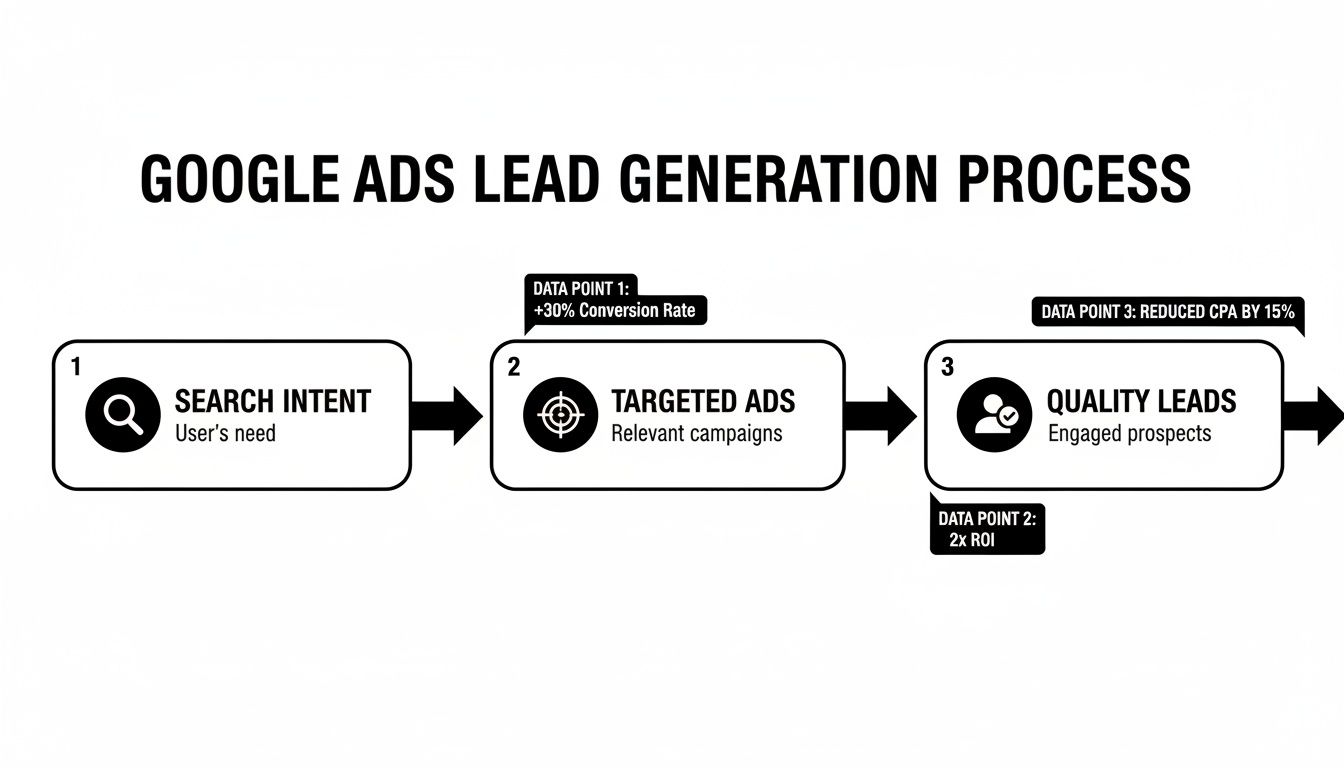
The main thing to remember is that every step is linked. A weak link anywhere—like a poorly targeted ad—will stop you from getting quality leads.
Choosing Your Campaign Type
Google offers a few different campaign types, but only a few really matter for generating leads. The right one depends on your business goals.
- Search Campaigns: This is the classic, and for good reason. Your ads show up the moment someone actively searches for your services.
- Performance Max (PMax): Think of this as Google’s all-in-one, AI-powered campaign. It pushes your ads across all of Google's channels (Search, Display, YouTube, etc.).
- Demand Gen: This newer option focuses on creating interest on visual platforms like YouTube and Discover. It's for reaching people before they start actively searching.
For most service businesses, starting with a Search campaign is the safest and most effective bet. You're targeting people who have already raised their hand and said, "I need this now."
Getting Conversion Tracking Right (This is a Big Deal)
This is the single most important step in the entire process.
If you don’t track conversions, you are flying blind. You have no idea which keywords or ads are actually making your phone ring. You’re just burning money on clicks.
Conversion tracking is how you tell Google what a "lead" means to you. It could be a form submission, a phone call, or a booked appointment.
In Short: Without accurate conversion tracking, Google's AI has no idea what to optimize for, so you end up paying for traffic, not results.
Once you have this data, Google’s automated bidding can finally do its job and find you more people who are likely to convert.
Structuring Your Ad Groups for Maximum Relevance
Okay, your tracking is set. Now it’s time to organize your campaign. A common mistake is dumping all your keywords into one massive ad group. Don't do this.
The right way is to create tightly themed ad groups. Each ad group should focus on one specific service you offer.
For example, a plumber shouldn’t have one generic ad group. It should be broken down into focused groups like:
- Emergency Plumbing
- Drain Cleaning
- Water Heater Repair
- Leak Detection
This tight structure lets you write hyper-specific ads for each service. When someone searches "emergency plumber near me," they see an ad that talks about "24/7 Emergency Service," not a generic plumbing ad. This laser-focused relevance boosts your Quality Score and lowers your ad costs.
Writing Ads and Landing Pages That Connect
Alright, your campaign structure is locked in. Now we get to the stuff your potential customers see: your ads and landing pages.
A killer ad that leads to a confusing landing page is a classic mistake. You create excitement, then immediate disappointment.
The key isn't creative wordsmithing. It's about psychology. Your ad needs to hook their attention, and your landing page has to seal the deal. Think of it as a one-two punch; both need to land perfectly for your Google Ads lead generation to work.
Crafting Ad Copy That Gets Clicks
Your ad copy has one job: get the right people to click. Not just any click, but a click from a genuine prospect.
Here’s a simple breakdown of what to focus on:
- Mirror Their Problem: Your headline should echo what they searched. If they searched "emergency plumber near me," your headline should be something like "24/7 Emergency Plumber."
- Highlight a Key Benefit: What makes you the best choice? Use the description to share a value prop like "Free, No-Obligation Estimates."
- Have a Clear Call-to-Action (CTA): Tell them what to do next. Use direct language like "Get Your Free Quote Now."
In Short: Your ad is the first handshake. It needs to be firm, confident, and directly address why they searched in the first place.
The Anatomy of a High-Converting Landing Page
Getting the click is only half the battle. Your landing page is where a visitor becomes a lead. The non-negotiable rule here is message match. The promise you made in your ad needs to be front and center on the landing page.
An effective landing page is a focused conversion machine. If you want to dive deeper, there are some great guides on the steps to creating a great PPC landing page that cover the fundamentals.
Must-Have Elements for Your Lead Gen Page
Think of your landing page as a short, direct sales pitch. It needs to be clean, simple, and stripped of all distractions. The goal is singular: get them to fill out the form.
Here’s a quick checklist:
- A Compelling Headline: Reiterate the offer from your ad.
- A Simple Form: Only ask for what you need. Name, email, phone—that’s usually it.
- Trust Signals: Add customer testimonials, reviews, or industry awards.
- Benefit-Driven Bullets: Don't just list what you do; explain why it matters to them.
- A Strong Call-to-Action Button: Make your CTA button pop with a contrasting color and use actionable text.
And remember: be mobile-first. An incredible 95% of all paid clicks on Google now come from mobile devices. If your landing page is slow or hard to use on a phone, you're just wasting your ad spend.
Choosing Keywords and Bids Without Wasting Money
Let's talk about the heart of any search campaign: keywords and bids. Get this part right, and you've got a profitable machine.
Your job is to get inside your customer's head. What are they frantically typing into Google when they need your help? Those phrases are your golden tickets.
Understanding Keyword Match Types
Google gives you a few "match types." Each one gives you a different degree of control over who sees your ads.
- Broad Match: This is Google on the loosest leash. It shows your ads for searches it thinks are related to your keyword. It can be a fast track to burning cash if you're not careful.
- Phrase Match: This is the sweet spot for most advertisers. Your ad shows for searches that include the meaning of your keyword. It's targeted but has enough flexibility.
- Exact Match: This is you telling Google, "I want this, and only this." Your ad will only appear for searches with the exact same meaning or intent. It's perfect for high-intent keywords.
Want to go deeper? I highly recommend you master the different Google Ads keyword match types. For a new Google Ads for lead generation campaign, start with a mix of phrase and exact match.
Your Secret Weapon: Negative Keywords
This is one of the most powerful and overlooked tools in Google Ads. Negative keywords are a list of terms you tell Google not to show your ads for. Think of them as a bouncer for your budget.
For example, a high-end kitchen remodeler doesn't want clicks from people searching for "DIY kitchen remodel ideas." By adding words like "DIY," "ideas," and "free" to your negative keyword list, you instantly disqualify that traffic.
In Short: Making a habit of reviewing your Search Terms report weekly to find new negative keywords is a critical, money-saving ritual.
Choosing the Right Bidding Strategy
Once your keywords are locked in, you have to tell Google how to spend your money. Google's automated bidding is smart, but only if you give it the right instructions.
For lead generation, these are the go-to strategies:
- Maximize Clicks: Use this for a brand new campaign. Your only goal is to get data—fast. Run this for a couple of weeks to feed the machine initial data.
- Maximize Conversions: Once you have 15-30 conversions over a 30-day period, flip the switch. Now you’re telling Google, "Go find me more people like the ones who already converted."
- Target CPA (Cost Per Acquisition): This is the final step. After your campaign has a stable Cost Per Lead (CPL), you can use Target CPA. You tell Google the maximum you're willing to pay for a lead, and its mission is to hit that average.
This phased approach is how you scale a campaign without breaking the bank.
Getting Your Hands Dirty: How to Analyze and Optimize Your Campaigns
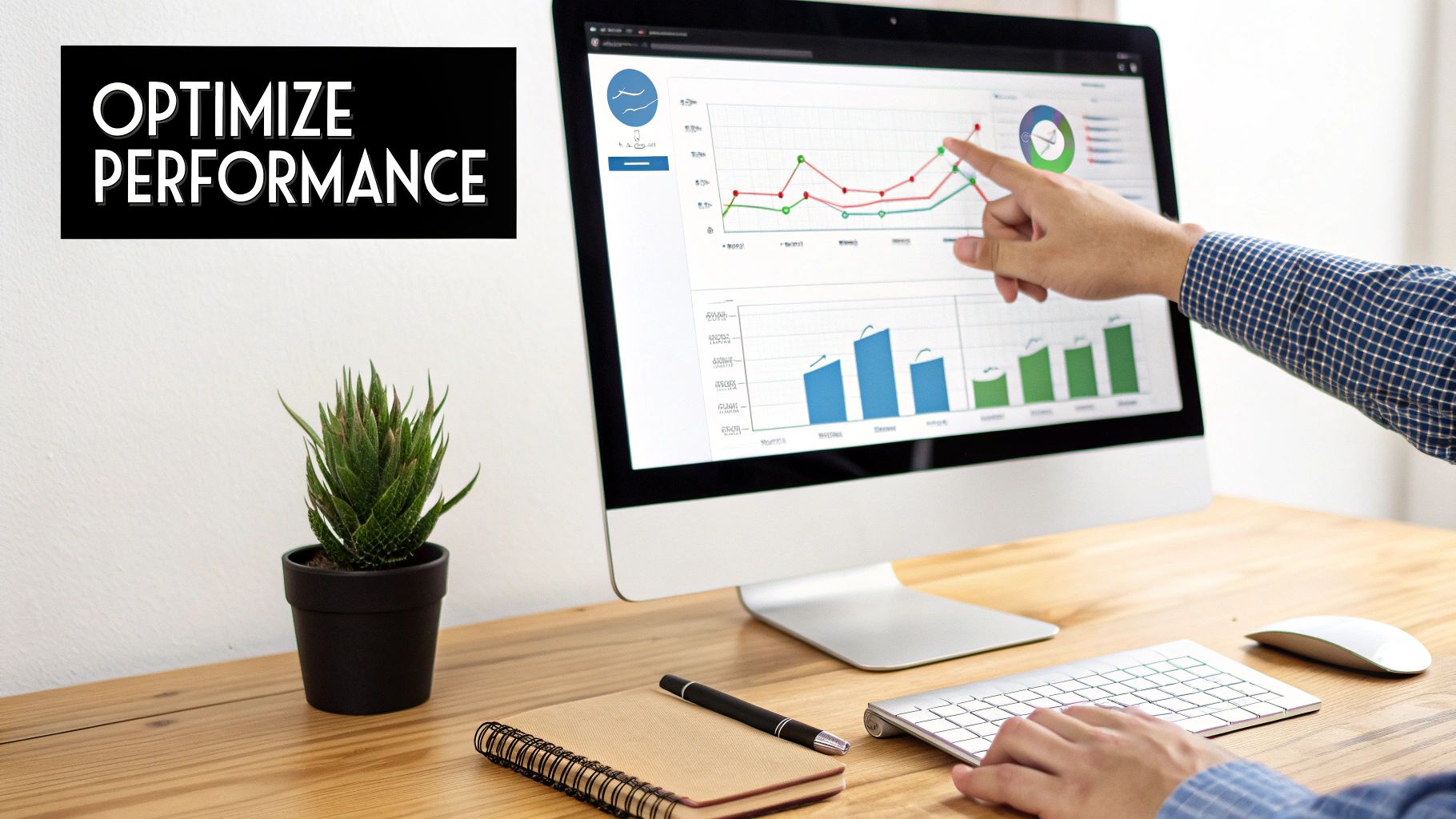
A successful Google Ads for lead generation campaign is never a "set it and forget it" deal. It's more like a garden. You have to tend to it and prune what isn't working.
This is about making small, data-driven adjustments that compound into big wins over time. You’re creating a simple feedback loop to consistently improve results.
Key Metrics to Actually Watch
It’s easy to get lost in the data inside your Google Ads account. To stay effective, just focus on a handful of key metrics.
- Click-Through Rate (CTR): This tells you if your ads are resonating. A low CTR means your ad copy and keywords are out of sync.
- Conversion Rate: This is the big one. It's the percentage of people who clicked your ad and actually became a lead.
- Cost Per Lead (CPL): This is your bottom line. How much are you paying for each new lead? This tells you if your campaign is profitable.
Don't just guess at what's "good." Recent data shows the average CPL on Google Ads is $70.11, with an average CTR of about 6.66%. This shows how critical a sharp optimization strategy is.
Digging for Gold in the Search Terms Report
The Search Terms Report is pure gold. It shows you the actual search queries people typed into Google that triggered your ads. Make it a weekly ritual to check this report.
You're looking for two main things:
- New Negative Keywords: Are you showing up for irrelevant stuff like "jobs," "free," or "DIY"? Add those to your negative keyword list.
- Hidden Keyword Opportunities: You’ll often find super-relevant, long-tail keywords that are converting. Add these as new phrase or exact match keywords.
In Short: The Search Terms Report is the most direct feedback you'll ever get from your audience. They are telling you, in their own words, exactly what they're looking for.
Your Weekly Google Ads Optimization Checklist
Building a routine is the best way to stay on top of your campaigns. This simple table can guide you through a quick weekly check-in.
| Task | Metric to Check | Action to Take |
|---|---|---|
| Review Search Terms | Search query relevance | Add irrelevant terms as negative keywords. Add high-performing queries as new, targeted keywords. |
| Check Ad Performance | CTR, Conversion Rate | Pause any ads with a bad CTR or zero conversions. Test a new ad variation against your best one. |
| Analyze Landing Page | Conversion Rate | If CTR is high but conversions are low, the landing page is the problem. Test a new headline or CTA. |
Sticking to a checklist turns a big task into a manageable 15-minute weekly habit. For a deeper dive, our guide on optimizing your Google Ads campaign for success lays out more advanced strategies.
The Simple Power of A/B Testing
A/B testing (or split testing) sounds more complicated than it is. It's just a simple experiment to see what your audience responds to. The golden rule? Only test one thing at a time.
Don't test a new headline, a new button color, and a new image all at once. You'll have no idea which change actually made the difference.
Start with your ads. Take your best-performing ad and duplicate it. In the copy, change only the headline. Let both run for a couple of weeks, then see which one has the better CTR. Pause the loser, and you've just made a measurable improvement. It's that simple.
Your Top Google Ads Questions, Answered
Let's tackle the real-world questions that come up when you consider using Google Ads. You're not just buying clicks; you're investing in your business.
Here are the big ones we get asked time and again.
How much should I spend on Google Ads for leads?
Anyone who gives you a single "magic number" is selling you something. Your budget depends on your industry's competitiveness and your location.
A solid starting point for many local service businesses is $500 to $2,000 per month. But the total spend isn't what matters most. The number to obsess over is your Cost Per Lead (CPL).
First, know what a new customer is worth to you in profit. Then you can work backward to decide what you’re willing to pay for a lead. If a new client brings in $1,500 in profit, paying $100 for a high-quality lead is a no-brainer.
How long does it take for Google Ads to generate leads?
This is the beautiful part about Google Ads. The results can be almost immediate.
Once Google approves your campaign, your ads can be live in just a few hours. Getting your first lead on day one is completely possible.
But there's a key distinction: getting a few leads is different from achieving stable performance. It typically takes a few weeks to a month for Google's algorithm to learn and for you to collect enough data. Think of the first 30-60 days as your "learning phase."
Are Google Ads worth it for a small business?
Yes, one hundred percent. For small and local service businesses, Google Ads is one of the most powerful tools available. It’s one of the few places you can compete with the big guys in your town.
Why? It all comes down to precision.
- You are in total control of your budget.
- You can target tiny geographic areas, even specific zip codes.
- You don’t waste money showing ads to people hundreds of miles away.
By zeroing in on people in your service area who are searching for what you do, you generate some of the highest-quality leads imaginable.
Ready to stop guessing and start getting a predictable stream of high-quality leads? The team at Clicks Geek specializes in building and managing profitable Google Ads campaigns for service businesses. Schedule your free strategy session today and let's build a plan to grow your business.