Feeling overwhelmed by marketing? You're not alone. The digital world moves fast, and it’s tough for small business owners to keep up.
Many guides offer generic advice that sounds good but doesn't tell you what to do. This leaves you guessing where to spend your limited time and budget.
That's why we've created this playbook. We're skipping vague theories and giving you actionable digital marketing tips for small business owners. These are proven tactics for service-based companies ready to grow. We'll show you how to get found on Google, turn visitors into customers, and use automation to handle leads.
This guide is your roadmap to a real return on your marketing investment. You'll learn what to focus on first, how much to spend, and what results to expect.
In Short: This guide provides 10 practical digital marketing tips designed for small service businesses to attract more customers and increase revenue.
1. Google Ads Management for Local Service Businesses
When you need an answer now, you go to Google. So do your customers, especially for urgent needs like a burst pipe.
Google Ads puts your business at the very top of search results at that exact moment. It's a powerful way to capture high-intent customers who are actively searching for your services.
Google Ads uses a pay-per-click (PPC) model. You only pay when someone clicks your ad. For a local plumbing company, this means you can bid on keywords like "emergency plumber near me" and appear instantly to someone who needs help.
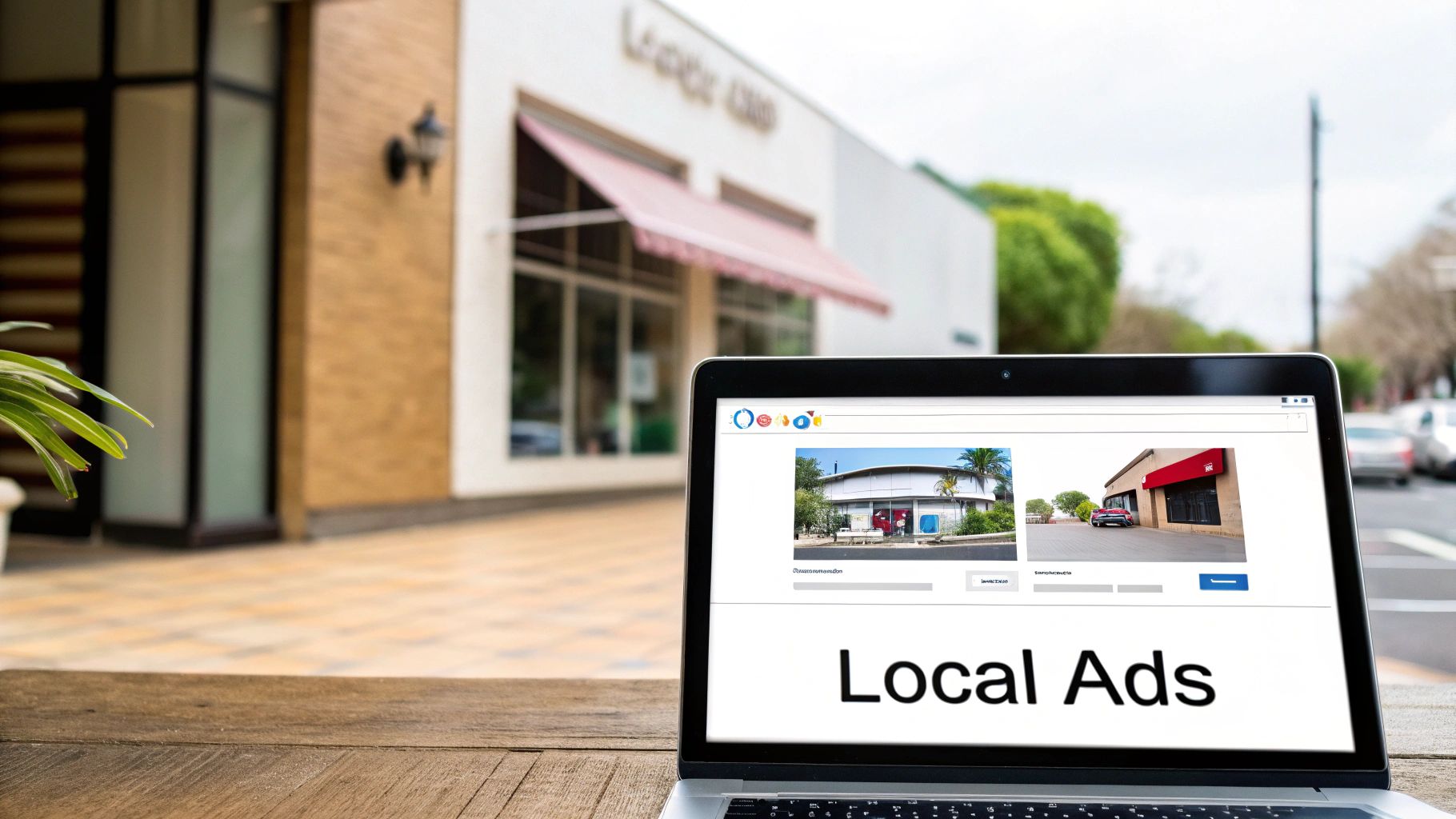
Actionable Tips for Local Google Ads
To get the most out of your budget, your campaign needs to be precise.
- Focus on High-Intent Keywords: Target phrases that signal urgency, like "24-hour HVAC repair" or "same-day dental appointment."
- Use Location and Call Extensions: Make it easy for mobile searchers to find and contact you. Location extensions show your address, while call extensions add a clickable phone number.
- Implement Negative Keywords: Add keywords you don't want to show up for. If you do residential plumbing, add terms like "commercial," "industrial," and "DIY" to your negative list.
- Track Everything: Set up conversion tracking for phone calls and contact form submissions. Without data, you're just guessing.
Key Insight: A successful Google Ads campaign isn't about getting the most clicks; it's about getting the right clicks. Use negative keywords and tight geographic targeting to maximize ROI.
Start with a modest daily budget, like $20–$50. Only increase spending once you have data showing a positive return.
2. Local SEO Optimization for Service-Based Businesses
While paid ads offer immediate visibility, Local SEO is the foundation for long-term growth. It's the process of making your business more visible in Google's local search results, like the "Map Pack."
For a roofer in Dallas, ranking for terms like "roof repair near me" means a steady stream of leads without paying for every click.
Unlike paid ads, a strong local SEO presence builds on itself over time. It establishes trust with search engines and customers. This is one of the most cost-effective digital marketing tips for a small business aiming for consistent growth.
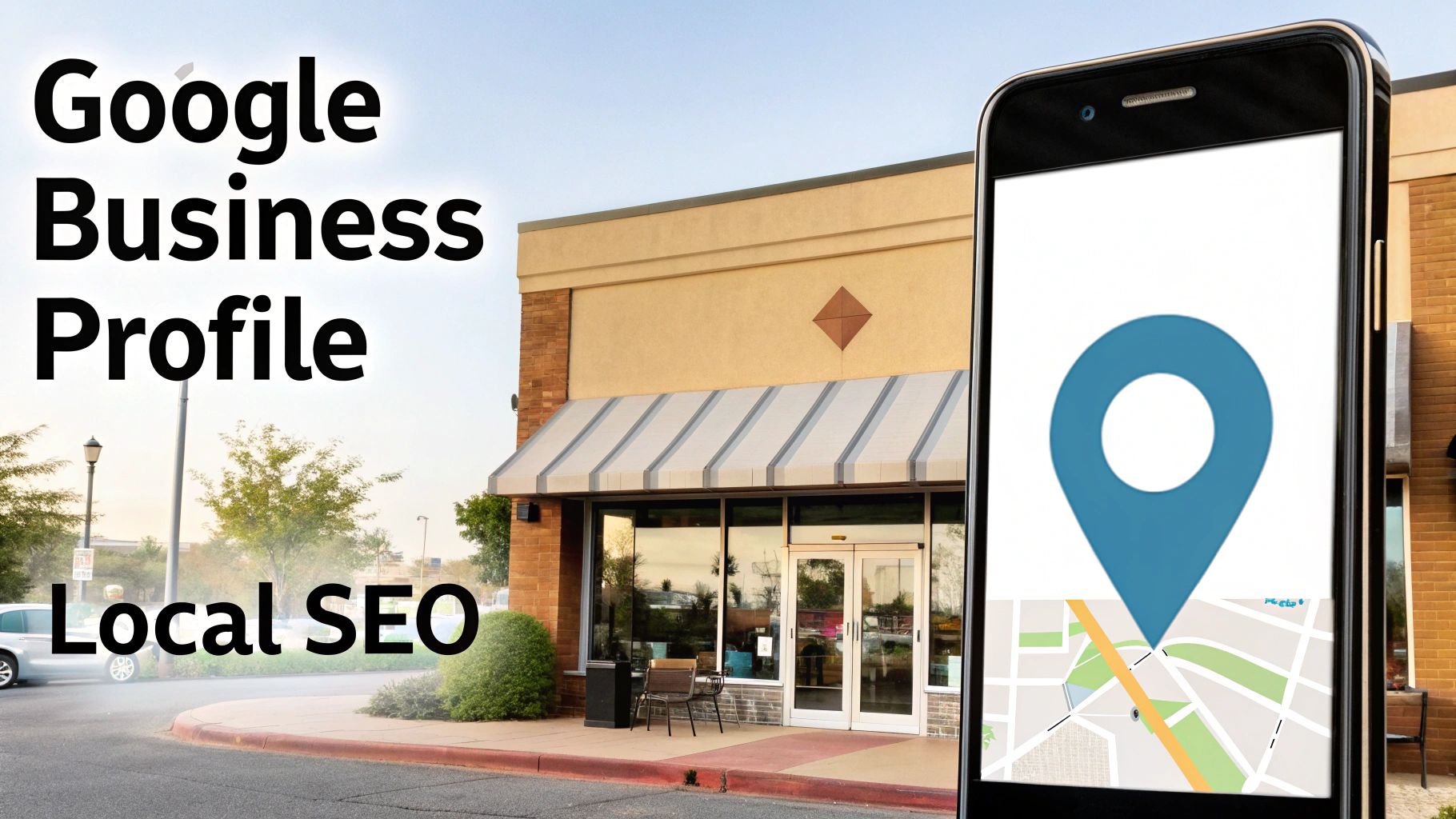
Actionable Tips for Local SEO
Dominating local search requires a focused, consistent effort.
- Claim and Optimize Your Google Business Profile (GBP): This is your most important local SEO tool. Fill out every section completely: services, service areas, hours, and photos.
- Generate a Steady Stream of Reviews: Actively ask every happy customer for a review. Positive reviews are a massive ranking factor.
- Build Local Citations: Ensure your business name, address, and phone number (NAP) are consistent across online directories like Yelp and Angie's List.
- Create Location-Specific Pages: If you serve multiple towns, create a unique page on your website for each one. Mention local landmarks and tailor the content to that audience.
Key Insight: Local SEO is a game of trust and relevance. An optimized Google Business Profile with positive reviews sends strong signals to Google that you are a legitimate local business.
3. Facebook Ads and Retargeting Campaigns
While Google captures users with immediate intent, Facebook and Instagram capture their attention.
Facebook Ads allow small businesses to reach specific audiences based on demographics and interests. This is a powerful tool for building brand awareness and generating leads.
Retargeting is where the real magic happens. This lets you show ads to people who have already visited your website. For a home service company, you can re-engage someone who viewed your "kitchen remodeling" page with a video testimonial. This targets a warm audience, leading to higher conversion rates.
Actionable Tips for Facebook Ad Campaigns
To avoid burning through your budget, campaigns must be strategic.
- Install the Meta Pixel: Before you do anything, install the Meta Pixel on your website. This tracking code is essential for monitoring conversions and building retargeting audiences.
- Segment Your Audiences: Don't show the same ad to everyone. Create different segments: a cold audience (based on interests), a warm audience (website visitors), and a lookalike audience (users similar to your customers).
- Use Compelling Visuals: Facebook is a visual platform. Use high-quality video with captions, carousel ads, and before-and-after images to stop users from scrolling.
- Test Lead Form Ads: Make it easy for customers to contact you without leaving the platform. Lead form ads pre-fill a user's contact information, making it a low-friction way to capture prospect details.
Key Insight: Successful Facebook campaigns combine broad awareness with focused retargeting. Use video to educate a cold audience, then retarget those who watched with a direct offer.
4. Landing Page A/B Testing and Conversion Rate Optimization
Getting traffic to your website is only half the battle. If your landing pages don't persuade visitors to act, your marketing spend is wasted.
Conversion Rate Optimization (CRO) is the process of improving your pages to get more visitors to take action. A core method is A/B testing, where you compare two versions of a page to see which one performs better.
A/B testing turns marketing from guessing into a data-driven science. For a service business, a small increase in conversion rate can dramatically improve ROI. For example, test a headline like "Same-Day AC Repair" against "Reliable AC Service" to see which gets more calls.
Actionable Tips for A/B Testing
Focus on high-impact changes first and test one element at a time.
- Test High-Impact Elements First: Start with what influences decisions the most. This includes your main headline, your call-to-action (CTA) button copy, and the number of form fields.
- Isolate Your Variables: To know what caused a change, only test one element at a time.
- Use Social Proof: Test adding a video testimonial or different trust badges (like BBB) to see what builds the most confidence.
- Remove Friction: Make it easy for users to convert. Try reducing the number of form fields from eight to four.
Key Insight: Successful CRO is a continuous process of testing, learning, and iterating. Focus on your customer's pain points and test copy and design that addresses them.
5. AI-Powered Call Assistants and Answering Services
For a service business, every missed phone call is a potential lost customer. When you're busy or it's after hours, you can't always answer.
AI-powered call assistants act as a virtual receptionist to ensure you never miss a lead. These systems use AI to handle calls, answer common questions, qualify leads, and even schedule appointments 24/7.
An AI assistant can instantly determine if a caller is a serious prospect, gathering details before the call ever reaches you. For a home service provider, it can ask about the project and book a consultation, turning a phone call into a scheduled appointment.
Actionable Tips for Implementing AI Call Answering
Set up your AI assistant thoughtfully to reflect your business.
- Map Common Inquiries: List the top 10-15 questions customers ask. Use this to build a script for the AI.
- Define Lead Qualification: Be specific about what makes a good lead. Give the AI clear rules to separate high-value prospects from general inquiries.
- Integrate with Your Calendar: Connect the AI directly to your scheduling software. This allows it to book appointments automatically.
- Set Clear Escalation Paths: Program the AI to know when to transfer a call to a human, like for complex questions or frustrated callers.
Key Insight: The goal of an AI assistant isn't to replace humans but to enhance them. Use it for repetitive tasks so your team can focus on high-value conversations.
6. Conversion-Focused Web Design and User Experience Optimization
Your website is your 24/7 salesperson. If it’s confusing or slow, it's not closing any deals.
Conversion-focused web design aims to turn visitors into leads. It uses strategic layout and messaging to make taking the next step, like calling you, the obvious choice.
This approach prioritizes action. For a law firm, this means putting trust signals like "Award-Winning" and a "Free Case Evaluation" button at the top. This is a vital digital marketing tip for a small business because it ensures the traffic you get from ads and SEO actually converts.
Actionable Tips for a High-Converting Website
Turn your site into a lead generation machine.
- Place Your Offer "Above the Fold": Your value proposition and call-to-action (CTA) button should be visible without scrolling.
- Make Your CTA Prominent: Use a contrasting color for your main CTA button (e.g., "Get a Free Quote") and use action-oriented text.
- Show, Don't Just Tell: Add social proof like customer testimonials, case studies, and star ratings to build credibility.
- Simplify Your Forms: Only ask for essential information. A form with 3 fields (Name, Phone, Service Needed) is more likely to be completed than one with 10.
Key Insight: A pretty website that doesn't generate leads is a liability. A conversion-focused website is a revenue-generating asset. Every design choice should make it easier for a customer to hire you.
7. Content Marketing and Educational Resources
Unlike paid ads, great content is an asset that can attract customers for years.
Content marketing is about creating and sharing valuable resources like blog posts and videos. For a service business, it's about proving you're the local expert and building trust.
When a homeowner's AC fails, they might search "why is my AC blowing hot air?" By creating a blog post that answers this question, an HVAC company can capture that user, provide value, and become the obvious choice for the repair.
Actionable Tips for Content Marketing
Effective content addresses your customers' biggest questions.
- Answer Specific Customer Questions: Create content titled "How to Unclog a Sink Drain" or "5 Signs You Need a New Roof."
- Create Content Pillars: Develop an in-depth guide on a core topic, then create smaller, related posts that link back to it.
- Repurpose Everything: Turn a blog post into a short video, a checklist for your newsletter, and a series of graphics. You can even add relevant Marketing Memes to make social content more engaging.
- Include Clear Calls-to-Action (CTAs): Every piece of content should guide the reader. End your post with a clear CTA like "Need professional help? Schedule your free inspection today."
Key Insight: Content marketing isn't about selling; it's about educating. When you share your expertise, you become the trusted authority people turn to when they're ready to buy.
8. Email Marketing and Lead Nurturing Automation
Not every customer is ready to buy right away. Many need time to research and build trust.
Email marketing allows you to stay in touch with these leads, nurturing them from interest to booking. It’s a direct line of communication you own.
By capturing an email address (often for a discount or guide), you can send automated sequences that build rapport and keep your business top-of-mind. This automated follow-up works 24/7, converting leads while you run your business.
Actionable Tips for Email Automation
An effective email strategy delivers the right message at the right time.
- Create a Valuable Lead Magnet: Offer something irresistible, like a "Home Maintenance Checklist" or a "5-Day Fitness Challenge" guide.
- Set Up a Welcome Sequence: Create a 3-5 email automated sequence that introduces your business and provides immediate value.
- Segment Your Audience: Group subscribers based on their interests. A lead interested in "kitchen remodeling" should get different content than one interested in "bathroom repairs."
- Focus on Value, Not Just Sales: Your emails should be 80% helpful and 20% promotional. Share tips, answer questions, and showcase projects.
Key Insight: The goal of email marketing is to become a trusted, helpful resource. When the time comes for a purchase, your business will be the obvious first choice.
9. Strategic Keyword Research and Content Planning
Keyword research is the blueprint for your digital marketing strategy. It’s the process of discovering what words your potential customers are typing into Google.
Ignoring this step is like building a house without a foundation. Understanding search behavior lets you create relevant content and ads that meet customers where they are.
For example, a home service company might find that “emergency plumber near me” has five times the search volume of “plumbing repair.” This insight lets them target ads and content to capture urgent, high-value leads.
Actionable Tips for Keyword Research
Turn search data into a real marketing plan.
- Focus on Long-Tail Keywords: Target longer, specific phrases (3+ words) like “cost to repair leaking faucet in Austin.” These have lower competition and attract users with higher purchase intent.
- Analyze Searcher Intent: Create blog posts for informational keywords (“how to fix a running toilet”) and landing pages for transactional keywords (“hire a plumber today”).
- Leverage Local Modifiers: Always include location-specific terms like “HVAC repair in [Your City]” or “best roofer near me.”
- Spy on Your Competitors: Use tools like Semrush to see which keywords your local competitors are ranking for. This can reveal valuable opportunities.
Key Insight: Effective keyword research is about understanding the person behind the search. Match your content to their intent, and you'll attract more qualified leads.
10. Reputation Management and Review Generation
In today's world, your online reputation is your storefront. Before a customer calls you, they've likely looked up your star rating on Google.
Reputation management is the process of monitoring and improving what people say about your business online. For a local service business, this means systematically generating positive customer reviews.
A steady stream of recent, positive reviews is a powerful trust signal. It impacts your local SEO rankings and convinces prospects to choose you. An HVAC company with 300+ reviews is more likely to get the click than one with 10.
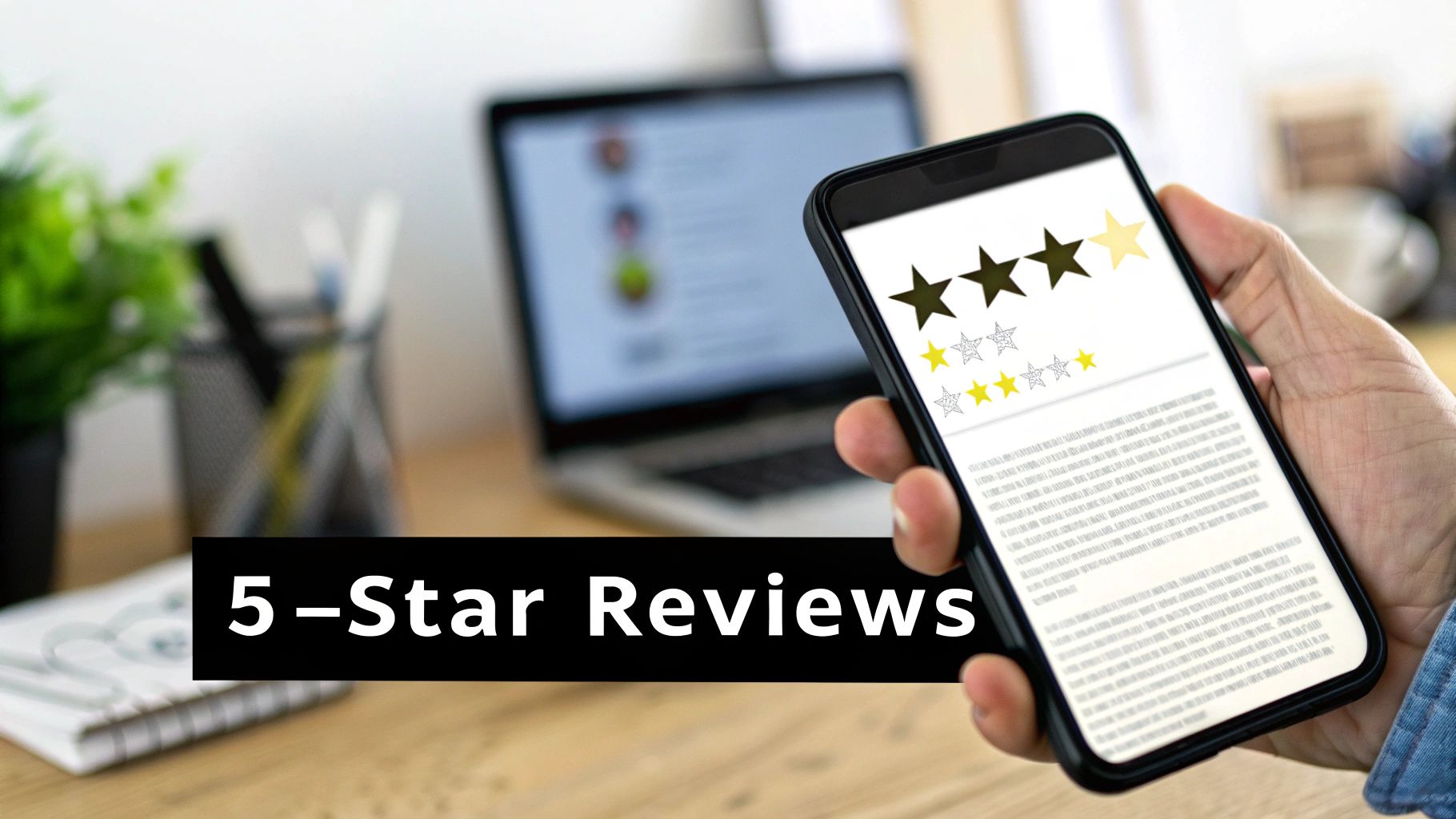
Actionable Tips for Reputation Management
Building a 5-star reputation requires a consistent system.
- Make It Effortless to Leave a Review: Send automated text messages or emails to customers after a service is completed with a direct link to your Google Business Profile review page.
- Time Your Request Perfectly: Ask for a review at the moment of peak customer satisfaction, like right after fixing a major leak.
- Respond to Every Single Review: Thank customers for positive feedback and address negative reviews professionally. Offer to take the conversation offline to resolve it.
- Leverage Reviews in Your Marketing: Feature your star rating and customer quotes on your website, in social media posts, and in your Google Ads.
Key Insight: Don't just wait for reviews. Building a great reputation is an active process. An automated system for requesting feedback is one of the most effective digital marketing tips for a small business.
10-Point Digital Marketing Tips Comparison for Small Businesses
| Service | 🔄 Implementation complexity | ⚡ Resource requirements | 📊 Expected outcomes | 💡 Ideal use cases | ⭐ Key advantages |
|---|---|---|---|---|---|
| Google Ads Management for Local Service Businesses | Medium–High: ongoing bid & campaign optimization | Moderate budget (start $20–50/day), PPC expertise, tracking setup | Immediate, measurable lead volume and ROI tracking | Emergency services, seasonal demand, high-intent local searches | High-intent traffic; scalable; precise attribution |
| Local SEO Optimization for Service-Based Businesses | Medium: continuous citations, GBP & on-site work | Low–Medium time investment, content & citation management | Sustainable organic visibility and lower long-term CAC (months) | Service-area businesses seeking long-term local dominance | Free organic traffic; trust-building; durable rankings |
| Facebook Ads and Retargeting Campaigns | Medium: audience setup, creative sequencing, pixel | Creative production, audience data, moderate ad spend | Strong awareness/consideration; retargeting lifts conversions | Brand awareness, re-engaging website visitors, visual offers | Low CPC; rich audience targeting; high retargeting ROI |
| Landing Page A/B Testing and Conversion Rate Optimization | Medium: experiment design, stats validation | Analytics tools, design/dev time, sufficient traffic | Improved conversion rates; multiplies value of existing traffic | Paid campaigns where small CR gains increase ROI | Data-driven conversion lifts; removes guesswork |
| AI-Powered Call Assistants and Answering Services | Medium: setup, training, CRM/calendar integration | Subscription cost, initial training, integrations | Near-zero missed calls; better lead qualification 24/7 | High-call-volume services; after-hours lead capture | 24/7 availability; cost-saving vs. staff; scalable |
| Conversion-Focused Web Design and UX Optimization | High: strategic design, UX research, iterative testing | Higher upfront design/dev cost, UX expertise | Higher site conversion rates; improved trust & engagement | Businesses relying on website leads and bookings | Stronger UX; higher conversions; supports all channels |
| Content Marketing and Educational Resources | Medium: ongoing content production & promotion | Writers, video production, time (months) | Compounding organic traffic, authority, inbound leads | Long-term inbound acquisition; complex purchase journeys | Low CAC over time; builds authority and SEO value |
| Email Marketing and Lead Nurturing Automation | Low–Medium: sequence design, segmentation setup | Email platform, copywriting, automation configuration | High ROI; sustained lead nurturing and repeat business | Nurturing leads, onboarding, re-engagement campaigns | Exceptional ROI; owned audience; scalable automation |
| Strategic Keyword Research and Content Planning | Low–Medium: analysis and mapping to content/ads | Keyword tools (some paid), analyst time | Better targeting for SEO/PPC; reduced wasted spend | Foundation for SEO, content, and paid strategies | Informs all channels; identifies high-opportunity keywords |
| Reputation Management and Review Generation | Low–Medium: process, monitoring, response workflows | Review tools, staff time for responses, automation | Improved local rankings, higher trust, increased conversions | Service businesses relying on local reputation and referrals | Boosts conversions; local SEO benefit; social proof |
Putting It All Together: Your Next Steps for Growth
We've covered a lot of digital marketing tips for small business owners. It’s easy to feel overwhelmed. But you don't have to do everything at once. The goal is to build a reliable system that brings you new customers.
Think of it like building a house. You need a solid foundation first. For you, that's a conversion-focused website and an optimized Google Business Profile. Everything else builds upon that base.
Your Action Plan: From Theory to Reality
Let’s turn motivation into momentum. Pick one or two areas that will have the biggest immediate impact.
Here’s a simple, three-step plan to get started today:
- The Foundational Fix (Low Effort, High Impact): Go to your Google Business Profile right now. Is every field filled out? Do you have at least 10 recent, high-quality photos? This is a non-negotiable first step.
- The Quick Win (Medium Effort, High ROI): Look at your website's homepage. Is your phone number immediately visible? Is there a clear "Get a Free Quote" button? Making it easy for visitors to contact you is a fast way to increase leads.
- The Growth Engine (Higher Effort, Scalable Results): If you need leads now, dedicate a small budget to a hyper-specific Google Ads campaign. Focus on one service in one area. This minimizes risk and lets you prove the concept before scaling up.
Successful businesses master the fundamentals. They understand that positive reviews, a website that converts, and top visibility on Google are the pillars of growth. By applying these core digital marketing tips, you create a system that works for you 24/7.
People Also Ask
What is the most effective digital marketing for small business?
The most effective strategy often combines Local SEO for long-term organic visibility and Google Ads for immediate, high-intent leads. A conversion-focused website is the essential foundation that makes both channels profitable.
How can I do digital marketing with a small budget?
Start with low-cost activities like optimizing your Google Business Profile and generating customer reviews. For paid ads, begin with a small, targeted Google Ads campaign (e.g., $20/day) focused on your most profitable service and track ROI carefully.
Where should a small business start with digital marketing?
Begin by claiming and fully optimizing your Google Business Profile. It's free, directly impacts your visibility in local search and maps, and is the single most important first step for any local service business.
If you're ready to implement these strategies with an expert team, Clicks Geek can help. As a top 1% Google Premier Partner, we specialize in building scalable customer acquisition systems for service-based businesses. Let us help you turn these tips into measurable results and take the guesswork out of your growth.