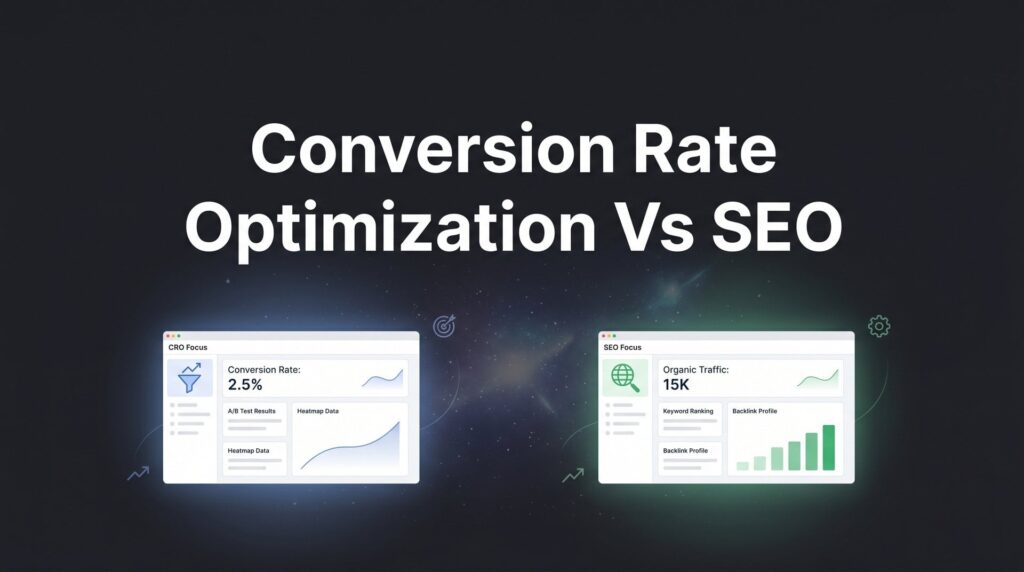
Most local business owners treat conversion rate optimization and SEO as separate, competing priorities. Budget goes into one while the other starves. It’s a common mistake, and it’s an expensive one.
Think of it this way: SEO is your engine, and CRO is your steering wheel. You need both to get anywhere. SEO drives traffic to your website, but without CRO, that traffic bounces, burns through your budget, and never turns into paying customers. On the flip side, a perfectly optimized landing page is worthless if nobody can find it in the first place.
The real question isn’t “conversion rate optimization vs SEO.” It’s how to make them work together so every dollar you invest in marketing actually generates revenue.
Whether you’re a plumber trying to rank in your service area, a pest control company struggling with a high cost per lead, or a home services business that’s tired of paying for clicks that go nowhere, this guide is for you. These 7 strategies will show you where to focus first, how to measure what matters, and how to build a digital marketing system that compounds results over time.
1. Audit Your Funnel to Find the Real Bottleneck First
The Challenge It Solves
Most local businesses skip straight to tactics. They launch a new Google Ads campaign or redesign their homepage without first answering a fundamental question: is the problem that not enough people are finding you, or that the people who do find you aren’t converting? Throwing money at the wrong problem is how marketing budgets disappear without results.
The Strategy Explained
Before spending another dollar, run a simple two-question diagnostic. First, look at your organic traffic volume over the past 90 days. Is it growing, flat, or declining? Second, look at your conversion rate on your most important pages. Are visitors filling out forms, calling, or booking appointments at a meaningful rate?
If traffic is low but your conversion rate on existing visitors is solid, you have an SEO problem. Double down on organic visibility. If traffic is healthy but leads are thin, you have a CRO problem. A dedicated sales funnel optimization agency can help you diagnose exactly where visitors are dropping off and fix the leaks before spending more to drive more of the same traffic.
This diagnostic also works at the page level. Use Google Search Console to identify which pages get impressions but low clicks (SEO opportunity), and Google Analytics to identify which pages get traffic but high bounce rates or low goal completions (CRO opportunity).
Implementation Steps
1. Pull a 90-day traffic report from Google Analytics segmented by organic, paid, and direct sources. Note total sessions and sessions by landing page.
2. Export goal completion or conversion data by landing page. Calculate a simple conversion rate for your top 10 traffic pages.
3. Create a 2×2 matrix: high traffic/low conversion (CRO priority), low traffic/high conversion (SEO priority), low traffic/low conversion (rebuild entirely), high traffic/high conversion (protect and scale).
4. Assign each of your key pages to a quadrant and create a prioritized action list based on where the biggest revenue opportunity sits.
Pro Tips
Don’t let this audit become a one-time exercise. Run it quarterly. Markets shift, rankings change, and user behavior evolves. The businesses that consistently outperform their competitors are the ones that know exactly where their funnel is leaking at any given moment, not just at launch.
2. Match Your Keyword Strategy to Pages Built for Buyers
The Challenge It Solves
Many local businesses rank for keywords that attract researchers, not buyers. They create blog content targeting informational queries and then wonder why organic traffic doesn’t generate calls. The issue isn’t the traffic volume. It’s the intent behind the traffic. When your SEO strategy ignores purchase intent, you end up with an audience that reads your content and leaves without ever becoming a lead.
The Strategy Explained
Google’s Search Quality Evaluator Guidelines recognize that search queries carry different types of intent: informational (learning something), navigational (finding a specific site), and transactional or commercial (ready to act). Your SEO and CRO strategies need to be mapped to these intent categories from the start.
Transactional and commercial intent keywords, such as “emergency plumber near me” or “pest control quote [city name],” should point to dedicated landing pages built specifically to convert. These pages should have a single clear call to action, trust signals like reviews and credentials, and minimal distractions. They should be SEO-optimized for the target keyword and CRO-optimized for the visitor who’s ready to hire. Understanding the nuances of conversion optimization for lead generation websites is essential for getting this right.
Informational content can still serve a purpose in your funnel, but it should include lead capture mechanisms, like a free estimate offer or a downloadable checklist, so that even early-stage visitors have a path toward becoming a customer.
Implementation Steps
1. Use a keyword research tool to segment your target keywords by intent. Flag all transactional and commercial terms as “conversion page” targets.
2. Audit your existing pages. If a high-intent keyword is currently ranking on a blog post or general service page, build or improve a dedicated landing page for it.
3. Ensure each conversion landing page has one primary CTA, above-the-fold contact options, and relevant social proof specific to that service or location.
4. Add internal links from your informational content to your conversion pages to pass authority and guide visitors further down the funnel.
Pro Tips
Location-specific landing pages are one of the most underused opportunities for local businesses. If you serve multiple cities or service areas, create separate pages for each with unique, locally relevant content. Mastering local SEO for service area businesses can help these pages rank for geo-modified transactional keywords while also serving as highly targeted conversion pages for visitors from those specific areas.
3. Treat Page Speed as the Foundation of Both Disciplines
The Challenge It Solves
Page speed is one of those rare areas where SEO and CRO are working toward exactly the same goal. Yet many local business websites are loaded with oversized images, bloated plugins, and unoptimized code that slow everything down. The result is a double penalty: lower search rankings and higher bounce rates from impatient visitors.
The Strategy Explained
Google has publicly documented that Core Web Vitals are a ranking signal as part of its Page Experience update, documented in Google Search Central. These metrics, including Largest Contentful Paint, Interaction to Next Paint, and Cumulative Layout Shift, measure real-world loading performance and visual stability.
On the CRO side, Google’s own public research has shown that as page load time increases, the probability of a visitor bouncing increases significantly. Slow pages frustrate users, erode trust, and reduce the likelihood that someone will fill out your contact form or call your business.
Speed optimization is therefore the single highest-leverage technical investment you can make because it improves both your ability to rank and your ability to convert. This is especially true for mobile visitors, where a mobile ad optimization service can help ensure your paid traffic also lands on fast, conversion-ready pages.
Implementation Steps
1. Run your site through Google PageSpeed Insights and Google Search Console’s Core Web Vitals report. Identify your lowest-scoring pages and the specific issues flagged.
2. Compress and properly size all images. Use modern formats like WebP where supported. This alone often produces meaningful improvements on image-heavy sites.
3. Minimize render-blocking JavaScript and CSS. Work with your developer or use a performance plugin to defer non-critical scripts.
4. Enable browser caching and consider a Content Delivery Network (CDN) if your hosting is slow or your audience is geographically distributed.
Pro Tips
Don’t just optimize for desktop. Mobile performance is critical for local businesses because a large portion of “near me” searches happen on mobile devices. A site that loads quickly on desktop but crawls on mobile is leaving a significant number of potential leads on the table. Test both environments separately and prioritize mobile if you have to choose.
4. Create Content That Ranks and Converts at the Same Time
The Challenge It Solves
Many businesses create SEO content that ranks well but does nothing to generate leads, or they create conversion-focused content that nobody ever finds organically. These two outcomes reflect a siloed approach where content is written either for Google or for visitors, but rarely for both. The result is a lot of effort with fragmented returns.
The Strategy Explained
Dual-purpose content is designed to earn organic visibility while simultaneously moving readers toward a conversion. This isn’t about stuffing a blog post with CTAs. It’s about building content assets that naturally attract links and shares because they’re genuinely useful, while also being structured in a way that guides interested readers toward taking action.
Think about comprehensive guides, comparison pages, or “how to choose” articles that target informational queries with commercial intent. A pest control company might create a guide on “how to choose a pest control company in [city].” It ranks for a relevant query, provides real value, earns links from local directories or home service sites, and positions the company as the obvious choice by the end of the page. Learning website conversion rate optimization principles will help you structure these pages for maximum impact.
The key is embedding conversion elements naturally: a free estimate CTA mid-page, a review section near the bottom, and a clear next step at the end. These elements don’t hurt SEO when implemented cleanly, and they turn organic readers into leads.
Implementation Steps
1. Identify 3 to 5 informational keywords in your niche that carry commercial intent. These are queries people ask before hiring someone, not just for general curiosity.
2. Build long-form content for each that genuinely answers the question better than competing pages. Include original insights, local context, and practical advice.
3. Add a mid-content CTA offering something of immediate value: a free estimate, a consultation, or a downloadable resource. Keep it relevant to the topic.
4. Include a section of real customer reviews or testimonials relevant to the service being discussed. Social proof embedded in content increases trust and conversion probability.
Pro Tips
Promote your best dual-purpose content through your Google Business Profile posts and email list. More initial traffic signals to Google that the content is valuable, which can accelerate ranking. And every additional reader is another potential conversion opportunity, so the promotional effort compounds your return on the content investment.
5. Run A/B Tests Without Putting Your Rankings at Risk
The Challenge It Solves
CRO practitioners want to test everything. SEO practitioners want to protect rankings. This tension causes many local businesses to either skip testing entirely (leaving conversion improvements on the table) or run tests carelessly in ways that can confuse search engines. Neither outcome is acceptable when you’re trying to grow.
The Strategy Explained
Google’s developer documentation explicitly states that A/B testing and multivariate testing are not considered cloaking when implemented properly. The key phrase is “properly.” There are specific practices that keep your tests SEO-safe, and following them means you can run CRO experiments on your highest-traffic pages without risking the rankings that are driving that traffic in the first place.
The principles are straightforward: don’t show different content to Googlebot than to users, use canonical tags correctly when testing alternate URLs, and implement winning variants quickly rather than running tests indefinitely. Exploring the right conversion rate optimization tools and consultants can help you choose a testing platform that follows these best practices by default.
Implementation Steps
1. Choose a testing tool that applies changes via JavaScript on the client side, such as Google Optimize alternatives or similar platforms. Avoid server-side tests that serve different HTML to different user agents.
2. When testing alternate URLs, use a rel=”canonical” tag on variant pages pointing back to the original. This tells Google which version is the primary page.
3. Set a defined test duration based on statistical significance, not a fixed calendar date. End tests once you have enough data to make a confident decision.
4. Implement winning variants directly into your site code promptly. Prolonged testing with significant content differences can create indexing ambiguity over time.
Pro Tips
Prioritize testing on pages that already have meaningful organic traffic. Testing on low-traffic pages takes too long to reach statistical significance, and the potential upside is smaller. Your highest-converting organic landing pages are also your highest-priority test candidates. Small improvements to a page that gets consistent organic traffic can produce compounding revenue gains over time.
6. Use Local SEO Signals as Conversion Proof Points
The Challenge It Solves
Local businesses often treat their Google Business Profile, online reviews, and NAP (name, address, phone number) consistency as purely technical SEO tasks. They check the boxes to satisfy ranking requirements and move on. What they miss is that these same elements are powerful trust-building signals that directly influence whether a visitor picks up the phone or fills out a form.
The Strategy Explained
Google’s local search documentation recognizes reviews, NAP consistency, and Google Business Profile optimization as factors in local ranking. But consider what these signals mean to a human visitor, not just a search algorithm.
A business with dozens of recent, detailed reviews isn’t just more likely to rank. It’s more likely to convert. A visitor who sees consistent contact information across your website, Google Business Profile, and local directories feels more confident that you’re a legitimate, established business. When weighing local SEO vs paid ads for customer acquisition, remember that these trust signals amplify the effectiveness of both channels simultaneously.
The strategy is to stop treating local SEO signals as technical checkboxes and start treating them as conversion assets. Every review you earn, every location page you build, and every citation you clean up is doing double duty: improving your rankings and increasing the trust of every visitor who lands on your site.
Implementation Steps
1. Audit your NAP consistency across your website, Google Business Profile, and major directories like Yelp, Angi, and industry-specific platforms. Fix any discrepancies.
2. Build a systematic process for requesting reviews from satisfied customers immediately after job completion. More recent, detailed reviews improve both local rankings and on-page social proof.
3. Embed your Google reviews or third-party review widget directly on your key conversion pages, not just your homepage. Proximity of social proof to your CTA increases its impact.
4. For each service area you target, create a dedicated location page that includes locally specific content, embedded map, local reviews, and a clear call to action for that area.
Pro Tips
Respond to every review, positive or negative. This matters for both SEO and conversion. Google’s local search guidelines note that businesses that respond to reviews demonstrate engagement. For human visitors, thoughtful responses to negative reviews signal professionalism and accountability, which can actually increase conversion rates by demonstrating how you handle problems.
7. Build One Attribution System That Connects Traffic to Revenue
The Challenge It Solves
When SEO and CRO are treated as separate functions, they often get measured separately too. The SEO team tracks rankings and organic sessions. The CRO team tracks form submissions and conversion rates. Neither team can answer the question that actually matters: how much revenue did our combined efforts generate? Without a unified view, budget decisions get made on vanity metrics instead of real ROI.
The Strategy Explained
A unified attribution framework connects organic traffic all the way through to closed revenue. This means tracking not just the click or the form fill, but the quality and close rate of the leads generated by different traffic sources and landing pages. When you can see that a specific organic keyword drives leads that convert to paying customers at a high rate, you know exactly where to invest more SEO effort. Understanding how to set up Google Analytics for conversion tracking is the critical first step in building this visibility.
This kind of connected measurement doesn’t require enterprise software. For most local businesses, it requires proper goal setup in Google Analytics 4, call tracking software that passes source data through to your CRM, and a simple reporting process that ties everything together on a regular cadence.
For deeper guidance on conversion rate optimization strategies and how to measure their impact, building this attribution layer is the prerequisite that makes everything else measurable.
Implementation Steps
1. Set up conversion goals in Google Analytics 4 for every meaningful action: form submissions, phone call clicks, booking completions, and chat initiations. Verify they’re firing correctly.
2. Implement call tracking software that captures the traffic source, campaign, and keyword for every inbound call. Connect this data to your CRM or lead tracking sheet.
3. Tag your organic traffic segments in GA4 using custom dimensions if needed, so you can compare conversion rates and lead quality by landing page and keyword category.
4. Create a simple monthly report that shows organic sessions, leads generated, lead-to-customer rate by source, and estimated revenue by channel. Review it with anyone making marketing budget decisions.
Pro Tips
Don’t wait until your attribution is perfect to start making decisions. A simple setup that tracks 80% of your conversions accurately is far more valuable than a complex system that takes six months to build and still has gaps. Start with form tracking and call tracking, get those working reliably, and layer in more sophistication over time as you identify gaps in your data.
Putting It All Together: Your Implementation Roadmap
Framing this as “conversion rate optimization vs SEO” is a false choice, and it’s one that costs local businesses real money every month. The strategies above prove that these two disciplines aren’t competitors. They’re force multipliers. When they work together, every improvement compounds.
Here’s where to start. Run Strategy 1 first: audit your funnel to find your actual bottleneck. If you’re getting traffic but no leads, your immediate priority is CRO. If your site converts well but nobody’s finding it, double down on SEO. That single diagnostic will tell you where your first dollar of effort should go.
From there, layer in the remaining strategies in the order that makes sense for your business. Fix your page speed because it helps everything. Align your keywords with conversion pages because it makes your SEO spend more efficient. Build unified tracking because it makes every future decision smarter.
The businesses that grow fastest aren’t the ones choosing between traffic and conversions. They’re the ones engineering both into a single, revenue-focused system where each piece reinforces the others.
Tired of spending money on marketing that doesn’t produce real revenue? Clicks Geek builds lead systems that turn traffic into qualified leads and measurable sales growth. As a Google Premier Partner agency, we specialize in exactly this kind of integrated approach, connecting PPC management, conversion rate optimization, and local SEO into one coherent growth engine for local businesses. If you want to see what this would look like for your business, we’ll walk you through how it works and break down what’s realistic in your market.