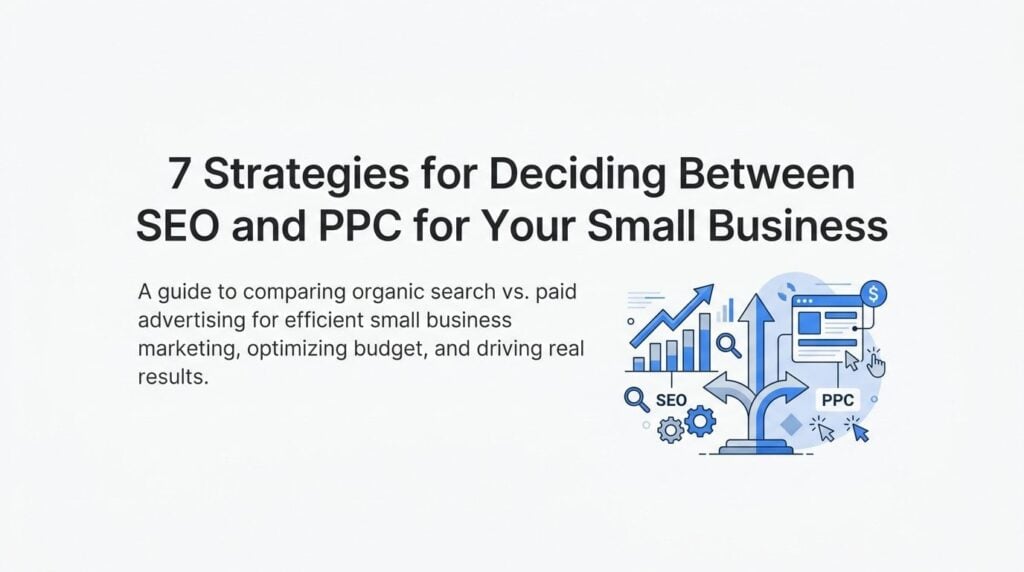
Most small business owners frame this as a competition: SEO vs. PPC, pick one. That framing costs them money.
The real question is which channel fits your situation right now, given your budget, your timeline, and how your customers actually find and hire people like you. A plumber with zero online presence needs a different answer than a wedding photographer building a long-term brand. One needs the phone to ring this week. The other can afford to play the longer game.
This article gives you a decision framework built around real trade-offs, not generic advice. Each strategy below is designed to help you think through the choice clearly, so you put your marketing dollars where they produce booked jobs, not just traffic reports.
1. Start With Your Timeline, Not Your Budget
The Challenge It Solves
Most owners approach this as a budget question. How much can I spend? That is actually the second question. The first question is: how soon do I need this to work? Getting that order wrong leads to months of frustration and wasted spend.
The Strategy Explained
PPC can put your phone number in front of buyers within days of launching a campaign. SEO at the local level typically takes 6 to 12 months before it delivers consistent, lower-cost leads. Those are not interchangeable timelines.
If your business is slow right now and you need revenue this quarter, waiting on SEO is a real operational risk. The leads SEO eventually produces are cheaper, but “eventually” does not pay next month’s payroll. On the other hand, if you have steady work coming in and you are thinking about where you want to be two years from now, starting SEO now makes sense precisely because of that ramp time.
Your timeline is the foundational filter. Run every other decision through it first.
Implementation Steps
1. Write down when you need leads to start arriving. This quarter? Next year? Be specific.
2. If your answer is within the next three months, PPC should be your starting point. Build the SEO plan in parallel, but do not depend on it for near-term revenue.
3. If you have a 12-month runway and steady current revenue, you can invest in SEO now and use PPC selectively to fill gaps while organic builds.
Pro Tips
Do not let an agency convince you to start with SEO alone if your business is in a slow period. The 30 to 90 day ramp on a well-run PPC campaign is already meaningful. Waiting 6 to 12 months for SEO to mature during a revenue drought is a risk most small businesses cannot absorb.
2. Map Your Market: Who Is Already Searching and How
The Challenge It Solves
Not every service business attracts the same search behavior. Running the wrong channel for your service type means you are paying to reach people at the wrong moment in their decision, which kills conversion rates regardless of how good your ads or rankings are.
The Strategy Explained
Emergency-need trades attract high-intent searches with almost no comparison shopping. Someone whose basement is flooding at 9 p.m. is not reading blog posts. They are clicking the first credible result that shows a phone number. That is PPC territory. The urgency is real, the window is short, and the buyer is ready to hire immediately.
Planned-purchase services work differently. Someone researching a landscaping redesign or a wedding photographer is going to look at multiple options over days or weeks. They will read reviews, browse portfolios, and compare prices. SEO has time to work here because the buyer is not in crisis mode.
There is also the Map Pack to consider. Roughly 42% of local clicks go to the Map Pack results. For any business with a defined service area, that three-pack is some of the most valuable real estate in local search, and it is driven by local SEO, not paid ads.
Implementation Steps
1. Categorize your primary service: is it emergency-driven, comparison-driven, or somewhere in between?
2. Search your own service category in your market. Note what the results page looks like. Is it dominated by ads? Is the Map Pack prominent? That tells you where the competition is spending.
3. For emergency services, weight your budget toward PPC. For planned purchases, SEO and Map Pack optimization deserve a larger share of your attention.
Pro Tips
Seasonal businesses often have a version of both dynamics. A roofing company might get emergency calls after a storm and planned replacement inquiries in spring. Consider running PPC aggressively during peak urgency periods and building SEO to capture the longer-consideration traffic year-round.
3. Do the Cost-Per-Lead Math Before You Commit
The Challenge It Solves
Owners often react to CPL numbers without context. Forty dollars a lead sounds expensive until you know a booked job is worth two thousand dollars. The math only works when you connect CPL to job value and close rate.
The Strategy Explained
Home services Google Ads campaigns typically run a CPL of $18 to $35. Local SEO at the 12-month mark typically brings that down to $7 to $15. Neither number tells you anything useful on its own.
Here is the calculation that matters. Take your average job value, multiply it by your close rate on inbound leads, and that gives you your revenue per lead. If your average job is $800 and you close 40% of inbound leads, each lead is worth $320 in revenue. A $30 CPL from Google Ads is extremely profitable at that math. A $15 CPL from SEO is even better, but only after the 12-month ramp.
The other cost to account for with SEO is the upfront investment. Content, technical work, and link building cost money before the leads arrive. PPC costs are pay-as-you-go. Neither is inherently cheaper without knowing your specific numbers.
Implementation Steps
1. Calculate your average job value and your typical close rate on inbound phone leads.
2. Divide your revenue per lead by a realistic CPL for your channel of choice. If that ratio is above 5:1, the channel is worth testing.
3. Factor in the time-to-return for SEO. If you spend $3,000 on SEO setup and leads do not arrive for nine months, account for that in your total cost calculation.
Pro Tips
Remember that 40 to 70% of home service leads arrive by phone. Your ability to answer those calls and convert them matters as much as your CPL. A great CPL with a poor call-handling process is still a losing equation.
4. Use PPC to Test Markets Before Investing in SEO
The Challenge It Solves
SEO requires months of investment before you know whether a service line or market is actually worth pursuing. Committing that time and budget to the wrong terms is an expensive mistake that is slow to diagnose.
The Strategy Explained
Running 60 to 90 days of paid search before committing SEO resources gives you real conversion data. You learn which service terms actually produce calls, not just clicks. You see which geographic areas convert. You find out which ad angles resonate with buyers in your market.
This is especially valuable when you are considering expanding into a new service line or a new city. Instead of guessing which keywords to build content around, you run ads against your target terms, watch what converts, and then build your SEO strategy around confirmed winners. It turns SEO from a bet into a more informed investment.
The data you collect from PPC, specifically which keywords drove calls and which did not, directly informs your content priorities, your service page structure, and where to focus link-building efforts.
Implementation Steps
1. Before launching an SEO campaign for a new service or market, run a targeted PPC campaign for 60 to 90 days with proper call tracking in place.
2. Identify which keyword groups drove actual phone calls, not just form fills or clicks.
3. Use those converting terms as the foundation for your SEO content and service page strategy. You are now optimizing for terms you know work, not terms you assume work.
Pro Tips
For multi-location expansion, this approach is particularly useful. Testing a new market with PPC before building out local SEO infrastructure saves you from investing heavily in a geography that may not convert the way you expected.
5. Protect Your Brand Position With Both Channels
The Challenge It Solves
Many business owners assume that strong SEO rankings protect them from competitors. They do not. Competitors can bid on your business name in Google Ads and appear above your organic listing, intercepting customers who were already looking specifically for you.
The Strategy Explained
This is one of the most overlooked reasons to run at least a minimal PPC presence even when your SEO is strong. Branded search campaigns, meaning ads triggered by searches that include your business name, are typically very low cost because your quality score on your own brand terms is high. The clicks are cheap, and the intent is as warm as it gets.
Without a branded campaign, a competitor can show up above your organic listing when someone searches your name. That customer came looking for you and found your competitor first. That is a real loss, and it happens regularly in competitive local markets.
Branded PPC is not about generating new demand. It is about protecting the demand that already exists for your business specifically.
Implementation Steps
1. Search your own business name in Google and check whether competitors are running ads against it.
2. If they are, or if your market is competitive enough that they might, set up a branded campaign with a modest daily budget. The cost is usually low relative to the protection it provides.
3. Monitor impression share on branded terms. If you are losing branded impressions to competitors, increase your branded bid.
Pro Tips
This strategy also applies in reverse. If you are in a market with a dominant competitor, bidding on their brand name is a legal and common tactic to capture buyers who are comparison shopping. It is worth knowing your competitors may be doing this to you whether or not you are doing it to them.
6. Match Your Channel to Your Competitive Environment
The Challenge It Solves
Generic advice about SEO vs. PPC ignores the fact that the same channel performs very differently depending on how competitive your local market is. What works in a rural county can fail completely in a major metro.
The Strategy Explained
In a saturated local market, breaking into the top organic positions takes longer and requires more content authority and more inbound links than most small businesses can build quickly. PPC gives you visibility immediately regardless of how new your domain is or how few backlinks you have. In a dense market, PPC is often the only realistic way to be visible in the short term.
In a smaller or less competitive market, SEO can rank faster and deliver cheaper leads because fewer competitors are doing the work. The same effort that might take two years to pay off in a major city could produce results in four to six months in a mid-size market.
High-cost-per-click trades like roofing and HVAC make this calculus particularly important. When paid clicks run expensive, organic rankings become more financially valuable over time because you are not paying per click for traffic you own. The harder and more expensive PPC is in your vertical, the more valuable a strong organic position becomes.
Implementation Steps
1. Search your primary service keywords in your market and count how many established competitors appear in the organic results and Map Pack.
2. Run a keyword tool or ask an agency to pull average CPCs for your target terms. High CPCs in your vertical are a signal that organic rankings are worth the investment.
3. In competitive markets, use PPC for immediate visibility while building SEO over 12 to 18 months. In less competitive markets, you may be able to rely more heavily on SEO sooner.
Pro Tips
Do not benchmark your SEO timeline against what someone in a different market experienced. A roofing company ranking in six months in a small market tells you nothing about what to expect in a large metro. Get a realistic assessment based on your actual competitive environment before committing to a timeline.
7. Build Toward Both, Even If You Start With One
The Challenge It Solves
The framing of SEO vs. PPC as a permanent choice leads owners to underinvest in one channel while the other matures, then scramble when circumstances change. A business that relies entirely on PPC is exposed to rising costs and algorithm shifts. A business that relies entirely on SEO is exposed to ranking drops and seasonal gaps.
The Strategy Explained
The strongest local service businesses do not choose permanently. They use PPC for immediate lead volume while SEO matures, then shift budget as organic starts producing. That is not hedging. It is sound resource allocation across different time horizons.
The recommended marketing spend of 8 to 12% of revenue needs to be allocated strategically across growth stages. Early on, that budget might be weighted 80% toward PPC and 20% toward SEO foundations. As organic rankings develop and leads start arriving from search, the ratio shifts. Eventually, many businesses find they can reduce PPC spend in areas where their SEO is strong and redirect that budget to new markets or new service lines.
Each channel also covers the other’s weaknesses. PPC stops producing the moment you stop spending. SEO builds an asset that keeps delivering even when your ad budget is paused. Together, they create a more resilient lead system than either one alone.
Implementation Steps
1. Set a total marketing budget as a percentage of your current revenue, targeting the 8 to 12% range as a starting point.
2. Allocate that budget based on your current growth stage. If you need leads now, weight heavily toward PPC. If you have lead volume and are building for the long term, start funding SEO in parallel.
3. Review the allocation every six months. As SEO begins delivering leads, adjust the ratio rather than keeping it fixed.
Pro Tips
Resist the urge to cut PPC entirely the moment SEO starts working. Organic rankings can drop. Algorithm updates happen. Keeping a baseline PPC presence means you have a lever to pull quickly if your organic visibility takes a hit.
The Bottom Line
There is no universal right answer between SEO and PPC. There is only the right answer for your business at this stage of growth.
If you need leads now, PPC gets you moving. If you are building for the long term and can absorb a 6 to 12 month ramp, SEO compounds into your lowest-cost lead source over time. Most established service businesses end up running both, because each one covers the other’s weaknesses in ways that matter when your revenue is on the line.
The goal is not to pick a winner. The goal is to book more jobs at a cost that keeps your margins intact. That requires being honest about your timeline, your market, your job value, and where your competitors are already winning.
Tired of spending money on marketing that does not produce real revenue? We build lead systems that turn traffic into qualified leads and measurable sales growth. If you want to see what this would look like for your business, we will walk you through how it works and break down what is realistic in your market.