You’re watching the numbers tick up in your ad dashboard. Clicks are coming in. Traffic is flowing. Your cost-per-click looks reasonable. But when you check your actual conversions? Crickets. Or worse—just enough to keep you hoping, but nowhere near enough to justify what you’re spending.
Here’s the uncomfortable truth: your landing page is probably costing you more money than your ad budget is. Every visitor who clicks through and bounces represents wasted ad spend. Every form that gets abandoned is a lead you paid for but never captured. Every confused visitor who can’t figure out what to do next is revenue walking out the door.
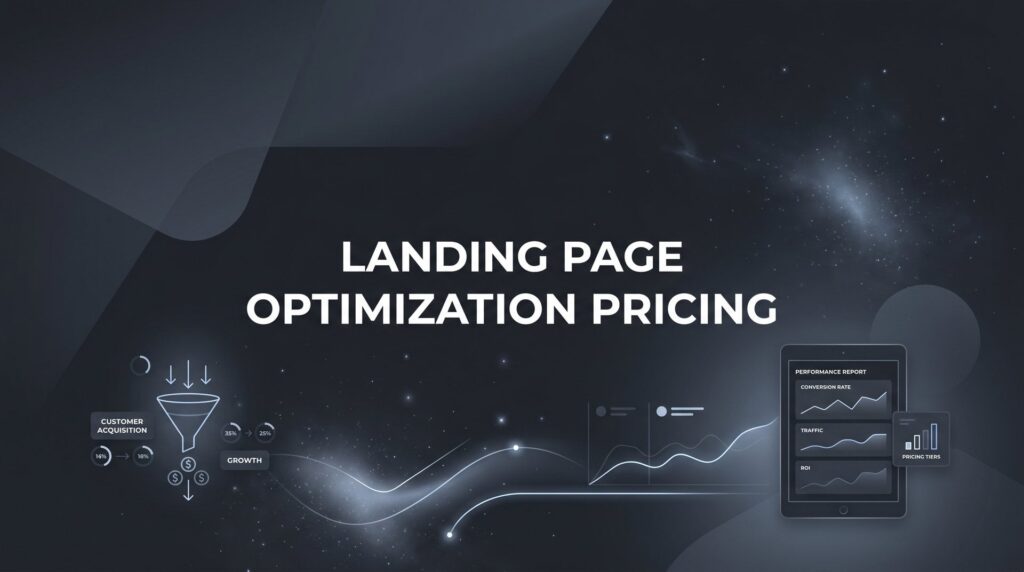
Landing page optimization isn’t some luxury reserved for enterprise companies with massive budgets. It’s the difference between profitable marketing and throwing money into a black hole. But when you start looking into getting your pages optimized, you hit the pricing question—and suddenly you’re drowning in options ranging from $500 to $50,000, with no clear way to figure out what you actually need or what makes sense for your business.
Let’s cut through the confusion. We’re going to break down exactly what different pricing models look like, what drives costs up or down, and most importantly, how to calculate whether the investment will actually pay off for your specific situation.
Why Your Landing Page Is Either Making or Breaking Your Ad Spend
Think of your landing page as the cashier at your store. You can drive all the foot traffic in the world, but if the person at the register is rude, slow, or confusing, people will walk out without buying. Your landing page is that cashier—and it’s working 24/7.
The math here is brutally simple. Let’s say you’re spending $5,000 per month on ads, getting 1,000 clicks at $5 each, and converting at 2%. That’s 20 conversions. If your average customer value is $500, you’re generating $10,000 in revenue from $5,000 in ad spend. Solid 2X return.
Now increase that landing page conversion rate to 4%—just two percentage points. Same ad spend, same traffic, but now you’re getting 40 conversions. That’s $20,000 in revenue from the same $5,000 investment. You just doubled your ROI without spending an extra dollar on advertising.
This is why landing page optimization isn’t optional—it’s the highest-leverage improvement you can make to your marketing. But most businesses don’t realize they have a problem until they start seeing the symptoms.
High bounce rates: When 60-70% of your paid traffic hits your page and immediately leaves, you’re literally paying for people to not engage with your business.
Low time on page: If visitors are spending 15 seconds on your page before bouncing, they’re not reading your copy, understanding your offer, or getting anywhere near a conversion decision.
Form abandonment: People start filling out your contact form but bail halfway through. This is one of the most expensive problems because these visitors were ready to convert—something in your process stopped them.
The “lots of clicks, no conversions” nightmare: Your ad campaigns are driving traffic, but that traffic isn’t turning into leads or sales. This is the classic sign that your ads are working but your landing page isn’t converting.
Here’s what makes landing page optimization such a powerful investment: the compounding effect. Unlike ad spend that stops working the moment you turn off the campaign, an optimized landing page keeps delivering returns month after month. Fix your conversion rate once, and every future visitor benefits from that improvement. Your cost-per-acquisition drops permanently. Your ROI on ad spend improves permanently.
This is why businesses that invest in optimization early tend to outpace competitors who just keep throwing more money at ads. They’re not spending more—they’re converting better.
The Four Main Pricing Models You’ll Encounter
When you start shopping for landing page optimization services, you’ll quickly discover that pricing structures vary wildly. Understanding these models helps you evaluate what you’re actually paying for and whether it aligns with your goals.
Project-Based Pricing: This is the one-time optimization package. An agency or freelancer audits your current landing page, develops hypotheses for improvement, implements changes, and runs initial tests. You’ll typically see packages ranging from $1,500 for basic optimization of a simple page to $15,000+ for comprehensive overhauls of multiple pages with extensive testing.
The advantage here is predictable costs and clear deliverables. You know exactly what you’re getting and what you’re paying. The downside? Optimization isn’t really a one-and-done activity. Markets change, audiences evolve, and what works today might not work in six months. Project-based work gives you a starting point but doesn’t account for ongoing refinement.
Monthly Retainer Models: This is ongoing optimization with continuous testing and improvement. Retainers typically range from $500 per month for basic monitoring and quarterly tests to $5,000+ per month for high-traffic sites with frequent multivariate testing, detailed analytics, and strategic consultation.
The pricing usually scales with your traffic volume and testing frequency. A site getting 10,000 monthly visitors can run meaningful tests relatively quickly. A site with 1,000 monthly visitors needs longer test cycles to reach statistical significance, which affects how much active work can happen each month.
Monthly retainers make sense when you have consistent traffic and want continuous improvement. You’re not just getting one optimization—you’re getting an ongoing process of hypothesis testing, data analysis, and incremental gains that compound over time. For a deeper breakdown, check out our guide on conversion optimization agency pricing.
Performance-Based Pricing: Some agencies tie their fees directly to conversion improvements. These deals typically work one of two ways: a lower base fee plus bonuses tied to conversion rate increases, or pure performance fees where you pay a percentage of additional revenue generated.
Sounds great in theory—you only pay when you get results. But read the fine print carefully. Some performance deals are tied to metrics that don’t actually matter to your business. An agency might optimize for “conversions” without distinguishing between qualified leads and junk submissions. Or they might focus on increasing form submissions while your actual sales close rate tanks because lead quality dropped.
The best performance-based arrangements tie compensation to metrics that actually impact your revenue: qualified leads, sales, or customer lifetime value. But these require sophisticated tracking and clear definitions of what counts as success.
Hybrid Approaches: Many agencies now offer combinations—a moderate base fee that covers core optimization work, plus performance bonuses that reward exceptional results. For example, $2,000/month base plus 10% of incremental revenue generated above your baseline.
This model aligns incentives better than pure project-based or pure performance deals. The agency has guaranteed revenue to cover their costs and invest in your success, but they also benefit directly when your conversions improve. You get committed service without paying premium rates for mediocre results.
The pricing model that makes sense for you depends on your traffic level, testing capacity, and how much ongoing attention your pages need. A simple lead generation page for a local service business might only need project-based optimization. An e-commerce site with thousands of daily visitors benefits from continuous testing and refinement.
What Actually Drives the Price Tag Up or Down
Not all landing pages cost the same to optimize. Several factors significantly impact what you’ll pay—and understanding these helps you evaluate whether a quote is reasonable or inflated.
Traffic volume and testing capacity: This is the biggest driver of both cost and timeline. If your page gets 10,000 visitors per month with a 2% conversion rate, you’re working with 200 conversions monthly. Running an A/B test for landing pages to detect a 20% improvement requires roughly 1,000 visitors per variation to reach statistical significance. That means you can run meaningful tests relatively quickly.
But if your page only gets 1,000 visitors per month with the same 2% conversion rate, you’re working with 20 conversions monthly. Now that same test needs to run for 10 months to gather enough data. This affects how agencies price their work—lower traffic means slower testing cycles, which means fewer optimizations per month, which often means lower monthly fees but longer timelines to results.
Higher traffic sites can run more aggressive testing programs, which requires more resources for analysis, design variations, and strategic oversight. This drives costs up, but the potential ROI is also much higher because improvements impact more visitors.
Current page condition: Starting from a blank slate versus optimizing an existing page requires vastly different effort levels. If you need a complete landing page built from scratch—strategy, copywriting, design, development, and testing framework—you’re looking at the high end of pricing ranges. Understanding landing page design cost separately can help you budget appropriately.
If you already have a decent landing page that just needs refinement, the work involves auditing what’s there, identifying specific friction points, and testing targeted improvements. This is typically less expensive because the foundation exists.
The worst-case scenario? A page that’s so broken it needs to be rebuilt but has enough traffic that you can’t just replace it without careful testing. This requires running parallel tests, gradual rollouts, and sophisticated tracking to ensure improvements don’t accidentally tank your conversions. This complexity drives costs up significantly.
Industry complexity and compliance requirements: Optimizing a landing page for a local restaurant is straightforward. Optimizing a landing page for a healthcare provider requires understanding HIPAA compliance, medical advertising regulations, and industry-specific trust signals that actually matter to patients.
Financial services, healthcare, legal services, and other regulated industries demand specialized expertise. The copywriter needs to understand what claims you can and can’t make. The designer needs to know what trust elements are non-negotiable. The testing process needs to account for compliance review cycles.
This specialized knowledge commands premium rates. Expect to pay 30-50% more for optimization in regulated industries compared to general e-commerce or lead generation. But this premium is worth it—a compliance violation can cost you far more than you’d save on cheaper optimization.
DIY vs. Agency vs. Freelancer: Comparing Your Options
You’ve got three main paths for getting your landing pages optimized. Each has real costs—some obvious, some hidden—and understanding these trade-offs helps you make the right choice for your situation.
The DIY route: Tools like Unbounce, Leadpages, and various A/B testing platforms offer free trials or affordable monthly plans starting around $50-$100. You can technically optimize your own pages without paying anyone else.
But factor in the real costs. First, there’s the learning curve. You’ll spend 20-40 hours learning the tools, understanding CRO principles, and figuring out what to test. If your time is worth $100/hour (and if you’re a business owner, it probably is), that’s $2,000-$4,000 in opportunity cost before you run a single test.
Then there’s the testing timeline. Without expertise, you’ll likely test the wrong things first, waste time on changes that don’t move the needle, and take 6-12 months to achieve results that an expert could deliver in 2-3 months. During those extra months, you’re leaving money on the table with suboptimal conversion rates. Our comparison of landing page optimization tools vs agency services breaks this down in detail.
DIY makes sense if you’re pre-revenue or have minimal traffic. You’re learning valuable skills, and the opportunity cost of your time is lower. But once you’re spending real money on advertising, the opportunity cost of slow optimization usually exceeds the cost of hiring expertise.
Freelancer rates and expectations: CRO freelancers typically charge $50-$200 per hour depending on experience and specialization. A basic landing page optimization project might run 10-20 hours ($500-$4,000), while comprehensive optimization with multiple testing cycles could be 40-80 hours ($2,000-$16,000).
The advantage of freelancers is flexibility and often lower overhead compared to agencies. You’re paying for expertise without the agency markup. The challenge is that one person rarely has deep expertise across copywriting, design, analytics, and strategic CRO. You might get great copy but mediocre design, or solid analytics but weak strategic thinking.
Freelancers work best when you have a specific, well-defined optimization need. If you know exactly what you want tested and just need someone to execute, a skilled freelancer can deliver excellent results at reasonable rates. But if you need comprehensive strategy and don’t know where to start, you might end up paying for execution without getting the strategic insight that drives real results.
Full-service agency advantages: Agencies bring integrated teams—strategists, copywriters, designers, developers, and analysts working together. This coordination matters because effective landing page optimization isn’t just about one element. You need copy that aligns with design, design that supports the conversion path, analytics that track the right metrics, and strategy that ties it all together.
Agencies typically charge $3,000-$15,000 for project-based optimization or $1,500-$5,000+ monthly for retainer relationships. Yes, it’s more expensive than freelancers. But you’re paying for coordinated expertise and faster results. Explore our roundup of the best landing page optimization services to see what top providers offer.
The premium makes sense when you’re spending significant money on advertising and conversion improvements directly impact substantial revenue. If you’re spending $10,000+ monthly on ads, paying an agency $5,000 for optimization that increases conversions by 30% pays for itself in the first month and keeps delivering returns indefinitely.
Agencies are overkill if you’re just starting out with minimal traffic. But once you’ve validated your market and you’re ready to scale, the coordinated expertise usually delivers better results faster than trying to coordinate multiple freelancers or struggling through DIY.
Calculating Whether the Investment Will Actually Pay Off
Here’s the question that actually matters: will spending money on landing page optimization generate more revenue than it costs? Let’s break down the math so you can evaluate any optimization investment with clear eyes.
Start with your current numbers. Let’s say you’re spending $10,000 per month on advertising, driving 2,000 clicks to your landing page, converting at 3%, and each customer is worth $400. That’s 60 customers per month generating $24,000 in revenue from $10,000 in ad spend. Your cost-per-acquisition is $167.
Now let’s say you invest $5,000 in landing page optimization and achieve a 25% improvement in conversion rate—moving from 3% to 3.75%. Same traffic, same ad spend, but now you’re getting 75 conversions instead of 60. That’s $30,000 in revenue instead of $24,000.
The optimization paid for itself in the first month ($6,000 additional revenue minus $5,000 cost equals $1,000 profit). But here’s where it gets interesting: that improvement doesn’t disappear after month one. In month two, you generate another $6,000 in incremental revenue. Month three, another $6,000. Over a year, that one-time $5,000 investment generates $72,000 in additional revenue.
This is why landing page optimization delivers such exceptional ROI compared to most marketing investments. The improvement compounds month after month. Understanding how to optimize landing pages for conversions helps you maximize these gains.
But not every business is ready for this investment. Here are the red flags that suggest you should wait:
Insufficient traffic: If you’re getting fewer than 500 visitors per month to your landing page, you don’t have enough volume to run meaningful tests in a reasonable timeframe. Focus on driving more traffic first, then optimize conversion.
Unclear value proposition: If you haven’t validated that your market actually wants what you’re selling, no amount of optimization will fix fundamental product-market fit problems. Make sure you have proof of concept before investing in optimization.
Broken tracking: If you can’t accurately measure your current conversion rate and attribute conversions to specific traffic sources, you can’t measure whether optimization is working. Fix your analytics foundation before spending money on optimization.
What about realistic expectations? Typical conversion rate improvements range from 10-50% depending on your starting point and industry. If you’re currently converting at 1% and your page has obvious problems, doubling to 2% is achievable. If you’re already at 8% with a well-designed page, squeezing out another 10-15% improvement is a win.
The businesses that see the biggest gains are usually those with decent traffic but poorly optimized pages. They’re converting at 1-3% when their industry average is 5-8%. There’s clear room for improvement, and the low-hanging fruit delivers quick wins.
Questions to Ask Before Signing Any Contract
Before you commit to any landing page optimization service, get crystal clear on exactly what you’re paying for. These questions help you avoid misunderstandings and ensure you’re getting value for your investment.
What specific deliverables are included? Don’t accept vague answers like “landing page optimization.” Get specific: How many page variations will be tested? How many design iterations are included? What’s the reporting frequency? How many revision rounds can you request? Will you get access to the testing data and insights, or just summary reports?
A good provider will outline exactly what you’re getting: initial audit and analysis, X number of hypothesis-driven tests, weekly or monthly reporting, access to analytics dashboards, and specific deliverables like updated copy, design files, or implementation support.
What’s the timeline and when should we expect results? Optimization isn’t instant. Depending on your traffic volume, meaningful test results might take 2-8 weeks per test cycle. Ask for a realistic timeline with milestones: when will the audit be complete, when will first tests launch, when should you expect to see measurable improvements?
Be skeptical of anyone promising dramatic results in unrealistic timeframes. If you’re getting 1,000 visitors per month, nobody can deliver statistically significant results in two weeks—the math doesn’t work. Honest providers set realistic expectations based on your traffic and current performance.
How will progress be tracked and reported? You need visibility into what’s being tested, what results are emerging, and how decisions are being made. Ask about reporting cadence (weekly, monthly?), what metrics will be tracked, and how you’ll collaborate on test prioritization.
Good providers offer regular reporting that includes not just “conversion rate increased by X%” but the strategic thinking behind tests, what was learned from failures, and recommendations for next steps. You should understand why certain tests are being prioritized and how the work connects to your business goals. Following best practices for landing pages ensures you’re asking the right questions.
Who owns the optimized assets and test data? This matters more than you might think. If the relationship ends, do you keep the optimized page designs, copy, and testing insights? Or does the provider retain ownership and you’re back to square one?
Make sure the contract specifies that you own all deliverables—design files, copy, analytics data, and strategic insights. You’re paying for this work; you should own the results.
What happens if results don’t meet expectations? Not every optimization effort succeeds immediately. Markets are unpredictable, and sometimes hypotheses don’t pan out. Ask what recourse you have if results fall short: Will they continue testing at no additional cost? Is there a performance guarantee? What defines success versus failure?
The best providers stand behind their work with clear success metrics and commitments to continue iterating until you see meaningful improvement. Be wary of anyone who won’t discuss what happens if initial tests don’t deliver results.
Putting It All Together
Landing page optimization pricing varies wildly because the service itself varies wildly. A basic one-time optimization of a simple page costs dramatically less than comprehensive, ongoing conversion rate optimization for a high-traffic site with complex customer journeys.
The right investment level for your business depends on three critical factors: your current traffic volume, your baseline conversion rate, and your growth goals. If you’re spending serious money on advertising but converting poorly, optimization isn’t an expense—it’s the highest-ROI investment you can make. Every percentage point improvement in conversion rate multiplies the return on every dollar you spend on marketing.
But if you’re just starting out with minimal traffic, focus on driving volume first. Once you have enough visitors to run meaningful tests, then invest in optimization to maximize the value of that traffic.
The businesses that win aren’t necessarily those spending the most on advertising. They’re the ones converting the highest percentage of the traffic they already have. They’ve stopped guessing about what works and started testing systematically. They’ve invested in making their landing pages into conversion machines that turn paid traffic into profitable customers.
If you’re tired of watching ad spend disappear into landing pages that don’t convert, it’s time to stop hoping and start optimizing. The math is simple: improve your conversion rate, and every marketing dollar works harder. If you want to see what this would look like for your business, we’ll walk you through how it works and break down what’s realistic in your market. No guessing, no generic advice—just a clear picture of what professional optimization could mean for your bottom line.
Want More Leads for Your Business?
Most agencies chase clicks, impressions, and “traffic.” Clicks Geek builds lead systems. We uncover where prospects are dropping off, where your budget is being wasted, and which channels will actually produce ROI for your business, then we build and manage the strategy for you.