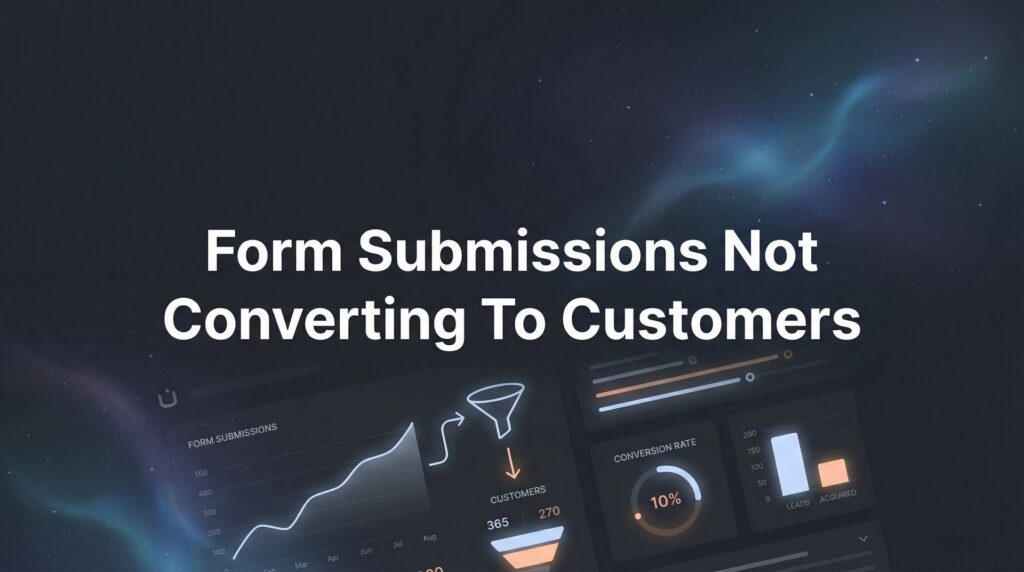
You’re getting form submissions. Your ads are working. People are filling out your contact forms. But then… nothing. They ghost you. They say they’re “just looking.” They go with a competitor.
Sound familiar?
This is one of the most frustrating problems local business owners face: the gap between someone raising their hand and actually becoming a paying customer. The truth is, most businesses lose a massive percentage of their leads somewhere between the form submission and the sale—not because their service is bad, but because their follow-up process is broken.
Think about it. You’re paying for ads. You’ve optimized your landing pages. You’re generating traffic. But if those form submissions aren’t turning into revenue, you’re essentially pouring money into a bucket with a hole in the bottom.
In this guide, we’ll walk through seven battle-tested strategies that transform form submissions into real revenue. These aren’t theoretical concepts—they’re the same approaches we use at Clicks Geek to help local businesses stop bleeding leads and start closing more deals.
1. Respond Within 5 Minutes (Or Lose the Lead)
The Challenge It Solves
Here’s what happens when someone fills out your form: they’re actively shopping. Right now. They’ve probably got three other tabs open with your competitors. They’re comparing options, and whoever responds first has a massive advantage.
When you wait hours—or worse, days—to respond, you’re not just being slow. You’re telling that prospect their business doesn’t matter. Meanwhile, your competitor who responded in ten minutes is already building rapport and booking the appointment.
The Strategy Explained
Speed-to-lead is the single biggest factor in converting form submissions. The difference between responding in five minutes versus responding in an hour can cut your conversion rate in half. This isn’t about being pushy—it’s about being present when the prospect is actually engaged and ready to talk.
The goal is simple: make contact while they’re still thinking about their problem. When someone submits a form, they’re in problem-solving mode. They’re motivated. That motivation decays rapidly. After an hour, they’ve moved on to other tasks. After a day, they’ve forgotten they even filled out your form.
Set up instant notifications that alert your sales team the moment a form comes in. This could be a text message, a Slack notification, or an email alert—whatever ensures someone sees it immediately. Then make the call or send the initial response within five minutes, every single time.
Implementation Steps
1. Configure your form platform to send instant alerts to your sales team via text message or push notification, not just email.
2. Create a rotation system so someone is always responsible for immediate follow-up during business hours.
3. Build a quick-response template that can be personalized in under 60 seconds for initial contact.
4. Track your actual response times in your CRM and hold your team accountable to the five-minute standard.
Pro Tips
If you can’t staff rapid response during all business hours, consider using automated SMS confirmation that sets expectations: “Thanks for your request! We’ll call you within 15 minutes.” This buys you a little breathing room while still acknowledging the lead immediately. Just make sure you actually follow through on that promise.
2. Qualify Leads Before They Hit Your Inbox
The Challenge It Solves
Not all form submissions are created equal. Some people are ready to buy tomorrow. Others are collecting quotes for a project six months away. Some are genuinely interested in your service. Others are competitors doing research or students working on school projects.
When you treat every lead the same, you waste time chasing people who were never going to buy, while serious prospects get lost in the noise. Your sales team gets demoralized following up with tire-kickers, and your actual buyers don’t get the attention they deserve.
The Strategy Explained
Strategic qualifying questions on your forms help you separate serious buyers from browsers before anyone picks up the phone. This doesn’t mean creating a ten-question interrogation that kills conversions. It means adding two or three smart questions that reveal intent and timeline.
The right qualifying questions accomplish two things: they help you prioritize which leads to contact first, and they give your sales team context before they make the call. When you know someone is planning to start a project within 30 days and has a budget in mind, you approach that conversation very differently than someone who’s “just exploring options.”
This also improves the prospect’s experience. When you call already knowing their situation, you sound prepared and professional. If you’re struggling with not enough qualified leads, better form qualification is often the fastest fix.
Implementation Steps
1. Add a timeline question to your form: “When are you looking to get started?” with options like “ASAP,” “Within 30 days,” “1-3 months,” “Just researching.”
2. Include a budget or project scope question appropriate to your industry to identify serious buyers versus casual browsers.
3. Create a lead scoring system that assigns priority levels based on responses (hot, warm, cold).
4. Route high-priority leads to your best closers and handle low-priority leads through automated nurture sequences.
Pro Tips
Don’t ask about budget directly if it makes prospects uncomfortable. Instead, ask about project scope or service level. Someone selecting “full-service package” is showing much higher intent than someone selecting “basic consultation.” You’ll get the same information without the awkward money question.
3. Build a Multi-Touch Follow-Up Sequence
The Challenge It Solves
Most businesses make one or two attempts to reach a lead, then give up. They call once, maybe send one email, and when they don’t get a response, they assume the lead is dead. This is leaving money on the table.
The reality is that most sales require multiple touchpoints before conversion. People are busy. They miss calls. Emails get buried. They need time to think. A single attempt isn’t follow-up—it’s barely an introduction.
The Strategy Explained
A systematic follow-up sequence keeps you top-of-mind with prospects over time without being annoying. This means creating a planned cadence of calls, texts, and emails that spans seven to fourteen days, with each touchpoint adding value rather than just saying “checking in.”
The key is varying your approach and your message. Your first contact might be a phone call. Your second might be a text with a link to a helpful resource. Your third might be an email with a case study relevant to their industry. Each touch gives them a different reason to engage and a different channel to respond through.
This isn’t about pestering people. It’s about being persistent and professional. You’re demonstrating that you’re organized, that you follow through, and that you’re genuinely interested in helping them solve their problem.
Implementation Steps
1. Map out a 7-14 day sequence with specific touchpoints: Day 1 (call + email), Day 2 (text), Day 4 (call), Day 7 (email with value), Day 10 (final call), Day 14 (final email).
2. Create templates for each touchpoint that can be quickly personalized with the prospect’s specific situation.
3. Use your CRM to automate reminders and track which touchpoints have been completed for each lead. Understanding your customer acquisition funnel helps you identify where leads typically drop off.
4. Include varied content in each touch: helpful resources, case studies, answers to common questions, not just “following up.”
Pro Tips
Track which touchpoint typically gets the response. You might discover that your Day 7 email consistently gets replies, or that text messages have a higher response rate than calls. Use this data to optimize your sequence over time. What works in one market or industry might not work in another.
4. Match Your Offer to the Buyer’s Stage
The Challenge It Solves
Here’s a common mistake: treating someone who’s ready to buy exactly the same as someone who’s just starting their research. You call both of them with the same pitch, ask for the same commitment, and wonder why one converts and the other disappears.
When you push for a sale too early, you scare off prospects who need more time. When you move too slowly with ready buyers, they go with a competitor who’s more decisive. The mismatch between where they are and what you’re asking for kills conversions on both ends.
The Strategy Explained
Different stages of the buying journey require different responses. Someone who says they’re “just researching” doesn’t want a sales pitch—they want information. Someone who says they’re “ready to start this week” doesn’t want to be nurtured with a six-email sequence—they want pricing and availability.
Your initial response should match their stated timeline and intent. For early-stage prospects, offer educational content, free consultations, or resources that help them make an informed decision. For late-stage prospects, get straight to logistics: pricing, availability, next steps.
This approach builds trust because you’re meeting people where they are. Investing in customer journey mapping can help you understand exactly what each buyer stage needs from you.
Implementation Steps
1. Create three distinct response frameworks: one for “researching” leads, one for “comparing options” leads, and one for “ready to buy” leads.
2. Train your team to identify buying stage signals in the form submission and initial conversation.
3. Develop stage-appropriate offers: free guides for researchers, comparison consultations for evaluators, fast-track proposals for ready buyers.
4. Adjust your follow-up intensity based on buying stage—ready buyers get daily contact, researchers get weekly nurture.
Pro Tips
Pay attention to the language prospects use. Someone who says “I need this done by next month” is in a different stage than someone who says “I’m thinking about doing this eventually.” Let their words guide your approach, not your sales quota.
5. Use Video and Personalization to Stand Out
The Challenge It Solves
Your prospects are getting the same generic responses from every business they contact. The same templated emails. The same scripted phone calls. The same “thanks for your inquiry” messages that could have been sent to anyone.
In a sea of sameness, you’re invisible. When every competitor sounds exactly alike, prospects choose based on price or convenience rather than trust. You need a way to differentiate yourself immediately, before they’ve even had a real conversation with you.
The Strategy Explained
Personalized video responses create an immediate connection that text and phone calls can’t match. When you send a prospect a quick video addressing them by name, referencing their specific situation, and offering tailored advice, you’re doing something 99% of your competitors aren’t.
This doesn’t require expensive equipment or professional editing. A simple 60-90 second video recorded on your phone, where you introduce yourself, acknowledge their specific request, and offer a relevant insight, builds more trust than a dozen templated emails.
The personalization is what matters. Use their name. Reference the specific service they asked about. Mention something from their form submission. Show that a real human reviewed their request and cares about helping them.
Implementation Steps
1. Set up a simple video recording tool (Loom, Vidyard, or even your phone’s camera) that you can use to create quick response videos.
2. Create a basic script framework that you personalize for each prospect: greeting with their name, acknowledgment of their request, one relevant insight, clear next step.
3. Send these videos within your initial response or as a follow-up touchpoint when you haven’t connected by phone.
4. Track response rates on video messages versus traditional emails to measure impact.
Pro Tips
Don’t overthink the production quality. Authentic beats polished. A slightly rough video that’s clearly created specifically for them is more effective than a slick generic video that could have been sent to anyone. Just make sure you’re in a quiet space with decent lighting and you’re looking at the camera.
6. Track Every Lead Through Your Pipeline
The Challenge It Solves
You know leads are falling through the cracks, but you don’t know where or why. Some leads never get followed up. Others get contacted but never move forward. Some ghost after the initial conversation. Without visibility into your pipeline, you’re guessing at what’s broken.
This lack of tracking means you can’t identify patterns, can’t hold your team accountable, and can’t fix the actual problems in your conversion process. You’re flying blind, making decisions based on gut feel rather than data.
The Strategy Explained
A proper CRM system tracks every lead from form submission through closed sale (or lost opportunity). This visibility shows you exactly where leads are getting stuck, which team members are converting at what rates, and what your actual numbers look like at each stage.
The goal isn’t just tracking for tracking’s sake. It’s identifying the specific breakdowns in your process. Maybe you’re great at initial contact but terrible at follow-up. Maybe you’re losing deals at the proposal stage because your pricing is off. If you’re not tracking marketing conversions properly, you’ll never know which channels actually drive revenue.
This data also lets you forecast revenue, allocate resources, and make intelligent decisions about where to invest your marketing budget. When you know that leads from Google Ads convert at twice the rate of leads from Facebook, you can adjust your spending accordingly.
Implementation Steps
1. Implement a CRM system (even a simple one like Google Sheets if you’re just starting) that tracks every lead through defined stages.
2. Create clear stage definitions: New Lead, Contacted, Qualified, Proposal Sent, Negotiating, Closed Won, Closed Lost.
3. Require your team to update lead status in real-time, not at the end of the week or month.
4. Run weekly reports showing conversion rates at each stage and identify where leads are falling out.
Pro Tips
Add “lost reason” tracking when deals don’t close. Categorize why you lost: price, timing, went with competitor, not a fit, no response. After a month, you’ll see patterns. If 60% of your losses are price-related, you have a pricing or value communication problem. If 60% are “no response,” you have a follow-up problem. The data tells you what to fix.
7. Train Your Team on Consultative Selling
The Challenge It Solves
Many local businesses approach sales as order-taking. Someone calls, you quote a price, they either buy or they don’t. This passive approach leaves money on the table because you’re not uncovering the real needs, you’re not handling objections effectively, and you’re not differentiating yourself from competitors who are quoting the same service.
When your team doesn’t know how to ask good questions, build value, or guide a prospect toward a decision, you end up competing purely on price. Every conversation becomes “how much does it cost?” followed by “I need to think about it.”
The Strategy Explained
Consultative selling means approaching each lead conversation as a discovery process, not a pitch session. Instead of immediately jumping to features and pricing, you ask questions that uncover what the prospect actually needs, what problems they’re trying to solve, and what outcomes matter most to them.
This approach positions you as an advisor rather than a vendor. You’re helping them make the right decision, even if that means recommending a smaller package than they initially inquired about, or explaining why your solution might not be the best fit. This builds trust and dramatically increases conversion rates with qualified prospects.
The key is teaching your team a structured conversation framework: ask about their current situation, understand their goals, identify obstacles, present your solution as the bridge between where they are and where they want to be, and handle objections by addressing the underlying concern rather than just defending your price. If your ads aren’t converting to sales, often the problem isn’t the ads—it’s what happens after the click.
Implementation Steps
1. Develop a discovery question framework that your team uses on every call: current situation, desired outcome, timeline, previous attempts, budget expectations.
2. Create objection-handling scripts for the five most common objections you hear (price, timing, competition, decision-maker access, need to think).
3. Role-play these conversations in team meetings so your salespeople get comfortable with the framework before using it with real prospects.
4. Record and review sales calls to identify where conversations are breaking down and coach your team on improvement areas.
Pro Tips
The best salespeople talk less and listen more. Train your team to ask a question, then stay quiet. Let the prospect talk. The more they share about their situation, the better you can position your solution as exactly what they need. Most sales are lost because the salesperson talked themselves out of the deal, not because the prospect wasn’t interested.
Putting It All Together: Your Lead Conversion Action Plan
Here’s the truth: you don’t need to implement all seven strategies at once. In fact, trying to do everything simultaneously will probably result in doing nothing well. Instead, start with the highest-impact fix first: response time.
Get your speed-to-lead down to five minutes or less. This single change can double your conversion rate overnight. Once that’s consistent, layer in better qualification questions on your forms so you’re prioritizing the right leads. Then build your systematic follow-up sequence so leads don’t slip through the cracks.
After those three fundamentals are solid, focus on the quality of your sales conversations. Train your team on consultative selling. Add personalized video responses. Implement proper CRM tracking so you can see what’s actually working.
Most local businesses can double their lead-to-customer conversion rate within 90 days by implementing these strategies consistently. Think about what that means for your business. If you’re currently converting 10% of your form submissions into customers, getting to 20% means you’re generating twice the revenue from the same marketing spend.
The leads you’re already paying for are worth far more than you’re currently extracting from them. Every form submission represents someone who took the time to reach out. They’re interested. They have a need. They’re comparing options. Your job is to make it easy for them to choose you.
Stop the leak, and your marketing ROI transforms overnight.
Tired of spending money on marketing that doesn’t produce real revenue? We build lead systems that turn traffic into qualified leads and measurable sales growth. If you want to see what this would look like for your business, we’ll walk you through how it works and break down what’s realistic in your market.
Want More Leads for Your Business?
Most agencies chase clicks, impressions, and “traffic.” Clicks Geek builds lead systems. We uncover where prospects are dropping off, where your budget is being wasted, and which channels will actually produce ROI for your business, then we build and manage the strategy for you.