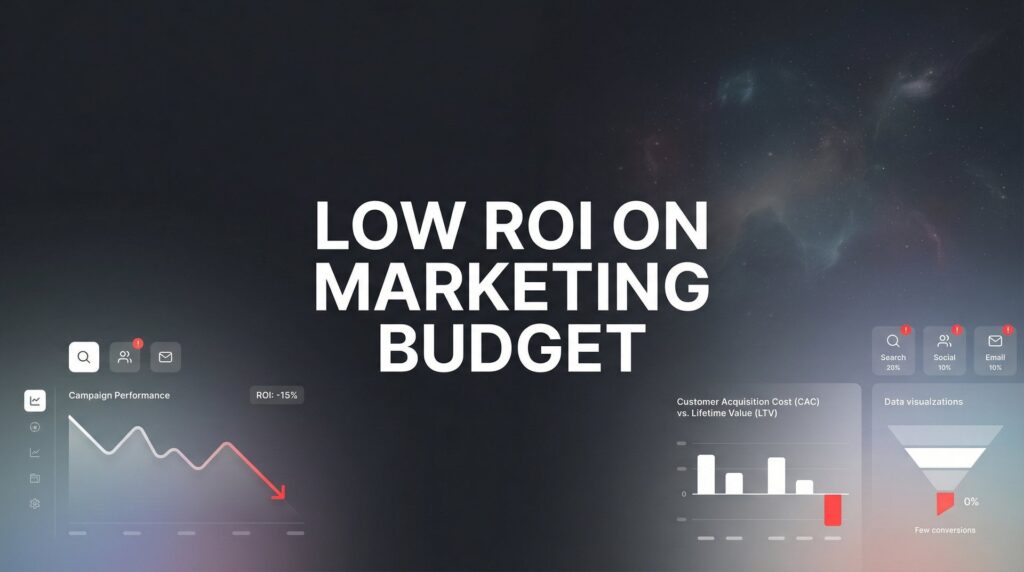
You check your bank statement and see another $3,000 charged to your Google Ads account. Your Facebook campaign just auto-renewed for $1,500. The SEO agency billed you $2,000 for “ongoing optimization.” You’re spending nearly $7,000 this month on marketing, and when you look at your sales pipeline, you can count on one hand how many legitimate leads came from all that spending.
Sound familiar?
You’re not alone. Thousands of business owners are trapped in this exact cycle—watching marketing budgets evaporate while their phones stay quiet and their sales numbers flatline. The frustration isn’t just about the money disappearing. It’s the nagging question that keeps you up at night: “Am I doing something fundamentally wrong, or is marketing just a gamble?”
Here’s the truth that most marketing agencies won’t tell you: low ROI on marketing budget isn’t bad luck, and it’s not because your market is “too competitive” or your product is “hard to sell.” It’s almost always the result of specific, identifiable problems in how your campaigns are structured, targeted, and optimized. The good news? These problems are fixable once you know what to look for.
What you’re about to read isn’t theory. It’s the diagnostic framework we use when business owners come to us after burning through tens of thousands of dollars with nothing to show for it. We’re going to walk through exactly why your marketing isn’t converting, which specific mistakes are bleeding your budget dry, and most importantly, how to turn things around before you waste another dollar.
The Real Cost of Marketing That Doesn’t Convert
When you spend $5,000 on a marketing campaign that generates zero sales, you didn’t just lose $5,000. You lost something far more valuable: the opportunity to invest that money in strategies that actually work while your competitors were capturing customers you should have won.
Think about it this way. While you were running broad-match Google Ads campaigns that attracted tire-kickers and bargain hunters, your competitor was building a laser-focused campaign targeting people ready to buy right now. While you were posting generic content on Facebook hoping something would stick, they were running conversion-optimized campaigns with proper retargeting sequences. Every month you spend on ineffective marketing isn’t just wasted money—it’s ground you’re losing in your market.
This creates what we call the marketing death spiral. Poor ROI leads to reduced confidence in marketing, which leads to cutting budgets, which makes it even harder to compete, which produces even worse results, which further erodes your belief that marketing can work for your business. Before you know it, you’re back to relying solely on referrals and word-of-mouth, watching your growth stagnate while competitors who figured out profitable marketing systems scale past you.
But here’s what really matters: understanding your true marketing ROI, not the vanity metrics that agencies love to report. The calculation is straightforward: take your revenue generated from marketing, subtract your total marketing costs, divide by your marketing costs, and multiply by 100. If you generated $15,000 in revenue from a $5,000 marketing investment, your ROI is 200%. That means for every dollar you spent, you got back three dollars total (your original dollar plus two dollars in profit).
Most businesses have no idea what this number actually is for their marketing. They know how many clicks they got, how many impressions their ads received, how many people visited their website. But they can’t tell you with confidence how much revenue each marketing channel actually generated. Without this fundamental number, you’re flying blind—and that’s exactly where the bleeding starts.
5 Hidden Reasons Your Marketing Budget Is Underperforming
The biggest budget killer we see is the “everyone is my customer” syndrome. When you try to target everyone, you end up connecting with no one. Your messaging becomes generic because you’re trying to speak to 25-year-old first-time buyers and 60-year-old retirees in the same ad. Your budget gets spread across dozens of audience segments, none of which receive enough exposure to actually convert. This spray-and-pray approach feels safe because you’re not “missing anyone,” but it’s precisely why your marketing isn’t working and your conversion rates are abysmal.
The second killer is even more insidious because it feels like success: tracking metrics that don’t matter. Your agency sends you a beautiful report showing 50,000 impressions, 2,500 clicks, and a 5% click-through rate. They’re celebrating. You’re nodding along. But here’s the question that matters: how many of those clicks turned into paying customers? Impressions don’t pay your rent. Clicks don’t cover payroll. Only revenue matters, and if you’re measuring anything else as your primary success metric, you’re optimizing for the wrong outcome.
Third is the landing page disconnect—the conversion killer that most businesses don’t even realize exists. Your ad promises a free consultation for kitchen remodeling. The prospect clicks, excited and ready to talk. They land on your homepage with a generic “Welcome to ABC Construction” message and no clear path to book that consultation. Within three seconds, they’re gone. You just paid $8 for that click, and the disconnect between what you promised and what you delivered killed the conversion before it had a chance.
Fourth is completely misunderstanding the customer journey. You’re running ads for a $10,000 service to people who just discovered you exist five minutes ago. That’s like proposing marriage on the first date. Cold audiences need education and trust-building before they’re ready to make significant buying decisions. When you hit them with aggressive sales pitches immediately, you’re not just wasting money on ads that won’t convert—you’re actively damaging your brand reputation with people who might have become customers if you’d approached them appropriately.
The fifth killer is the set-it-and-forget-it mentality. You launch a campaign, it runs for three months without anyone looking at the data, and you wonder why performance degraded. Markets shift. Competitors change their strategies. Customer behavior evolves. Seasonal factors impact conversion rates. A campaign that was profitable in January might be hemorrhaging money by March, but if nobody’s monitoring and optimizing, you won’t discover the problem until you’ve blown through thousands of unnecessary dollars.
Channel-Specific ROI Killers (And How to Fix Them)
Let’s talk about PPC, because this is where we see the most dramatic budget waste. The worst offender is broad match keywords combined with inadequate negative keyword lists. You bid on “kitchen remodeling” in broad match, thinking you’re capturing everyone interested in kitchen remodels. Instead, you’re paying for clicks from people searching “kitchen remodeling shows on Netflix,” “kitchen remodeling timeline,” and “DIY kitchen remodeling on a budget”—none of whom are ready to hire you. Without a comprehensive negative keyword list constantly updated based on search term reports, you’re essentially paying Google to show your ads to anyone who types words vaguely related to your business.
Then there’s ego bidding—spending premium dollars to rank #1 for your own brand name or bidding on industry terms that make you feel important but generate zero revenue. Yes, it feels good to dominate the search results for “best kitchen remodeler in Chicago,” but if that keyword costs $45 per click and converts at 1%, you’re paying $4,500 to acquire each customer. Meanwhile, longer-tail keywords like “kitchen remodel contractor north Chicago suburbs” might cost $12 per click, convert at 8%, and deliver customers for $150 each. The ego term makes you feel like a big player. The strategic term makes you profitable.
Social media presents different traps, starting with the follower obsession. Building a Facebook page with 10,000 followers feels like an accomplishment until you realize that 95% of them will never see your posts due to algorithm changes, and even fewer will ever buy anything. You spent months and thousands of dollars building an audience that doesn’t convert because you optimized for vanity metrics instead of revenue. The harsh reality is that 500 highly targeted email subscribers who actually want what you sell are worth more than 50,000 social media followers who don’t.
Platform selection kills budgets too. B2B service companies pouring money into Instagram because “everyone’s on social media” while their actual decision-makers are on LinkedIn. Local service businesses running national Facebook campaigns because they didn’t properly configure geographic targeting. E-commerce brands trying to make Pinterest work when their products have zero visual appeal. Understanding the difference between performance marketing and traditional marketing helps you choose the right platform for your business model.
SEO mistakes often fly under the radar because they don’t involve direct ad spend, but they absolutely destroy marketing ROI. The classic error is targeting keywords with zero commercial intent—ranking #1 for “what is kitchen remodeling” when people searching that phrase are in research mode, not buying mode. Or chasing impossibly competitive terms where you’re trying to outrank national brands with million-dollar SEO budgets while you’re spending $2,000 per month. You end up with traffic that doesn’t convert or no rankings at all, and either way, your SEO investment produces nothing.
The ROI Recovery Framework: A Step-by-Step Turnaround
Recovery starts with a brutal, honest audit of exactly where every marketing dollar is going and what it’s producing. Pull your analytics for the last 90 days. For every marketing channel and campaign, you need three numbers: total spend, total revenue generated, and cost per customer acquisition. Not estimates. Not “we think it’s working.” Actual tracked, verified numbers. This is where most businesses discover that the channel they thought was their best performer is actually breaking even or losing money, while a channel they barely paid attention to is quietly generating profitable returns.
The audit reveals uncomfortable truths. That Facebook campaign you’ve been running for eight months? It’s generated 47 leads, but only 3 became customers, and the revenue from those 3 customers doesn’t even cover half of what you spent. That Google Ads campaign? Seventy percent of your budget is going to three keywords that have never converted a single customer. Your email marketing? You’re sending to 5,000 people, but 80% never open your emails, and the deliverability is tanking because you never cleaned your list.
Once you have clarity, the next step is ruthless reallocation. This is where business owners struggle because it requires killing campaigns that “might work eventually” and doubling down on what’s already producing results. If your audit shows that one specific Google Ads campaign is generating customers at $200 each while your target is $300, you don’t “keep testing” the campaigns losing money. You shut them down immediately and move that budget into the profitable campaign. You scale what works and eliminate what doesn’t. Sounds obvious, but most businesses keep feeding budget to underperforming campaigns out of hope or fear of “missing opportunities.”
The final piece is implementing proper conversion tracking that actually reveals truth. Most businesses use last-click attribution, which means they give 100% of the credit to whatever the customer clicked right before buying. This completely ignores the Facebook ad they saw two weeks ago, the email campaign that brought them back to your site three times, and the retargeting ad that reminded them you existed. Multi-touch attribution modeling shows you the real customer journey—how people actually find you, what touchpoints influence their decision, and which marketing activities deserve credit for the sale.
Proper attribution changes everything. You might discover that your “low-performing” Facebook campaigns are actually introducing customers who later convert through Google search. Or that your email sequences are the critical factor in converting leads generated by paid ads. Without understanding the full journey, you make decisions based on incomplete data—and incomplete data leads to cutting profitable channels because you don’t realize their true value.
When to DIY vs. When to Bring in Experts
Here’s how you know your marketing problems need professional intervention: you’ve been trying to fix it yourself for six months, you’ve watched multiple YouTube tutorials, you’ve read the blog posts, and your results are still terrible or getting worse. The learning curve for effective digital marketing is steep, and every month you spend climbing it is another month of wasted budget and lost opportunities.
Let’s talk about the real math. Say you’re spending $5,000 per month on marketing that’s generating a 50% ROI—you’re getting back $2,500 in revenue while spending $5,000. You’re losing $2,500 monthly. Over six months of trying to learn and fix it yourself, that’s $15,000 in losses. An experienced agency or specialist might charge $3,000 per month but deliver a 300% ROI—turning that $5,000 monthly spend into $15,000 in revenue. After their fee, you’re netting $7,000 per month instead of losing $2,500. The “expensive” expert just put an extra $9,500 per month in your pocket.
The learning curve cost isn’t just the money you lose while figuring things out. It’s the opportunity cost of what an expert could have been building while you were learning. A specialist who’s managed 50 campaigns in your industry doesn’t need to test whether broad match keywords work (they know they don’t). They don’t need to experiment with landing page layouts (they know what converts). They don’t need to discover which audiences respond (they’ve already identified them). They start from knowledge you’d take years to acquire.
But not all experts are created equal. Before trusting anyone with your marketing budget, understand what agencies actually charge and ask these questions: Can you show me three businesses similar to mine where you’ve generated documented ROI improvements? What specific metrics do you track and report on? How do you determine if a campaign is working or failing? What’s your process for optimization? How quickly do you cut underperforming campaigns? If they talk mostly about impressions, reach, and engagement without discussing revenue and customer acquisition costs, keep looking.
Turning Your Marketing Into a Profit Center
Realistic ROI benchmarks vary dramatically by industry and business model. Local service businesses with high-ticket offerings can often achieve 400-600% ROI once campaigns are properly optimized because their customer lifetime value is substantial. E-commerce businesses might operate profitably at 150-200% ROI because their margins are thinner but their volume is higher. B2B companies with long sales cycles might see 200-300% ROI but need to track it over 6-12 months because their customer journey is extended.
What matters more than hitting some arbitrary industry benchmark is understanding your own unit economics. Calculate your customer lifetime value—how much profit the average customer generates over their entire relationship with your business. Determine your maximum allowable customer acquisition cost—the most you can spend to acquire a customer while remaining profitable. If your lifetime value is $3,000 and you want a 3:1 return, you can spend up to $1,000 to acquire each customer. Now you have a clear target. Any marketing that acquires customers for less than $1,000 is profitable and should be scaled. Anything above that needs optimization or elimination.
Building a testing culture prevents the big losses that come from launching major campaigns based on assumptions. Instead of spending your entire monthly budget on one unproven approach, allocate 20% to testing new channels, audiences, or messaging. Run small experiments. Gather data. Scale only what proves profitable at a small level. This approach means you’re constantly discovering new opportunities without risking catastrophic losses when something doesn’t work. Consider using marketing automation tools to streamline your testing and optimization processes.
Create accountability systems that keep ROI front and center. Weekly reviews of key metrics—not monthly. Monthly reviews mean you can waste four weeks of budget before discovering a problem. Weekly reviews catch issues after one week of waste. Dashboard tracking that shows revenue and customer acquisition costs in real-time, not vanity metrics. Clear decision rules: if a campaign doesn’t hit target ROI within 30 days, it gets paused and budget reallocated. If a campaign exceeds targets, budget increases immediately. Remove emotion and hope from the equation. Let data drive decisions.
Your Path to Profitable Marketing
Low ROI on marketing budget isn’t a permanent condition—it’s a symptom of specific, fixable problems in how your campaigns are built and managed. The business owners who turn things around are the ones who stop hoping their marketing will magically improve and start demanding accountability from every dollar spent.
Ask yourself these diagnostic questions right now: Can you name your exact ROI for each marketing channel you’re using? Do you know your cost to acquire a customer versus your customer lifetime value? Are you tracking revenue or just clicks and impressions? Can you prove which marketing activities actually generate sales? If you can’t answer these questions with confidence, you’ve identified exactly why your marketing budget isn’t producing returns.
The difference between marketing that bleeds money and marketing that generates profit often comes down to expertise and execution. The frameworks and strategies we’ve covered work—but only when implemented correctly, monitored consistently, and optimized based on real data. Every month you continue with underperforming marketing is money you’re choosing to waste and growth you’re choosing to delay.
Tired of spending money on marketing that doesn’t produce real revenue? We build lead systems that turn traffic into qualified leads and measurable sales growth. If you want to see what this would look like for your business, we’ll walk you through how it works and break down what’s realistic in your market. No fluff, no vanity metrics—just a clear-eyed assessment of what it takes to turn your marketing into a profit center instead of an expense you dread.
Want More Leads for Your Business?
Most agencies chase clicks, impressions, and “traffic.” Clicks Geek builds lead systems. We uncover where prospects are dropping off, where your budget is being wasted, and which channels will actually produce ROI for your business, then we build and manage the strategy for you.