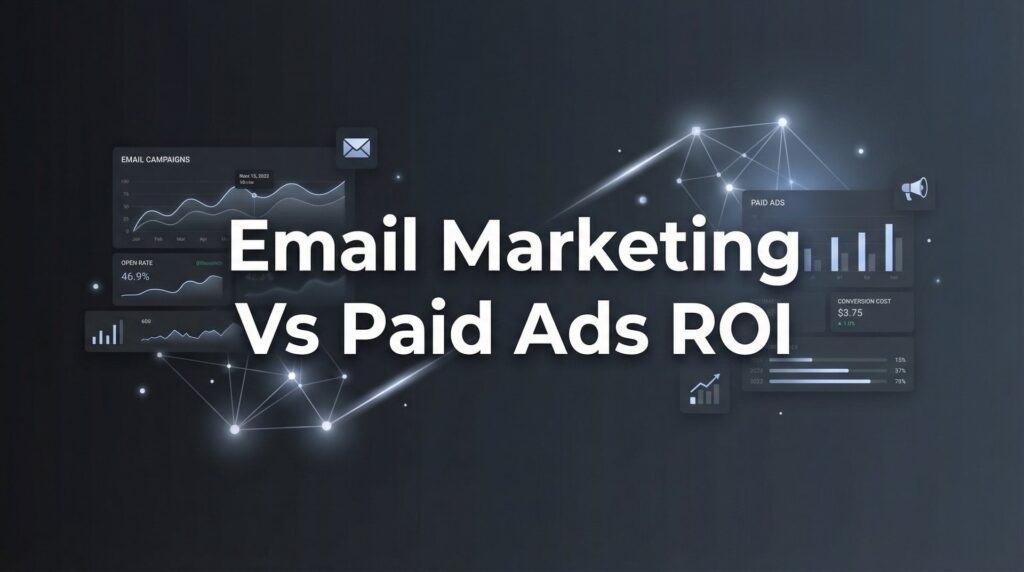
You’re staring at your marketing dashboard, and the numbers tell two very different stories. Your email campaigns show a 4,200% ROI according to one report, while your Google Ads are burning through budget faster than you can analyze the results. Meanwhile, your Facebook campaigns are generating clicks but questionable conversions. The question keeping you up at night: where should your next marketing dollar actually go?
For local business owners watching every penny, the email marketing vs paid ads ROI debate isn’t just theoretical—it’s the difference between profitable growth and watching your budget evaporate. Here’s what most businesses get wrong: they treat this as an either-or decision when the real winners understand exactly when to deploy each channel and how to make them work together.
Both channels can deliver exceptional returns, but only when you measure them correctly and deploy them strategically. This guide cuts through the marketing noise with seven actionable strategies that help you extract maximum ROI from both email and paid advertising. Whether you’re running Google Ads, Facebook campaigns, or nurturing your email list, you’ll discover exactly how to track, compare, and optimize your marketing spend so you know precisely where your next dollar should go.
1. Establish True Cost-Per-Acquisition Tracking for Both Channels
The Challenge It Solves
Most businesses dramatically underestimate their email marketing costs while overestimating what they spend on paid ads. They look at their Google Ads dashboard showing $2,000 in ad spend and think that’s the full story. Meanwhile, their “free” email marketing is costing them $500 in platform fees, 10 hours of content creation time, $300 for design work, and another $400 for list building campaigns—costs that never make it into their ROI calculations.
This accounting blind spot leads to terrible decisions. You might be celebrating a “high-performing” email campaign that actually costs more per acquisition than your supposedly “expensive” paid ads when you factor in all the hidden costs.
The Strategy Explained
True cost-per-acquisition tracking means accounting for every dollar and hour that goes into each channel. For paid ads, this includes obvious costs like ad spend and platform fees, but also the time spent on campaign management, creative development, and landing page optimization. For email, it means tracking platform subscriptions, content creation hours, design costs, list maintenance, segmentation work, and the paid advertising you use to build your list in the first place.
Think of it like comparing two restaurants. One has a simple menu with clear pricing. The other has a complex pricing structure with hidden fees, service charges, and mandatory add-ons. Without seeing the full bill, you can’t make an informed choice about which delivers better value.
Implementation Steps
1. Create a comprehensive cost tracking spreadsheet with separate columns for direct costs (ad spend, platform fees), labor costs (valued at your hourly rate or what you pay team members), and indirect costs (tools, software, outsourced services).
2. For paid ads, track not just the ad spend but also the hours spent on campaign setup, monitoring, optimization, creative development, and landing page work—multiply hours by your actual labor cost to get true expense figures.
3. For email marketing, document platform costs, content creation time, design expenses, list building ad spend, segmentation work, automation setup time, and A/B testing hours—most businesses discover their “cheap” email channel costs 3-5x more than they thought.
4. Calculate true cost-per-acquisition by dividing total channel costs by the number of new customers acquired, ensuring you’re comparing apples to apples across both channels. If you’re struggling with this process, our guide on how to track marketing ROI breaks down the exact methodology step by step.
Pro Tips
Set up monthly tracking rituals where you update these numbers consistently. Many businesses discover that their email ROI is still excellent even with accurate cost tracking, but the margin is much thinner than they believed. This accurate picture lets you make informed decisions about where to scale investment. Don’t forget to track the learning curve costs—your first three months of email marketing or paid ads will have higher costs as you figure out what works.
2. Segment Your Audience to Deploy the Right Channel at the Right Time
The Challenge It Solves
Sending cold traffic straight to a sales pitch through paid ads wastes money. Bombarding cold prospects with email sequences they never asked for destroys deliverability. Yet businesses make these mistakes constantly because they haven’t matched their channel strategy to their audience’s awareness level.
Picture this: someone who’s never heard of your business sees your ad, clicks through, and lands on a page asking them to buy a $2,000 service. That’s like proposing marriage on a first date. Meanwhile, you’re sending generic promotional emails to customers who’ve already bought from you three times, missing the opportunity to deepen that relationship with personalized communication.
The Strategy Explained
Channel selection should map directly to customer journey stage. Paid ads excel at reaching cold audiences who don’t know you exist—they’re scrolling Facebook or searching Google with a problem, and your ad interrupts with a relevant solution. These prospects aren’t ready to buy yet; they’re ready to learn more, download a resource, or join your email list.
Email marketing dominates with warm and hot audiences. Someone who downloaded your guide, attended your webinar, or purchased from you before has given you permission to communicate directly. These people are much more likely to convert on your offers because they already have some relationship with your brand. Email’s ROI shines brightest here because you’re not paying for each impression—you’re leveraging an asset you’ve already built.
Implementation Steps
1. Map your customer journey into three stages: cold (never heard of you), warm (engaged with your content or visited your site), and hot (requested information, added to cart, or previous customers).
2. Allocate paid advertising budget exclusively to cold and warm audience acquisition—use ads to drive awareness, capture leads, and build your email list rather than pushing for immediate sales. Understanding the difference between marketing qualified leads vs sales qualified leads helps you target the right stage.
3. Reserve email marketing for warm prospects who’ve opted in and hot prospects who’ve shown buying intent—create separate email sequences for each stage with messaging that matches their readiness level.
4. Set up tracking to measure conversion rates at each stage so you can see exactly where each channel performs best—you’ll typically find email converts at 5-10x the rate of cold paid ads for audiences that have engaged with your content.
Pro Tips
Create a simple matrix that shows which channel to use for each audience segment and goal. Cold audience + awareness goal = paid ads. Warm audience + conversion goal = email sequence. Hot audience + upsell goal = personalized email. This clarity eliminates the guesswork and ensures you’re deploying each channel where it naturally excels. The businesses that master this segmentation often discover they can cut their paid ad spend by 30-40% while maintaining or increasing total conversions.
3. Build a Paid Ads-to-Email Funnel That Compounds ROI
The Challenge It Solves
Treating paid ads and email as separate channels leaves massive ROI on the table. You run Facebook ads that drive traffic to your website, some people convert, most bounce, and you never hear from them again. Meanwhile, your email list grows slowly through organic signups, but you’re missing thousands of potential subscribers who engaged with your paid campaigns but didn’t take the next step.
This siloed approach means you’re paying for traffic once, getting a single conversion opportunity, and then starting over. It’s like filling a bucket with a hole in the bottom—you’re constantly pouring in new leads without capturing the ones that slip through.
The Strategy Explained
An integrated paid ads-to-email funnel transforms one-time ad spend into a compounding asset. Instead of sending paid traffic directly to a sales page, you send them to a high-value lead magnet—a guide, calculator, checklist, or video training that solves a specific problem. In exchange for this resource, they join your email list.
Now your paid ad investment does double duty. First, it builds your email list with qualified prospects who raised their hand for your solution. Second, your email sequences convert these leads over time without additional ad spend. A prospect who wasn’t ready to buy when they first saw your ad might convert after receiving three valuable emails that build trust and demonstrate expertise.
Implementation Steps
1. Create a compelling lead magnet that addresses a specific pain point your target customer experiences—make it valuable enough that people would pay for it, but offer it free in exchange for their email address.
2. Build a dedicated landing page focused solely on this lead magnet with no navigation, minimal copy, and a single clear call-to-action—remove every distraction that might prevent someone from opting in.
3. Run paid ad campaigns (Google, Facebook, LinkedIn) that drive traffic to this landing page rather than your main website or sales pages—optimize for cost-per-lead rather than cost-per-purchase since the conversion happens in your email sequence. If you’re new to this approach, our paid search advertising guide for beginners walks you through the setup process.
4. Set up an automated email sequence that delivers the lead magnet immediately, then continues with 5-7 additional emails over 2-3 weeks that build relationship, demonstrate value, and introduce your core offer.
Pro Tips
Track the full funnel metrics: cost-per-lead from ads, email open and click rates, and conversion rate from email to customer. Many businesses discover that while their ad-to-sale conversion might be 2%, their ad-to-lead conversion is 25%, and their lead-to-customer conversion through email is 15%—resulting in a much higher overall ROI than direct-to-sale ads. The key is patience: this approach takes 2-4 weeks to show results versus immediate conversions from direct-sale ads, but the long-term ROI compounds significantly.
4. Implement Lifecycle-Based Email Sequences That Outperform Cold Ads
The Challenge It Solves
Most businesses treat their email list like a megaphone—they blast the same promotional message to everyone regardless of where that person is in their customer journey. A brand-new subscriber who just downloaded your guide gets the same “30% off sale” email as a loyal customer who’s purchased five times. This one-size-fits-all approach leaves conversions on the table and trains your audience to ignore your emails.
Meanwhile, you’re spending heavily on paid ads to acquire new customers when your existing list contains warm prospects who just need the right sequence of messages to convert. It’s like ignoring the people already in your store while you stand outside handing out flyers to strangers.
The Strategy Explained
Lifecycle-based email sequences deliver the right message at the right time based on where someone is in their relationship with your business. A welcome sequence introduces new subscribers to your brand, shares your best content, and builds trust before asking for a sale. A nurture sequence educates prospects who aren’t ready to buy yet, positioning you as the expert they’ll turn to when they are ready. A re-engagement sequence targets inactive subscribers with compelling reasons to pay attention again.
These automated sequences consistently outperform cold paid ads because they’re speaking to people who’ve already expressed interest in your solution. While a cold Facebook ad might convert at 1-2%, a well-crafted welcome sequence can convert at 10-15% because you’re talking to someone who actively chose to hear from you. The right marketing automation tools make building these sequences much easier.
Implementation Steps
1. Build a welcome sequence (5-7 emails over 2 weeks) that new subscribers receive automatically—start with delivering what you promised, then share your best content, tell your story, and introduce your core offer with a special new-subscriber incentive.
2. Create a nurture sequence for prospects who engaged with your welcome series but didn’t purchase—focus on education, case studies, and addressing common objections rather than hard selling.
3. Set up a re-engagement campaign for subscribers who haven’t opened your emails in 60-90 days—use a compelling subject line, acknowledge the silence, and offer something valuable to win back their attention.
4. Develop a post-purchase sequence that thanks customers, ensures they’re getting value from what they bought, and strategically introduces complementary products or services they might need next.
Pro Tips
The magic happens in the transitions between sequences. Use tags and automation to move people between sequences based on their behavior. Someone who opens every email but hasn’t purchased moves from welcome to nurture. Someone who purchases jumps to post-purchase. Someone who goes cold enters re-engagement. This behavior-based automation ensures you’re always sending the most relevant message, which dramatically outperforms both generic email blasts and cold paid advertising in terms of conversion rate and customer lifetime value.
5. Use Retargeting to Bridge the Email-Paid Ads Gap
The Challenge It Solves
Your email list is a goldmine of qualified prospects, but email alone has limitations. Not everyone opens every message. Some people need multiple touchpoints across different channels before they convert. And your best customers—the ones most likely to buy again—might miss your new offer announcement if it arrives on a busy day when they’re not checking email.
Similarly, your paid ads reach new audiences, but you’re leaving money on the table if you’re not leveraging the behavioral data from your email subscribers to improve your ad targeting. These two powerful channels often operate in silos when they should be amplifying each other.
The Strategy Explained
Retargeting bridges the gap by using your email list to create custom audiences for paid campaigns. Upload your email list to Facebook, Google, or LinkedIn to show ads specifically to people already on your list. This multi-channel approach ensures your message reaches subscribers even if they miss your email. You can also create lookalike audiences based on your email subscribers—the platforms analyze your list and find new people with similar characteristics, dramatically improving your cold ad performance.
Think of it like reinforcing a message. Someone sees your email in the morning but doesn’t have time to engage. That afternoon, they see your ad on Facebook, which reminds them of your offer. That evening, they open your email and click through. This coordinated multi-touch approach converts at much higher rates than either channel alone. Our complete guide to Facebook remarketing ads shows you exactly how to set this up.
Implementation Steps
1. Export your email list and upload it to Facebook Ads Manager, Google Ads, and LinkedIn Campaign Manager to create custom audiences—most platforms match 40-60% of email addresses to user accounts.
2. Create specific ad campaigns targeting only these custom audiences with messaging that acknowledges they’re already familiar with your brand—use phrases like “As a subscriber” or “You’ve seen our emails” to create continuity.
3. Build lookalike audiences based on your best email segments (most engaged subscribers, recent purchasers, high lifetime value customers) and use these for cold prospecting campaigns—these will dramatically outperform generic interest-based targeting.
4. Set up retargeting pixels on your website and coordinate email campaigns with retargeting ads—when you send a promotional email, launch a simultaneous retargeting campaign showing the same offer to people who visited your site but didn’t convert.
Pro Tips
Segment your custom audiences based on engagement level. Create separate campaigns for highly engaged subscribers (opened 80% of emails in last 30 days) versus less engaged subscribers. The highly engaged audience should see more direct offers since they’re warmer, while less engaged subscribers might need more brand awareness and value-building content. This strategy typically reduces your cost-per-acquisition by 40-60% compared to cold prospecting because you’re advertising to people who already have some relationship with your brand.
6. Track Customer Lifetime Value, Not Just Initial Conversion
The Challenge It Solves
You’re making decisions based on incomplete data. Your paid ads dashboard shows you acquired a customer for $150, and your email platform shows a customer from your nurture sequence cost $50 when you factor in list building costs. Based on these numbers, email looks like the clear winner. But this comparison ignores a critical question: what happens after that first purchase?
The paid ads customer might buy once and disappear. The email customer might purchase three more times over the next year and refer two friends. Without tracking customer lifetime value (CLV), you’re optimizing for the wrong metric and potentially cutting budgets from channels that deliver the most profitable long-term customers.
The Strategy Explained
Customer lifetime value tracking reveals the full picture of what a customer is worth to your business over their entire relationship with you, not just their first purchase. This metric often shows that email-acquired customers have significantly higher CLV than paid ads customers because email builds stronger relationships and facilitates repeat purchases more naturally.
However, paid ads might excel at rapid customer acquisition even if individual CLV is lower. The strategic insight comes from understanding both metrics: use paid ads to acquire customers quickly, then use email to maximize their lifetime value. This approach recognizes that each channel has different strengths rather than trying to make them compete on a single metric.
Implementation Steps
1. Tag customers in your CRM or email platform based on their acquisition channel (paid ads, organic email signup, referral, etc.) so you can track their behavior separately over time.
2. Calculate average customer lifetime value by channel by tracking total revenue from each customer segment over 12-24 months, including repeat purchases, upsells, and referrals they generate.
3. Divide your total marketing costs by the number of customers acquired to get true cost-per-acquisition, then compare this to CLV by channel—a channel is profitable when CLV exceeds acquisition cost by at least 3:1. If you’re not sure your tracking is accurate, learn how to fix your marketing conversion tracking before making budget decisions.
4. Track time-to-second-purchase by acquisition channel to understand how quickly different customer segments become repeat buyers—email-acquired customers often make their second purchase 40-60% faster than paid ads customers.
Pro Tips
Many businesses discover that paid ads customers have lower initial CLV but much higher volume, while email customers have higher CLV but slower acquisition. The winning strategy combines both: use paid ads to rapidly build your email list and acquire customers, then use email to nurture relationships and drive repeat purchases that maximize CLV. Track your “blended” CLV—customers who were acquired through paid ads but nurtured through email—and you’ll often find these represent your most profitable segment because they combine the acquisition speed of paid ads with the relationship-building power of email.
7. Run Controlled Tests to Find Your Business’s Optimal Channel Mix
The Challenge It Solves
Every business is different. What works brilliantly for a SaaS company might flop for a local service business. An e-commerce brand’s optimal channel mix will look nothing like a B2B consultant’s. Yet most businesses make channel investment decisions based on industry averages, competitor observation, or the latest marketing guru’s advice rather than their own data.
This guessing game means you might be over-investing in a channel that doesn’t work for your specific audience while under-investing in the channel that would deliver exceptional returns. Without controlled testing, you’re flying blind, making expensive decisions based on assumptions rather than evidence.
The Strategy Explained
Controlled testing means designing experiments that isolate variables and reveal exactly where your marketing budget delivers the best returns for your specific business. Instead of making permanent shifts based on a single month’s data, you run structured 90-day tests that account for seasonal variations, audience fatigue, and market conditions.
The goal isn’t to prove that email or paid ads is “better”—it’s to discover your optimal channel mix. Maybe that’s 60% paid ads and 40% email. Maybe it’s 30% paid ads for list building and 70% email for conversion. The only way to know is to test methodically and measure accurately. Understanding what performance marketing is helps you approach this testing with the right mindset.
Implementation Steps
1. Design a 90-day test where you allocate specific budgets to each channel and commit to not making major changes during the test period—this duration accounts for learning curves and seasonal variations that shorter tests miss.
2. Establish clear success metrics before starting: cost-per-acquisition, customer lifetime value, time-to-conversion, repeat purchase rate, and overall ROI—decide which metrics matter most for your business model.
3. Track weekly performance but resist the urge to make changes based on short-term fluctuations—paid ads often start strong then plateau, while email builds momentum slowly but sustains performance longer.
4. At the end of 90 days, analyze the full dataset to identify patterns: which channel acquired customers faster, which delivered higher CLV, which had better repeat purchase rates, and which provided the best overall ROI when all factors are considered.
Pro Tips
Run multiple tests over different quarters to account for seasonal variations in your business. Your optimal channel mix in December might differ from June. Document everything: what you tested, why you made specific decisions, and what you learned. This creates a knowledge base that prevents you from repeating failed experiments and helps you double down on what works. Most businesses discover that their optimal mix changes as they grow—early-stage companies often need paid ads for rapid customer acquisition, while established businesses with large email lists can shift more budget to email marketing and still maintain growth.
Putting It All Together: Your ROI Optimization Roadmap
The email marketing vs paid ads ROI question isn’t about choosing one channel over the other—it’s about deploying each strategically where it naturally excels. Start with accurate tracking that captures true costs across both channels. Without this foundation, every other decision is built on quicksand.
Next, implement audience segmentation that matches channel to customer journey stage. Use paid ads to reach cold audiences and build your email list. Use email to convert warm prospects and maximize customer lifetime value. This strategic deployment ensures you’re not wasting paid ad budget on audiences that would convert better through email, and you’re not sending cold email to people who need paid ads to discover you exist.
Build the integrated funnel that compounds your ROI—paid ads feed your email list, email sequences convert leads, and retargeting bridges both channels to create multiple touchpoints. Layer in lifecycle-based email sequences that consistently outperform cold advertising for warm audiences. Track customer lifetime value to reveal the full picture of what each channel delivers beyond the initial conversion.
Then commit to controlled testing that reveals your business’s optimal channel mix. What works for your competitor might not work for you. Your data is the only truth that matters.
The businesses that win aren’t the ones that picked the “right” channel—they’re the ones that built systems to extract maximum value from both. They understand that paid ads excel at rapid acquisition and reaching cold audiences, while email dominates at relationship building and driving repeat purchases. They’ve stopped debating which channel is better and started optimizing how both channels work together.
Tired of spending money on marketing that doesn’t produce real revenue? We build lead systems that turn traffic into qualified leads and measurable sales growth. If you want to see what this would look like for your business, we’ll walk you through how it works and break down what’s realistic in your market.
Want More Leads for Your Business?
Most agencies chase clicks, impressions, and “traffic.” Clicks Geek builds lead systems. We uncover where prospects are dropping off, where your budget is being wasted, and which channels will actually produce ROI for your business, then we build and manage the strategy for you.