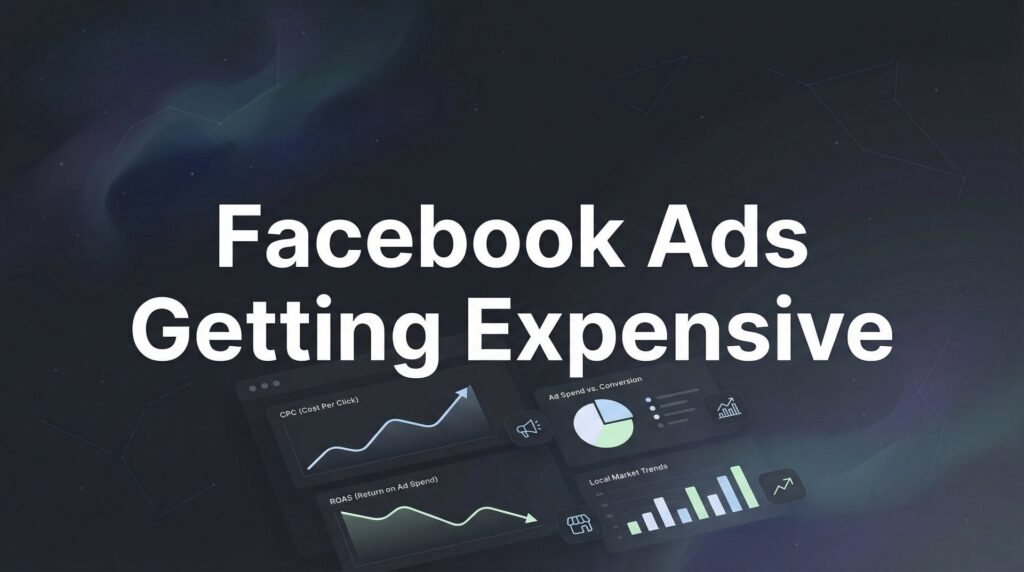
Your Facebook ad costs have doubled in the last six months. You’re hitting your daily budget by noon, and the leads you’re getting aren’t even as qualified as they used to be. You keep checking Ads Manager, hoping something changed overnight, but the numbers just keep climbing.
You’re not imagining it. Competition on the platform has intensified across nearly every industry, and advertisers everywhere are feeling the squeeze. Between increased competition, iOS privacy changes disrupting targeting, and auction dynamics pushing costs higher, the landscape has fundamentally shifted.
But here’s the thing: rising costs don’t have to mean shrinking profits.
The businesses that thrive in this environment aren’t necessarily the ones with the biggest budgets. They’re the ones who know how to optimize strategically, squeeze more value from every dollar, and adapt their approach when the old playbook stops working.
In this guide, we’ll walk you through exactly how to fight back against expensive Facebook ads. You’ll learn actionable steps to reduce your cost per click, improve your ad relevance, and ultimately get more customers without bleeding your budget dry. Whether you’re a local business owner managing your own campaigns or working with an agency, these strategies will help you reclaim control of your ad spend.
Let’s get started.
Step 1: Audit Your Current Campaign Performance
Before you can fix what’s broken, you need to know exactly where you stand. Pull up your Facebook Ads Manager and set your date range to the last 90 days. This timeframe gives you enough data to spot trends without getting lost in daily fluctuations.
Start by looking at your overall account performance. What’s your average cost per click? How does it compare to three months ago? Six months ago? Document these baseline numbers—you’ll need them to measure whether your optimization efforts are actually working.
Now drill down into individual campaigns. Sort by cost per result and identify your three most expensive campaigns. These are your problem children, and they’re likely draining your budget faster than they’re delivering value. For each one, ask yourself: Is the high cost justified by the quality of results, or are you just throwing money at underperformers?
Check Your Frequency Metrics: This is where many advertisers discover their biggest cost driver. Frequency measures how many times the average person sees your ad. When frequency climbs above 3-4 impressions per user, you’re likely experiencing ad fatigue—people have seen your ad so many times they’re actively ignoring it or, worse, hiding it.
High frequency drives costs up dramatically. Facebook’s algorithm notices that people aren’t engaging with your ad anymore, so it charges you more to keep showing it. If you see frequency numbers above 4, that’s a red flag screaming for fresh creative or audience expansion.
Look at your click-through rates alongside your costs. A declining CTR combined with rising costs tells you exactly what’s happening: your ads have lost their punch. The audience is tired of seeing them, and Facebook is making you pay extra to force them in front of people who’ve already decided they’re not interested.
Examine Your ROAS by Ad Set: Return on ad spend reveals which audience segments are actually profitable. You might discover that one ad set is delivering a 5x ROAS while another is barely breaking even at 1.2x. This information is gold—it tells you exactly where to shift your budget.
Create a simple spreadsheet documenting your findings. List your campaigns, their current CPC, CTR, frequency, and ROAS. Mark the ones that need immediate attention. This becomes your roadmap for the optimization work ahead.
The businesses that successfully combat rising costs don’t guess—they measure, analyze, and act on data. If you’re struggling with Facebook ads not converting, this audit gives you the foundation for everything that follows.
Step 2: Refine Your Audience Targeting to Reduce Competition
Broad interest targeting is where most advertisers go to burn money in today’s Facebook environment. When you target “small business owners interested in marketing,” you’re competing in an auction with thousands of other advertisers fighting for the same people. That competition drives your costs through the roof.
The solution? Get specific, get strategic, and find the audience segments your competitors haven’t discovered yet.
Build Custom Audiences from Your Best Customers: Upload your customer email list to Facebook and create a custom audience. These are people who already know your business and have demonstrated they’re willing to buy from you. Targeting them costs significantly less than chasing cold prospects because they’re more likely to engage and convert.
Create a separate custom audience for your website visitors from the last 180 days. Then segment it further—people who visited your pricing page are warmer than people who only hit your homepage. People who added items to cart but didn’t purchase are your hottest segment. Each of these deserves its own tailored campaign with messaging that matches their stage in the buying journey.
Leverage Lookalike Audiences Intelligently: Lookalike audiences find people similar to your best customers, but not all lookalikes are created equal. Start with a 1% lookalike based on your purchasers or highest-value customers. This gives you the most concentrated group of people who resemble your ideal buyers.
Many advertisers make the mistake of jumping straight to 5% or 10% lookalikes because they want scale. Resist that temptation. Broader lookalikes mean more competition and higher costs. Test the 1% first, and only expand when you’ve maxed out its potential.
Layer Targeting Parameters Strategically: Instead of targeting everyone interested in “digital marketing,” narrow it down. Layer in job titles, company sizes, or behaviors that indicate genuine buying intent. For local businesses, geographic targeting becomes your secret weapon—you’re not competing with national advertisers when you focus on a 15-mile radius around your location.
Consider demographic narrowing based on what you know about your actual customers. If your data shows that 80% of your revenue comes from business owners aged 35-55, stop wasting budget on 18-24 year-olds just because Facebook’s default settings include them.
Use Exclusion Audiences to Eliminate Waste: Create exclusion lists for people who’ve already converted, people who’ve visited your careers page (they’re job hunting, not buying), and anyone who’s engaged with your ads but hasn’t taken action in 90 days. Every dollar you don’t spend on these unlikely converters is a dollar you can invest in better prospects.
The goal isn’t to reach the most people—it’s to reach the right people at the lowest cost. Refined targeting gets you there.
Step 3: Improve Your Ad Relevance Score
Facebook doesn’t just care about how much you’re willing to pay. The platform rewards advertisers who create ads that people actually want to see. This is where relevance diagnostics come in—and they directly impact how much you pay per click.
Facebook evaluates your ads across three dimensions: Quality Ranking, Engagement Rate Ranking, and Conversion Rate Ranking. Each one compares your ad’s performance against other ads competing for the same audience. If your ad ranks in the bottom 35% on any of these metrics, Facebook charges you more. It’s their way of penalizing ads that create poor user experiences.
Align Your Creative with Audience Pain Points: Generic ads get ignored. Specific ads that speak directly to what keeps your audience up at night get engagement. Instead of “Grow Your Business with Facebook Ads,” try “Tired of Facebook Ads That Eat Your Budget Without Delivering Leads?” The second version acknowledges a specific frustration your audience feels right now.
Look at your top-performing organic social posts. What topics generated the most comments and shares? Those are the themes that resonate with your audience. Build your ad creative around similar angles, because you’ve already proven those messages work.
Test Multiple Ad Variations Systematically: Create at least three different ad variations for each campaign—different images, different headlines, different opening hooks. Let them run for 3-5 days to gather meaningful data, then kill the underperformers and scale the winners.
Don’t just test random elements. Test strategic differences. Try a benefit-focused headline against a problem-focused one. Test an image showing your product against an image showing the result your customer wants. Each test teaches you what resonates with your specific audience.
Match Your Landing Page to Your Ad Promise: This is where many advertisers sabotage their own relevance scores. Your ad promises a free guide to cutting marketing costs. The user clicks and lands on your generic homepage with no guide in sight. They bounce immediately, and Facebook’s algorithm notices.
Conversion Rate Ranking measures what happens after the click. If people click your ad and immediately leave your site, Facebook interprets that as a poor user experience—and charges you more for future clicks. Your landing page needs to deliver exactly what your ad promised, with a clear path to conversion and fast load times.
Remove navigation menus from landing pages. Eliminate distractions. Make the conversion path obvious. Every element should guide the visitor toward one specific action, whether that’s filling out a form, making a purchase, or downloading a resource.
Monitor Your Relevance Diagnostics Weekly: Check your Quality Ranking, Engagement Rate Ranking, and Conversion Rate Ranking in Ads Manager. If any metric shows “Below Average” or “Below Average (Bottom 35%),” that ad needs immediate attention. Pause it, fix the underlying issue, and relaunch with improvements.
Higher relevance scores mean lower costs. It’s that simple. Facebook wants to show users ads they’ll enjoy, and they’ll charge you less when you help them achieve that goal.
Step 4: Refresh Your Creative to Combat Ad Fatigue
Even your best-performing ad has an expiration date. Run it too long, and the same people see it over and over until they develop banner blindness. Your click-through rate drops, your costs rise, and suddenly that winning ad is losing you money.
The solution isn’t to completely abandon what’s working. It’s to refresh your creative before performance falls off a cliff.
Establish a Creative Rotation Schedule: Plan to introduce new creative variations every 2-3 weeks, especially for campaigns targeting smaller audiences. You don’t need to replace everything at once—introduce one or two new ads while keeping your best performers running. This gives you fresh options to test while maintaining baseline performance.
Watch your frequency metric like a hawk. When it creeps above 3, start preparing new creative. When it hits 4-5, your refresh is already overdue. Don’t wait for performance to crater before you act.
Test Different Content Formats: Facebook video ads often achieve higher engagement rates than static images, which can improve your relevance scores and lower costs. But not all videos work equally well. Test short-form videos under 15 seconds against longer explainer content. Try user-generated content style videos that look native to the platform instead of polished commercial productions.
Carousel ads let you showcase multiple products or tell a sequential story. They work particularly well for e-commerce and service businesses with multiple offerings. Static images still have their place—they’re quick to produce and test, making them ideal for rapid iteration.
Update Hooks While Keeping Proven Frameworks: If you’ve discovered that problem-focused headlines outperform benefit-focused ones for your audience, keep that framework but change the specific problem you’re highlighting. Rotate through different pain points your product solves. This keeps your messaging fresh without abandoning what works.
Change your visual creative while keeping your headline, or keep your visual while testing new copy. Systematic testing reveals which elements drive performance and which ones you can safely refresh.
Leverage Dynamic Creative Testing: Facebook’s dynamic creative feature automatically tests different combinations of headlines, images, descriptions, and calls-to-action. You provide multiple options for each element, and the algorithm figures out which combinations perform best for different audience segments.
This approach works particularly well when you’re not sure which creative elements matter most. Let Facebook’s machine learning do the heavy lifting while you focus on creating quality assets to feed into the system.
Creative fatigue is inevitable. The businesses that keep costs down are the ones who stay ahead of it with consistent, strategic refreshes.
Step 5: Optimize Your Bidding Strategy and Budget Allocation
How you bid and where you allocate budget matters just as much as who you target and what creative you show them. The right bidding strategy can cut your costs significantly, while the wrong one leaves you overpaying for every click.
Test Cost Cap and Bid Cap Strategies: Facebook’s default “Lowest Cost” bidding aims to get you the most results at the lowest price, but it doesn’t give you much control. When costs start rising, you’re at the mercy of the algorithm. Cost cap bidding lets you set a target cost per result—Facebook will work to keep your average cost at or below that number.
Start with a cost cap slightly below your current average cost per result. If you’re paying $8 per click, try setting a cost cap at $7. Facebook will optimize delivery to hit that target, though you might see reduced volume initially. Monitor performance for 3-5 days before making adjustments.
Bid cap gives you even more control by setting a maximum bid for each auction. This prevents Facebook from overpaying in competitive auctions, but it can also limit your reach if you set it too low. Test bid caps when you have clear data on what a conversion is worth to your business and you know exactly how much you can afford to pay.
Shift Budget Toward Top Performers: This sounds obvious, but many advertisers spread their budget evenly across all campaigns regardless of performance. That’s a mistake. Your highest-ROAS campaigns should get the lion’s share of your budget. Your underperformers should get drastically reduced budgets or paused entirely.
Review performance weekly and reallocate accordingly. If Campaign A delivers a 4x ROAS while Campaign B struggles at 1.5x, move 70% of your budget to Campaign A. Scale what works, starve what doesn’t. Learning how to scale Facebook ads effectively requires this disciplined approach to budget management.
Implement Campaign Budget Optimization: CBO lets Facebook automatically distribute your budget across ad sets within a campaign based on performance. Instead of setting budgets at the ad set level, you set one campaign budget and let the algorithm allocate it to the best-performing ad sets.
This works particularly well when you’re testing multiple audiences or creative variations. Facebook can shift budget in real-time toward whatever’s converting best. However, CBO can sometimes over-concentrate budget in one ad set. Monitor your distribution and use ad set spending limits if you need to ensure all variations get adequate testing.
Adjust for Time-of-Day and Day-of-Week Patterns: Pull a report showing your conversion rates by hour and by day. You might discover that you get better results on Tuesday through Thursday than on weekends. Or that evening traffic converts better than morning traffic for your specific audience.
Use ad scheduling to focus your budget during high-performance windows. Why pay the same rate for low-converting weekend traffic when you could concentrate spend during weekday business hours when your audience is more likely to take action?
Smart bidding and budget allocation turn the same ad spend into better results. Every optimization compounds, lowering your effective cost per acquisition.
Step 6: Strengthen Your Conversion Funnel
You can have the perfect ad targeting the perfect audience with the perfect creative, but if your landing page is slow, confusing, or broken on mobile, you’re still wasting money. The conversion funnel beyond the click matters just as much as the ad itself.
Improve Landing Page Load Speed: Test your landing page speed using Google PageSpeed Insights. If it takes more than three seconds to load on mobile, you’re losing conversions before people even see your offer. Compress images, minimize code, and consider a faster hosting solution if necessary.
Every second of delay costs you conversions. Studies consistently show that bounce rates increase dramatically as load times extend beyond two seconds. Faster pages don’t just convert better—they also improve your Facebook Conversion Rate Ranking, which lowers your ad costs.
Simplify Your Conversion Path: Count the number of steps between landing on your page and completing a conversion. Every additional field in your form, every extra page in your checkout process, every unnecessary click creates friction that costs you customers.
If you’re collecting information you don’t actually need, remove those form fields. If you can reduce a three-page process to one page, do it. Make the path to conversion as frictionless as possible. The easier you make it, the more people will complete it.
Test your mobile experience specifically. Over half of Facebook traffic comes from mobile devices, and if your landing page isn’t optimized for small screens, you’re hemorrhaging conversions. Make sure buttons are large enough to tap easily, forms work smoothly on mobile keyboards, and content is readable without zooming.
Implement Strategic Retargeting Campaigns: Most people don’t convert on their first visit. That’s normal. What’s not normal is failing to follow up with them. Facebook remarketing ads targeting people who visited your site but didn’t convert typically have much lower CPCs than cold traffic campaigns because you’re reaching warmer audiences.
Create separate retargeting campaigns for different behaviors. People who viewed your pricing page are closer to buying than people who only read a blog post. Tailor your messaging and offers accordingly. The person who abandoned their cart might respond to a limited-time discount, while the person who just discovered you needs more education about why your solution matters.
Focus on Conversion Rate Optimization: Getting more value from existing traffic is often easier and cheaper than buying more traffic. Run A/B tests on your headlines, calls-to-action, form layouts, and page designs. Even a 10% improvement in conversion rate effectively cuts your cost per acquisition by 10%.
Test one element at a time so you know what’s actually moving the needle. Change your headline and your CTA button simultaneously, and you won’t know which change drove the improvement. Systematic testing reveals what works for your specific audience and business.
Your funnel is only as strong as its weakest link. Strengthen every step, and you’ll convert more of the traffic you’re already paying for.
Step 7: Diversify Beyond Facebook While Optimizing Within It
Putting all your acquisition eggs in the Facebook basket creates risk. When costs rise or algorithm changes hit, you’re vulnerable. Smart businesses diversify their traffic sources while continuing to optimize their Facebook presence.
Test Instagram Placements Separately: Instagram is part of the Facebook ecosystem, but it often delivers different results at different costs. Create separate campaigns for Instagram rather than lumping it together with Facebook placements. You might discover that Instagram delivers lower CPCs for your specific audience, especially if your creative is visually strong.
Instagram Stories and Reels placements can be particularly cost-effective for certain audiences. Test them individually to see if they outperform standard feed placements. The only way to know is to separate them and measure performance independently.
Consider Audience Network and Messenger Strategically: Facebook’s Audience Network extends your ads to third-party apps and websites. Costs are often lower, but quality can be variable. Test it carefully with a small budget and strict conversion tracking. If it delivers profitable results, scale it. If not, exclude it from your placements.
Messenger ads can work well for businesses where conversation-based engagement makes sense. They’re less competitive than news feed placements, which can mean lower costs. However, they require a different approach—you’re starting a conversation, not driving to a landing page.
Build Owned Audiences to Reduce Platform Dependency: Every email subscriber you capture is someone you can reach without paying Facebook. Focus on building your email list aggressively. Offer valuable lead magnets, create compelling opt-in incentives, and make it easy for people to subscribe.
Your email list is an asset you own. Facebook can change its algorithm tomorrow and double your costs, but your email list remains under your control. The bigger it grows, the less dependent you become on paid platforms for reaching your audience.
Integrate PPC Strategies Across Platforms: Understanding the differences between Google Ads and Facebook Ads for lead generation helps you build a balanced acquisition strategy. Someone searching “digital marketing agency near me” on Google is showing high intent—they’re actively looking for what you offer right now. That’s different from interruption-based Facebook advertising.
Diversifying across platforms doesn’t mean abandoning Facebook. It means building a balanced acquisition strategy where no single platform controls your business’s fate. When Facebook costs spike, your Google campaigns keep delivering. When Google gets competitive, your Facebook retargeting picks up the slack.
Test new platforms with small budgets and clear success metrics. Give each channel a fair shot to prove itself, but don’t throw good money after bad if something isn’t working. The goal is a portfolio of profitable channels, not presence everywhere just to check boxes.
Platform diversification gives you leverage. When you’re not desperate for Facebook to work at any cost, you can optimize it more effectively and walk away from unprofitable campaigns without fear.
Putting It All Together
Rising Facebook ad costs are a reality, but they’re not a death sentence for your marketing ROI. The businesses getting crushed by increasing costs are the ones running the same campaigns the same way they did two years ago, hoping the old playbook will start working again. It won’t.
The businesses thriving are the ones who adapt. They audit their performance religiously. They refine their targeting to find less competitive audience segments. They improve their relevance scores by creating ads people actually want to see. They refresh creative before fatigue sets in. They optimize their bidding strategies and budget allocation based on data. They strengthen every step of their conversion funnel. And they diversify beyond Facebook while continuing to optimize within it.
Each of these strategies compounds. Improve your relevance score by 10% and your costs drop. Increase your conversion rate by 15% and your effective CPA drops even further. Combine multiple optimizations and you can cut your acquisition costs in half while maintaining or increasing volume.
Your Quick Action Checklist:
✓ Pull your 90-day performance report today and identify your baseline metrics
✓ Identify your three highest-cost campaigns and audit what’s driving those costs
✓ Create one new custom or lookalike audience segment to test this week
✓ Schedule creative refreshes for any ads with frequency above 3
✓ Review your landing page load speed and mobile experience
✓ Set up at least one retargeting campaign for warm traffic
✓ Test one new placement or platform with 10% of your budget
Start with the lowest-hanging fruit. If your audit reveals ads with frequency above 4, refresh those immediately. If you’re not using custom audiences, build one today. If your landing page loads slowly, fix that before spending another dollar on traffic.
The key is systematic improvement, not perfection. You don’t need to implement everything at once. Pick the strategy that addresses your biggest cost driver, implement it, measure results, and move to the next one.
Managing all of this while running your business can feel overwhelming. You’re juggling operations, sales, customer service, and a dozen other priorities. Finding time to dive into Ads Manager, analyze data, test creative variations, and optimize bidding strategies often falls to the bottom of the list—right up until you realize you’ve spent $5,000 last month with little to show for it.
At Clicks Geek, we help local businesses cut through the noise and generate leads that actually convert into revenue. We don’t just run ads—we build complete lead generation systems designed to deliver qualified prospects at profitable costs. If you want to see what this would look like for your business, we’ll walk you through how it works and break down what’s realistic in your market. No fluff, no unrealistic promises—just honest assessment and proven strategies that turn ad spend into measurable growth.
Want More Leads for Your Business?
Most agencies chase clicks, impressions, and “traffic.” Clicks Geek builds lead systems. We uncover where prospects are dropping off, where your budget is being wasted, and which channels will actually produce ROI for your business, then we build and manage the strategy for you.