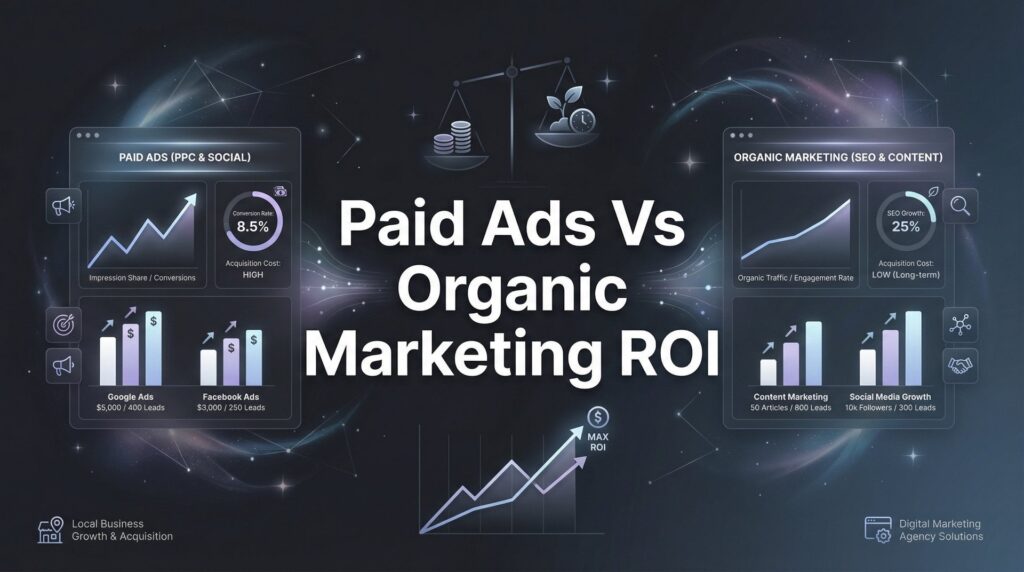
Every dollar you invest in marketing should work harder than the last. Yet most local business owners find themselves paralyzed by the paid ads vs organic marketing debate—pouring money into one channel while neglecting the other, or worse, spreading budgets so thin that neither delivers meaningful results.
The truth? This isn’t an either/or decision.
The businesses seeing the highest ROI in 2026 are those who understand exactly when to deploy paid advertising for immediate returns and when to invest in organic marketing for compounding long-term value. In this guide, we’ll break down seven battle-tested strategies that help you allocate your marketing budget based on actual performance data—not guesswork.
Whether you’re working with $1,000 or $100,000 per month, these approaches will help you build a marketing mix that delivers measurable, profitable growth.
1. Map Your Customer Journey to Identify Channel Fit
The Challenge It Solves
Most businesses waste money because they’re using the wrong marketing channel at the wrong stage of the customer journey. You might be running expensive paid ads to people who aren’t ready to buy, or relying on organic content when prospects are actively searching for immediate solutions. This misalignment kills ROI faster than anything else.
Understanding where your customers are in their decision process determines which channel will actually convert them into paying clients.
The Strategy Explained
Start by mapping out the actual path your customers take from first awareness to final purchase. For most local businesses, this journey includes three distinct phases: awareness (they realize they have a problem), consideration (they’re researching solutions), and decision (they’re ready to buy now).
Paid ads excel at capturing people in the decision phase—those high-intent searches where someone types “emergency plumber near me” or “divorce attorney consultation.” These prospects know what they need and are ready to act immediately. That’s where your paid budget should focus first.
Organic content dominates the awareness and consideration phases. Someone researching “signs you need a new HVAC system” isn’t ready to buy today, but they’re beginning a journey that could lead to a $15,000 purchase in the next 30-90 days. Your blog posts, guides, and educational content build trust during this critical research period.
Implementation Steps
1. Interview your last 10 customers and ask them to describe every step they took before choosing you—what they searched for, what content they read, how long they researched, and what finally made them decide to call.
2. Create a simple three-column spreadsheet labeled Awareness, Consideration, and Decision, then list the specific questions and search terms your customers use at each stage based on those interviews.
3. Assign each marketing channel to the stages where it performs best: allocate paid ads to decision-stage keywords with commercial intent, and organic content to awareness and consideration-stage educational topics.
Pro Tips
Track the time lag between first touch and conversion for your business. If customers typically take 60 days to decide, your organic content needs to nurture them through that entire window while your paid search campaigns capture the small percentage ready to buy immediately. This timing insight transforms how you allocate budget between channels.
2. Calculate True ROI Using Attribution Windows That Match Your Sales Cycle
The Challenge It Solves
Default platform tracking tells you almost nothing about real ROI. Google Ads might show a conversion happened within 30 days of a click, but if your average customer takes 90 days to decide, you’re missing the entire picture. This leads to killing campaigns that are actually working and doubling down on channels that only look good on paper.
Without proper attribution windows, you’re making budget decisions based on incomplete data.
The Strategy Explained
Your attribution window should match your actual sales cycle, not the default settings in your ad platforms. If you’re a B2B service provider where deals take 120 days to close, measuring conversions within a 30-day window is meaningless. You need tracking that connects initial clicks to eventual revenue across the entire customer journey.
This becomes critical when comparing paid and organic ROI. Organic traffic often plays a role early in the journey, while paid ads might deliver the final conversion. If you only credit the last click, you’ll systematically undervalue your organic efforts and potentially cut budgets from channels that are actually driving revenue.
The solution is implementing proper multi-touch attribution that gives credit to every marketing touchpoint a customer interacts with before purchasing. Learn the fundamentals in our guide on how to track marketing ROI effectively.
Implementation Steps
1. Calculate your average sales cycle by reviewing closed deals from the past six months and measuring the time between first contact and final purchase—this becomes your minimum attribution window.
2. Set up conversion tracking in Google Analytics 4 with custom attribution models that extend beyond the default windows, ensuring you’re capturing the full customer journey from first visit to conversion.
3. Create a simple CRM system or spreadsheet where you manually track the first marketing source for every lead, then connect it to eventual revenue so you can see which channels actually generate paying customers, not just form fills.
Pro Tips
For service businesses with longer sales cycles, implement phone call tracking that tags each incoming call with the marketing source. Many of your highest-value conversions happen over the phone, and if you’re not tracking which channel drove that call, you’re flying blind on ROI calculations. This single addition often reveals that organic content drives far more revenue than your analytics suggest.
3. Deploy Paid Ads for Speed-to-Market and Immediate Revenue
The Challenge It Solves
When you need revenue this month, organic marketing won’t save you. Building SEO authority takes time you don’t have when payroll is due or you’re launching a new service that needs immediate validation. Waiting six months for organic traffic to ramp up means missing market opportunities and burning through cash reserves while you hope your content eventually ranks.
Paid advertising solves the speed problem by putting your offer in front of ready-to-buy customers within hours of campaign launch.
The Strategy Explained
Think of paid ads as your revenue acceleration tool. When you launch a new service, paid campaigns let you test messaging and validate demand before investing months in organic content creation. When you have capacity to take on more clients immediately, paid ads fill your pipeline faster than any other channel.
The key is understanding that paid advertising works best for capturing existing demand, not creating it. Someone searching for “emergency roof repair” is already convinced they need the service—your ad just needs to convince them to call you instead of your competitor.
This makes paid ads perfect for high-intent, bottom-of-funnel keywords where prospects are ready to purchase now. Your cost per acquisition might be higher than organic traffic, but the speed to revenue and the ability to scale up or down based on capacity makes it worth the premium. Understanding what performance marketing is helps you leverage this approach effectively.
Implementation Steps
1. Identify your highest-margin services or products where you can afford to pay $50-$200 per customer acquisition and still maintain healthy profit margins—these become your paid advertising priorities.
2. Build search campaigns around high-intent keywords that include buying signals like “near me,” “emergency,” “cost,” “hire,” or “consultation”—these terms indicate someone is ready to make a decision now, not just researching options.
3. Set daily budgets based on your capacity to handle new business, starting conservatively and scaling up only when you’ve proven you can convert leads profitably and deliver excellent service to those new customers.
Pro Tips
Use paid ads to fill specific capacity gaps in your business. If you’re a contractor with a crew sitting idle next week, a short burst of aggressive paid advertising can fill your schedule within 48 hours. Then pause or reduce ad spend when you’re at capacity. This flexibility is something organic marketing simply can’t provide—you can’t turn SEO traffic on and off based on your weekly schedule.
4. Build Organic Assets That Compound Returns Over Time
The Challenge It Solves
Paid advertising stops working the moment you stop paying. Every lead costs you money, and if you pause campaigns for a month, your pipeline dries up immediately. This creates a treadmill effect where you’re constantly spending to maintain revenue, with no way to reduce customer acquisition costs over time.
Organic content breaks this cycle by creating assets that continue generating traffic and leads long after you publish them.
The Strategy Explained
A well-optimized blog post you publish today can rank in Google search results for years, driving hundreds or thousands of visitors without additional spending. This is what we mean by compounding returns—your investment in content creation pays dividends month after month, reducing your average cost per lead as the asset ages.
The businesses with the lowest customer acquisition costs are those who built substantial organic assets years ago that continue performing today. A comprehensive guide published in 2023 might still generate 500 qualified visitors per month in 2026, delivering leads at effectively zero marginal cost.
This makes organic content your long-term wealth-building strategy. While paid ads fund immediate operations, organic assets create sustainable competitive advantages that become harder for competitors to replicate over time. Explore our comparison of performance marketing vs traditional marketing to understand how these approaches complement each other.
Implementation Steps
1. Create a content calendar focused on evergreen topics your customers search for repeatedly—avoid trendy subjects that will become outdated quickly and instead target timeless questions that will remain relevant for years.
2. Publish one comprehensive, 2,000+ word guide per month that thoroughly answers a specific customer question, optimized for search intent rather than just keyword density—quality depth beats keyword stuffing every time.
3. Track the performance of each piece of content monthly, noting which articles continue driving traffic 6, 12, and 24 months after publication to identify your highest-performing asset types and topics worth expanding.
Pro Tips
Focus your initial organic efforts on topics where you can realistically rank within 6-12 months. Targeting extremely competitive keywords like “digital marketing” when you’re a local agency is a waste of resources. Instead, go after specific long-tail phrases like “PPC management for dental practices in Phoenix” where you can actually win rankings and drive qualified traffic that converts into real revenue.
5. Use Paid Data to Supercharge Your Organic Strategy
The Challenge It Solves
Creating organic content without data is guesswork. You’re hoping the topics you choose will resonate with your audience and rank in search results, but you won’t know for months whether your investment paid off. Meanwhile, you might be creating content around keywords that don’t actually convert or questions your customers don’t really care about.
Your paid advertising campaigns generate immediate, actionable data that can eliminate this guesswork from your organic strategy.
The Strategy Explained
Every PPC campaign you run is essentially a rapid testing laboratory for your organic content strategy. The search terms report in Google Ads shows you exactly what phrases people use when they’re ready to buy. The ad copy that gets the highest click-through rates reveals messaging that resonates with your audience. The landing pages with the best conversion rates demonstrate what content structure and calls-to-action actually drive action.
Smart marketers mine this paid data to inform their organic content creation. If a particular search term drives 50 conversions per month through paid ads, you know there’s substantial search volume and commercial intent around that topic—making it a perfect target for an organic content piece.
This approach dramatically increases your organic content ROI because you’re investing in topics and messaging that have already proven they convert, rather than gambling on untested ideas. Our Google Ads optimization guide shows you how to extract these valuable insights from your campaigns.
Implementation Steps
1. Export your PPC search terms report monthly and identify the top 20 queries that drove actual conversions, not just clicks—these represent topics your audience actively searches for when they’re ready to buy.
2. Analyze your highest-converting ad copy to identify specific phrases, benefits, and calls-to-action that resonate with your audience, then incorporate this proven messaging into your organic content headlines and body copy.
3. Review your landing page conversion rates to determine which content structures, page layouts, and CTAs perform best, then apply these insights to your blog posts and service pages to improve organic conversion rates.
Pro Tips
Pay special attention to search terms that convert well in paid campaigns but have relatively low cost-per-click. These represent opportunities where search volume exists but competition is moderate—perfect targets for organic content where you can potentially rank quickly and capture traffic without ongoing ad spend. This strategy helps you systematically replace paid spend with organic traffic over time.
6. Implement the 70/30 Budget Shift Strategy
The Challenge It Solves
New businesses or those entering new markets face a chicken-and-egg problem: organic marketing takes months to generate results, but you need revenue now to stay in business. Conversely, established businesses often continue pouring money into paid ads long after their organic presence could handle most of their lead generation at a fraction of the cost.
The budget allocation that works for a startup is completely wrong for a business with three years of content assets already ranking.
The Strategy Explained
The 70/30 strategy recognizes that optimal budget allocation changes as your organic assets mature. In your first year, you might allocate 70% of your marketing budget to paid advertising and 30% to organic content creation. This heavy paid investment generates immediate revenue while you’re building organic authority.
As your content begins ranking and driving consistent traffic—typically 12-18 months in—you gradually shift the ratio. By year two, you might move to 50/50. By year three, when you have substantial organic traffic, you could flip to 30% paid and 70% organic, using paid ads primarily for new service launches or capacity filling.
This evolution reflects the changing economics of each channel over time. Early on, paid delivers better ROI because you have no organic presence. Later, organic delivers superior ROI because your content assets are established and generating traffic without ongoing spend. Discover more approaches in our breakdown of best ROI marketing strategies.
Implementation Steps
1. Calculate your current monthly marketing budget and split it 70/30 between paid and organic if you’re in your first year, ensuring you’re generating immediate revenue while building long-term assets simultaneously.
2. Set quarterly benchmarks for organic traffic growth—when organic traffic consistently delivers 25% of your total leads, shift to 60/40; when it delivers 50%, move to 50/50; when it delivers 70%, flip to 30/70 paid/organic allocation.
3. Track customer acquisition cost separately for paid and organic channels each month, using this data to inform your budget shifts rather than following a rigid timeline—let performance dictate allocation, not arbitrary dates.
Pro Tips
Don’t eliminate paid advertising entirely even when your organic presence is strong. Maintain at least 20-30% of budget in paid channels for flexibility and testing. This allows you to quickly capitalize on new opportunities, fill capacity gaps, and continue gathering competitive intelligence on what messaging and offers resonate in your market. The businesses with the most stable growth maintain a balanced mix rather than going all-in on either channel.
7. Create an Integrated Measurement Dashboard
The Challenge It Solves
You can’t optimize what you don’t measure, and most businesses are looking at paid and organic performance in completely separate systems. Google Ads shows one set of metrics, Google Analytics shows another, and your CRM tracks something else entirely. This fragmentation makes it nearly impossible to understand which channel actually drives revenue or how they work together.
Without unified reporting, you’re making budget allocation decisions based on incomplete, often contradictory data.
The Strategy Explained
An integrated measurement dashboard brings all your marketing data into one place where you can see the complete picture. This means tracking not just traffic and clicks, but actual leads generated, conversion rates, customer acquisition costs, and ultimately revenue attributed to each channel.
The real power comes from viewing paid and organic performance side-by-side with consistent metrics. When you can see that paid ads generated 50 leads at $100 each while organic generated 30 leads at $20 each, you can make informed decisions about where to invest your next dollar.
This unified view also reveals how channels work together. You might discover that prospects who interact with both paid ads and organic content convert at twice the rate of those who only touch one channel—insight that would be invisible if you’re only looking at each platform in isolation. If you’re struggling with this, our guide on fixing marketing conversion tracking can help you get started.
Implementation Steps
1. Choose a central reporting platform—this could be a spreadsheet, Google Data Studio, or a dedicated marketing dashboard tool—where you’ll manually or automatically pull data from all your marketing channels into one unified view.
2. Define your core metrics that matter for business decisions: total leads, cost per lead, lead-to-customer conversion rate, customer acquisition cost, and customer lifetime value for both paid and organic channels separately.
3. Update your dashboard weekly with fresh data and review it monthly to identify trends, spot underperforming campaigns early, and make data-driven budget reallocation decisions before small problems become expensive mistakes.
Pro Tips
Include revenue data in your dashboard, not just lead counts. A channel that generates fewer leads but higher-quality prospects who actually buy is far more valuable than one that floods you with tire-kickers. Track which channel produces customers with the highest average order value and longest retention—these insights often reveal that the channel with the “worst” cost-per-lead actually delivers the best ROI when you measure what truly matters: profitable revenue growth.
Putting Your Paid and Organic Strategy Into Action
The paid ads vs organic marketing debate misses the point entirely. The question isn’t which channel is better—it’s how to deploy each one strategically based on your current business stage, goals, and resources.
Start by mapping your customer journey to understand where each channel fits naturally. Set up proper attribution that reflects your actual sales cycle so you’re measuring real ROI, not vanity metrics. Use paid advertising when you need speed and immediate revenue, but simultaneously build organic assets that compound returns over time.
Mine your paid campaign data to inform smarter organic content decisions. Implement the 70/30 budget shift strategy as your organic presence matures. And create an integrated dashboard that shows you the complete picture so you can make budget allocation decisions based on actual performance data.
The businesses winning in 2026 aren’t choosing between paid and organic—they’re using both strategically, at the right time, for the right purpose. They’re allocating budgets based on data, not opinions. And they’re building marketing systems that generate profitable growth month after month, regardless of which channel delivers each individual lead.
Tired of spending money on marketing that doesn’t produce real revenue? We build lead systems that turn traffic into qualified leads and measurable sales growth. If you want to see what this would look like for your business, we’ll walk you through how it works and break down what’s realistic in your market.
Your next customer is searching right now. The only question is whether they’ll find your competitor’s paid ad, your competitor’s organic content, or your integrated strategy that captures them at every stage of their journey.
Want More Leads for Your Business?
Most agencies chase clicks, impressions, and “traffic.” Clicks Geek builds lead systems. We uncover where prospects are dropping off, where your budget is being wasted, and which channels will actually produce ROI for your business, then we build and manage the strategy for you.