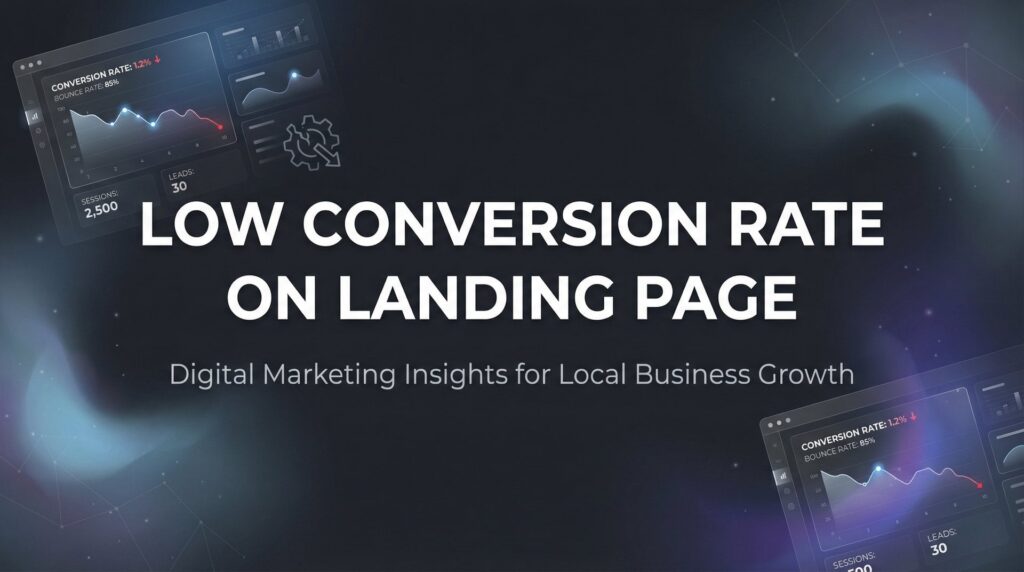
You check your analytics dashboard for the third time today. The numbers confirm what you already suspected: 847 visitors landed on your page this week. Eleven converted. Your ad spend is climbing while your phone stays quiet and your inbox remains empty. You’re paying to drive traffic that arrives, looks around, and leaves without a trace.
This isn’t a traffic problem. It’s a conversion problem. And it’s costing you real money every single day.
The frustrating part? Those visitors wanted what you offer. They clicked your ad. They arrived ready to solve a problem. Something on that landing page convinced them to look elsewhere instead. The good news is that low conversion rates aren’t mysterious forces beyond your control—they’re symptoms pointing to specific, fixable issues. Let’s identify what’s driving visitors away from your landing page and how to turn more of that expensive traffic into actual customers.
Understanding What “Low” Really Means for Your Business
Before you panic about your conversion rate, let’s establish what actually qualifies as problematic. A conversion rate is simply the percentage of visitors who complete your desired action—whether that’s filling out a contact form, calling your business, or making a purchase.
Calculate it like this: (conversions ÷ total visitors) × 100. If 50 people out of 1,000 visitors submit your form, that’s a 5% conversion rate.
Here’s where it gets tricky: “good” varies wildly depending on your industry, traffic source, and what you’re asking visitors to do. A local plumber asking for a phone call might see 8-12% conversion rates on search traffic. An ecommerce site selling high-ticket items might celebrate 2%. A real estate agent offering a home valuation tool could hit 15% or higher.
Paid search traffic typically converts better than cold Facebook ads because the intent is stronger—people searched for your solution. Organic traffic from Google often converts better than paid because visitors perceive organic results as more trustworthy. Traffic from email campaigns to existing contacts crushes cold traffic every time.
The percentage itself matters less than the economics behind it. If you’re paying $15 per click and converting at 2%, each conversion costs you $750. Can your business profit at that acquisition cost? That’s the real question. A 2% conversion rate that generates $2,000 in average customer value beats a 10% conversion rate that costs more than customers are worth. Understanding website conversion rate benchmarks for your industry helps put your numbers in perspective.
Focus on cost per acquisition and customer lifetime value rather than obsessing over the percentage alone. That said, if you’re running paid traffic and converting below 3-5% for local service businesses or below 1-2% for ecommerce, something’s broken. Your page is actively pushing away people who were interested enough to click.
The Credibility Problem Killing Your Conversions
Your visitors don’t know you. They don’t trust you. And they’re deciding whether to hand over their contact information or money in about eight seconds. If your landing page doesn’t immediately establish credibility, they’re gone.
Think about the last time you almost bought something online but backed out at the last second. What stopped you? Probably a nagging voice asking “Is this legit?” That same voice is talking to your visitors right now.
Generic stock photos scream fake. That image of a diverse group of business people high-fiving around a conference table? Every visitor has seen it on fifty other websites. It signals that you couldn’t be bothered to show your actual business, your real team, or genuine customers. Why should they trust you with their information?
Vague claims without proof create skepticism. “We provide excellent service” means nothing. “We increased Johnson Hardware’s monthly leads from 12 to 47 in 90 days” means everything. Specific numbers, named customers, and documented results build belief. General promises build doubt. This is one of the most common low conversion rate problems we see across industries.
Missing social proof leaves visitors wondering if anyone else has actually used your service. Where are the reviews? The testimonials? The case studies? If you’ve helped hundreds of customers, prove it. If you’re new and haven’t built that library yet, get three strong testimonials and feature them prominently. Three detailed, specific testimonials beat twenty generic “Great service!” quotes.
Here’s what actually builds trust fast: real photos of your team or your work, specific results with customer names (with permission), recognizable trust badges if you have them (Google Premier Partner, BBB accreditation, industry certifications), and testimonials that tell mini-stories rather than generic praise.
The best testimonials answer the skeptic’s question: “Did this actually work for someone like me?” A testimonial from a local restaurant owner about how you helped them fill tables on slow nights resonates with other restaurant owners. A review from a homeowner about your fast response time matters to other homeowners facing emergencies.
Video testimonials multiply trust exponentially. A 30-second video of a real customer explaining their results does more credibility work than a full page of written reviews. People can see genuine emotion and hear authentic voices. It’s harder to fake.
When Your Ad Makes Promises Your Page Doesn’t Keep
Someone searches “emergency plumber near me” at 11 PM with water flooding their basement. Your ad promises “24/7 Emergency Service—We Answer Now.” They click, desperate for help. Your landing page headline reads “Professional Plumbing Services for Your Home.” No mention of emergency service. No prominent phone number. A contact form asking for their preferred appointment time next week.
They leave. They call your competitor instead.
This disconnect between ad promise and landing page reality kills conversions instantly. The visitor arrived expecting one thing and found something else. The cognitive dissonance triggers an immediate exit. You paid for that click and got nothing because your message didn’t stay consistent from ad to page.
Every element of your landing page should reinforce what convinced the visitor to click in the first place. If your ad highlighted same-day service, your headline should emphasize same-day service. If your ad promised a free estimate, your page should lead with that free estimate offer. If your ad targeted “small business owners,” your page copy should speak directly to small business owners.
Search intent alignment matters even more than matching your own ad copy. When someone searches “how to remove wine stains from carpet,” they want immediate DIY advice, not a sales pitch for professional carpet cleaning. But if they search “carpet cleaning service near me,” they’re ready to hire someone. Your landing page needs to match where they are in the decision process. Learning how to create high converting landing pages starts with understanding this intent alignment.
The visitor’s mental state when they click determines what your landing page should deliver. Someone clicking a Facebook ad about “5 mistakes killing your Google Ads performance” wants educational content, probably a guide or checklist. Someone searching “PPC management services” wants to evaluate providers and see pricing. Same business, different landing pages, different approaches.
Creating seamless continuity means your headline echoes your ad, your opening paragraph expands on the promise, and your call-to-action delivers exactly what was offered. If your ad says “Get Your Free Marketing Audit,” your CTA button better say “Get My Free Audit” not “Contact Us” or “Learn More.”
Use the same language your visitors use. If they search for “furnace repair,” don’t suddenly talk about “HVAC system maintenance solutions.” They’re not looking for maintenance. They’re not thinking in industry jargon. They have a broken furnace and need it fixed. Speak their language, not yours.
The Hidden Obstacles Driving Visitors Away
Your landing page loads in 6.2 seconds. You just lost 40% of your visitors before they saw a single word. Page speed isn’t a minor technical detail—it’s a conversion killer. Every additional second of load time increases bounce rates exponentially. Mobile users are even less patient than desktop visitors.
Slow pages signal to visitors that your business is outdated, unprofessional, or technically incompetent. If you can’t make a webpage load quickly, how can you deliver quality service? That’s the subconscious calculation happening while they wait for your images to render. A high bounce rate on landing page often traces directly back to speed issues.
Confusing layouts create decision paralysis. When visitors land on your page and don’t immediately understand what to do next, they leave. Multiple competing calls-to-action split attention and reduce conversions. “Call Now” versus “Get a Quote” versus “Schedule Consultation” versus “Download Guide” forces visitors to choose between options when you should guide them to one clear next step.
The paradox of choice applies ruthlessly to landing pages. More options feel helpful but actually decrease action. One clear path forward converts better than three good options. Decide what action matters most for this traffic source and make that the only prominent CTA.
Forms create natural resistance. Every field you add reduces completion rates. Asking for name, email, phone, company, job title, company size, current challenges, budget range, and preferred contact time might give you rich data, but it also gives visitors ten reasons to abandon the form. Each additional field is a micro-commitment that tests their interest.
Start with the minimum viable information needed to follow up. For most local service businesses, that’s name, phone, and maybe zip code. You can gather additional details during the actual conversation. The goal is to start the conversation, not collect a comprehensive dossier before you’ve earned the right to ask.
Mobile experience matters more than ever. Over 60% of local searches happen on smartphones. If your landing page isn’t optimized for mobile—if buttons are too small to tap, text is too tiny to read without zooming, or forms are frustrating to fill out on a phone screen—you’re losing the majority of your potential conversions.
Navigation menus on landing pages create escape routes. Every link away from your conversion goal is a leak in your funnel. Remove the main site navigation. Eliminate sidebar links. Get rid of footer links to your blog, about page, and service pages. The only clicks should be toward conversion or clarifying information that supports the decision to convert.
Technical Friction Checklist
Page Load Speed: Test your actual load time on mobile and desktop. If it’s over 3 seconds, you have a problem. Compress images, minimize code, and use a quality hosting provider.
Form Length: Count your form fields. If you’re asking for more than 5 pieces of information, you’re creating unnecessary resistance. Cut it down to essentials.
Mobile Usability: Pull up your landing page on your phone right now. Can you easily read everything? Are buttons thumb-friendly? Does the form work smoothly? If not, fix it today.
Click Clarity: Look at your page with fresh eyes. Is it immediately obvious what action to take? Would your grandmother understand what to do next? If there’s any confusion, simplify.
Why Your Offer Fails to Motivate Action
Your value proposition sounds like everyone else in your market. “Quality service at competitive prices.” “Experienced team of professionals.” “Customer satisfaction guaranteed.” These phrases are so generic they’re essentially meaningless. They don’t differentiate you or give visitors a compelling reason to choose you over the three other tabs they have open.
A weak value proposition is invisible. It doesn’t register in the visitor’s mind because it could apply to literally any business in your category. Compare “Professional digital marketing services” to “We build lead generation systems that deliver qualified calls, not just clicks.” One is forgettable. The other communicates a specific outcome and positions against a common problem.
Your offer lacks urgency. Why should someone act now instead of tomorrow, next week, or never? If there’s no compelling reason to take action today, most visitors will default to “I’ll think about it” and never return. You need to create a legitimate reason for immediate action. Following best practices for landing pages means crafting offers that compel immediate response.
Artificial urgency backfires. Countdown timers that reset every time someone visits the page, fake scarcity claims about “only 3 spots left,” or manufactured deadlines that never expire train visitors to distrust you. Real urgency comes from genuine constraints: actual limited availability, seasonal timing, or legitimate deadlines.
For service businesses, real urgency often comes from the cost of waiting. A leaking roof costs more to fix the longer you wait. A broken HVAC system in summer means discomfort every day you delay. Marketing campaigns that aren’t optimized are wasting money right now, today, while you read this. Frame the cost of inaction rather than inventing fake scarcity.
Your offer might not be valuable enough to overcome the friction of taking action. Asking someone to fill out a form and schedule a call requires effort. What are they getting in return? “Free consultation” is weak because everyone offers free consultations. “Free audit revealing exactly where your Google Ads budget is being wasted” is stronger because it promises specific, valuable insight.
The best offers solve an immediate problem or deliver quick value before asking for a big commitment. A roofer offering a “Free 10-Point Roof Inspection Report with Photos” gives tangible value. A marketing agency offering a “Free Landing Page Conversion Audit” delivers actionable insights. These offers have inherent value beyond just talking to a salesperson.
Risk reversal amplifies offer strength. Guarantees, money-back promises, or trial periods reduce the perceived risk of saying yes. “Try our service risk-free for 30 days” lowers the barrier to conversion because the visitor knows they can back out if it doesn’t work. Not every business can offer this, but if you can reduce perceived risk, conversions increase.
Specificity makes offers more believable and valuable. “Free guide” is vague. “Free 27-page guide to cutting your PPC costs by 30% without losing leads” tells visitors exactly what they’re getting and what result to expect. Specific numbers, specific outcomes, specific deliverables all increase perceived value.
The Systematic Approach to Conversion Improvement
You can’t fix what you don’t measure. Before changing anything, you need to understand exactly where visitors are losing interest and what’s working versus what’s failing. Your analytics dashboard holds the answers if you know what to look for.
Start by identifying your biggest leak points. Where do most visitors abandon the page? If they’re leaving within 10 seconds, your headline or opening message isn’t connecting. If they scroll halfway down and then exit, something in that section creates doubt or confusion. If they reach your form but don’t submit, the form itself is the problem. Using the right conversion rate optimization tools makes identifying these issues much easier.
Heat mapping tools show you exactly where visitors click, how far they scroll, and what elements they ignore. You might discover that nobody reads your carefully crafted third section, or that visitors repeatedly click an element that isn’t actually clickable, creating frustration. Session recordings let you watch real visitors interact with your page, revealing confusion points you’d never notice otherwise.
A/B testing is how you turn observations into improvements. Testing means showing half your visitors version A of something and half your visitors version B, then measuring which version produces more conversions. The key is testing one thing at a time so you know what actually made the difference. A comprehensive guide to A/B testing for landing pages can help you structure these experiments properly.
Start with high-impact elements that typically move conversion rates the most. Your headline is the first thing visitors see and the primary filter for whether they stay or leave. Test dramatically different headline approaches: benefit-focused versus question-based, specific versus broad, urgent versus informational. Small headline tweaks rarely matter—test fundamentally different approaches.
Your call-to-action button is the conversion point itself. Test button copy that’s action-oriented versus benefit-focused: “Get Started” versus “Get My Free Audit.” Test button color, size, and placement. Test one CTA versus multiple CTAs at different scroll depths. These elements directly impact whether visitors take action.
Hero images or videos significantly influence trust and engagement. Test showing your actual team versus showing your work results. Test video versus static images. Test lifestyle imagery versus product-focused shots. Visual elements communicate instantly and powerfully.
Form optimization deserves dedicated testing. Test short forms versus longer forms. Test multi-step forms that feel less overwhelming than one long form. Test different field labels and placeholder text. Test whether asking for phone versus email first impacts completion rates. Small changes to forms can double conversion rates.
The iterative improvement mindset recognizes that optimization is ongoing, not a one-time project. You test, learn, implement the winner, then test something else. Each improvement compounds. A 10% improvement in headline performance plus a 15% improvement from form optimization plus an 8% improvement from better social proof adds up to 36% more conversions from the same traffic.
Set up a testing calendar. This month, test headlines. Next month, optimize the form. The following month, test different offers. Systematic testing beats random changes every time. Track what you test, what you learn, and what you implement so you build institutional knowledge about what works for your specific audience.
Turning Diagnosis Into Revenue
A low conversion rate on landing page isn’t a failure—it’s feedback. Your visitors are telling you exactly what’s not working through their behavior. They’re showing you where trust breaks down, where messages don’t align, where friction creates resistance, and where offers fail to motivate action.
The businesses that win aren’t the ones with perfect landing pages from day one. They’re the ones that systematically identify problems, test solutions, and continuously improve. Your 3% conversion rate can become 5%, then 7%, then 10% through deliberate optimization. That’s the difference between struggling to break even on ad spend and building a profitable growth engine.
Start with the fundamentals: audit your trust signals, verify your message matches visitor intent, eliminate obvious friction points, and strengthen your offer. These aren’t creative exercises—they’re systematic improvements that directly impact your bottom line. Every percentage point of conversion improvement means more revenue from the same marketing budget.
Most business owners know something’s wrong with their landing pages but can’t pinpoint exactly what’s costing them conversions. The problems are often invisible to you because you’re too close to your own business. You need an outside perspective that’s seen thousands of landing pages and knows exactly what separates the ones that convert from the ones that bleed money.
Tired of spending money on marketing that doesn’t produce real revenue? We build lead systems that turn traffic into qualified leads and measurable sales growth. If you want to see what this would look like for your business, we’ll walk you through how it works and break down what’s realistic in your market. We’ll identify the specific issues killing your conversions and show you exactly what needs to change to turn that traffic into actual customers and revenue.
Want More Leads for Your Business?
Most agencies chase clicks, impressions, and “traffic.” Clicks Geek builds lead systems. We uncover where prospects are dropping off, where your budget is being wasted, and which channels will actually produce ROI for your business, then we build and manage the strategy for you.