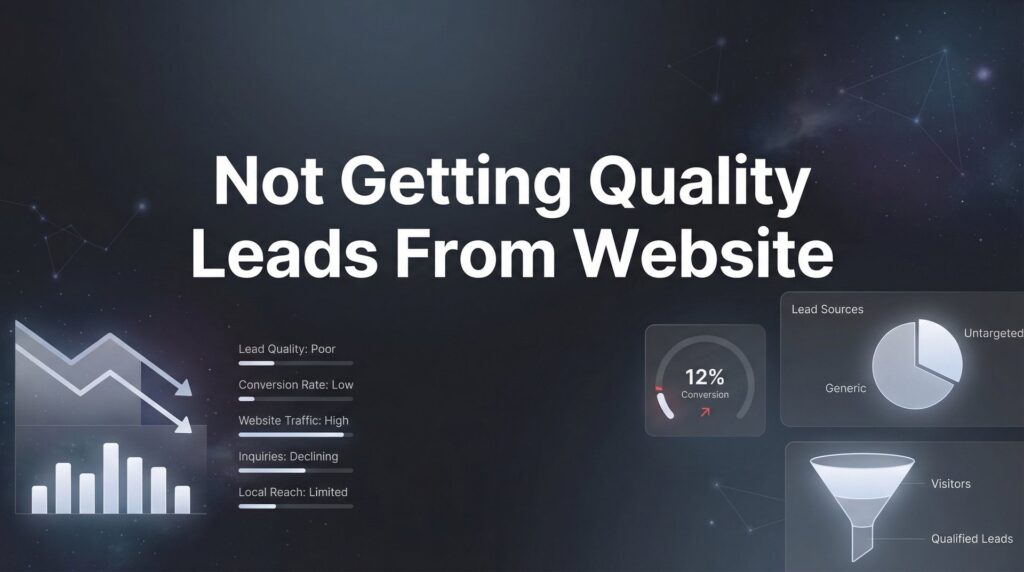
Your website traffic looks decent on paper, but your phone rings with tire-kickers, price shoppers, and people who clearly aren’t a fit for your services. Sound familiar? You’re not alone. Many local business owners find themselves drowning in low-quality leads while struggling to attract the customers who actually convert into profitable revenue.
The problem isn’t that lead generation doesn’t work. It’s that your website is likely attracting the wrong audience, sending mixed signals about who you serve, or failing to qualify visitors before they hit that contact form.
Here’s what’s really happening: Your marketing is doing its job—bringing people to your site. But somewhere in the process, you’re attracting browsers instead of buyers, researchers instead of ready-to-purchase customers, and people looking for bargain-basement pricing when you deliver premium value.
The good news? This is fixable. The solution isn’t about generating more leads. It’s about generating better ones.
In this guide, we’ll walk you through exactly how to diagnose why you’re not getting quality leads from your website and implement targeted fixes that attract serious buyers ready to do business. By the end, you’ll have a clear action plan to transform your website from a lead-quantity machine into a lead-quality engine that brings in customers who actually close.
Step 1: Audit Your Current Lead Sources to Identify the Quality Gap
You can’t fix what you don’t measure. Before making any changes, you need to understand exactly where your quality problem originates.
Start by reviewing your last 30 to 60 days of leads. Create three categories: hot leads (ready to buy, good fit, reasonable budget), warm leads (interested but timing or fit isn’t perfect), and junk leads (price shoppers, wrong service area, unrealistic expectations, or straight-up spam).
Be honest with this categorization. A lead that requires extensive education before they’re ready to buy might feel like progress, but if they rarely convert, they belong in the warm or junk category depending on their ultimate potential.
Next, identify which traffic sources produced each lead. Did they come from Google Ads? Organic search? Facebook? A referral? Direct traffic? Most CRM systems or contact forms can track this automatically, but if yours doesn’t, you’ll need to ask leads how they found you during initial conversations.
The pattern that emerges tells you everything. You might discover that organic search brings you serious buyers while Facebook ads attract price shoppers. Or that certain keywords in your Google Ads campaigns consistently generate tire-kickers who never convert.
Pay special attention to the difference between commercial intent and informational intent in your traffic. Commercial intent keywords include phrases like “hire,” “cost,” “near me,” or “best [service] for [specific need].” Informational intent keywords include “how to,” “what is,” “DIY,” or “free.” If you’re ranking for or bidding on informational keywords, you’re attracting researchers, not buyers.
Success indicator: You can pinpoint exactly where bad leads originate and which channels deserve more investment. You have data showing that X% of your leads from Source A convert while only Y% from Source B ever close. This clarity drives every decision that follows.
Step 2: Refine Your Targeting to Attract Your Ideal Customer Profile
Now that you know where bad leads come from, it’s time to get surgical about who you’re trying to attract.
Define your ideal customer with uncomfortable specificity. Not “small business owners” but “established service businesses with 10-50 employees, annual revenue of $1M-$10M, located within 50 miles, experiencing growth challenges they’re willing to invest $5K-$15K to solve.” The more specific you get, the easier it becomes to filter out everyone else.
This exercise feels risky. You worry that narrowing your focus means turning away potential revenue. But here’s the reality: those budget shoppers and bad-fit prospects were never going to become profitable customers anyway. They were just consuming your time and making you question whether marketing works at all.
Audit your current ad targeting and keyword strategy through this lens. Are you bidding on terms that attract the wrong audience? Keywords containing “cheap,” “affordable,” “discount,” or “budget” attract price-sensitive searchers who will never pay premium rates. Keywords that are too broad (like just “plumber” instead of “emergency plumber for commercial properties”) bring in everyone instead of your ideal customer.
Add negative keywords aggressively to your PPC campaigns. Common negative keywords for service businesses include: free, cheap, DIY, how to, jobs, career, salary, training, course, and any geographic areas you don’t serve. This immediately filters out unqualified searchers before they cost you a click.
For local businesses, geographic targeting matters enormously. If you serve a specific metro area, don’t run ads to the entire state. If you have minimum project sizes, don’t target residential areas when you only serve commercial clients.
Success indicator: Your targeting explicitly excludes audiences unlikely to convert into profitable customers. Your cost per lead might initially increase slightly, but your cost per qualified lead—the metric that actually matters—drops significantly.
Step 3: Rewrite Your Website Copy to Pre-Qualify Visitors
Your website copy does more than explain what you do. It should actively repel bad-fit prospects while attracting ideal customers.
This concept feels counterintuitive. Most businesses want to appeal to everyone. But when you try to speak to everyone, you connect with no one. Worse, you attract people who waste your time.
Add qualifying language throughout your site that signals who you’re for AND who you’re not for. Instead of “We help businesses grow,” try “We help established service businesses with proven products scale from $1M to $5M in revenue.” The first version attracts startups with no budget. The second version attracts exactly who you want.
Include pricing indicators even if you don’t list exact prices. Phrases like “Our typical projects start at $10,000” or “We work with businesses investing $5,000+ monthly in growth” immediately filter out prospects looking for $500 solutions. Yes, some qualified prospects might leave too—but they were going to leave anyway once they learned your pricing. Better to lose them before they waste your sales team’s time.
Mention your service area boundaries upfront. If you only serve a three-county area, say so on your homepage. Don’t bury this information in your footer or wait until someone calls to tell them you don’t serve their location.
Replace vague value propositions with specific outcomes that resonate with serious buyers. Instead of “We deliver results,” specify “We help HVAC companies generate 50+ qualified service calls monthly through targeted PPC campaigns.” Serious buyers want to know exactly what they’re getting. Tire-kickers prefer vague promises they can project their unrealistic expectations onto.
Use case studies and testimonials strategically in your copy. Don’t just showcase any happy customer—feature customers who match your ideal profile. If you want to attract commercial clients, your homepage should feature commercial success stories, not residential ones. This subtly communicates who you serve best.
Success indicator: Visitors self-select out before submitting if they’re not a fit. You might see slightly fewer total leads, but the quality of conversations improves dramatically. Your sales team stops saying “Why did this person even contact us?”
Step 4: Redesign Your Lead Capture Forms to Filter Quality
Your contact form is a gatekeeper. Right now, it’s probably letting everyone through. It’s time to make it more selective.
Add strategic qualifying questions that help you prioritize follow-up. The right questions depend on your business, but consider including: budget range, project timeline, project type or service needed, company size or revenue, and current situation or biggest challenge.
For example, a digital marketing agency might ask: “What’s your monthly marketing budget?” with options like “Under $2,500,” “$2,500-$5,000,” “$5,000-$10,000,” and “$10,000+.” Anyone selecting the first option gets a different response than someone selecting the last option.
A home services company might ask: “When do you need this service?” with options like “Emergency (today),” “This week,” “This month,” and “Just researching for future.” This immediately identifies hot leads who need immediate help versus cold leads who are months away from making a decision.
Use conditional logic in your forms when possible. If someone indicates they’re outside your service area, the form can display a message explaining you can’t help them rather than submitting their information. If someone indicates a budget below your minimum, you can route them to a different resource or automated response.
Balance friction carefully. Too many questions and you’ll lose legitimate prospects. Too few and you’re back where you started with unqualified leads. A good rule of thumb: if the information helps you decide whether to respond within 5 minutes versus 5 hours, it’s worth asking. If it’s just nice-to-know, skip it.
Consider using a two-step form process. Step one captures basic information (name, email, phone). Step two asks qualifying questions. This reduces initial friction while still gathering the information you need. Some prospects will abandon at step two, but those are often the ones who weren’t serious anyway.
Success indicator: Form submissions contain enough information to prioritize follow-up. Your team can look at a new lead and immediately know whether this is a “drop everything and call now” prospect or a “respond when you have time” inquiry.
Step 5: Build Trust Signals That Attract Serious Buyers
Quality leads need quality proof. The trust signals you display should speak directly to the customers you want to attract, not just demonstrate general credibility.
Start with case studies and testimonials from your ideal customer type. If you want to attract enterprise clients, showcase enterprise success stories. If you serve local restaurants, feature restaurant owners raving about results. Generic testimonials from anyone who was happy don’t move the needle with sophisticated buyers.
Structure these testimonials to highlight specific, measurable outcomes. Instead of “Great service, highly recommend!” feature testimonials like “Clicks Geek helped us generate 127 qualified leads in 90 days, resulting in $340K in new revenue. Their targeting strategies eliminated the tire-kickers we used to waste time on.” Serious buyers want to see serious results.
Display certifications, awards, and partnerships that matter to high-value prospects. Being a Google Premier Partner signals expertise and proven results to businesses investing in PPC. Industry-specific certifications demonstrate specialized knowledge. Awards from recognized organizations build credibility.
But be selective. Don’t clutter your site with every badge and certification you’ve ever earned. Feature the ones that matter most to your ideal customer. A local restaurant owner doesn’t care about your MBA. They care about your track record helping restaurants fill tables.
Include social proof that demonstrates results, not just satisfaction. Numbers matter: “500+ businesses served” is less compelling than “Generated $47M in revenue for clients in 2025.” Process descriptions matter: “We’ve managed $12M in ad spend” tells prospects you have experience at scale.
Add trust signals at key decision points throughout your site. Your homepage should establish credibility immediately. Your service pages should include relevant case studies for that specific service. Your contact page should feature testimonials from customers similar to the prospect who’s about to reach out.
Success indicator: Your credibility markers speak directly to the customers you want to attract. When ideal prospects land on your site, they see themselves reflected in your success stories and think “These people understand my business and my challenges.”
Step 6: Implement Lead Scoring and Follow-Up Prioritization
Even with all the filtering you’ve implemented, not all leads are created equal. You need a system to prioritize your time on the prospects most likely to close.
Create a simple lead scoring system based on form responses and behavior signals. Assign points for indicators of quality: high budget selection (+10 points), urgent timeline (+10 points), ideal service area (+5 points), company size in your sweet spot (+5 points), visited pricing page (+5 points), returned to site multiple times (+3 points).
Subtract points for red flags: budget below your minimum (-10 points), timeline is “just researching” (-5 points), outside service area (-10 points), only visited homepage then submitted form (-3 points).
You don’t need fancy software for this. A simple spreadsheet formula can calculate scores automatically based on form responses. The goal is to create an objective way to rank leads so your best prospects get immediate attention.
Set up automated responses that differ based on lead quality tier. High-scoring leads (30+ points) get an immediate email saying “We’ll call you within 15 minutes” and trigger an alert to your sales team. Medium-scoring leads (15-29 points) get a response within a few hours with a calendar link to schedule a call. Low-scoring leads (under 15 points) get an automated email with resources and an invitation to reach out when they’re ready to move forward.
Establish a follow-up protocol that prioritizes high-quality leads within minutes, not hours. Speed matters enormously with hot prospects. Companies that respond to leads within 5 minutes are 100 times more likely to connect than those who wait 30 minutes. But you can’t respond to everyone within 5 minutes—you’d never get other work done. That’s why prioritization matters.
Train your team to recognize quality signals beyond the score. A lead who asks specific, informed questions is higher quality than one asking generic “how much does it cost” questions. A prospect who mentions a competitor or demonstrates they’ve done research is further along than someone starting from zero.
Review your lead scoring system monthly. Track which scored leads actually converted into customers. If high-scoring leads aren’t closing at a higher rate than low-scoring leads, your scoring criteria needs adjustment. This is an iterative process that improves over time as you learn what signals actually predict conversions in your specific business.
Success indicator: Your team spends 80% of their time on the 20% of leads most likely to close. Your sales process becomes more efficient, your close rate improves, and you stop feeling like you’re chasing ghosts who were never going to buy.
Putting It All Together
Transforming your website from a junk-lead magnet into a quality-lead generator isn’t about getting fewer inquiries. It’s about getting the right inquiries.
Start with Step 1 this week: audit your current leads and identify exactly where the quality problem originates. Don’t skip this foundation. You can’t fix what you don’t understand. Once you have clarity on your quality gap, work through each step systematically.
Here’s your quick checklist to track progress:
✓ Lead source audit completed—you know which channels produce quality vs junk
✓ Ideal customer profile documented with uncomfortable specificity
✓ Negative keywords added to campaigns to filter unqualified searchers
✓ Website copy includes qualifying language that repels bad fits
✓ Forms capture qualifying information through strategic questions
✓ Trust signals target and resonate with ideal customers
✓ Lead scoring system active and prioritizing follow-up
Expect to see changes within 30 days. Your total lead volume might drop slightly, but your qualified lead volume should increase. More importantly, your sales conversations will feel different. Instead of educating skeptics and defending your pricing, you’ll be talking with prospects who already understand your value and are ready to discuss how you can help.
The businesses that win in local markets aren’t the ones generating the most leads. They’re the ones generating the best leads and converting them efficiently. Every hour you spend with a bad-fit prospect is an hour you’re not spending with a prospect who would actually buy. Every dollar you spend attracting tire-kickers is a dollar you’re not investing in reaching serious buyers.
This shift requires discipline. You’ll be tempted to loosen your qualifying criteria when leads slow down. Don’t. Stay focused on quality. The revenue follows when you’re talking to the right people.
Need help implementing these fixes faster? At Clicks Geek, we specialize in conversion rate optimization and lead generation strategies that deliver quality over quantity. Our Google Premier Partner team has helped countless local businesses stop wasting time on bad leads and start closing profitable customers.
We don’t just drive traffic. We build systems that attract the right traffic, qualify prospects effectively, and convert serious buyers into revenue. If you want to see what this would look like for your business, we’ll walk you through how it works and break down what’s realistic in your market. No pressure, no generic pitches—just a straight conversation about whether we can help you fix your low quality leads problem.