Imagine you run a great web design agency. Clients love your work, but they always ask, "How do we get traffic to our new site?"
You could build an entire SEO department from scratch—hire specialists, buy expensive tools, and spend months training.
Or, you could partner with an expert SEO firm that does the work behind the scenes. They handle the SEO, you put your brand on the reports, and your client gets amazing results.
That’s what white label digital marketing is all about.
What Is White Label Digital Marketing?
White label digital marketing is a business model where one company (the provider) creates a service, and another company (your agency) rebrands and sells it as its own.
Your clients get expert-level work, like SEO, PPC, or social media management, all under your agency's name. They never know a third-party partner is involved.
This allows you to add new services to your menu instantly without the high costs and risks of hiring new employees.
In Short: White label digital marketing lets you sell another company's expert services under your brand, making you look like a full-service agency without the massive costs.
Who Does What in a White Label Partnership?
To make this crystal clear, it helps to see the roles laid out side-by-side. Think of it as a clear division of labor designed for efficiency.
| Responsibility | White Label Provider (The 'Bakery') | Your Agency (The 'Storefront') |
|---|---|---|
| Service Execution | Handles all the technical work (e.g., running ad campaigns, writing SEO content). | |
| Client Communication | Manages the entire client relationship, acting as the sole point of contact. | |
| Strategy & Direction | Sets the high-level strategy and goals with the client. | |
| Reporting & Deliverables | Creates reports and campaign results, branded with your agency's logo. | |
| Branding | Works completely behind the scenes, remaining anonymous. | All work is presented under your brand, reinforcing your expertise. |
| Billing & Invoicing | Bills your agency at a wholesale rate. | Bills the end client at your retail price, keeping the profit margin. |
This structure ensures everyone plays to their strengths. The provider focuses on execution, and you focus on growth and client satisfaction.
Why Is White Labeling So Popular Now?
The digital marketing industry is growing incredibly fast. The market is projected to rocket from $531 billion in 2022 to a staggering $807 billion by 2026. In a space that competitive, agencies need an edge.
White label partnerships offer that edge. They provide a smart way to handle complex, specialized tasks—like managing intricate Google Ads campaigns or technical SEO audits—without getting bogged down.
This isn't just basic outsourcing; it's a strategic growth model.
- You're in the Driver's Seat: You own the client relationship. You are their main contact and trusted advisor.
- The Partner Does the Work: Your white label provider operates in the background, executing campaigns and analyzing data.
- Your Brand Gets the Credit: Every report and deliverable is branded with your agency's logo.
A perfect example is white label PPC management. An agency can suddenly offer sophisticated advertising services without needing to hire a team of expensive pay-per-click specialists. It’s all about working smarter, not harder.
How a White Label Partnership Actually Works
So you get the basic idea, but what does this look like day-to-day? Let's break down the process. It’s a smooth, behind-the-scenes operation designed to make your agency look like the hero.
Imagine you run a web design agency. A client loves the site you built but now needs help ranking on Google. Instead of saying no, you partner with a white label SEO provider.
The process starts when you land the new client. You handle the sales call and discovery process, just like always. You are the face of the project.
Onboarding and Getting Things Done
Once the contract is signed, you onboard the client. To them, everything looks normal. But behind the scenes, you’re also bringing your white label partner up to speed.
You pass along all the important details—the client’s goals, target audience, competitors, and necessary logins. This is usually done through a shared project management tool or secure portal.
From there, the provider's team of specialists takes over.
- Strategy & Planning: They perform a deep dive, including a full site audit, keyword research, and mapping out a complete campaign strategy.
- Execution: They get to work. This could be anything from fixing technical SEO issues to building high-quality backlinks.
- Ongoing Management: SEO is never a one-and-done deal. The partner's team constantly monitors rankings, analyzes performance data, and adjusts the strategy for better results.
Throughout this entire process, you remain the only point of contact for your client.
This diagram shows just how simple and effective the relationship is.
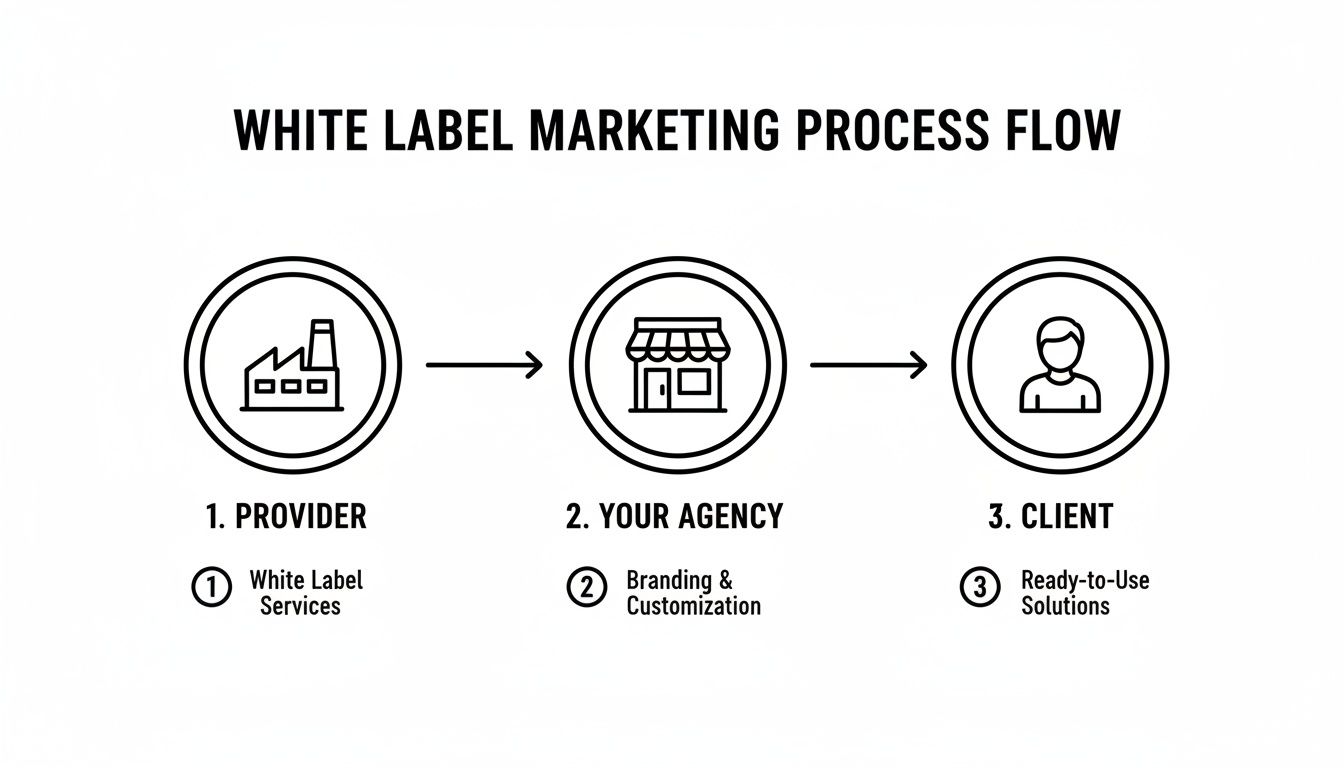
As you can see, the provider does the heavy lifting, you put your name on it, and the client gets a fantastic solution that they believe came directly from you.
Reporting and Keeping Everyone in the Loop
Now for the best part: reporting. Your white label provider creates detailed performance reports with all the key metrics and updates. But these reports are completely unbranded.
You just add your logo, contact info, and maybe a quick summary for the client. The final report that lands in their inbox looks like it was crafted by your in-house team, reinforcing your agency's expertise.
The Bottom Line: In a solid white label partnership, your agency keeps 100% control over the client relationship. The partner handles the technical work and provides the reports, letting you shine in your client's eyes.
What if the client asks a tricky technical question? The process is seamless. You simply send the question to your contact at the partner agency, get a clear, jargon-free answer, and deliver it back to the client. The system is designed to help you grow your service offerings without diluting your brand.
What You Really Get When You White Label
Working with a white label partner is a strategic move that can fundamentally change how you grow your agency. The real benefits go beyond just adding a service—they impact your operations, scalability, and profitability.
Instead of getting stuck in the weeds of hiring and managing, you can focus on building client relationships and closing new business.
Instantly Add New Services (Without the Headaches)
Imagine a great client asks if you can run their Google Ads, but your agency only does SEO. With a white label partner, your answer is, "Absolutely."
Just like that, you've added an expert-level service overnight. This instant scalability is a game-changer.
- Meet client needs on the spot: Never turn away good money because you lack the right staff.
- Attract bigger clients: Go after larger accounts that want a single agency for all their marketing needs.
- Test new offerings with zero risk: Offer a new service through a partner without committing to a new salary.
This flexibility lets you adapt to whatever the market throws at you.
Slash Your Overhead Costs
Building an in-house team is expensive. You're not just paying a salary. You're covering benefits, taxes, software subscriptions, and continuous training. A senior marketing specialist can easily cost over $100,000 per year.
White labeling flips that script.
You swap a massive fixed cost (an employee's salary) for a predictable variable cost. You only pay for the service when you sell it.
All that money saved on overhead goes straight to your bottom line, boosting your profit margins.
Get an Expert Team on Day One
Digital marketing is a world of specialists. A white label partnership gives you a ready-made team of experts who live and breathe their specific channels.
These pros are obsessed with the latest algorithm updates and platform changes. You get the benefit of their deep expertise without paying for their training and certifications.
Make Your Agency Stickier and Boost Client Value
When a client juggles multiple agencies, it's a hassle for them and a risk for you. By offering a full suite of services, you become the only partner they need.
Modern brands see 250% higher engagement and an 89% retention rate when they're active across three or more channels. When you provide those channels, you make your agency indispensable. Discover more insights about these marketing trends and see how they can fuel your growth.
You stop being just another vendor and become a true, irreplaceable part of their team.
Popular White Label Marketing Services You Can Offer
Think of white label digital marketing as your secret weapon for expanding your service menu. It’s how you go from being a specialist to a full-service powerhouse without the overhead.
Let's dive into the most popular and profitable services that agencies are reselling.
White Label SEO Services
Every business wants to rank on Google, but SEO is complex and constantly changing. By partnering with a white label SEO provider, you instantly gain a team of experts to handle the heavy lifting.
SEO services often include:
- Technical SEO: Site audits, page speed optimization, and fixing indexing errors.
- On-Page SEO: Keyword research, content optimization, and building an internal linking structure.
- Local SEO: Optimizing Google Business Profiles for local map searches. A must-have for local businesses.
- Link Building: Running ethical outreach campaigns to earn high-quality backlinks.
The whole concept of what is white label digital marketing really took off because of how complex SEO has become. With AI search now in the mix, having a specialist team is more critical than ever.
White Label PPC Management
Pay-per-click (PPC) ads on platforms like Google Ads can be a goldmine, but they require constant monitoring. A white label PPC partner is a game-changer.
They manage the entire campaign:
- Campaign Setup: Building everything from ad groups and keyword selection to compelling ad copy.
- Ongoing Optimization: Testing ads, tweaking bids, and managing the budget to maximize return on ad spend (ROAS).
- Performance Reporting: Providing clear, professional reports with your logo that show clients exactly what their ad budget is achieving.
This is the perfect service for clients who need leads now. If you're curious, check out this deep dive on white label Facebook Ads.
White Label Content Creation
Clients know they need content, but who has the time or skills? A white label content partner acts as your on-demand creative team.
They can produce anything you need, all under your brand:
- Blog Posts: SEO-friendly articles to build authority and attract organic traffic.
- Website Copy: Persuasive copy for homepages and landing pages that converts.
- Email Newsletters: Engaging content to nurture leads and retain customers.
- Social Media Content: A steady stream of posts, graphics, and captions for various platforms.
Key Idea: By offering these three pillars—SEO, PPC, and Content—you cover the core needs of modern digital marketing. This instantly elevates your agency's status, making you a comprehensive solution that clients will find incredibly valuable and hard to leave.
Popular White Label Services At A Glance
| Service | Primary Goal | Best For Agencies Serving… |
|---|---|---|
| SEO | Increase organic visibility and drive long-term, sustainable traffic. | Local businesses, B2B companies, e-commerce stores, and service providers. |
| PPC Management | Generate immediate leads and sales through paid ad campaigns. | Businesses needing quick results, e-commerce, and lead generation clients. |
| Content Creation | Build brand authority, engage audiences, and support SEO efforts. | Thought leaders, professional services, B2B, and brands with a long sales cycle. |
| Social Media Mgmt | Build community, increase brand awareness, and drive engagement. | B2C brands, e-commerce, restaurants, and personality-driven businesses. |
| Web Development | Create or redesign professional, high-performing websites. | Startups, businesses rebranding, or clients with outdated, clunky websites. |
This table can help you mix and match services to build the perfect package for any client.
How to Choose the Right White Label Partner
Picking the right partner is the most critical decision you'll make. A good partner will feel like an extension of your team. A bad one can damage your reputation.
This isn't about finding the cheapest provider. It's about finding a reliable partner you can trust.
Start With Your Goals
Before you start searching, get clear on what you want to achieve.
Ask your team these questions:
- What specific services do we need to add?
- Which clients will these services be for?
- What does a successful partnership look like in six months?
Having clear answers creates a scorecard to measure potential partners against.
Vet Their Experience and Expertise
Now it’s time to dig into their track record. A great partner should be happy to show off their work.
Here’s a simple checklist:
- Proven Case Studies: Ask for real-world examples of their work with results similar to what you want for your clients.
- Sample Reports: Get a sample client report. Is it professional and easy to understand? This is what your clients will see.
- Client Testimonials: Find out what other agencies are saying about them. Honest reviews provide a behind-the-scenes look.
To get a broader perspective on successful collaborations, it's often useful to see how other ecosystems work, like the world of Shopify agency partners.
Understand Their Process and Communication
How a partner operates is just as important as the quality of their work. You need a team that communicates clearly and has an organized workflow.
Key Question: Ask potential partners, "Walk me through your onboarding process for my team and for a new client." Their answer will tell you how organized they are.
A solid partner will have a documented system for everything. They should also give you a dedicated account manager—a single point of contact to keep things simple.
Review Pricing and Agreements
Finally, get into the details of the contract and pricing. Transparency is non-negotiable. You need to know exactly what you’re paying for. You can learn about different white label agency pricing models to see what's standard.
Look closely at their service level agreement (SLA). This document should outline turnaround times, reporting schedules, and confidentiality clauses. A trustworthy partner will have a fair, straightforward agreement.
Common Pitfalls and How to Avoid Them
White label partnerships can be a game-changer, but it’s smart to be aware of potential challenges.
The good news? The most common issues are avoidable if you know what to look for.

Loss of Control Over Quality
This is the number one fear for most agency owners. When you're not doing the work yourself, it’s natural to worry if the quality will meet your standards.
How to Avoid It:
Create a solid review process before anything gets to your client.
- Vet Providers Thoroughly: Dig into their case studies and always ask for real work samples.
- Create Your Own QA Checklist: Use an internal checklist to review every deliverable from your partner.
- Run a Small Test Project: Before signing a long-term contract, give them a small, low-risk project to see how they work.
Gaps in Communication
Poor communication can kill a partnership. Vague instructions or missed deadlines can create nightmares.
Pro Tip: Never assume your partner is a mind reader. Over-communicating is always the right call, especially at the beginning.
How to Avoid It:
Set clear communication expectations from the start.
- Use Shared Tools: Use a project management tool like Asana or ClickUp, or a dedicated Slack channel.
- Schedule Regular Check-ins: A quick 15-minute weekly call can prevent problems before they grow.
- Write Detailed Briefs: The more detail you provide about the client's goals and needs, the better the final result will be.
If you're still weighing the pros and cons, our guide on whether you should hire a white label PPC service or do the work in-house can help you find some clarity.
Choosing a Partner Based Only on Price
It's tempting to go with the cheapest option, but it's usually a mistake. The lowest bidder often cuts corners on quality or communication. This ends up costing you more in lost clients and headaches than you "saved" on the price. Always prioritize value and reliability.
Frequently Asked Questions (FAQs)
Here are the most common questions agency owners ask about white label digital marketing.
How Much Does White Label Marketing Cost?
There’s no single price tag. Pricing depends on the service. However, most white label partners use a few simple models:
- Flat Monthly Retainer: For ongoing work like SEO. You pay a set fee each month for each client.
- Percentage of Ad Spend: Standard for PPC. The partner takes a percentage of the client's monthly ad budget.
- Fixed Project Fee: For one-off jobs, like a new website or a content package.
A good partner will be transparent about their costs, so you can easily mark them up—most agencies aim for a 40% to 60% margin.
Is White Labeling the Same as Outsourcing?
Not exactly. Outsourcing is just delegating a task to a third party. They might communicate with your client, and their brand might be visible.
White labeling is a specific type of outsourcing where the third party remains completely anonymous. All work is delivered under your brand, making it a seamless experience for your client.
Will My Clients Find Out I’m Using a Partner?
No, not if you choose the right partner. The entire system is designed to be invisible to your client.
Your white label provider is your silent partner. Everything that reaches your client has your name and logo on it.
- Performance reports? Your brand.
- Client dashboards? Your brand.
- Emails and presentations? All from you.
You are the star of the show; your partner is the behind-the-scenes crew making you look good.
How Do I Start a White Label Business?
Starting a white label business (as a provider) involves three main steps:
- Develop an Expert Service: Master a specific marketing skill, like SEO or PPC, and create a repeatable process for delivering great results.
- Create Unbranded Materials: Build a suite of unbranded reports, dashboards, and sales materials that agencies can easily rebrand.
- Network with Agencies: Reach out to marketing agencies that could benefit from your services. Offer a partnership that helps them scale without the overhead.
How Do We Onboard a New Client?
The onboarding process is designed to be simple. Your job is to manage the relationship; your partner’s job is to handle the heavy lifting.
You run the sales process and initial discovery call. Once the client signs, you pass the project details to your partner through an intake form or a kickoff call. From there, their technical team takes over execution, while you focus on keeping your client happy.