As a local business owner, you're competing for attention in a noisy online world. A solid digital marketing plan isn't just helpful—it's essential. It’s about showing up exactly where your customers are already looking: on their phones and computers.
The goal is simple: get more calls, more website visits, and more people walking through your door. This guide avoids confusing jargon and focuses on what actually works for businesses like yours, whether you're a plumber, a cafe owner, or a contractor.
In Short: Digital marketing helps you get found online by local customers who are ready to buy.
Find Customers in Your Neighborhood
Digital marketing for local businesses lets you focus on people in your immediate service area. Instead of wasting money on broad ads, you can target potential customers just a few miles away. This is a game-changer for any local service provider.
The journey from a customer finding you to hiring you often follows a clear path, starting with search and moving to paid ads.
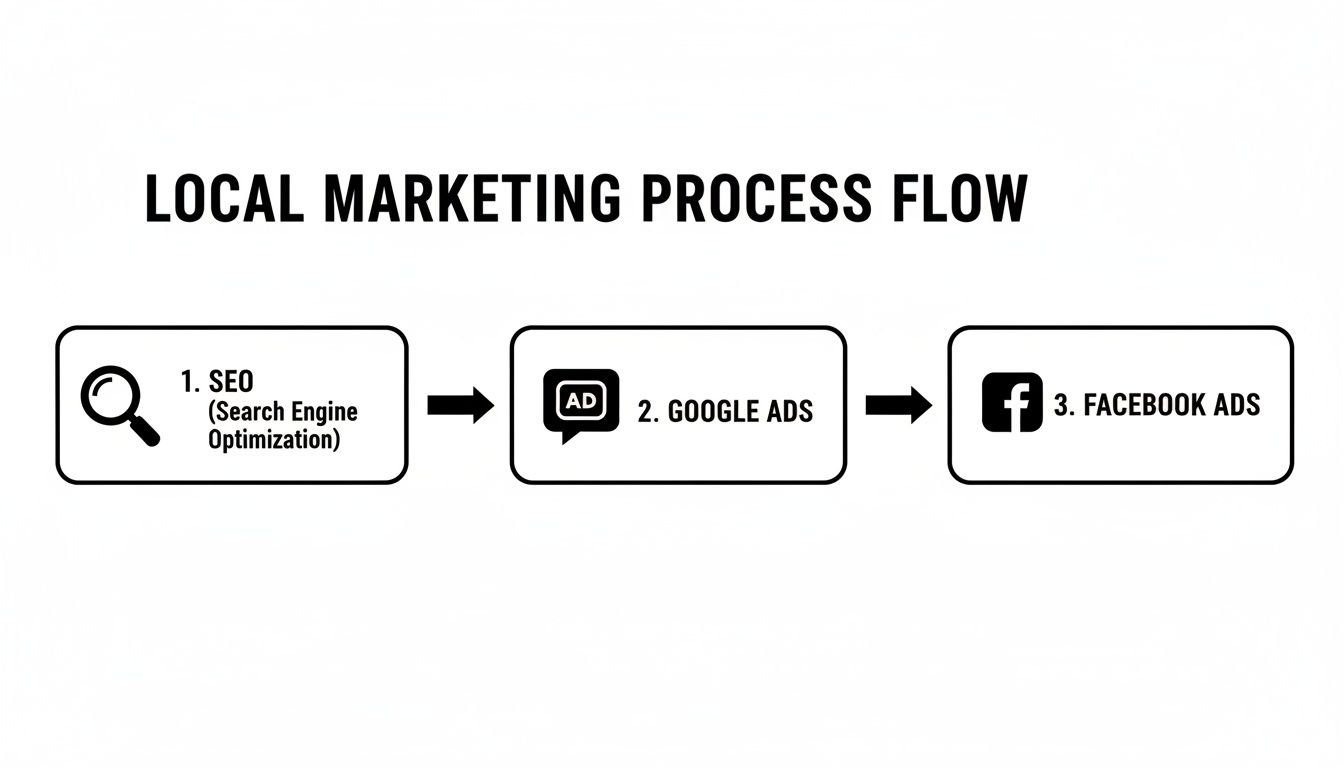
This flow—from Local SEO to targeted ads—is the foundation of a strategy that captures local customers and keeps your business top of mind.
How do I promote my small business locally?
To promote your small business locally, focus on these key areas:
- Optimize your Google Business Profile (GBP): This is the most critical step for appearing in local search and on Google Maps.
- Run targeted ads: Use Google Ads for "near me" searches and Facebook Ads for community awareness.
- Engage in local SEO: Build a website with location-specific pages and gather local citations.
- Get customer reviews: Positive reviews on Google and other sites build trust and improve rankings.
The numbers don't lie: 18% of local searches lead to a sale within 24 hours. That simple Google query can turn into cash in your pocket. It's why 59% of small and medium-sized businesses (SMBs) make local SEO their top priority. They know it's a direct line to growth.
To learn more, you can check out these 10 essential local business marketing strategies. But in this guide, we’ll focus on the tactics that drive the best results.
The Winning Trio: SEO, Google Ads, and Facebook
We're going to break down three powerful channels:
- Local SEO: Get your business to show up in the Google "Map Pack" for local searches.
- Google Ads: Jump to the top of search results to capture people ready to buy.
- Facebook Ads: Build awareness in your community and encourage repeat business.
By the end, you’ll have a clear, actionable playbook to drive real growth.
Key Digital Channels for Local Business Growth
Here’s a quick breakdown of the core digital channels and what they do best.
| Channel | Primary Goal | Best For |
|---|---|---|
| Local SEO | Get found in "near me" searches & Google Maps | Generating consistent, high-quality organic leads |
| Google Ads | Capture immediate, high-intent search traffic | Businesses needing leads now (e.g., emergency services) |
| Facebook Ads | Build community awareness & drive repeat business | Promoting special offers & staying top-of-mind |
Think of these channels as your core toolkit. They work best when used together to attract and retain local customers.
How to Win with Local SEO
When someone in your town needs a plumber right now or searches for a "roofer near me," they go to Google. Your mission is to be the first name they see. This starts with getting the fundamentals of local search right.
This isn't about secret SEO tricks. It’s about building a solid digital foundation so that Google sees your business as the best local answer.
The cornerstone of this is your Google Business Profile (GBP). It's your digital storefront on Google Search and Maps. It’s free, powerful, and absolutely necessary if you want local customers to find you. Optimizing your profile can double your inbound calls.
Nail Your Google Business Profile Setup
Getting your GBP right from the start is everything. Each field you fill out is a signal to Google about what you do, where you are, and why you’re trustworthy.
Here's a simple checklist:
- Keep NAP Consistent: Your Name, Address, and Phone Number (NAP) must be identical everywhere online. Don't use "St." on one site and "Street" on another. Consistency builds trust with search engines.
- Pick the Right Categories: Be specific. Your primary category should be your main service, like "Plumber." Then add secondary categories for everything else you do. This is a huge ranking factor.
- Write a Real Description: Don't just stuff it with keywords. Tell people what makes you the best choice. Talk about your experience and the neighborhoods you serve.
- Upload Good Photos: Show your team at work, your branded vans, before-and-after shots, and your storefront. Aim for at least 10-15 quality photos. Visuals build instant trust.
- Turn on Messaging & Q&A: Make it easy for people to reach you. Enable messaging and add common questions and answers to the Q&A section.
In Short: A complete and updated Google Business Profile is the most important thing you can do for local SEO.
Your Website and Local Authority
Your GBP is the hook, but it works best when tied to a locally-focused website. Your site is where you close the deal by detailing your services.
Many businesses drop the ball here. A generic "Services" page isn't enough. You need dedicated pages for each service and each neighborhood you serve.
Create Hyper-Local Service Pages
People search for specific things, like "roofer in Brookside." Creating pages that target these searches is a game-changer.
For example, a plumber could create pages like:
yourwebsite.com/emergency-plumber-brooksideyourwebsite.com/drain-cleaning-maplewoodyourwebsite.com/water-heater-repair-oak-hill
Each page needs unique content. Talk about the service in the context of that location. Mention a local landmark. This shows Google you are relevant to that area. For a deeper dive, there's a great guide on local maps SEO.
Build Local Trust and Authority
Google wants to see that you're a real part of the community. It measures this through local citations and backlinks.
Here are a few ways to build this authority:
- Get Listed in Local Directories: Use Yelp, Angi, and industry-specific sites. Keep your NAP consistent.
- Sponsor a Local Event: Getting a link from a local 5K run or festival website is gold for local SEO.
- Join the Chamber of Commerce: Most have an online member directory, which is an easy and valuable link.
- Partner Up: Write a testimonial for a non-competing local business in exchange for a link.
Winning in local search takes time. It's about providing accurate information, creating helpful local content, and proving you're a trusted name in your town.
Creating Simple Content That Attracts Customers
"Content marketing" sounds complicated, but for a local business, it's simple. You don't need to be a publisher. Just answer the questions your customers are already Googling.
When you create helpful content, you build trust and become the local expert. It’s about solving real problems for people in your community.
Answer Your Customers' Questions
The best content ideas come from your customers' biggest problems. Your blog should be a resource that guides them toward your service as the solution.
Think about the advice you give people every day. That's your content.
- For a plumber: A post like "5 Signs You Need a Plumber" can catch someone early in their search.
- For a painter: An article on "How to Choose the Right Paint Finish" helps a homeowner planning a project.
- For an HVAC company: A guide titled "Why Is My AC Making That Noise?" directly answers a common search.
This type of content helps you show up in search results before your competitors and builds a relationship with potential customers.
Showcase Your Local Work
Your local projects are your best marketing assets. Turn each project into a short case study. This gives Google fresh content and provides social proof.
For example, a contractor could create a blog post titled "A Modern Kitchen Remodel in the Northwood Neighborhood." In it, you can:
- Talk about the customer's problem: Explain what they wanted to fix.
- Walk through your solution: Show the steps you took and highlight your craftsmanship.
- Post before-and-after photos: Visuals provide clear proof of your work quality.
- Name the specific location: Mentioning the town helps you rank for hyper-local search terms.
This strategy connects your services to real results in the communities you serve, making your business feel more trustworthy.
In Short: Don't just talk about your services; demonstrate your expertise with real-world examples and helpful advice.
How effective is digital marketing for small businesses?
Digital marketing is highly effective. Small businesses that blog consistently attract 55% more website traffic. Blogging is often the top channel for ROI for local service providers. You can find more small business marketing statistics over at Sixth City Marketing.
How Do I Get Started with a Business Blog?
Getting started is the hardest part. Just focus on being consistently helpful.
- Brainstorm 5-10 common customer questions.
- Write a short, simple answer for each one.
- Post one new article every week or two. Consistency is more important than frequency.
This approach is a sustainable way to grow your local online presence and attract a steady stream of new leads.
Getting Leads Now with Paid Ads
SEO is a long-term strategy. But sometimes you need the phone to ring today. That’s where paid advertising comes in.
For local businesses, this means Google Ads and Facebook Ads. Think of Google as your hammer for immediate, high-intent leads. Facebook is your paintbrush for building brand awareness.
Using both creates a powerful machine for generating leads on demand.
Use Google Ads to Find Customers with a Problem
When a homeowner's AC breaks, they search Google for "emergency AC repair near me."
With Google Ads, you pay to jump to the front of the line. Your business appears at the top, ready to be the solution. This is about capturing high-intent customers.
A winning Google Ads strategy for a local business includes:
- Hyper-Local Targeting: Don't waste money on clicks from outside your service area. Target a tight radius—like 5 or 10 miles—or specific zip codes.
- Urgent Ad Copy: Speak directly to the searcher's problem. Use headlines like "24/7 Emergency Plumbing" or "Same-Day Roof Repair Quote."
- Local Service Ads (LSAs): For home service businesses, LSAs are a game-changer. They appear at the top of search results with a "Google Guaranteed" badge, which builds trust. You only pay when a customer calls you through the ad.
Setting up your ads correctly is crucial. For a deeper dive, there are great resources on using Google Ads for lead generation.
Build Your Brand with Facebook Ads
Facebook Ads are different. You’re not catching people actively searching. Instead, you're interrupting their scroll with a relevant message. This makes Facebook great for building your local brand.
A landscaper could run video ads in the spring targeting homeowners in certain neighborhoods. A local gym could target people nearby who are interested in fitness.
55% of U.S. small business owners use social media ads, and 84% of them report strong results.
Pro Tip: Use retargeting on Facebook. Set up an ad that only shows to people who have recently visited your website. It's a perfect way to bring back warm leads.
If designing ads isn't your thing, services that offer Done For You Ads can help.
Google Ads vs. Facebook Ads
The best answer is to use "both," but they serve different purposes.
| Feature | Google Ads | Facebook Ads |
|---|---|---|
| User Intent | Active. People are searching for a solution now. | Passive. People are browsing, not looking to buy. |
| Best For | Capturing immediate demand (e.g., plumbers, roofers). | Building brand awareness (e.g., restaurants, gyms). |
| Targeting | Based on keywords and search terms. | Based on demographics and interests. |
| Cost Model | Pay-Per-Click (PPC). | Cost-Per-Impression (CPM) or PPC. |
Use Google Ads to be the answer when a customer has a problem. Use Facebook Ads to introduce yourself before they even know they need you.
Turning Website Clicks Into Paying Customers
Getting a click on your ad is just the start. The real work begins when they land on your site. You need to turn that curious browser into a paying customer.
Make it incredibly easy for them to take the next step. A confusing or slow website will waste the money you spent on that click.
What Makes a Good Landing Page?
A great landing page is about clarity and trust. If someone clicks your ad for "emergency roof repair," the page needs to instantly confirm they're in the right place.
Here are the must-haves for a local business landing page:
- A Headline That Matches the Ad: If your ad says "24/7 Plumbers," your headline should say the same.
- A Clear Call-to-Action (CTA): Use big, obvious buttons like "Call for a Free Quote." Your phone number should be large and clickable.
- Social Proof: Include real customer reviews, photos of your team, and any local awards.
- A Simple Contact Form: Only ask for what you need: name, phone, email, and a message box.
Nailing these fundamentals makes a huge difference. You can learn how to improve website conversion rate with just a few changes.
Know Which Ads Are Working
Once the phone rings, you need to know which ads are working. Call tracking is your secret weapon.
Call tracking provides unique phone numbers for each marketing channel—one for Google Ads, one for Facebook, etc.
When a customer calls, the system logs where the call came from. You'll know exactly which campaigns are driving calls and which are not.
Never Miss a Lead with AI Assistants
What happens when a customer calls at 10 PM? In the past, that lead was lost.
Modern AI call assistants can answer your phone 24/7. They can have a full conversation with the caller.
These assistants can:
- Answer common questions.
- Qualify the lead.
- Book appointments directly on your calendar.
- Text you a summary of the conversation.
This ensures you capture every opportunity, even when you're busy.
In Short: Getting clicks is just the start. A trustworthy landing page, call tracking, and AI assistants help you turn your marketing spend into real revenue.
What are the best ways to track marketing for a small business?
Pouring money into marketing without measuring results is like flying blind. You need to connect your marketing dollars to actual results, like phone calls and booked jobs.
Focus on the metrics that matter for a local business:
Google Business Profile (GBP) Insights: This is your local SEO scoreboard. Track clicks for directions, website visits, and calls from your Google listing. If these numbers are rising, your local search presence is getting stronger.
Cost Per Lead (CPL): This is the most important metric for your paid ads. The math is simple: total ad spend / number of leads. Your CPL tells you exactly what you're paying to make your phone ring.
For example, if a new HVAC installation brings in $1,500 in profit and your CPL is $75, you're in a great position. But if your CPL climbs to $300, it's time to review your campaigns.
Watching these metrics removes the guesswork and helps you invest your budget wisely.
Frequently Asked Questions
Here are a few common questions from business owners like you.
What's a Realistic Marketing Budget for a Small Business?
There's no magic number, but a good rule of thumb is 5-10% of your total revenue. If you're just starting, a few hundred dollars a month is enough to get your local SEO in order and run a small Google Ads campaign.
The Bottom Line: Start with a budget you're comfortable with. Track every dollar, find out what works, and then double down on the winners.
I Have a Facebook Page, Do I Still Need a Website?
Yes, 100%.
Your website is your digital home base—the only place online you truly own. Your Facebook page and Google Business Profile are great, but you're just renting space there.
A professional website gives you credibility and lets you control the customer journey. All your marketing efforts should lead back to it.
Seriously, How Long Until Local SEO Starts Working?
Local SEO is a marathon, not a sprint. You might see quick wins in a few weeks after optimizing your Google Business Profile.
But to rank consistently for competitive local keywords (like "roofer near me"), you should expect 3 to 6 months of consistent effort. This includes getting new reviews, building local content, and ongoing optimization.
If you need leads today, paid ads are your best bet for immediate results.
At Clicks Geek, we specialize in these strategies. We help local businesses get a flood of new calls, leads, and paying customers every day. If you're ready to build a customer acquisition machine, let's talk. Learn more at Clicks Geek.