You’re spending money on PPC ads, but are you actually getting the returns you deserve? Most business owners launch campaigns and hope for the best—then wonder why their cost per lead keeps climbing while conversions stay flat.
Here’s the truth: running PPC ads isn’t the same as optimizing them.
The difference between a mediocre campaign and a profit-generating machine comes down to systematic optimization. At Clicks Geek, we’ve seen countless businesses transform underperforming campaigns into consistent lead-generating assets by following a disciplined approach to PPC campaign optimization.
Think of it this way: launching a PPC campaign without optimization is like planting a garden and never watering it. You might get some results by accident, but you’re leaving massive growth on the table.
Whether you’re managing Google Ads, Microsoft Ads, or social PPC, the principles remain the same. This guide walks you through the exact process we use to squeeze maximum value from every advertising dollar. By the end, you’ll have a repeatable framework that turns guesswork into predictable, profitable growth.
Step 1: Conduct a Comprehensive Performance Audit
Before you optimize anything, you need to understand where you actually stand. Most businesses skip this step and start making changes based on hunches rather than data. That’s expensive.
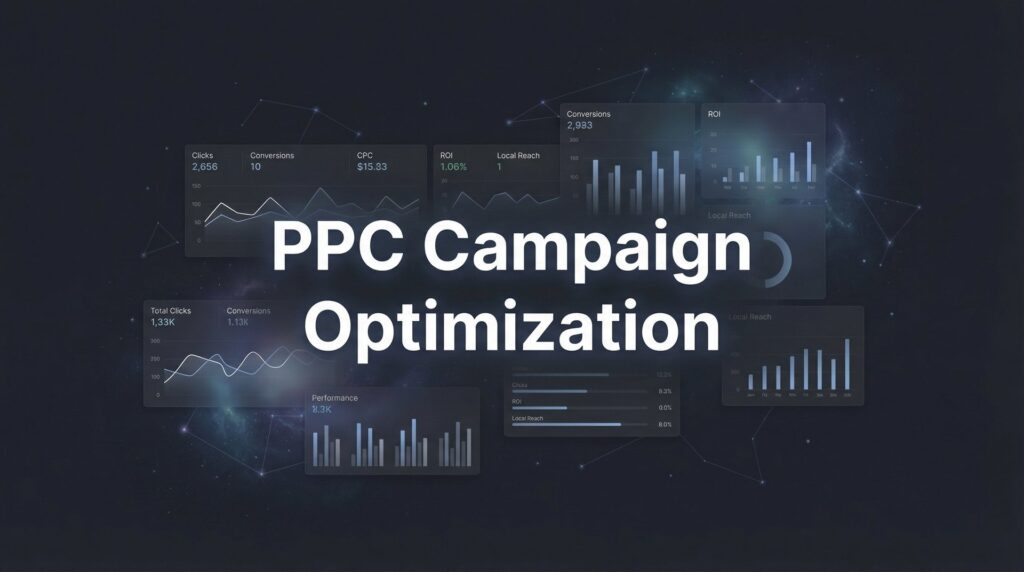
Start by pulling your key performance metrics from the last 30 days. You’re looking for five critical numbers: click-through rate (CTR), conversion rate, cost per conversion, quality score, and impression share. These metrics tell you everything about campaign health.
Click-Through Rate: Your CTR reveals whether your ads resonate with searchers. If people see your ad but don’t click, your messaging is off or you’re targeting the wrong audience.
Conversion Rate: This shows whether clicks turn into actual business results. A high CTR with low conversions means your landing page or offer needs work.
Cost Per Conversion: This is your reality check. You might be getting conversions, but if each one costs more than it’s worth to your business, you’re losing money with every click.
Quality Score: Google’s quality score directly impacts what you pay per click. Higher scores mean lower costs and better ad positions. If your scores sit below 7, you’re overpaying.
Impression Share: This metric shows how often your ads appear when they could. Low impression share means you’re missing opportunities because of budget constraints or low ad rank.
Now comes the crucial part: identify your money drains. Drill down to the campaign and ad group level. Which ones consume budget without delivering conversions? You’ll typically find that 20% of your campaigns generate 80% of your results, while the rest just burn cash. For a deeper dive into this process, check out our Google Ads optimization guide that covers these metrics in detail.
Document everything. Write down your baseline numbers. You need this benchmark to measure improvement after you implement changes. Without it, you’re flying blind.
Compare your metrics against industry standards for your business type. Local service businesses typically see conversion rates between 3-5%, while e-commerce might run 1-2%. If you’re significantly below these benchmarks, you’ve identified your first optimization opportunity.
Step 2: Rebuild Your Keyword Foundation
Your search terms report is a goldmine most advertisers ignore. It shows the actual queries triggering your ads—and this is where you’ll find your biggest waste.
Pull your search terms report for the last 30 days. Sort by cost, then start reading. You’ll likely find dozens of irrelevant searches eating your budget. Someone searching “free PPC tools” isn’t ready to hire an agency. Someone searching “PPC management services near me” is.
Build your negative keyword list aggressively. Add any term that doesn’t align with buyer intent. Common negatives for service businesses include “free,” “DIY,” “jobs,” “salary,” “course,” and “tutorial.” These searches represent tire-kickers, job seekers, or people looking to do it themselves—not qualified prospects.
Here’s where most businesses get it wrong: they treat all keywords equally. You need to segment by intent.
Informational Intent: Searches like “what is PPC” or “how does Google Ads work” represent early-stage researchers. These typically waste budget for local service businesses because the searcher isn’t ready to buy.
Transactional Intent: Terms like “hire PPC agency” or “PPC management services” signal buying readiness. These should get the bulk of your budget and most aggressive bids. If you’re new to paid search advertising, understanding this distinction is critical to avoiding wasted spend.
Navigational Intent: Branded searches where someone looks for a specific company. If they’re searching for your brand, bid on it. If they’re searching for competitors, bid strategically but carefully—it’s expensive.
Now let’s talk match types. The landscape has shifted significantly. Broad match has become more intelligent with Google’s machine learning, but it still requires careful management.
Use exact match for your highest-converting, most profitable keywords. You’ll pay more per click, but you’re guaranteeing relevance. Use phrase match for related variations where you want some flexibility but need to maintain control. Use broad match only when you have robust negative keyword lists and sufficient conversion data for Google’s algorithms to optimize effectively.
The biggest mistake? Using broad match on new campaigns without conversion history. You’ll burn through budget testing irrelevant variations before the algorithm learns what works.
Step 3: Transform Your Ad Copy Performance
Your ad copy has one job: get qualified clicks. Not just any clicks—clicks from people likely to convert.
Start with your headlines. These carry the most weight in both user attention and quality score. Your headline should immediately address the searcher’s specific need or pain point. If someone searches “emergency plumber near me,” your headline better include “24/7 Emergency Plumber” or “Same-Day Plumbing Repair.”
Include your primary keyword naturally in at least one headline. This improves relevance scores and reassures the searcher they’ve found what they need. But don’t just stuff keywords—make it read naturally.
Test different value propositions systematically. What matters most to your audience? Run ads emphasizing different benefits and let the data tell you what resonates.
Price-Focused: “Starting at $99” or “No Hidden Fees” works when you’re competitively priced and dealing with price-conscious buyers.
Speed-Focused: “Same-Day Service” or “Results in 30 Days” appeals to urgency-driven buyers who need solutions fast.
Quality-Focused: “Certified Experts” or “Award-Winning Service” attracts buyers willing to pay more for proven expertise.
Guarantee-Focused: “Money-Back Guarantee” or “Satisfaction Guaranteed” reduces risk and builds trust with hesitant buyers.
Here’s what separates amateur ads from professional ones: extensions. Use every relevant extension available. Sitelink extensions let you showcase multiple services or pages. Callout extensions highlight key benefits. Structured snippets display service categories or brands you work with. Call extensions make it easy for mobile users to contact you immediately.
Extensions don’t just give you more real estate—they improve your quality score and click-through rate. Ads with extensions consistently outperform those without. Yet most small business campaigns leave this opportunity untapped. Understanding why marketing campaigns fail often comes down to overlooking these foundational elements.
Write at least three ad variations per ad group. Google will automatically rotate them and show which performs best. This gives you continuous optimization without manual work.
Step 4: Create Landing Page Alignment
You can have perfect keywords and brilliant ad copy, but if your landing page doesn’t deliver on the promise, you’ve wasted the click.
Message match is non-negotiable. If your ad headline says “Same-Day AC Repair,” your landing page headline better say something nearly identical. When there’s disconnect between ad and page, visitors bounce. They clicked expecting one thing and got something else.
Check your page load speed right now. Use Google’s PageSpeed Insights tool. If your page takes longer than three seconds to load, you’re losing conversions before visitors even see your content. Studies consistently show that every additional second of load time drops conversion rates significantly.
Optimize images by compressing them without losing quality. Remove unnecessary scripts and plugins. Enable browser caching. Use a content delivery network if you’re targeting multiple geographic areas. Speed isn’t optional—it’s foundational.
Your call-to-action needs to be crystal clear and above the fold. Visitors shouldn’t have to scroll to understand what action you want them to take. Use contrasting colors for CTA buttons. Make the text action-oriented: “Get Your Free Quote” beats “Submit” every time. For more strategies on improving page performance, explore our guide to landing page optimization services.
Here’s a critical mistake most businesses make: they include full navigation menus on PPC landing pages. Every link is an exit opportunity. Your landing page has one goal—conversion. Remove the main navigation. Eliminate footer links. Get rid of anything that distracts from the primary conversion action.
Think of your landing page as a focused conversation, not a website tour. The visitor came for a specific solution. Give them exactly that, make it easy to take action, and remove everything else.
Test your forms ruthlessly. Ask only for information you absolutely need. Every additional field drops conversion rates. If you can follow up with a phone call to get details, don’t require them in the form. Name, phone, and email often suffice for initial contact.
Step 5: Optimize Your Bidding Strategy
Your budget allocation reveals whether you understand your numbers or you’re just hoping for the best.
Start by identifying your winners and losers at the campaign level. Pull a report showing cost per conversion by campaign. Rank them from most to least efficient. Now shift budget from the bottom performers to the top performers. This sounds obvious, but most businesses keep feeding money into campaigns that haven’t converted profitably in months.
Choosing the right bidding strategy depends on your goals and data volume. If you’re generating fewer than 30 conversions per month, automated bidding strategies don’t have enough data to optimize effectively. Stick with manual CPC bidding and adjust based on performance.
Once you’re consistently generating 30+ conversions monthly, you can test automated strategies. Target CPA works well when you know exactly what you can afford to pay per conversion. Maximize conversions helps when you want volume and have a fixed budget. Target ROAS makes sense when you’re tracking actual revenue values and need specific return multiples. Understanding PPC campaign management cost helps you set realistic expectations for what you should be spending.
Here’s where granular optimization pays off: bid adjustments. Your campaigns don’t perform equally across devices, locations, and times of day.
Device Adjustments: Check your conversion rates by device. If mobile converts at half the rate of desktop, reduce mobile bids by 30-50%. If mobile converts better, increase bids there.
Location Adjustments: For local businesses, some zip codes or cities will vastly outperform others. Increase bids in high-converting areas. Decrease or exclude locations that consistently waste budget.
Time of Day Adjustments: Run a day and hour report. You might discover that conversions happen primarily during business hours while evening clicks rarely convert. Reduce bids during low-performing hours or pause ads entirely.
The manual versus automated bidding debate misses the point. Use manual bidding when you need tight control and don’t have conversion volume. Use automated bidding when you have sufficient data and want to scale. Often, the best approach combines both—manual bidding for new or low-volume campaigns, automated for proven, high-volume campaigns.
Step 6: Build a Testing and Measurement System
If you’re not tracking conversions accurately, every optimization decision is guesswork. Set up conversion tracking properly before you do anything else.
For Google Ads, implement conversion tracking through Google Tag Manager or directly via the Google Ads tag. Track meaningful actions: form submissions, phone calls, chat initiations, purchases. Don’t just track page views—track actions that indicate genuine business interest. Implementing call tracking for marketing campaigns is essential for businesses that generate leads via phone.
Verify your tracking works. Submit a test form or make a test call. Check that it appears in your conversions report. You’d be surprised how many businesses run campaigns for months with broken tracking.
Now establish your testing framework. A/B testing isn’t optional—it’s how you improve systematically. But test one variable at a time, or you won’t know what caused the change.
Ad Copy Tests: Run two ads per ad group with one element changed. Different headline, same description. Different CTA, same headline. Let them run until you have statistical significance—typically 100+ clicks per variation.
Landing Page Tests: Test headlines, images, form length, button colors, and copy length. Use tools like Google Optimize or Unbounce to split traffic evenly between variations.
Audience Tests: Try different audience segments, remarketing lists, or customer match lists. Some audiences will convert at multiples of your baseline rate.
Create a weekly optimization routine. Consistency matters more than complexity. Every Monday, spend 30 minutes reviewing the previous week’s performance. Add negative keywords. Pause underperforming ads. Adjust bids based on new data. This regular maintenance prevents small issues from becoming expensive problems.
Build a reporting dashboard that shows your critical metrics at a glance. You should be able to open one screen and see: total spend, total conversions, cost per conversion, conversion rate, and ROAS. When these numbers are visible daily, you’ll catch problems immediately instead of weeks later. Understanding how to optimize your conversion funnel helps you identify exactly where prospects drop off.
Your Optimization Action Plan
PPC campaign optimization isn’t a one-time project—it’s an ongoing discipline that separates profitable advertisers from those who waste money hoping for different results.
Start with a thorough audit to understand your current reality. Restructure your keywords to eliminate waste and focus on buyer intent. Sharpen your ad copy to speak directly to searcher needs. Align your landing pages with ad promises and remove conversion barriers. Optimize your bidding based on actual performance data, not assumptions. Commit to continuous testing and measurement.
Here’s your quick-start checklist to implement immediately:
Pull your last 30 days of campaign data today and identify your baseline metrics.
Review your search terms report and identify your top three wasted spend areas.
Add at least 20 negative keywords this week based on irrelevant search queries.
Write and test one new ad variation per ad group focusing on different value propositions.
Check your landing page load speed and optimize any pages loading slower than three seconds.
Set up weekly bid reviews and adjust based on device, location, and time performance.
Verify your conversion tracking is working accurately before making major changes.
The businesses that win with PPC aren’t necessarily the ones with the biggest budgets. They’re the ones who optimize relentlessly, test systematically, and make data-driven decisions instead of guessing.
When you’re ready to stop guessing and start scaling, Clicks Geek specializes in turning PPC campaigns into predictable lead-generation systems for local businesses. We focus on what actually matters: qualified leads that turn into measurable revenue growth. If you want to see what this would look like for your business, we’ll walk you through how it works and break down what’s realistic in your market.
Want More Leads for Your Business?
Most agencies chase clicks, impressions, and “traffic.” Clicks Geek builds lead systems. We uncover where prospects are dropping off, where your budget is being wasted, and which channels will actually produce ROI for your business, then we build and manage the strategy for you.