Starting a digital marketing agency involves four key steps: defining your niche, setting up your legal and financial basics, packaging your services, and landing your first clients. The most critical first step in learning how to start a digital marketing agency is to specialize. Avoid being a generalist and become the known expert for a specific industry or service. This focus simplifies every other step.
Step 1: Find Your Niche And Core Services

The biggest mistake new agency owners make is trying to serve everyone. The digital marketing space is crowded. To stand out, you must specialize.
Focusing on a niche makes your marketing simpler. It also allows you to charge premium prices because you are positioned as an expert, not a jack-of-all-trades.
Think about it: instead of targeting "local businesses," get laser-focused. Dig into industries you already know or feel passionate about. This inside knowledge gives you a huge advantage. You'll understand your clients' problems and speak their language from the start.
In Short: Picking a niche simplifies marketing, client acquisition, and service delivery, allowing you to become a go-to expert.
Why A Niche Is Non-Negotiable
Choosing a niche isn't just a good idea; it makes running your agency much easier. Your marketing message becomes clearer, finding your ideal client is simpler, and service delivery is more efficient because you solve similar problems repeatedly.
Let's compare:
- Broad: "We offer SEO services." (So does everyone else.)
- Niche: "We provide local SEO for multi-location dental practices." (Now you're an expert.)
Here's another example:
- Broad: "We run Facebook Ads." (Uninspired.)
- Niche: "We manage Facebook Ad campaigns for direct-to-consumer sustainable fashion brands." (Much more interesting.)
The niche option instantly signals authority. It grabs the attention of a specific client who needs—and will pay more for—specialized help. Before committing, you need to ensure a real market exists for your idea. Learning How to Validate a Startup Idea is a smart first move.
How to Identify a Profitable Niche
Finding the right niche is a mix of your passion, skills, and market demand. Don't guess. Start by answering these questions.
- What industries do you have experience in? Even a past summer job can provide valuable context.
- What are you genuinely interested in? Passion will keep you going during tough times.
- Which industries have a high customer lifetime value? Think about businesses like law firms, HVAC contractors, or cosmetic surgeons. They have the budget to invest in good marketing.
- Are there clear, painful problems you can solve? A roofer needs leads for emergency repairs—a tangible problem. An artist who wants "more exposure" is a much harder sell.
Once you have a shortlist, do some research. Are other agencies in this niche? Some competition is a good sign—it proves the market is profitable. For local business ideas, check out this guide on the best local SEO niches for inspiration.
Packaging Your Core Services
After picking your niche, avoid offering a huge menu of services. This confuses potential clients and creates logistical headaches for you.
Instead, build a few core service packages. Each package should solve one specific, high-value problem for your target audience.
🔑 Key Takeaway: A great service package is a solution, not a list of tasks. Clients don't buy "SEO" or "PPC." They buy more leads, more patients, or more sales. Frame your offers around the outcomes they want.
High-Demand Service Packages for New Agencies
Here are some in-demand services, the clients who need them, and the business problem you would solve.
| Service Package | Ideal Client Niche | Problem Solved |
|---|---|---|
| Local Lead Generation Machine | Home Services (Plumbers, Electricians) | "My phone isn't ringing enough with high-quality local jobs." |
| D2C Sales Accelerator | E-commerce (Fashion, Skincare) | "I need to drive more profitable sales from social media ads." |
| Patient Acquisition System | Medical (Dentists, Chiropractors) | "I need to book more new patient appointments every month." |
| Authority Website Builder | Professional Services (Lawyers, CPAs) | "My outdated website doesn't reflect my firm's expertise." |
This approach works. A "Local Lead Generation" package for a plumber might include:
- Local SEO: Optimizing their Google Business Profile for searches like "emergency plumber near me."
- Google Ads Management: Running targeted ads to capture people who need immediate help.
- Conversion-Focused Landing Page: A simple, fast webpage designed only to turn clicks into phone calls.
This bundle directly solves the plumber's biggest problem. It's a clear, valuable solution that's much easier to sell than a list of marketing buzzwords.
Step 2: Set Up Your Agency The Right Way

Let's cover the essentials for your agency’s survival. Getting your legal and financial setup right from day one is what separates professionals from hobbyists.
Many new agency owners delay this, thinking they'll handle it "later." But "later" is often too late. A solid foundation lets you build your business with confidence.
Choosing Your Business Structure
How should you legally set up your agency? You could operate as a sole proprietorship, but a Limited Liability Company (LLC) is almost always the smarter choice.
The reason is simple: liability protection.
- It separates you from the business. If the agency gets sued or has debt, an LLC protects your personal assets—your house, car, and savings.
- It adds credibility. An "LLC" after your agency name looks more professional to clients. It shows you're serious.
- It’s easy to set up. The process varies by state but is usually straightforward. You can often do it for a few hundred dollars on your state's Secretary of State website.
You don't need to be a lawyer for this step. State websites typically guide you through the process.
Your Financial Foundation
As soon as your LLC is official, go to the bank. Open a dedicated business bank account. Do not mix your personal and business finances. Ever.
🔑 Key Takeaway: Keeping your finances separate is non-negotiable. It simplifies bookkeeping, makes tax season easier, and is required to maintain the liability protection of your LLC.
Bring your new business registration documents to the bank. This one small step puts you in a professional mindset that will pay off as you grow. And while you're at it, get your online presence ready. Using one of the top digital marketing website templates for your agency can make you look professional online quickly.
Basic Contracts and Agreements
Let me be clear: Never start client work without a signed agreement. A contract isn’t about mistrust; it’s about clarity. It protects both you and the client by setting clear rules before work begins.
Your first service agreement doesn't need to be a 50-page legal document. It just needs to cover the basics:
- Scope of Work: What, exactly, will you do? (e.g., "Manage one Google Ads campaign with a $1,500 monthly ad spend.")
- Deliverables: What will the client receive? (e.g., "One monthly performance report delivered by the 5th of each month.")
- Payment Terms: How much do they owe, when is it due, and what are the late fees?
- Term and Termination: How long does the agreement last, and how can either party end it?
Putting this in writing is your best defense against "scope creep"—when clients ask for just one more little thing. It ensures you get paid for the value you deliver.
Step 3: Figure Out Your Pricing and Tech Stack
Deciding what to charge can feel like a major hurdle. New agency owners often worry about charging too much or, more commonly, too little.
Your pricing isn't just a random number. It reflects the value you deliver. Getting this right from the start is key to building a profitable, sustainable business.
Common Pricing Models That Actually Work
There's no single "best" way to charge clients. The right model depends on the service and the scope of work. Most successful agencies use a mix of these models.
- Monthly Retainer: The gold standard for agencies. A client pays a fixed fee each month for ongoing services like SEO or social media management. This provides predictable revenue for you and consistent support for them.
- Project-Based Fee: A flat fee for a specific, one-time project with a clear start and end, like building a website. It's clean and simple.
- Hourly Rate: Try to avoid this for core services. It punishes you for being efficient—the faster you work, the less you earn. Save it for small tasks or consulting calls.
- Performance-Based: High-risk, high-reward. Your pay is tied directly to results, like a percentage of ad spend or a fee per lead. It shows confidence but can backfire if factors outside your control affect the campaign.
For a new agency, a mix of project-based fees and monthly retainers is ideal. You can prove your value with a one-off project and then transition the client to a stable monthly contract.
Assembling Your Lean Tech Stack
Next is your toolkit. It's easy to get distracted by shiny new software. Resist that temptation. When starting out, stay lean.
🔑 Key Takeaway: Your first tech stack should solve your most immediate problems: managing projects, tracking leads, and reporting results. Anything else is a distraction until you have consistent revenue.
You can build your operational backbone with just a few core tools.
Essential Tools for a New Agency
1. Project Management: This is crucial for tracking client work and hitting deadlines.
- Go-To's: Trello, Asana, or Monday.com all have excellent free or low-cost plans perfect for starting out.
2. Customer Relationship Management (CRM): You need a central place to track leads and manage your sales pipeline.
- Pick: HubSpot’s free CRM is incredibly powerful and more than enough for any new agency.
3. Reporting and Analytics: Clients need to see the results you're delivering.
- Pick: Looker Studio (formerly Google Data Studio) is a fantastic free tool. It connects to Google Analytics and Google Ads, letting you build professional reports.
4. Communication: You need a way to chat with your team and clients without getting lost in emails.
- Pick: Slack is the industry standard. Its free version is perfect for internal team chat.
This simple stack covers your core needs without a high cost. You can add specialized tools like SEMrush for SEO or Hootsuite for social media as your agency grows. Only pay for tools that directly improve client results or operational efficiency.
If you're focused on paid ads, you can learn more about different PPC pricing models to help calculate your rates.
Step 4: Land Your First Paying Clients
An agency is just an idea until you have paying clients. This is where it gets real. Landing your first few clients doesn't require a complex sales funnel or a big ad budget. It's about being practical, strategic, and human.
Your job is to be a problem-solver, not a salesperson. Here’s a simple playbook to get those first critical clients.
Your Untapped Goldmine: The People You Already Know
Before you think about cold calls or ads, look at your existing connections. This warm market includes friends, family, and former colleagues. It's the lowest-hanging fruit and where most agencies find their first client.
You're not asking for a handout. You're just letting people know what you're doing.
Here’s a simple script you can adapt for an email or a LinkedIn message:
Hey [Name],
Hope you’re doing well! I recently launched a digital marketing agency that helps [Your Niche, e.g., 'local plumbers'] get more leads from Google.
Since you're connected in the [Their Industry] world, I was wondering if you know any business owners who are struggling with their online marketing. Any introduction would be a huge help!
That’s it. It’s authentic, direct, and low-pressure. You'd be surprised how many people are happy to help.
How Do I Find My First Digital Marketing Clients?
Beyond your immediate circle, you need a proactive plan. Find businesses that already show signs they need your help.
Here are a few effective methods:
- Audit Their Online Footprint: Find businesses in your niche with a weak online presence. Is their website slow or outdated? Are they running Google Ads that point to their homepage? These are problems you can solve.
- Get Smart with LinkedIn: Use LinkedIn Sales Navigator (the free trial is a great start) to find decision-makers. Filter by industry, company size, and job titles like "Owner" or "Marketing Manager."
- Give Away Value First: Don't just pitch. Send a free, 5-minute video audit of their website or a quick analysis of a competitor's ad campaigns. This positions you as an expert and starts the conversation by giving, not asking.
This approach flips the script. You're not a salesperson; you're a helpful expert.
Mastering The Art of The Cold Email
Cold email still works if you do it right. Generic, mass emails get deleted. A great cold email is short, personal, and focused on the recipient.
Here’s a simple structure that gets replies:
- A Personalized Hook: Show you did your homework. Mention a recent project or a post they shared.
- Point Out the Problem (Gently): Highlight a clear opportunity you noticed. For example, "I saw you're running ads for 'emergency roofing,' but your main competitor is outranking you on Google for that search."
- Hint at the Solution: Briefly explain how you solve that problem. "I have a few ideas on how you could capture that traffic, which could realistically add 10-15 qualified calls to your business each month."
- A Low-Stakes Call to Action: Make it easy to say yes. Instead of "hop on a call," try "Are you open to seeing a couple of those ideas?"
This approach respects their time and sparks curiosity. For a deeper dive, check out this guide on how to get digital marketing clients for more playbooks.
Nailing The Discovery Call
Once someone agrees to chat, the discovery call is where you win the deal. Your job isn't to talk about yourself. Your job is to listen.
🔑 Key Takeaway: Spend 80% of the call asking intelligent questions and only 20% talking.
Dig in to understand their business goals, their current struggles, and what a "win" looks like to them.
Try asking questions like these:
- "What's the average lifetime value of a new customer for your business?"
- "What have you tried in the past for marketing? What worked, and what flopped?"
- "If we were talking a year from now, what would have to happen for you to feel this was a massive success?"
By the end of the call, you'll have everything needed to build a powerful proposal. It won't be a list of services; it will be a clear roadmap to their desired future.
Step 5: Deliver Results and Scale Your Operations
Getting the client's signature is the starting line. Now you have to prove your worth and turn a one-time project into a long-term partnership. It’s all about creating smooth systems that build trust and prepare you for growth.
A great client onboarding process is your first chance to impress them. It sets clear expectations, defines communication, and maps out the first 90 days. Nailing this avoids future problems.
Building A Bulletproof Onboarding Process
Your onboarding needs to be a repeatable checklist, not a chaotic scramble. The goal is to make the client feel secure while you gather what you need. A messy start often leads to a rocky relationship.
A solid process includes these key moments:
- The Welcome Packet: Send a professional document outlining communication schedules, introducing their main contact, and providing links to their reporting dashboard.
- The Kickoff Call: This is a strategy session. Dive deep into their business goals, define Key Performance Indicators (KPIs), and agree on what "success" looks like.
- Credential and Asset Collection: Securely get all logins, brand assets, and access to platforms like Google Analytics.
This structured approach shows professionalism and ensures nothing gets missed.
Reporting That Clients Actually Value
Your reports prove you're earning your fee. Many agencies get this wrong by sending dense spreadsheets filled with jargon.
A business owner doesn't care about "impressions." They care about results.
🔑 Key Takeaway: Clients don't care about clicks; they care about cash. Your reports should tell a simple story focused on metrics that impact their bottom line—leads, sales, customer acquisition cost, and return on investment (ROI).
Frame everything in terms of business outcomes. Instead of saying, "We increased organic traffic by 30%," say, "We drove 30% more visitors to the website, which generated 15 new qualified leads for your sales team." This connects your work directly to their revenue goals.
Scaling Your Agency Smartly
When you start getting great results, demand grows. How do you scale without sacrificing quality? Many founders think they need to hire full-time staff immediately, but there are smarter ways to grow.
It all comes back to a solid client acquisition process. Finding, connecting with, and closing prospects is the engine of your agency's growth.
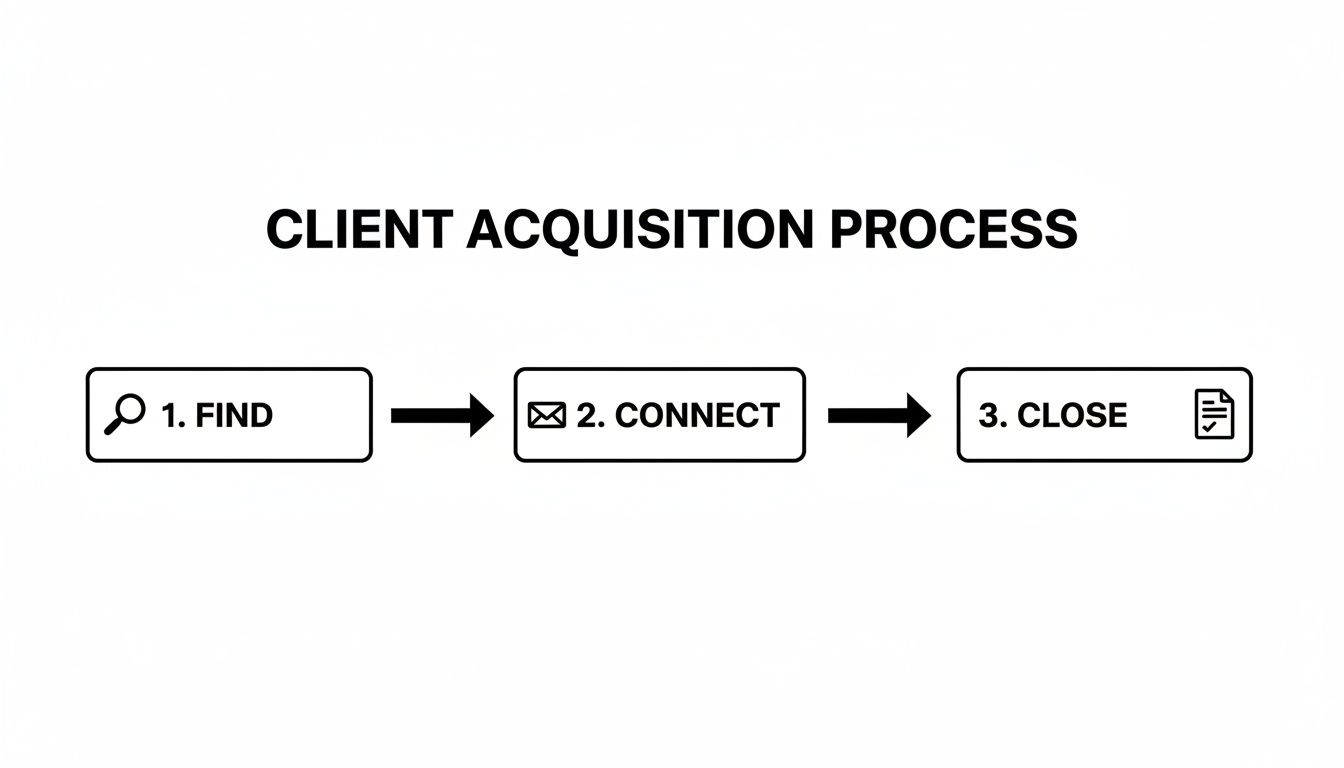
This simple flow is a constant cycle. Master it, and scaling becomes much easier.
The opportunity is massive. The digital marketing industry was valued at $531 billion globally in 2022 and is projected to hit $807 billion by 2026. This growth means businesses are desperate for expert marketing help. You can check out the full digital marketing industry statistics for more details.
When it’s time to expand your team, you have options:
- Hiring Full-Time Employees: Best for core, long-term roles. It helps build company culture but comes with higher costs.
- Using Freelance Contractors: Perfect for specialized tasks or temporary work overflow. It's a low-risk way to add expertise without a full-time salary.
- Partnering with White-Label Providers: A game-changer for new agencies. A white-label partner can deliver services like SEO or PPC under your brand, letting you sell more without an in-house team.
For most new agencies, a hybrid model using contractors and white-label partners is the best approach. It allows you to serve more clients and grow revenue without taking on huge financial risks.
People Also Ask: Common Questions About Starting an Agency
Starting out brings a million questions. That's normal. Let's tackle some of the most common ones from new agency founders.
How much money do I need to start a marketing agency?
You can start for less than you think. The real cost to launch a lean agency is surprisingly low.
Your main upfront costs are:
- Business Registration: Setting up an LLC will likely cost between $100 to $500, depending on your state.
- Website: A domain name and a year of hosting can usually be found for $100 to $300.
- Essential Software: A few subscriptions for project management and reporting will likely cost $50 to $150 per month.
In Short: You can launch your digital marketing agency for under $1,000. Your biggest initial investment isn't cash—it's your time.
How do I get clients with no experience?
This is a classic challenge. When you don't have a portfolio, you have to sell your potential and make it a no-brainer for the client to say yes.
One of the best ways is to offer a low-cost or free "pilot project." A quick website audit or a small ad campaign can be enough to prove you know your stuff.
🔑 Key Takeaway: When you can't show a portfolio, show your process. Create a case study on a personal project or mock up a detailed strategy for a well-known brand. This shows potential clients how you think, which is just as powerful as past results.
Giving away free value through blog posts or consultations is another great way to build trust and convince someone to take a chance on you.
Is starting a marketing agency profitable?
Yes, a well-run agency can be very profitable. Most successful digital marketing agencies have net profit margins between 15% to 30%.
The most profitable agencies have a few things in common:
- They serve a lucrative niche.
- They use a monthly retainer model for predictable income.
- They run a highly efficient operation.
Keeping clients happy and paying every month is the biggest key to profitability. It costs much more to find a new client than to keep an existing one. After that, it's about controlling your operational costs, like team and software expenses.
What is the hardest part of starting a digital marketing agency?
For most new founders, the biggest struggle is finding a consistent flow of new clients. You might be great at running ads for clients, but marketing your own services is a different challenge.
Getting out of the "feast or famine" cycle is the number one hurdle. This means you must build a reliable sales pipeline that constantly brings in fresh leads.
The second hardest part is the mental shift. You have to stop being just a "doer" and start thinking like a business owner. This involves learning to delegate, manage people, and work on the business, not just in it.
At Clicks Geek, we don’t just run a successful agency; we've built the blueprint for others to do the same. Our courses and services are born from years in the trenches, designed to help you skip the mistakes and accelerate your growth. Check out our proven strategies and services to see how we can help.