Showing up in the Google 3-Pack comes down to one thing: proving to Google your business is the most relevant, prominent, and closest option for a local search. This isn't about a secret trick. It's about doing the work, like fully optimizing your Google Business Profile (GBP), getting a steady stream of reviews, and making sure your website is a local authority.
In Short: Ranking in the 3-Pack means optimizing your GBP, getting reviews, and building local authority online.
Your Ultimate Guide to Dominating the Google 3-Pack
When someone searches for "plumber near me" or "best coffee in Brooklyn," they aren't just browsing. They have an immediate need and are ready to buy.
Getting your business into the Google 3-Pack puts you directly in front of these high-intent customers. It’s the digital version of having the best storefront on the busiest street. You're either a top option or you're invisible.
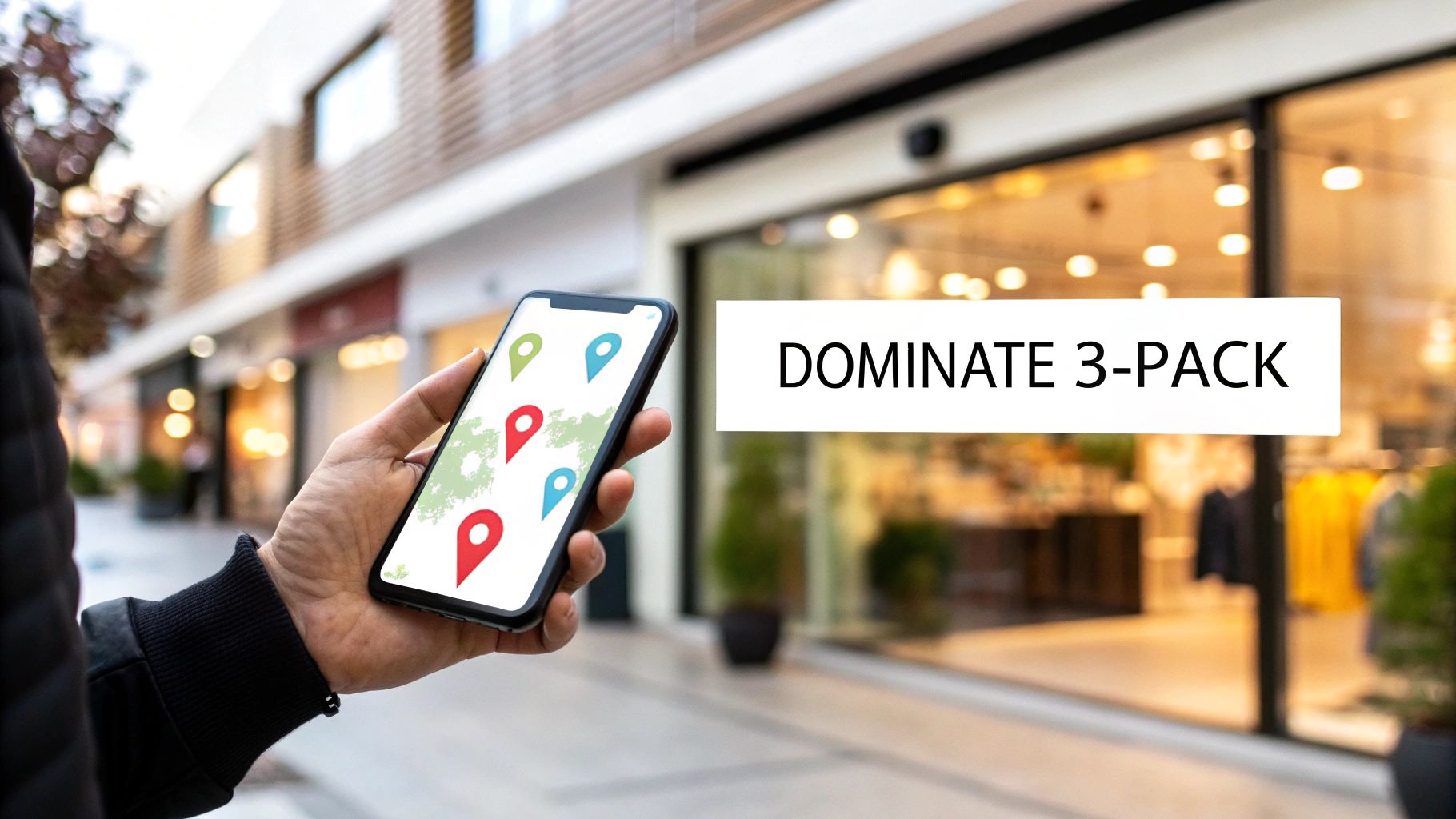
This guide is your playbook. We will break down exactly how to rank in the Google 3-Pack by focusing on what actually works.
Understanding Google’s Ranking Factors
Google’s local algorithm is designed to give searchers the best possible answer for their needs. To do this, it relies on three core factors.
Here's a quick look at what Google considers when deciding who makes the cut.
Google 3-Pack Ranking Pillars at a Glance
| Pillar | What It Means for Your Business | Key Actions You Can Take |
|---|---|---|
| Relevance | How well does your business match the search query? | Perfect your GBP categories, list all services, and use relevant keywords naturally. |
| Proximity | How close are you to the person searching? | You can't move your business, but you can ensure your address is 100% accurate online. |
| Prominence | How well-known is your business in your local area? | Get more positive reviews, build local citations, and earn links from other local websites. |
Think of it like this: Relevance gets you in the game. Proximity puts you on the right field. Prominence is what helps you win.
For a deeper dive, our guide on the 8 essential steps for dominating local maps SEO is a great resource.
Why the 3-Pack Is a Game-Changer
Landing a spot in the local pack leads to more calls, more foot traffic, and more revenue.
Data shows that businesses in the 3-Pack get significantly more clicks and engagement than the organic results below them. It's a huge competitive advantage.
Optimizing for the 3-Pack is part of a larger strategy. To build a strong local presence, consider these 10 essential local business marketing strategies as well.
Getting Your Google Business Profile to Work for You
Your Google Business Profile (GBP) is your digital storefront. It is the foundation of your local SEO strategy and the first place to focus if you want to rank higher. If you're wondering how to rank higher on Google Maps, it starts here.
Your GBP is a living tool that tells Google you're an active and trustworthy business. Simply creating a profile and letting it sit is not enough.
The Most Important GBP Factor
Before anything else, you must get your primary category right. This is the single most critical ranking factor you control. It tells Google exactly what you do.
Choosing the wrong category is like putting a "Bakery" sign on a hardware store. It confuses customers and Google.
Local SEO experts agree that the primary GBP category is a top factor for 3-Pack rankings. Data shows GBP signals account for 32% of local pack ranking factors, far ahead of website signals (19%) or reviews (16%).
Fill Out Everything (And I Mean Everything)
A complete profile is a must. Google rewards businesses that provide detailed and accurate information because it helps users.
Here's what to focus on:
- Business Name: Use your real-world business name. Do not add keywords like "Joe's Plumbing – Best Plumbers in Brooklyn." This violates Google's guidelines and can lead to suspension.
- Categories: Your primary category must be specific. If you're a personal injury lawyer, choose "Personal Injury Attorney," not just "Lawyer." Then add all relevant secondary categories.
- Address and Service Area: If you have a physical location, your address must be 100% accurate. For service-area businesses, define your service areas by city, zip code, or radius.
- Hours of Operation: Keep your hours updated, especially for holidays. An incorrect listing frustrates customers and sends a negative signal to Google.
Writing a Business Description That Sells
You have 750 characters for your business description. This is your elevator pitch. Tell customers who you are, what you do, and why you are the best choice.
Weave your main keywords and location into a compelling story.
Instead of this: "We do roofing, siding, and windows."
Try this: "For over 20 years, homeowners in Austin have trusted us for expert roof repair, durable siding installation, and energy-efficient window replacements." It provides context for both people and search engines.
Go All-In on Photos
Photos build trust and show off your work. A profile with few photos looks neglected. Aim for a large library of high-quality photos and videos.
Start with a goal of 100+ photos and add more regularly.
🔑 Pro Tip: Mix it up. Use a combination of professional shots and real-life pictures. Include photos of your team, happy customers (with permission), your storefront, and before-and-after shots.
Organize photos into the right categories:
- Exterior Shots: Show your storefront, signage, and parking.
- Interior Shots: Give customers a feel for your shop or office.
- Team Photos: Put a human face to your business.
- Work in Action: Show your team doing what they do best.
Use "Extra" GBP Features to Stand Out
An active profile sends powerful signals to Google. Use the features Google provides to show you are a prominent business.
- Google Posts: These are like mini-ads on your profile. Share updates, offers, and events. Posts expire after seven days, so post at least once a week.
- Q&A Section: You can ask and answer common questions about your business yourself. This addresses customer concerns proactively. Monitor this section and answer new questions quickly.
- Services/Products: List everything you offer in the dedicated "Services" or "Products" section. Add detailed descriptions and pricing. This helps you appear in specific, long-tail searches.
The Real Power of Reviews and Customer Engagement
After optimizing your GBP, focus on customer engagement. Reviews are modern word-of-mouth. They provide social proof to Google and potential customers that you are a trusted local business.
Google’s algorithm looks at the quantity, velocity (how often you get new ones), and the specific keywords people use in their reviews.
Generating a Steady Stream of Authentic Reviews
Consistency is key to a great review profile. You need a simple way to ask happy customers for feedback. Many people will leave a review if you make it easy for them.
Here are a few ways to get more reviews:
- Ask at the right time: The best time to ask is right after a great customer experience.
- Use your direct review link: Google provides a unique link to your review form. Add it to your email signature, invoices, or follow-up messages.
- Get your team involved: Train your team to ask for reviews. A simple request can make a big difference.
⚠️ A word of caution: Never offer incentives for reviews. This is against Google's policies and can get your profile suspended. The goal is genuine feedback.
Why You Must Respond to Every Single Review
Responding to all reviews—both good and bad—is critical. It signals to Google that you are an engaged business owner. It also shows potential customers that you care.
A thoughtful reply to a positive review makes a happy customer feel valued. A professional response to a negative one can resolve the issue and show others you take customer service seriously.
Customer-driven signals are a big piece of the puzzle.

While your primary category is most important, factors like proximity and keywords found in reviews are also highly influential.
The Hidden SEO Gold in Customer Feedback
When customers leave detailed reviews, they often use the exact search terms other people use.
For example, a review that says, "They did a fantastic job with our emergency roof repair in Austin," helps you rank for that specific search. This user-generated content reinforces your relevance.
If you're managing reviews across multiple sites, the best reviews management services can help you stay organized.
People Also Ask About Google Reviews
How many reviews do I need to get into the 3-Pack?
There is no magic number. However, businesses in the 3-Pack typically have more reviews than their competitors. Top-ranking businesses often have over 80 reviews, while those ranked lower average under 50. Your goal should be to consistently get more reviews than your local rivals.
Does responding to reviews really help my ranking?
Yes, absolutely. Responding to reviews is a direct signal to Google that you are an active business. It is a known ranking factor and builds trust with potential customers.
What’s the best way to handle a negative review?
Respond quickly and professionally. Acknowledge the issue, apologize for their experience, and offer to resolve it offline. Never get into a public argument.
Building Local Authority with Citations and Links
A great Google Business Profile is a start, but it's not enough. Google looks for other reputable sources across the web to confirm your business information.
This is where citations and local links are important. They act as digital votes of confidence that prove you are an established part of your local community.
The more positive and consistent mentions Google finds about your business online, the more it will trust you.
The Foundation of Trust: NAP Consistency
A citation is any online mention of your business’s Name, Address, and Phone number (also known as NAP). You find them on sites like Yelp, Apple Maps, and Bing Places.
The most important rule is absolute consistency.
Even a small difference, like "Main St." versus "Main Street," can confuse search engines. This inconsistency can hurt your chances of ranking in the 3-Pack.
🔑 Pro Tip: Your NAP is your business's digital fingerprint. It must be identical everywhere. Check your listings on Yelp, Facebook, and Apple Maps to ensure they match your GBP exactly.
Where to Build Your Most Important Citations
Not all citations are created equal. Focus on high-quality, relevant sites.
Here's how to prioritize your efforts:
- The Big Data Aggregators: Companies like Data Axle supply business data to hundreds of other websites and apps. Correct information here has a widespread positive effect.
- Top-Tier Directories: These are well-known sites like Yelp, Facebook, Apple Maps, and the Better Business Bureau (BBB). A presence here is essential.
- Industry-Specific Sites: These sites signal your relevance. Contractors should be on Houzz. Lawyers should be on Avvo. Doctors should be on Zocdoc.
This strategy helps you build a strong, trustworthy online footprint, which is crucial for figuring out how to rank in the Google 3-Pack.
Earning Local Links That Actually Move the Needle
Citations are the foundation. Local backlinks are what you build on top of it. A backlink is a link from another website to yours. A link from a respected local website is one of the strongest signals of prominence you can get.
It’s about quality over quantity. One link from your city's official website is worth more than a hundred generic directory listings.
Here are a few ways to earn these links:
- Sponsor a local event or team. Organizations often link to their sponsors on their websites.
- Host a free workshop. Local bloggers and event sites may link to your site when they share your event.
- Partner with neighboring businesses. Team up with a non-competing business for a joint promotion and get a link from their "Partners" page.
- Become a source for local media. Reach out to a local reporter with a useful tip or story. Getting quoted in an article usually comes with a high-authority backlink.
Sending the Right Signals from Your Website
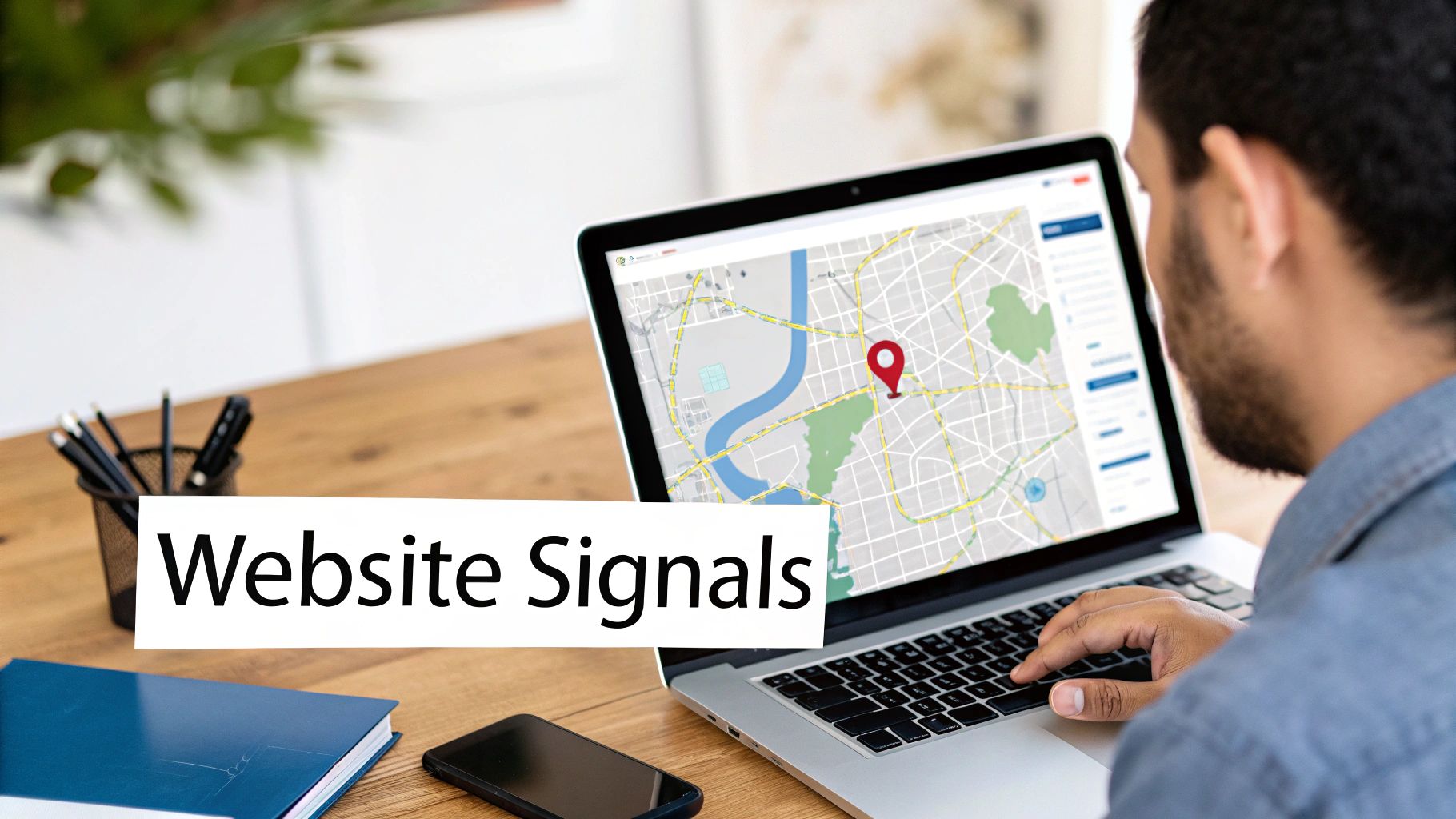
Your Google Business Profile is the star player, but your website is the support team. It must reinforce every signal your GBP sends.
Many businesses neglect their website, which creates confusion for Google. When your GBP and website are aligned, it signals authority and trust. This is a huge part of learning how to rank in the Google 3-Pack.
On-Page SEO for Local Wins
Local on-page SEO makes it easy for people and search engines to know where you are and what you do.
Your website should clearly signal its local focus. Weave your city or service area into key parts of your site naturally.
- Title Tags & Meta Descriptions: Your title tag is the clickable link in search results. It must include your main service and location. For example: "Expert Roof Repair in Brooklyn | Joe's Roofing Co."
- Page Content: Include your main keywords and locations naturally in your headings (H1, H2) and page text.
- Footer & Contact Page: Your full Name, Address, and Phone number (NAP) must be on your contact page and in the footer of every page. It has to match your GBP exactly.
Create Hyper-Focused Location Pages
Create dedicated pages for each core service you offer in each main location you serve.
For example, a plumber who works in Brooklyn and Queens should have specific pages like:
yourwebsite.com/plumbing-services-brooklynyourwebsite.com/emergency-plumber-queensyourwebsite.com/drain-cleaning-brooklyn
Each page becomes a focused asset that can rank for specific, high-intent searches. This is a core tactic for any serious local business SEO campaign.
Use Schema Markup to Spoon-Feed Google
Schema markup is code you add to your site that acts like a label for search engines. It helps Google understand your content without guesswork. The "LocalBusiness" schema type is essential for local businesses.
It lets you clearly define key details:
- Your exact business name, address, and phone number
- Your hours of operation
- The geographic area you serve
- Accepted payment types
In Short: Adding schema markup gives Google a perfectly organized cheat sheet on your business, which builds trust and boosts visibility.
Don't Forget the User Experience
All the SEO in the world won't help if your website is difficult to use. Local searchers are often on their phones and need a quick solution.
Mobile-Friendliness: Your website must work perfectly on a smartphone. A site that is hard to navigate on mobile will drive customers away and is a red flag for Google.
Page Speed: A slow site will lose visitors. Google gives a ranking advantage to faster, user-friendly websites.
One last tip: embed a Google Map on your contact page. It visually confirms your address and strengthens your local signals.
Got Questions About Cracking the 3-Pack?
Diving into local SEO can bring up a few questions. Let's tackle the most common ones business owners face.
"Seriously, How Long Is This Going to Take?"
The answer is: it depends. Local SEO is not an overnight fix.
If you are in a low-competition area with a perfectly optimized GBP, you might see results in 30 to 60 days.
For most businesses in competitive markets, it will take 3 to 6 months of consistent work. This timeframe allows Google to notice your updates, find your citations, and see your new reviews.
"What Kind of Budget Are We Talking About Here?"
The budget varies widely. A small-town coffee shop will have a different budget than a law firm in a major city.
Costs depend on:
- Your Competition: More competition means you'll need to invest more to stand out.
- Scope of Work: The cost depends on whether you need basic GBP management or a full website rebuild and link-building campaign.
- DIY vs. Hiring Help: Doing it yourself saves money but costs time. Hiring an agency costs more upfront but provides expertise.
A small local business might start with a few hundred dollars a month, while businesses in competitive industries may invest several thousand.
"I Have Multiple Locations. Can I Just Use the Same Strategy for All of Them?"
Yes and no. The core principles—a complete GBP, consistent NAP, and steady reviews—are universal. However, you cannot simply copy and paste your strategy for each location.
🔑 Pro Tip: Each of your locations is a separate entity in Google's eyes. You must treat it that way.
This means every location needs its own:
- Unique Google Business Profile: With its own address and phone number.
- Location-Specific Webpage: A dedicated page on your site for each location.
- Localized Reviews: Encourage customers to review the specific location they visited.
- Local Citations: Build directory listings that point to each unique address.
"Do I Have to Pay for Ads to Get in the 3-Pack?"
No. The organic 3-Pack spots are earned through SEO, not bought.
However, running Google Local Service Ads can get you a spot above the organic 3-Pack, marked with a "Sponsored" tag. Paid ads provide instant visibility while your organic SEO efforts build over time.
Ready to stop guessing and start getting real results from your local SEO? The team at Clicks Geek specializes in creating data-driven strategies that get local businesses noticed. Let us show you how we can drive measurable growth for your business.