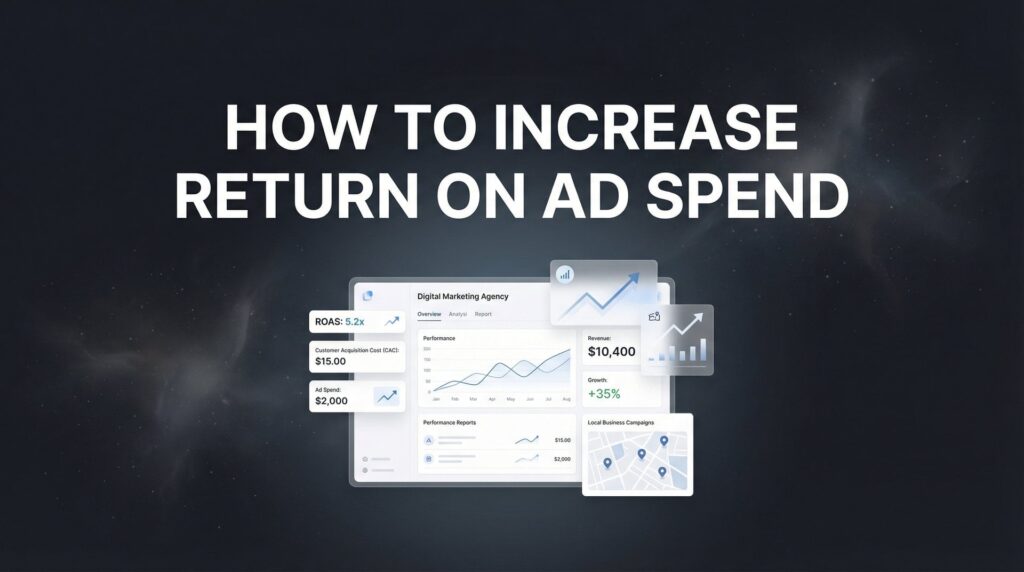
You’re spending money on ads, but are you actually making money from them? If your return on ad spend (ROAS) feels more like a guessing game than a growth engine, you’re not alone. Many business owners watch their ad budgets evaporate without seeing the revenue to justify the investment.
Here’s the reality: increasing your ROAS isn’t about spending more—it’s about spending smarter.
Whether you’re running Google Ads, Facebook campaigns, or any paid media, the difference between a 2x return and a 6x return often comes down to strategic optimizations that most advertisers overlook. In this step-by-step guide, you’ll learn exactly how to increase return on ad spend through proven tactics that transform underperforming campaigns into profit machines.
We’ll cover everything from auditing your current setup and refining your targeting to optimizing your landing pages and scaling what works. No fluff, no theory—just actionable steps you can implement today to start seeing better returns from every dollar you invest in advertising.
Step 1: Audit Your Current Campaign Performance and Identify Profit Leaks
Before you can improve your ROAS, you need to know exactly where you stand right now. Think of this like checking your bank balance before creating a budget—you can’t fix what you haven’t measured.
Start by calculating your actual ROAS using this simple formula: Revenue ÷ Ad Spend = ROAS. If you spent $1,000 on ads and generated $3,000 in revenue, your ROAS is 3x. Do this calculation for every campaign, ad group, and even individual keywords if you’re running search campaigns. For a deeper dive into the math, check out our guide on how to calculate return on ad spend.
Here’s where most advertisers make their first mistake: they look at overall account performance and miss the details. Your account might show a healthy 4x ROAS, but dig deeper and you’ll often find that three campaigns are crushing it at 8x while five others are barely breaking even at 1.5x. The winners are masking the losers.
Pull reports for the last 30 to 90 days and sort by ROAS or revenue. Flag anything below your break-even point. If your average customer lifetime value is $500 and your cost per acquisition is $400, you’re only making $100 per customer—that’s a profit leak disguised as a working campaign.
Document everything in a spreadsheet. Record your baseline ROAS for each campaign, your total ad spend, revenue generated, conversion rates, and cost per acquisition. This becomes your benchmark for measuring improvement as you implement the remaining steps. Understanding how to track marketing ROI properly is essential for this process.
Pay special attention to time-based patterns. Some campaigns might perform well on weekdays but drain budget on weekends. Others might convert beautifully on mobile but waste money on desktop. These patterns reveal optimization opportunities that can dramatically improve your returns.
The goal here isn’t perfection—it’s clarity. You need to see exactly where your money is going and what it’s producing. Once you have this visibility, you can make intelligent decisions about where to cut, where to optimize, and where to scale.
Step 2: Tighten Your Audience Targeting to Eliminate Wasted Spend
Now that you know which campaigns are bleeding money, let’s stop the hemorrhaging. The fastest way to improve ROAS is to stop paying for traffic that will never convert.
If you’re running search campaigns, download your search term report immediately. This shows you the actual phrases people typed before clicking your ads. You’ll be shocked at how much irrelevant traffic you’re paying for. Selling high-end consulting services? You’re probably getting clicks from people searching for “free consulting advice” or “consulting jobs near me.”
Add these irrelevant terms as negative keywords. Be aggressive here. Every click from someone who can’t or won’t buy from you is money thrown away. Build a comprehensive negative keyword list and apply it across all relevant campaigns.
Next, review your demographic and geographic targeting. Pull a report showing conversions by age, gender, household income, and location. If you discover that 80% of your conversions come from people aged 35-54 in urban areas, why are you still targeting 18-24 year olds in rural zip codes?
Tighten your geographic targeting to focus on areas where your customers actually live. If you’re a local business, exclude locations beyond your service area. If you’re selling nationwide, identify the states or cities with the highest conversion rates and allocate more budget there. Learning how to generate qualified leads online starts with reaching the right audience.
For display and social campaigns, implement audience exclusions. Stop showing ads to people who already converted, people who visited your careers page (they’re job hunting, not buying), or people who bounced from your site in under 10 seconds. These audiences cost money without producing results.
Build custom audiences from your actual customer data. Upload your customer email list and create lookalike audiences that match the characteristics of people who already buy from you. These audiences consistently outperform broad targeting because they’re based on real behavior, not assumptions.
The principle is simple: narrow your focus to people who look, act, and behave like your best customers. Every dollar you save on irrelevant traffic is a dollar you can reinvest in reaching qualified prospects.
Step 3: Optimize Your Ad Creative for Higher Click-Through and Conversion Rates
Your targeting is now dialed in, but if your ads don’t compel people to click—or worse, if they click but feel misled—you’re still wasting money. Great ad creative does two things: it attracts the right people and repels the wrong ones.
Start with your headlines. Forget clever wordplay and focus on outcomes. What specific problem are you solving? What result will customers get? Instead of “Innovative Marketing Solutions,” try “Get 3x More Qualified Leads in 60 Days.” The second headline speaks directly to what the customer wants.
Test multiple headline variations that address different pain points. Some prospects care most about speed, others about cost, and others about reliability. Create ad variations that speak to each motivation and let the data tell you which resonates strongest. Our guide on how to improve ads breaks down this testing process in detail.
Your ad copy must align perfectly with your landing page. If your ad promises “Free Consultation,” your landing page better offer exactly that—not a contact form that leads to a sales call three days later. Mismatched messaging kills trust and tanks conversion rates.
Craft calls-to-action that create urgency without sounding desperate. “Get Your Free Audit” works better than “Learn More.” “Claim Your Spot” works better than “Sign Up.” The language should feel like an opportunity, not a chore.
Run A/B tests on everything: headlines, descriptions, display URLs, and calls-to-action. Let each test run until you have statistical significance—usually at least 100 clicks per variation. Then pause the losers and create new challengers to test against your winner.
Here’s a critical point many advertisers miss: your ad creative should pre-qualify prospects. If you only work with businesses doing over $1 million in annual revenue, say that in your ad. You’ll get fewer clicks, but the clicks you get will be worth more because they’re from qualified prospects. For more on crafting compelling ad copy, see our step-by-step guide on how to create ads that convert.
Monitor your click-through rates by ad variation. Higher CTR typically indicates more relevant, compelling messaging. But also track conversion rates—sometimes an ad with a lower CTR converts better because it attracts more qualified traffic.
Step 4: Fix Your Landing Pages to Convert More Visitors Into Customers
This is where most campaigns fail. You’ve paid for the click, the visitor arrived at your site, and then… nothing. They bounce. They browse. They leave without converting. Your landing page is the last mile between ad spend and revenue, and it’s often the highest-leverage place to improve ROAS.
Start with speed. Test your landing page load time using Google PageSpeed Insights. If it takes more than three seconds to load, you’re losing conversions before visitors even see your offer. Compress images, minimize code, and use a quality hosting provider. Every second of delay costs you money.
Your landing page headline must match what your ad promised. If your ad said “Get a Free Marketing Audit,” your landing page headline should say “Get Your Free Marketing Audit”—not “Welcome to Our Services Page.” Consistency builds trust. Inconsistency triggers skepticism.
Remove every distraction. No navigation menus. No sidebars full of links. No blog posts or company history. Your landing page should have one job: convert the visitor. Create a single, clear path from headline to call-to-action with nothing that pulls attention away from that goal. Learn more about how to optimize landing pages for conversions to maximize every click.
Place trust signals strategically near your conversion point. Customer testimonials, review ratings, industry certifications, and money-back guarantees all reduce perceived risk. Position these elements right before or alongside your call-to-action button so visitors see them at the moment of decision.
Make your forms as short as possible. Every field you add reduces conversion rates. If you only need an email address to start the relationship, don’t ask for phone number, company size, and job title. You can collect that information later. Right now, your job is to get the conversion.
Test your landing page on mobile devices. Most traffic comes from phones, and if your page isn’t mobile-optimized, you’re throwing away conversions. Buttons should be large enough to tap easily. Forms should auto-fill. Text should be readable without zooming.
Use heat mapping tools to see where visitors click, how far they scroll, and where they lose interest. This data reveals friction points you can’t see in analytics. If everyone’s clicking a non-clickable element, make it clickable or remove the confusion. For a complete blueprint, check out our guide on how to create high converting landing pages.
Step 5: Implement Smart Bidding Strategies That Maximize Revenue
Manual bidding gives you control, but it can’t process data and make adjustments as quickly as automated systems. Smart bidding strategies use machine learning to optimize bids in real-time based on conversion likelihood, but they only work if you set them up correctly.
First, ensure your conversion tracking is bulletproof. If your tracking is broken or incomplete, automated bidding will optimize toward the wrong goal. Test your conversion tracking by completing a test conversion yourself and verifying it appears correctly in your platform’s reports. If you’re struggling with this, our guide on fixing your marketing conversion tracking walks you through the entire process.
Choose the right bidding strategy for your goal. Target ROAS bidding works when you have clear revenue data and want to maximize return. Target CPA bidding works when you’re focused on cost per acquisition. Maximize conversions works when you want volume and have budget flexibility. Pick the strategy that aligns with your actual business objective.
Here’s the catch: smart bidding needs data to learn. You typically need at least 15-30 conversions per month for the algorithm to optimize effectively. If you’re below that threshold, stick with manual bidding or enhanced CPC until you build sufficient conversion volume.
When you switch to automated bidding, expect a learning period. Performance might fluctuate for the first week or two as the algorithm tests different bid amounts and gathers data. Don’t panic and switch back immediately—give it time to optimize.
Layer bid adjustments on top of your automated strategy. Even with smart bidding, you can adjust bids by device, location, and time of day. If mobile converts at half the rate of desktop, apply a negative bid adjustment to mobile. If conversions spike on Tuesday afternoons, increase bids during that window.
Monitor your actual ROAS against your target. If you set a target ROAS of 5x but consistently hit 6x, you’re leaving growth on the table. Gradually lower your target to capture more volume while maintaining profitability. If you’re missing your target, raise it until performance stabilizes.
Review your bid strategy performance weekly. Look for campaigns where automated bidding isn’t delivering results and consider switching back to manual control. Not every campaign benefits from automation—some need the human touch.
Step 6: Scale Winning Campaigns and Cut Losers Without Hesitation
You’ve optimized your campaigns, and now you have clear winners and obvious losers. This is where most advertisers get emotional and make expensive mistakes. They keep feeding budget to underperforming campaigns hoping they’ll turn around. They don’t.
Pull your performance data and identify your top 20% of campaigns by ROAS or revenue. These are your winners—the campaigns that drive the majority of your profitable results. This is where you should focus your attention and budget.
Scale winners gradually. Don’t double your budget overnight—that can disrupt the algorithm and tank performance. Increase budget by 20-30% every few days while monitoring key metrics. If ROAS holds steady or improves, keep scaling. If it drops, pause and let performance stabilize before trying again. Understanding how to scale customer acquisition profitably is key to sustainable growth.
Set clear kill criteria for underperforming campaigns. If a campaign hasn’t hit your minimum ROAS target after 30 days and 50+ conversions, it’s not suddenly going to become profitable. Turn it off. Redirect that budget to your winners or to testing new opportunities.
Don’t let sunk costs cloud your judgment. The money you already spent on a failing campaign is gone. The only question that matters is: will spending more money on this campaign produce a positive return? If the answer is no, cut it.
Reinvest your savings strategically. Take the budget from killed campaigns and split it two ways: 70% into scaling your proven winners, 30% into testing new campaigns, audiences, or creative angles. This balance lets you maximize current performance while exploring future opportunities. If you’re looking to reduce customer acquisition cost, this reallocation strategy is essential.
Create a testing calendar. Every month, launch at least one new campaign or test one significant variable in your existing campaigns. Markets change. Customer behavior shifts. What works today might not work next quarter. Continuous testing keeps you ahead of the curve.
Document what you learn from both winners and losers. Why did that campaign succeed? What made that audience convert? Why did that creative fall flat? These insights inform future decisions and help you spot patterns that drive profitability.
Your Roadmap to Sustainable ROAS Growth
Increasing your return on ad spend isn’t a one-time fix—it’s an ongoing process of measurement, optimization, and strategic scaling. By following these six steps, you’ve built a framework for transforming your ad campaigns from cost centers into profit generators.
Quick checklist before you go: ✓ Audit complete with baseline ROAS documented ✓ Targeting tightened with negative keywords and audience refinements ✓ Ad creative tested and aligned with landing pages ✓ Landing pages optimized for speed and conversions ✓ Smart bidding strategies implemented with proper tracking ✓ Winners scaled, losers cut, and reinvestment plan in place.
The difference between a campaign that drains your budget and one that fuels your growth comes down to these fundamentals. You’ve now got the action plan. The question is: will you implement it?
Ready to stop guessing and start growing? At Clicks Geek, we specialize in turning underperforming ad campaigns into revenue machines for local businesses. Tired of spending money on marketing that doesn’t produce real revenue? We build lead systems that turn traffic into qualified leads and measurable sales growth.
If you want to see what this would look like for your business, we’ll walk you through how it works and break down what’s realistic in your market.
Want More Leads for Your Business?
Most agencies chase clicks, impressions, and “traffic.” Clicks Geek builds lead systems. We uncover where prospects are dropping off, where your budget is being wasted, and which channels will actually produce ROI for your business, then we build and manage the strategy for you.